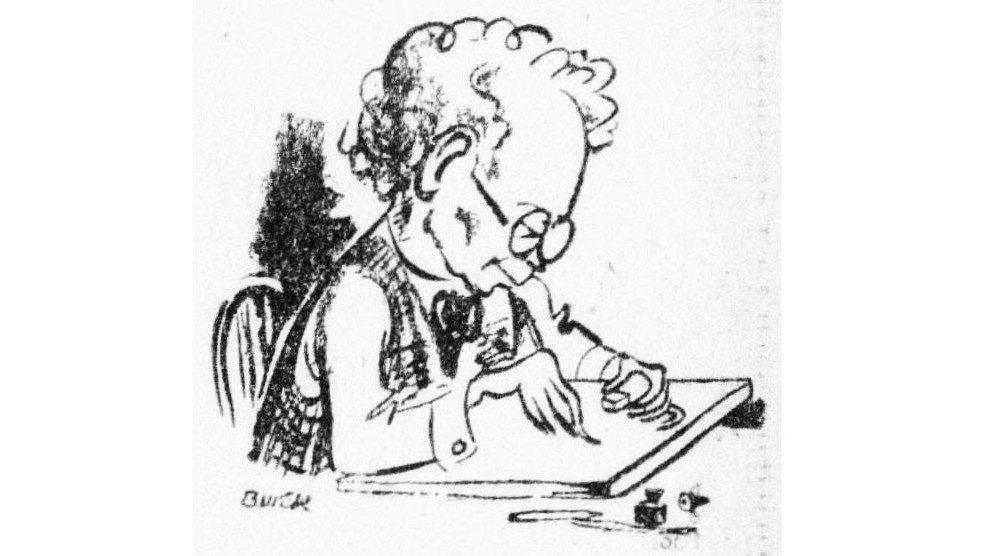
William Mailly, former Socialist Party National Secretary, pays tribute to one of the great Left artists in U.S. history just midway through his career. While largely unknown today, every radical of Ryan Walker’s day would have known the work of this revolutionary cartoonist and creator of ‘Henry Dubb’, whose hugely popular, simple proletarian drawings adorned nearly every Socialist paper in the country for decades. Born in Kentucky in 1870, he would later join the Communist Party became a staff artist of the Daily Worker. He died while touring the Soviet Union in 1932 at age 61 leaving a vast printed legacy.
‘Ryan Walker–An Appreciation’ by William Mailly from The Coming Nation. No. 13. December 10, 1910.
The work of Ryan Walker has rightfully won him recognition as a cartoonist not alone in his native country, but wherever in the world there is appreciation of an art which exercises an increasing influence in the moulding of public thought and the course of social evolution. But, in addition to this he has also established himself firmly in the affections and gratitude of a great mass of people in America, both as a cartoonist and as a Socialist, and it is as a Socialist, using his exceptional ability in service to his ideals, that he would himself first choose to be known.
For success, and the fame that comes with success, have not spoiled him. He remains today, after years of intense struggle and disillusionment–the sort experience that so often quenches enthusiasm and blasts ide–as unquenchably enthusiastic, as radiantly idealistic as in those first days, fifteen years ago when in Kansas City, the Tight of Socialism first flashed upon him. And that light has ever since remained strong and clear before him even though his feet have walked in dark places and the path was rough and narrow where he trod.
It is because of his Socialism that Ryan Walker has kept sweet. Because he had a Social philosophy that illuminated the dark places and made smooth the rough pathway, that gave him to understand the motives that actuate mankind under certain social conditions and environment, bitterness found not lodgement in his heart and his soul has revealed only gentleness and kindness to his fellowmen. His passion for ultimate social righteousness has not obscured or dulled his sense of relationship to his fellows here and now. He is a true exemplar of the gospel of helpfulness in the present as well as in the future.
In other words, Ryan Walker is a practical idealist. He believes that the day is coining when all humanity will have an equal chance in the race of life to win the best there is to be gotten out of life and he works for that day to come and come soon; but le believes also in giving a chance to every man to “make good” now, in making it possible for each man to survive in the existing hideous, competitive struggle. And so Walker not only gives freely and generously of his ability to Socialism but he gives freely and generously of his good will and service to the man whom capitalism would throttle and cast down.

“Every man at some time or the other needs a helping hand. This talk about a man being sufficient unto himself and the maker of his own destiny is all rot. The man who has only himself is too badly handicapped, he has too many obstacles to overcome. I’ve been there and I know. So I believe in giving a man a push forward when I can–Gratitude? I don’t care whether he’s grateful or not. I’ve helped him–that’s enough for me.” That’s how Walker himself put it. Perhaps what I am trying to make clear here has been expressed no better than when the The Friars, the national association of press agents, actors, dramatists and other theatrical people, with headquarters in New York, gave Walker a complimentary supper about two years ago. No member of the The Friars is more popular than he, and this particular occasion was enlivened by a ditty, sung in chorus, written by Willard D. Coxey (who was “in advance” of Barnum and Bailey’s circus for years), of which the following is part:
Who Is it sketches every day
Cartoons enough to make a play.
And never takes a cent of pay?
Ryan. Ryan Walker!
Who is it seems to know and greet
Most everybody on the street?
Who’d rather draw your phiz than eat?
Ryan, Ryan Walker!
CHORUS
Here’s to Ryan Walker.
Who ain’t much of a talker,
A bluffer or a balker
Say, but he’s all right!
O, RYAN!
You can bet we’re tryin’
To make it bot for you tonight!
Who don’t believe in chapel bella,
In future bliss or blazing bells,
But in whose heart love always dwells?
Ryan, Ryan Walker!
Who is preaches anarch-i (?)
Who swears the autocrats must die.
But who, be’gosh! won’t hurt a fly?
Ryan, Ryan Walker!
Whose heart is always on his sleeve?
Who has no use for make-believe?
Whose motto is: Work on–achieve?
Ryan, Ryan Walker!
Now, by the stars that shine above–
By Jingo and my indy’s glove!
Who is the rascal that we love?
Ryan, Ryan Walker!
A tribute like this, from such a source, affirms that one need not become less an idealist in order to win, the respect and confidence of others, who, while sincere in disposition and essentially sound at heart, may not sympathize or agree with one’s ideas. It depends almost wholly upon the individual himself. And Ryan Walker has shown that it is possible for a man to be a Socialist, to be outspoken and frank in the expression of his opinions, to be devoted heart and soul to an unpopular ideal, and yet associate with and be loved by men whose opinions are in the main conventional but who, being sincere themselves, are quick to recognize sincerity of conviction in others.
Ryan Walker has never lowered his colors nor changed front to achieve success. Throughout the bitter struggle to survive in the work which he felt was his, he has never equivocated nor compromised. He has been true to the Social Revolution, which is as much a reality to him at this moment, amid all the terrible and gross materialism of New York–America’s citadel of capitalism–as if capitalism itself were naught and its horrors but a faded phantasmagoria. For in being true to the Social Revolution he has been true to himself, and the affection and respect with which everybody who knows him, Socialist and non-Socialist alike, regard him testify that truth, sincerity and kindness are the essential things in life after all.
Walker served a hard apprenticeship in a hard school. He was only thirteen when he voluntarily entered that school by sending two sketches to Judge. The pictures were not used but the ideas were and when “Zim” of that paper sent him a check for fifteen dollars for those ideas, the boy saw fame and fortune just ahead. Working at all sorts of odd jobs–among other things, running a publishing house of his own in Kansas City at one time, doing some original stunts as an advertising man in Fort Worth, Texas, at another–he stuck to his drawing, self-developed and practically self-taught. He was born in Kentucky, by the way, leaving there when a child.
It was in Kansas City that he became a Socialist, and his was the first cartoon that ever appeared in the Appeal to Reason. J.A. Wayland was then publishing the Appeal in that city and young Walker, having read the paper, visited Wayland and had a talk with him, expressing some of his ideas. Wayland encouraged him and Walker reappeared several days later with some drawings. “Just what I want,” said Wayland. Since that time Walker’s work has appeared in almost every Socialist paper and magazine in America–mostly without payment, it may be noted.
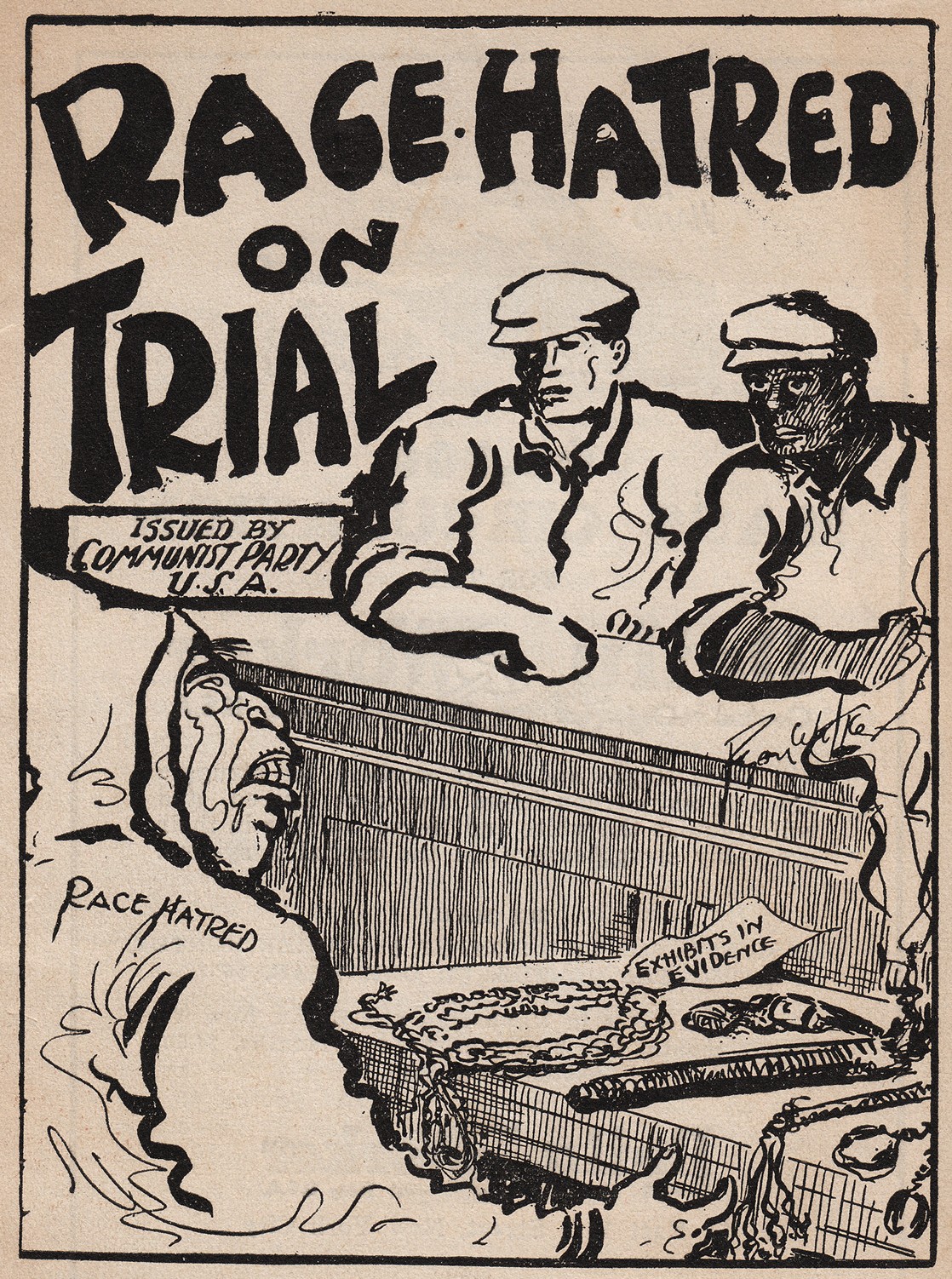
In his commercial career, he has worked on some of the leading daily papers in the country, and his experiences are worth listening to, but limited space will not admit of their relation here. Some day he should be prevailed upon to tell them himself in the COMING NATION. The Kansas City Times, the St. Louis Republic, the Boston Globe, the New York Times, the New York Mail and Express, the New York Commercial Advertiser, are among the papers he has worked on successively, while Life, the Bookman, St Nicholas, the Area, and the Twentieth Century Magazine are among the magazines that have published his work from time to time. At present he contributes regularly to the International Syndicate of Baltimore, comprising a weekly service of six cartoons and a daily column of jokes which are used by nearly 500 papers in the United States and Canada. His cartoons are copied in publications all over the world. He is also special illustrator for the New York Star, a theatrical journal, and his sketches of theatrical celebrities are in constant demand. It is doubtful if he has his equal at this kind of work in America. There is hardly a well-known actor that has played in this country during recent years but treasures an original sketch by Ryan Walker, and he numbers among his friends the most noted people in the theatrical, operatic and artistic world. He has been the recipient of signed mementoes from the most famous actors, dramatists, singers, authors and artists of Europe and America.
Then, in addition, there is his work for The Friars. Every function–dinner, smoker, amateur vaudeville, etc.–has an announcement and program specially designed by him and the design is always a “hit” for its originality and humor. And then again, are his contributions to the Socialist press, an ever-flowing stream of caricature that seems to increase in power as it grows in volume. This alone would keep any ordinary cartoonist busy.
Indeed, it is this very capacity for work that is one of the most astonishing things about Walker. Short, slight, frail, he is yet a very dynamo of nervous energy. His brain is always alert and his slim, quick fingers are never still. He can work at all times and in all places, regardless of surrounding or interruptions. At his sketch work the rapidity of his movement is remarkable and he succeeds in seizing the salient characteristics of his subject with a deftness and sureness that denote the true caricaturist. I have often wondered how Walker accomplished all that he did. The fecundity and ever-recurring freshness of his ideas, the fertility of his resources, the almost colossal amount of his product–these are sufficient cause for wonder. I understand better now, since I have come to see him at closer range.
Of course, the secret consists in his instinctive love for his work, in his power of concentration and in his knowledge and appreciation of the fundamental rudiments, the historical development and the social significance of his art. These are the requirements of genius, The application of patience, industry and study to the art-loving spirit and instinct, enjoying work for the work’s sake, always sounding its depth for new meanings, always keeping the mind and heart open for fresh revelations, always ready to watch and learn and learn and yet learn–these are what make ultimately for facility, fertility, clearness of vision and accomplishment.
Walker is one of the few cartoonists in America who takes his work seriously. The great majority are utterly devoid of idealism. They are mere time-servers, devoted to material interests and the gospel of getting on. They have no inspiration for their work and they don’t need any. The ideas which they illustrate are not their own; they draw as their employers tell them to. They have little or no conception of the great social importance of their work, and art to them is usually a theme for mirth and ridicule. No more sorry spectacle is presented to us in this present day society than this pitiful prostitution of useful talents and splendid art to ignoble ends.
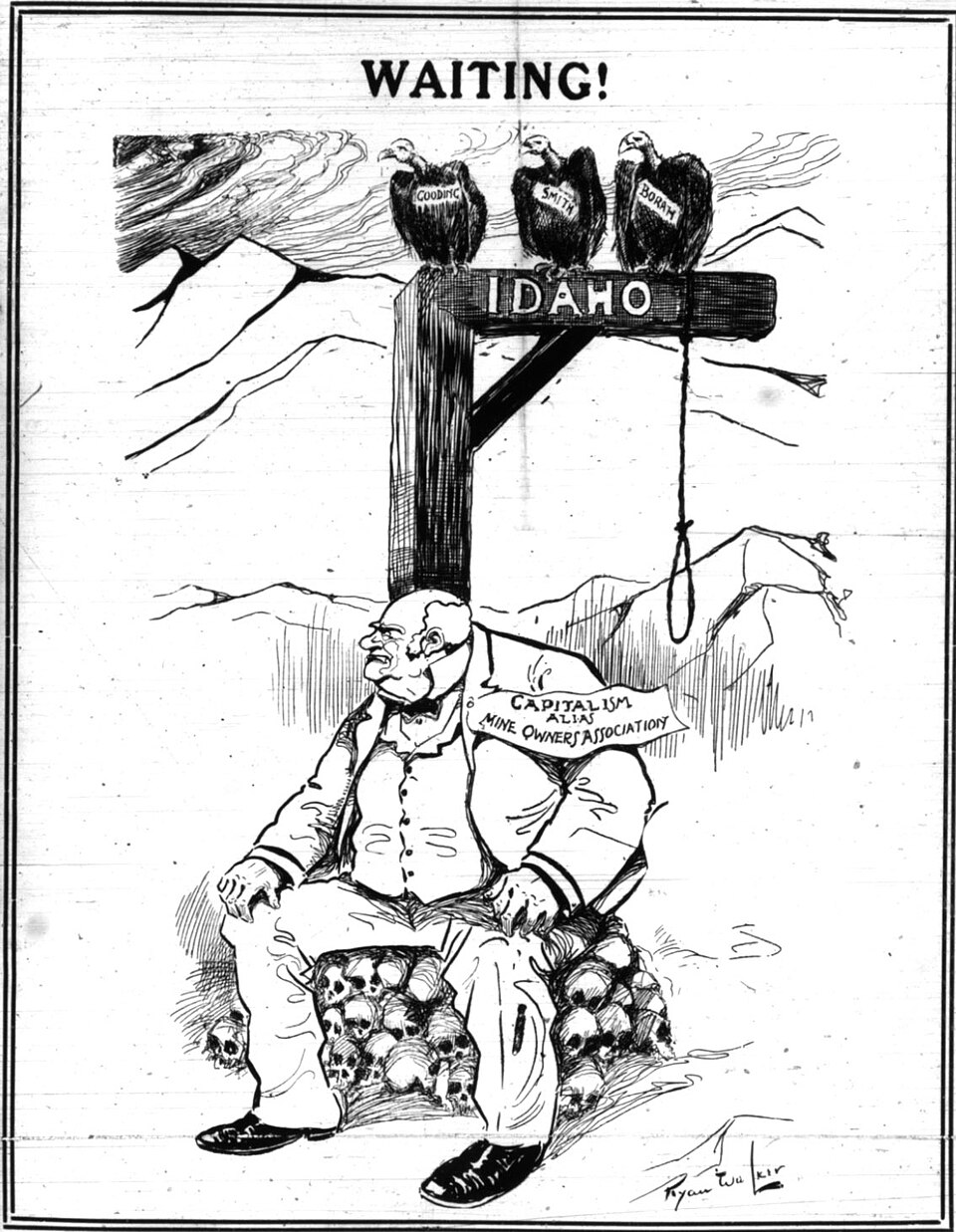
But Walker works at all times with a central principle directing the thought that guides the hand holding the pencil. This is the creative principle, embodying the constructive with the critical, analyzing, revealing, interpreting, producing, all in one. Walker has not been satisfied with regarding his work as a mere temporary thing, to pass as the moment passes. The art of caricature, like every other art, he knows is a social product, the companion and helpmate of all the other arts, and, like them, reflecting and giving permanent form and substance to the social conditions, facts and tendencies of every age. Caricature is history, as much, if not more, than the written word and it is comprehensive to everybody.
Realizing this, Walker has studied his art from its beginnings, noting its technical development and its growing potency as social influence. The works of all the great caricaturists are familiar to him–Hearth, Cruikshank, Leech, Beardsley. D’Arc, Nast–all the long array of brilliant men of all countries who satirized the evils, follies and manners of their day. And this he has supplemented with a knowledge of his tory, literature, economics, philosophy and politics, which, united with an unusual and unconventional mental equipment and viewpoint has given him the basis for his most notable productions. This erudition and insight are shown most strikingly in his Socialist cartoons. Take, for instance, that terrific pictorial indictment of capitalism, “The Social Hell,” and that grim whimsical fantasy, “Fairy Stories from Real Life,” two series that are unequaled in our day for imaginative sweep and power, intellectual penetration, pitiless satire and rebuke, permeated with and giving utterance to high moral passion and spiritual protest. For it is the human note in Walker’s work that both stirs and appeals at the same time, just as his sense of humor saves him from too bleak tragedy or futile pessimism and despair.
It is required of the cartoonist, in these busy days, that, to be effective, he must convey his idea quickly, that is, “with a punch.” Walker has this acuity developed to a high degree. “Cave Man and Rave Men” published in the COMING NATION recently example of this and a gem of its kind. Here the idea, a daring and original one, and of which only a Socialist could be capable, is projected so clearly and forcibly, with such absolute veracity, that no lettering is required to elucidate its meaning and to immediately grasp the idea. It is in this and his boldness of conception, his mastery of the swift firm and illuminating line, in his elimination of irrelevant detail and the retention of the essential and vital, that Walker shows himself to increasingly skillful in execution and striking and far-reaching in effect. Such a product is more destructive of social wrong than the bombs that could be thrown by all the anarchists in the world.
Certainly no man could go so far and accomplish so much, exhibiting so much keen sympathy with and understanding of the common humanities, if there were not a woman nearby. And Mrs. Walker happens to be just the right kind of a wife for Ryan Walker to have. They have always been good comrades, they have struggled and suffered together, and their home reflects their mutual love and perfect understanding. A woman of intellect in her own right, performing her own literary and artistic work, Mrs. Walker is at one with her husband in all that he does. And as a Socialist she is probably even more radical than he is–which, it must be admitted, is saying a good deal.
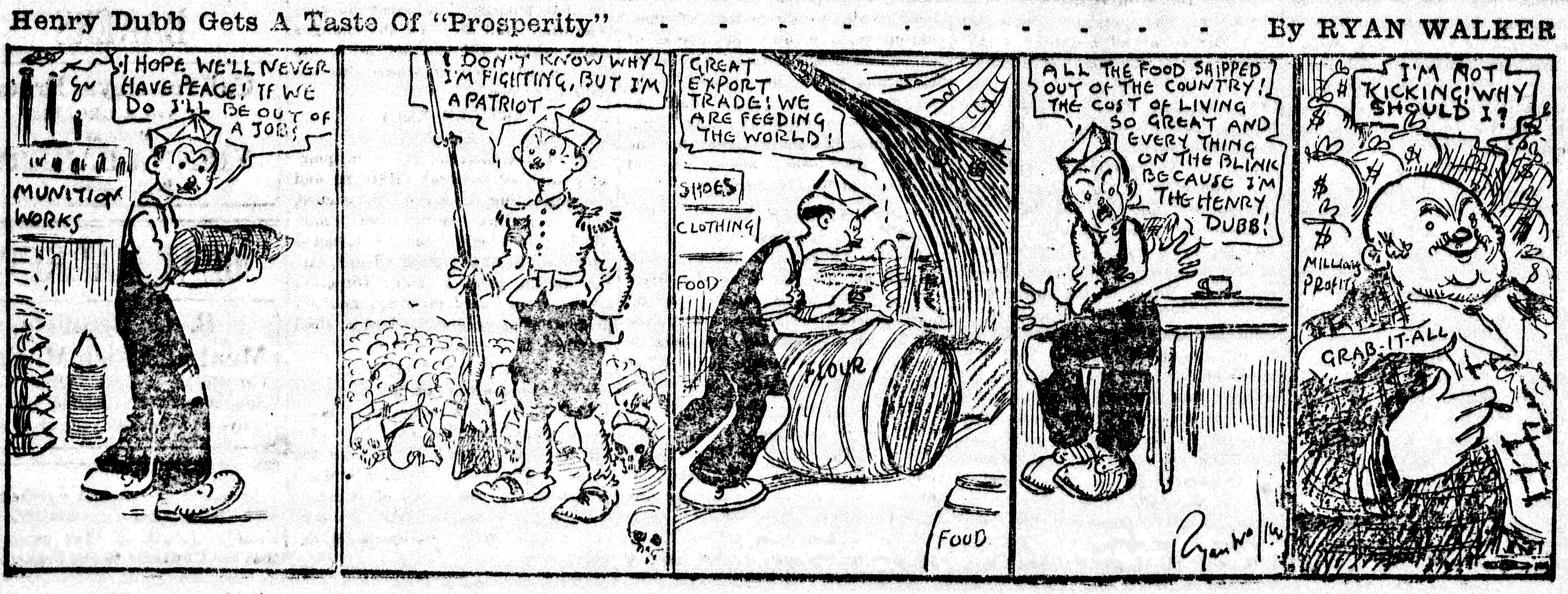
I do not know how old Walker is. I have not asked him and really it does not matter much, anyway. He may be either twenty or forty, for he has all the buoyancy of the one and the gravity of the other. But one thing is sure: He will never be old, though his curly hair turn gray or he lose it altogether, which may heaven forfend! Having a good work to do, and having jus begun to do that work, he will ways remain young in heart, growing old only in years and wisdom, with the spirit of social revolt keeping him ever youthful and vigorous, finding individual joy in preparing the way for social joy, a fervent advocate and fine example of the comradeship, which, in the good time coming, will eventually make glad the hearts of men and beautify the world.
The Coming Nation was a weekly publication by Appeal to Reason’s Julius Wayland and Fred D. Warren produced in Girard, Kansas. Edited by A.M. Simons and Charles Edward Russell, it was heavily illustrated with a decided focus on women and children.
PDF of full issue: https://www.marxists.org/history/usa/pubs/coming-nation/101210-comingnation-w013.pdf

