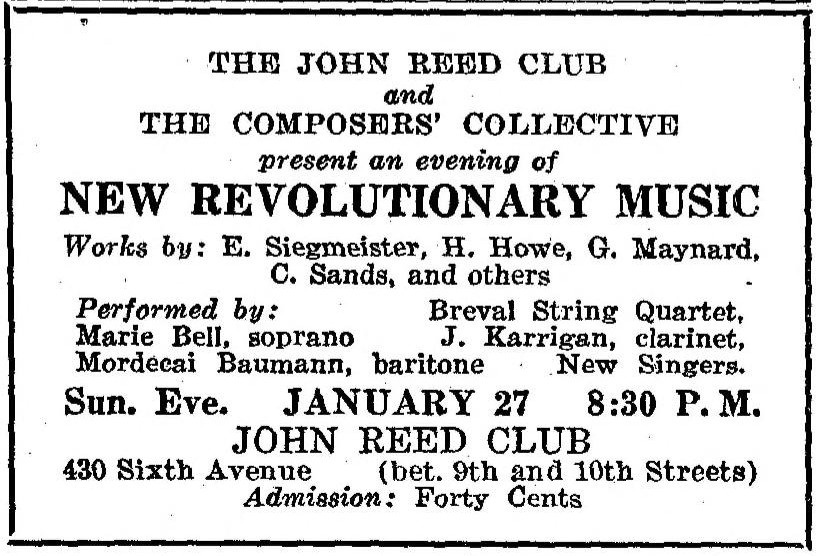
A review of the inaugural concert of the Composers Collective at the John Reed Club in January, 1935.
‘Concert of the Composers Collective’ by Max Marcutis from New Masses. Vol. 14 No. 10. March 5, 1935.
AT the first concert of the Composers Collective (Sun. Jan. 27) held at the John Reed Club, the hall was packed to the doors. For the first time in American musical history, a concert audience experienced the palpable fact of a revolutionary content in music, a content that was infinitely rich, complex and varied. Commanding musical materials and resources inferior to none of their bourgeois colleagues, the composers of the Collective demonstrated a startling truth to the latter—that vitality and direction in music grow out of a clear revolutionary world view. The momentously relevant content emphasized the world of difference between a bourgeois “radical” composer and a Carl Sands. Significantly, composition after composition on the Collective’s program aroused the huge audience to cheers. Yet, so high was the artistic standard, that there were shiningly outstanding works. For example, Elie Siegmeister’s Strange Funeral in Braddock, having withstood the test of a number of repetitions, was still a moving, vivid experience. Especially splendid was Mordecai Baumann’s rendition of the solo voice part. Herbert Howe’s songs for solo voice with piano accompaniment and clarinet obligato, revealed exceptional talent—especially the magnificent Goodbye Jesus, a work as characteristically indigenous as has ever been heard in this, country. The appearance of Andre Cibulski, the soloist, who had not been announced on the program, was a gratifying event, for his rendition of these songs will not soon be forgotten. George Maynard’s excellent John Reed, Our Captain, for chorus, was distinguished by its mature and finely sustained intensity.
Workers’ Rounds are becoming increasingly popular. Rounds by Siegmeister and Carl Sands received ovations. Sands’ “Oh Joy upon the earth, to live and see the day when Rockefeller Senior shall come up to me and say, ‘Comrade, can you spare a dime?’” a remarkably succinct and humorous take-off on English madrigal style, had to be repeated, with the audience participating in the singing. Sands’ mass song We are the Builders remains one of the best works in its field. The Flying Squadron and Picket Line by Earl Robinson, were as effective as ever, though their conventional character was too noticeable in comparison with the rest of the program. The Thaelmann Freedom Song by John Lewis and United Front by J. Fairbanks were real contributions to our mass song literature.
Siegmeister’s choral arrangement of Sistern and Brethern, a stirring Negro song of protest, one of a collection by Lawrence Gellert, was impressive; likewise J.C. Richards’ arrangement of a Red Mongolian Song.
The vocal works suffered notably from bad texts; the words in most cases were shoddy, and only by a stretch of courtesy were they an equivalent to the music. The instrumental works, on the other hand, left much to be desired. Howe’s Four Moods for string quartet, alone achieved a large measure of success; sharply outlined musical these were handled in a pithy, brisk manner, developed briefly, and by means of their own logic, were brought to an end on their own special climaxes. The Quartet of Herman Chaloff did not seem to deviate from the usual path of “radical” bourgeois composers. The same may be said of his piano pieces, which do not achieve more than technical interest. Norman Gazden’s short satirical pieces, written for the dance, are necessarily limited; epigramatic, their satire is boldly presented in rhythmic figures. The general criticism above holds for Siegmeister’s Piano Variations, an early work.
“Art must have its deepest roots in the broad masses of the workers,” Lenin said. “It must be understood and loved by them. It must awaken and develop the artist in them. It must unite their feelings, thoughts and wills,” The works of these eleven composers represented the first, or pioneering phase of such an art.
The New Masses was the continuation of Workers Monthly which began publishing in 1924 as a merger of the ‘Liberator’, the Trade Union Educational League magazine ‘Labor Herald’, and Friends of Soviet Russia’s monthly ‘Soviet Russia Pictorial’ as an explicitly Communist Party publication, but drawing in a wide range of contributors and sympathizers. In 1927 Workers Monthly ceased and The New Masses began. A major left cultural magazine of the late 1920s and early 1940s, the early editors of The New Masses included Hugo Gellert, John F. Sloan, Max Eastman, Mike Gold, and Joseph Freeman. Writers included William Carlos Williams, Theodore Dreiser, John Dos Passos, Upton Sinclair, Richard Wright, Ralph Ellison, Dorothy Parker, Dorothy Day, John Breecher, Langston Hughes, Eugene O’Neill, Rex Stout and Ernest Hemingway. Artists included Hugo Gellert, Stuart Davis, Boardman Robinson, Wanda Gag, William Gropper and Otto Soglow. Over time, the New Masses became narrower politically and the articles more commentary than comment. However, particularly in it first years, New Masses was the epitome of the era’s finest revolutionary cultural and artistic traditions.
PDF of full issue: https://www.marxists.org/history/usa/pubs/new-masses/1935/v14n10-mar-05-1935-NM.pdf

