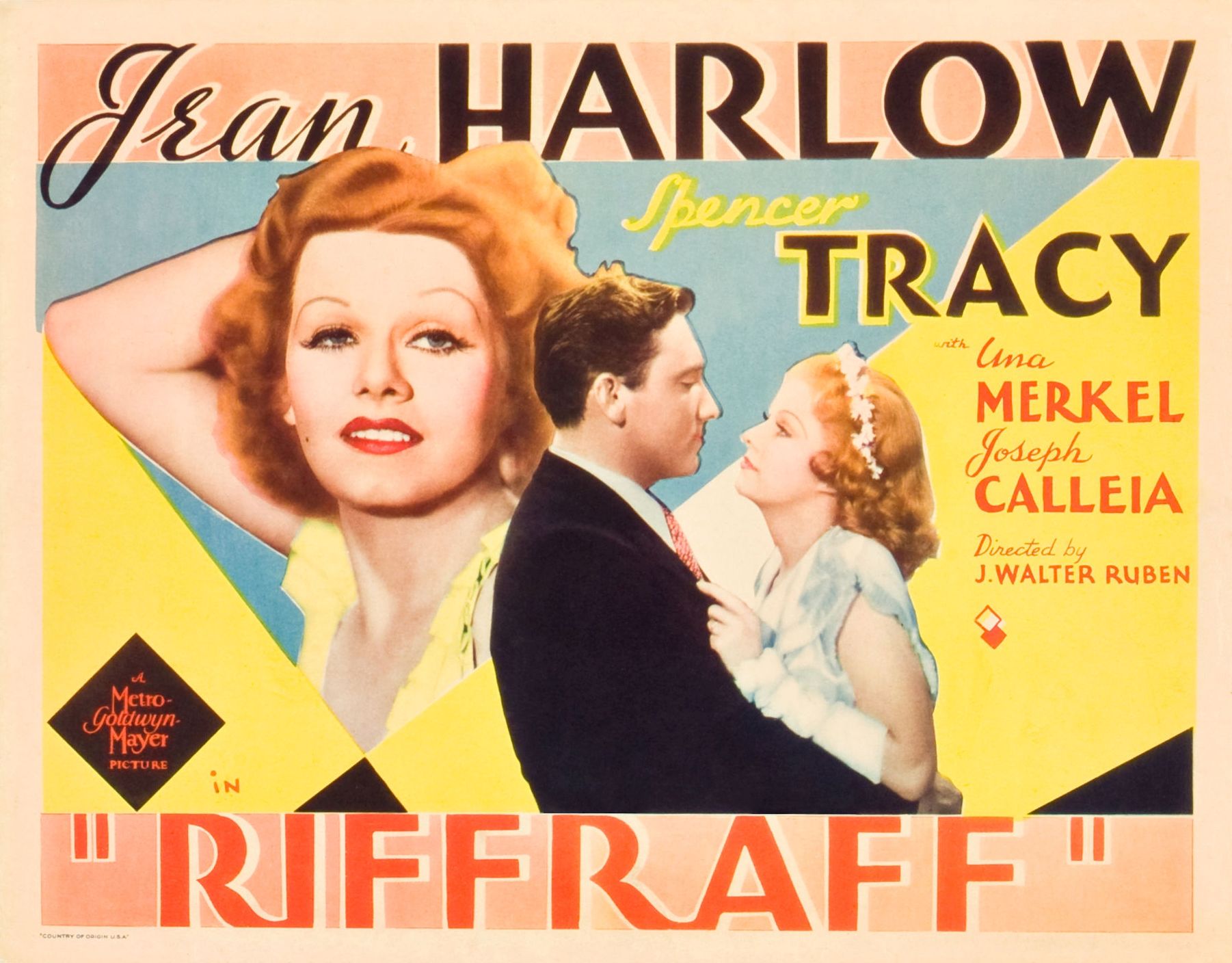
Despite its reputation, Hollywood has always been a bastion of reaction and its ‘entertainment’ a pillar of the status quo. The industry’s anti-collectivism baked in with its own history of violent anti-unionism and strike-breaking. Long before Rambo, long before On the Waterfront, long before the films reviewed below, Hollywood movies both reflected and defined the capitalist project. Here, an extrapolation of anti-Communist themes pulled from the 1935 M.G.M. movie Rif-Raff with Spencer Tracy and Jean Harlow. As it was, so it shall be.
‘Hollywood as Strikebreaker’ by Ed Ray from New Masses. Vol. 17 No. 1. October 1, 1935.
THE entire Pacific Coast is threatened with an industrial crisis in maritime and allied industries and Hollywood propagandists are right on the job with the production of two motion pictures to aid in breaking a strike that has not yet started. Each of these pictures attacks militant labor leadership, seeks to win sympathy for scabs, pictured as “loyal” workers and strives to bolster up the fascist ideology implicit in such productions as Black Fury and Stranded. These new pictures are Metro-Goldwyn-Mayer’s Rif-Raff, starring Jean Harlow and Spencer Tracy, and Warner Brothers’ The Frisco Kid.
The Frisco Kid attempts to evade the propaganda issue by dating the story in the Barbary Coast days and its plot: centers around the action of vigilante mobs in cleaning out water-front grumblers, Riff-Raff is more vicious, it has a point to make and doesn’t care who knows it. Frances Marion, once a Hearst newspaper woman and now the highest-paid writer in the world at a salary of $3,000 a week, is the author, The scenario deliberately seeks to prove that the waterfront strike with which it deals is fostered through a “Red” conspiracy to delude the workers and all of Hollywood’s outworn cliches are utilized to drive home the lesson. Even the obstacles in Jean Harlow’s path to the hero’s arms result from the machinations of a San Francisco Communist agitator,
The scene is laid in a waterfront town in which fishermen and the boss are getting along famously until the advent of Red Belcher, the Communist agitator, described as a “newcomer to fish-harbor who uses his dynamic personality to breed discontent among the men.” In contrast to this dangerous agitator the conservative union leader is “although ignorant, a fine type of man, serious, intent and reliable.”
Of course, Belcher manages to get Spencer Tracy, Jean’s husband of only a few days, in his toils. The rest is easy. Belcher incites a strike by telling the men to “Rise up. Take your necks from under the iron heel. The workers shall be free. Strike the fetters from your starved bodies. How long will you sell your souls for their dirty pennies while they take the dollars you make? Those are your dollars. Yours and Yours and YOURS.”
The strike collapses when the boss threatens to import scabs to be furnished by a “San Diego labor leader”! Belcher is happy. He proposes to blow up the fleet but the conservative union leader herds the men back on the ships by recalling that “the union is for justice—justice for everybody—but it ain’t a union for criminals. We’ve never committed a criminal offense and–we ain’t gonna destroy property.”
Balked in their scheme and dropped from the union, Belcher and Spencer Tracy leave for San Francisco. Her home broken up, Jean follows but Spencer refuses to see her, a decision encouraged by Belcher’s “quotation” from the “Communist Manifesto: “by the actions of modern industry all family ties among the proletarians are torn asunder” There are complications; Jean gets thrown into jail, Spencer returns home to get a job as night watchman and wins his way back into the boss’ heart when he prevents Belcher from dynamiting the fishing fleet. The scenario ends on a happy note with the boss tendering Spencer a dinner and with Jean home again. Just to round the story out the union returns Spencer his card. “One of these days,” Jean tells him, “You’ll own that fishing fleet.”
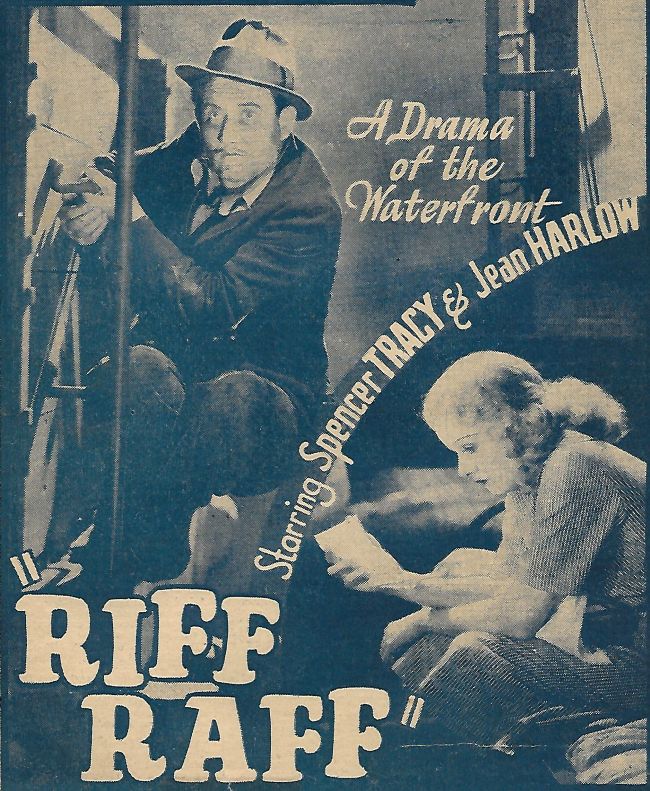
To list every attack on the working class made in Riff-Raff would entail copying the complete script. If this film had been blessed with a glossary it would run something like this:
Communist Manifesto—Balderdash, a ridiculous document that says, page 40, “by the actions of modern industry all family ties are torn asunder.”
Hero—A man who resorts to violence to knock out Reds and stop strikes.
Heroine—Female of “hero”; contented and happy when staying home attending to her wifely duties. 2. A girl who accepts furs and attentions of men she does not like. 3. A girl whose only interest in life is the man she loves.
Villain—A Red, whose chief pleasure in life comes from making employes disloyal.
Boss—In the Russian language, boss and villain are synonymous. In English, a good guy who hides a heart of gold beneath a brusque, business-like manner. Their favorite pastime, after business hours, is throwing parties for the help.
Workers—(Especially waterfront workers). Drunken, improvident, lazy good-for-nothings, addicted to much thoughtless ca rousing. They are usually uneducated, illiterate, speak and look like gangsters.
Radicals—Habitat, San Francisco. Agitators, foreigners. Alien fanatics who believe in violence and destruction, happiest when throwing bombs. They talk of rank-and-file control but take orders from Moscow. Thus, “When your husband has been out late and comes home smelling of booze, he’s been out with a radical.”
Union Members—See Easily swayed by speeches.
Strikes—Unnecessary demonstrations by misguided workers which can only lead to increased profits for the bosses and privation for the strikers.
Demonstration—A gathering of “workers,” “union members” (see above) carrying placards. They usually feel silly.
Scab—A loyal worker who hates to see a boss imposed upon. Sometimes they have been loyal in other parts of the country and are transported to troublesome spots by “loyal labor leaders.” They are an irresistible force and once they come on the scene, strikers had better go back to work.
Union Leader—An intelligent, big-hearted man who was once thought to be a “worker” (see above) but fooled ’em, He believes that an employer has a legitimate right to use scabs in industry. He believes strikes should end at the first opportunity, so long as the boss is willing to forgive and forget. Sometimes he gets the boys a pay cut.
Labor Agreement—See dictionary for definition of Ten Commandments, Book of Moses, Holy Writ, New Testament. This is holier.
Union Demands—Never mentioned.
Relief—A plate of soup and roll given by pretty women in the Red Cross.
Solidarity—The feeling among workers, especially as demonstrated by a worker’s son who steals the rations of four other workers at the relief station, bringing his mother’s approbation and this comment to her neighbor: “Ain’t he a good kid—always thinkin’ of his family.”
The New Masses was the continuation of Workers Monthly which began publishing in 1924 as a merger of the ‘Liberator’, the Trade Union Educational League magazine ‘Labor Herald’, and Friends of Soviet Russia’s monthly ‘Soviet Russia Pictorial’ as an explicitly Communist Party publication, but drawing in a wide range of contributors and sympathizers. In 1927 Workers Monthly ceased and The New Masses began. A major left cultural magazine of the late 1920s and early 1940s, the early editors of The New Masses included Hugo Gellert, John F. Sloan, Max Eastman, Mike Gold, and Joseph Freeman. Writers included William Carlos Williams, Theodore Dreiser, John Dos Passos, Upton Sinclair, Richard Wright, Ralph Ellison, Dorothy Parker, Dorothy Day, John Breecher, Langston Hughes, Eugene O’Neill, Rex Stout and Ernest Hemingway. Artists included Hugo Gellert, Stuart Davis, Boardman Robinson, Wanda Gag, William Gropper and Otto Soglow. Over time, the New Masses became narrower politically and the articles more commentary than comment. However, particularly in it first years, New Masses was the epitome of the era’s finest revolutionary cultural and artistic traditions.
PDF of full issue: https://www.marxists.org/history/usa/pubs/new-masses/1935/v17n01-oct-01-1935-NM.pdf

