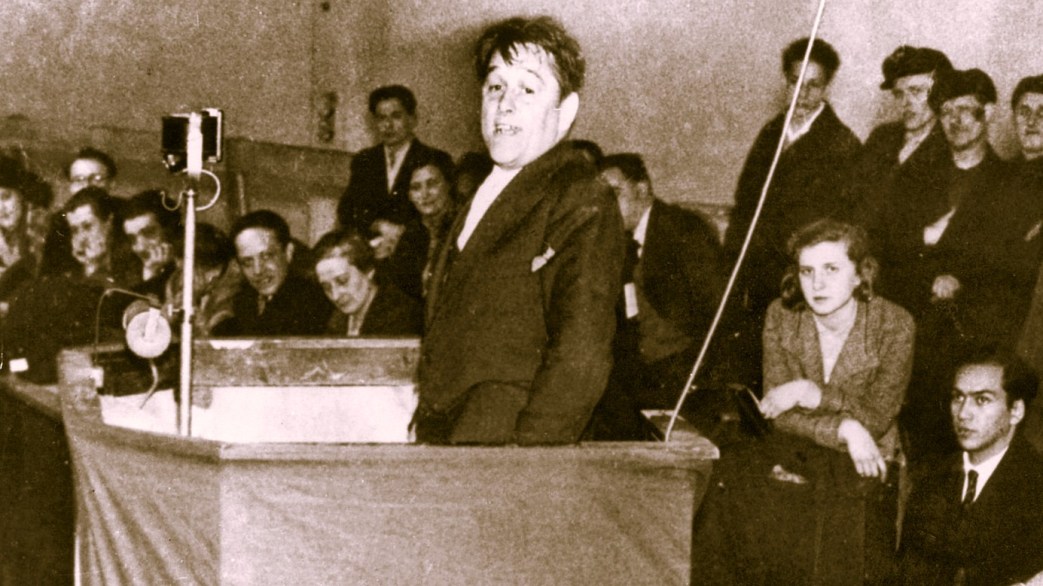
Always seeking new, novel, and mass ways of communicating, the reason the Workers International Relief also became the center of Communist film-making is due in large part to the energies of Willi Münzenberg. Here, he makes his appeal to comrades to take film centrally serious.
‘Capture the Film!’ by Willi Münzenberg from the Daily Worker. Vol. 2 No. 166. July 24, 1925.
FERDINAND LASSALLE characterized the press as a new major power. The same can be said of the a film, which, in some countries, has already achieved a greater significance than the press itself. The total attendance in the movie theaters of England, France and the United States is perhaps even today greater than the total number of newspaper readers in those countries.
Even if the press were granted the greater numerical dissemination, let it not be forgotten that the film, through the medium of the visual picture, influences its patrons far more strongly and emphatically than does the printed word its readers.
He then develops the thought of the importance of technical progress in the film world finally convincing the last opponent of its value and permanence.
We must develop the tremendous cultural possibilities of the motion picture in a revolutionary sense the film must truthfully reflect social conditions instead of the lies and fables with which the bourgeois kind befuddles the workers, etc.
As in many other instances, the working class organizations were the most timid and most tardy in the effort to put this new medium to their use. The time is not so far past when social-democratic leaders, in common with bourgeois ideologists, in all seriousness proposed to boycott the films because of their competition with the theater, their flattening of public taste and destruction of literary standards. Only after the war were timid attempts made to put the film into the service of working class propaganda. In various countries workers’ organizations arranged “Better Movie Nights” in which, besides the showing of educational and cultural films, criticism of current entertainment films was given. In 1922 in Germany the A.D.G.B. (All German Federation of Trade Unions) tried, through the establishment of a “Peoples Movie,” to produce and exhibit socialistic working class pictures.
The attempt was unsuccessful, but it was later repeated by the A.G.D.B. in the production and distribution of the film “The Smithy,” which, however, also failed of mass influence. In the main the labor organizations and even the Communist Parties and groups have left this most effective means of propaganda and agitation unopposedly in the hands of their enemy.
The bourgeoisie, and especially the extreme nationalists and militarists very early recognized the significance of the film as a propaganda weapon, and constantly and most extensively! put it to their service. Particularly far-reaching exploitation of the film took place during the world war, particularly by England and France which spent tremendous sums on film propaganda against the Central Powers in allied and neutral countries. Germany tried in vain to beat the opponent at this game, and even created a special film center for the purpose of pushing nationalist films to fan the war spirit. These films received little distribution outside of Germany and Austria. But it is beyond argument that the war and incitive films contributed very heavily to the creation of the chauvinist insanity in the war, and the post-period showed continued use of the films for the purpose.
WHILE in England and France a whole row of pictures proclaimed the military victory, the German producers were more concerned with awakening a faith in the possibility of rebirth of the “good old times” of Germany’s “greatness.” A typical example of this series is the picture “Frederick, The Great,” which was mightily effective along this very line in petit-bourgeois and “spiessbürgerlichen” circles.
In considering the development of the German film industry it is interesting to note the reflection of the cur- rent political tendencies. During the mounting wave of the monarchist movement which culminated openly in the election of Hindenberg there was decided increase in the product on and release of monarchist and militarst films. The pictures, “The King’s Grenadier,” “Ash Wednesday,” “Revellie,” “The Tragedy of Major Redl,” etc., are typical examples of this tendency, and it would be very interesting to establish statistically in how many theaters, during the few weeks before the presidential by-elections these and similar films were shown to the public.
How far film is exploited for definite political ends is shown in the large number of prejudice building films directed by European and American producers against Soviet Russia. For example the film “Death Struggle” (Todesreigen) produced in Berlin, which for months in practically all German cities conjured up on the screen the most unconsciable concoction of invention and fantasy of terror and horror on the part of the Soviet government against the Russian workers and peasants. In several industrial centers the workers became so enraged at this calumny that, as in Leipsig, they smashed up the projectors and burned the films. The attitude of these workers is entirely understandable, but it recalls its precedent in the early days of capitalism when the workers, feeling their livelihood threatened by the new machines smashed the new tools and set a red cock on the roof of the manufacturer. Only later did the proletarians learn that it does no good to destroy machines, but that what concerns us in the conquest of those machines and their application in a manner useful to the workers. Understandable though the action of the Leipsig workers, it shows no workable remedy with which to meet the evil. Not the destruction of tools and technical equipment, but their conquest and their turning to the use of the labor movement, for the idea-world of Communism. One of the most pressing tasks confronting Communist parties on the field of agitation and propaganda is the conquest of this supremely important propaganda weapon until now the monopoly of the ruling class, we must wrest it from them and turn it against them.
***
ARTICLE II. August 15, 1925
NUMEROUS means for agitation and propagandation of the Communist idea are at the disposal of the Communist Parties and organizations; the spoken word in mass meetings, factory meetings, demonstrations, etc. The printed word thru leaflets, papers, manifestos, magazines, pamphlets, and books. These means have been in use since the first days of the working class movement.
Besides these means firmly established through decades of use, more and more, although slowly and against opposition, the picture is taking its place in Communist agitation and propaganda. Up to two years ago the picture was virtually ignored in Communist literature. It was seldom that in a book or any kind of pamphlet a picture was used to support and emphasize the text. In no daily paper, in no youth organ, in no woman’s paper was it used. Fortunately this situation within the past two years, had been largely improved and more and more the picture serves the Communist daily, magazine, women’s paper, etc., to liven up the text–although still in regretfully limited extent.
OUR enemy controls in Germany alone more than hundreds of variegated illustrated papers, and in Berlin alone there appear every day numerous papers with special pictorial supplements. It is unquestionably necessary and desirable that pictures be utilized in Communist papers to a far greater extent than heretofore, The picture is most tellingly effective upon the children, youth, on the primitively thinking, unorganized, indifferent masses of workers, agricultural labor, small peasants and similar groups. Coincident with the illustrations in the dailies, youth and children’s organs, women’s and peasants’ papers, we must unquestionably begin the development of the Illustrated workers’ paper.
Right in the factory an illustrated paper is far easier to sell to an indifferent fellow worker than is a theoretical pamphlet. We must make it possible to combat the stupefying influence of the bourgeois illustrated journals that are now circulated in the millions.
Besides the creation and development of the illustrated labor paper the picture must be fully utilized for our propaganda, by means of photos, cards, picture collections, etc. Particularly for the popularizing of the leaders of the Communist International, for the combatting of the hero-worship toward bourgeois leaders and military figures, and above all, in the education and agitation work on behalf of Soviet Russia the picture can and shall render priceless service.
A further extension of the use of t the picture is seen in the stereoptican slide lecture, which in the rural sections of Germany and Czecho-Slovakia, where they have thus far been most used, have had best results. These slides make it possible to present in most convincing and plastic form such themes as the economic upbuilding of Soviet Russia, the life of the Russian worker and peasant, the children’s homes in Soviet Russia, the Red army, etc.
ON all these fields a start, although perhaps, a humble one, has al- ready been made. But next to nothing has been done to put the film into the arsenal of agitation and propaganda weapons of the Communist Parties. Quite properly the enlarged executive of the Comintern in March, 1925, called attention to this shortcoming, and instructed all affiliated parties to concern themselves much more than formerly in turning this weapon to their service. Leading comrades of the International have repeatedly and emphatically pointed out the tremendous significance of the film propaganda.
Vladimir Ilitch Lenin, in a conversation with Comrade Lunacharski, said: “You must powerfully develop film production, taking especially the proletarian kino to the city masses and in still a much greater extent to the village. You must always consider that of all the arts the motion picture is for us the most important.”
A statement from Comrade Zinoviev on the motion picture: “The motion picture in the possession of the bourgeoisie is the strongest means for the betrayal and befuddling of the masses. In our hands it can and must become a mighty weapon of Communist propaganda and for the enlightenment of the widest working masses.”
N.A. SEMASCHKO, Peoples’ Commissar for Health said, “the kino gives a vital and accurate picture full of life and true to life, it can agitate through the Fable, through the picturization. These circumstances enhances the value of this form of propaganda also in the protection of public health, for today, with the widespread increased popular interest in world questions, with the prevailing universal nervous tension, dry discourses and lectures on public health, no mat ter how learned they may be, cannot always get to the heart of their audience.”
A.V. Lunacharsky, Commissar for Public Education: The kino proves itself extremely vital. We possess mostly a very busy and highly promising production, but although we have decided upon a salvation bringing unification of all motion picture activity in the U.S.S.R., and particularly in the R.S.F.S.R., our steps in carrying out this decision are hesitant and uncertain.”
K. Woroschilow, commander of the Red Army in the Moscow military district, “The motion picture, as a cultural plane (the carpenter’s tool), has won itself a place of honor in the U.S.S.R. It is no less popular in the Red Army than among the worker and peasant masses.”
CLARA ZETKIN writes concerning the significance of the film in the Communist propaganda: “On no account can the Communist movement ignore the propaganda power of the motion picture. For it seeks its followers in first instance from those strata deprived of educational opportunity and barred from books, it must call out the foreign-speaking colonial peoples against their masters, and unite the proletariat of all lands. The film is particularly significant for the Soviet Union. Czarism left a heritage of illiteracy and feudalism. Soviet Russia includes great primitive, but culture hungry masses, speaking hundreds of varying tongues. Here the film is a means of popular education of tremendous importance, a tool for the raising of productivity, a weapon in the struggle against unhealthy habits of living, and against plagues, a disseminator of knowledge, an educator, a bringer of culture and happiness.”
Let us value to film by the great propagandistic, cultural possibilities that it contains.
When we think of the masses that daily, in city and tiny village, fill the movie theaters, and that of those eighty to ninety per cent are workers or closely connected with the workers, and when we consider further the effect of these pictures upon the masses, knowing their power of mass suggestion, then we welcome indeed the decision, and pledge of the Communist Party for the full utilization of this means. To make available and use the film as a means of winning support, in support of our efforts at enlightening the working masses, is the most pressing task of Communist propaganda and agitation. The film can, for instance, be employed for the unmasking and gibbeting of our opponents, in showing the development of the social-democratic party from the first beginnings under Marx and Engels down to the Barmat circle in Hotel Bristol. The effect of such a film can be appraised when one re- members the effect of even only a series of stereoptican slides, dealing with this same subject, during the recent reichstag elections.
THE same applies to a film to meet the militarist and monarchist propaganda prejudice films with a true ex- position of the old Russian militarism, showing the torture in the barracks, the beastly treatment of the soldiers, and the gruesome horror of the war. In districts where the clericals are especially strong, a film showing the horrors of the medieval inquisition, would surely not fail of effect on the hitherto loyal supporters of the Zentrum.
But not only against the enemy can our film be directed, it also bears the possibility to present positively the aims and struggles of the Communist movement and of the revolutionary workers’ organizations. There can be no doubt, that a film showing the life of a youth, beaten in school, mistreated by teachers, suffers, hungers, and finally comes into contact with the Communist Youth Movement where he finds defense, protection, support, of his interests, is drawn into the mass movement, learns the meeting routine, takes part in demonstrations, etc.; such a film would surely exert suggestive power upon thousands of Juveniles and bring great crowds of them closer to the Communist movement.
THE same applies to a film showing the life story of a worker, returned from the war, plunged into the maelstrom of the November events, and on the barricades of Berlin defends his family and his class. Or a really extensive picture along the lines of the Griffith film, “Intolerance,” recreates historical periods of revolutionary upheaval, beginning with Spartacus, the peasant uprisings, Thomas Munzers, the great French Revolution, and closing with the great triumphant victory of the workers and peasants of Russia. In the factories or after working hours we could show the workers by means of trick film the constant lowering of their living conditions, of the actual lowering of their wages in comparison to the rising prices, and thus demonstrate the actual working out of bourgeois control of politics and industry. There are hundreds of motives and objects that can be utilized in film propaganda. We are not oblivious to the colossal censorship difficulties, technical and organizational obstacles, that stand in the way of all these suggested plans. Much ground would already be won if we could put every Communist Party and organization into a position to show a monthly film chronicle of the most important happenings in Soviet Russia, and thus to bring the development of this strongest prop of the international proletarian and revolutionary movement into the clear vision of the masses. Good and valuable as our present agitational and propaganda media, the spoken or printed word, may be, their effect would be tremendously increased if they could be combined with the up-to-date medium of the film.
THERE must no longer be any country in which the Communist Party and its groups do not make extensive propagandist use of the motion picture film.
The Daily Worker began in 1924 and was published in New York City by the Communist Party US and its predecessor organizations. Among the most long-lasting and important left publications in US history, it had a circulation of 35,000 at its peak. The Daily Worker came from The Ohio Socialist, published by the Left Wing-dominated Socialist Party of Ohio in Cleveland from 1917 to November 1919, when it became became The Toiler, paper of the Communist Labor Party. In December 1921 the above-ground Workers Party of America merged the Toiler with the paper Workers Council to found The Worker, which became The Daily Worker beginning January 13, 1924. National and City (New York and environs) editions exist.
PDF of full issue: https://www.marxists.org/history/usa/pubs/dailyworker/1925/1925-ny/v02b-n166-NY-jul-24-1925-DW-LOC.pdf
PDF of issue 2: https://www.marxists.org/history/usa/pubs/dailyworker/1925/1925-ny/v02b-n185-NYE-aug-15-1925-DW-LOC.pdf

