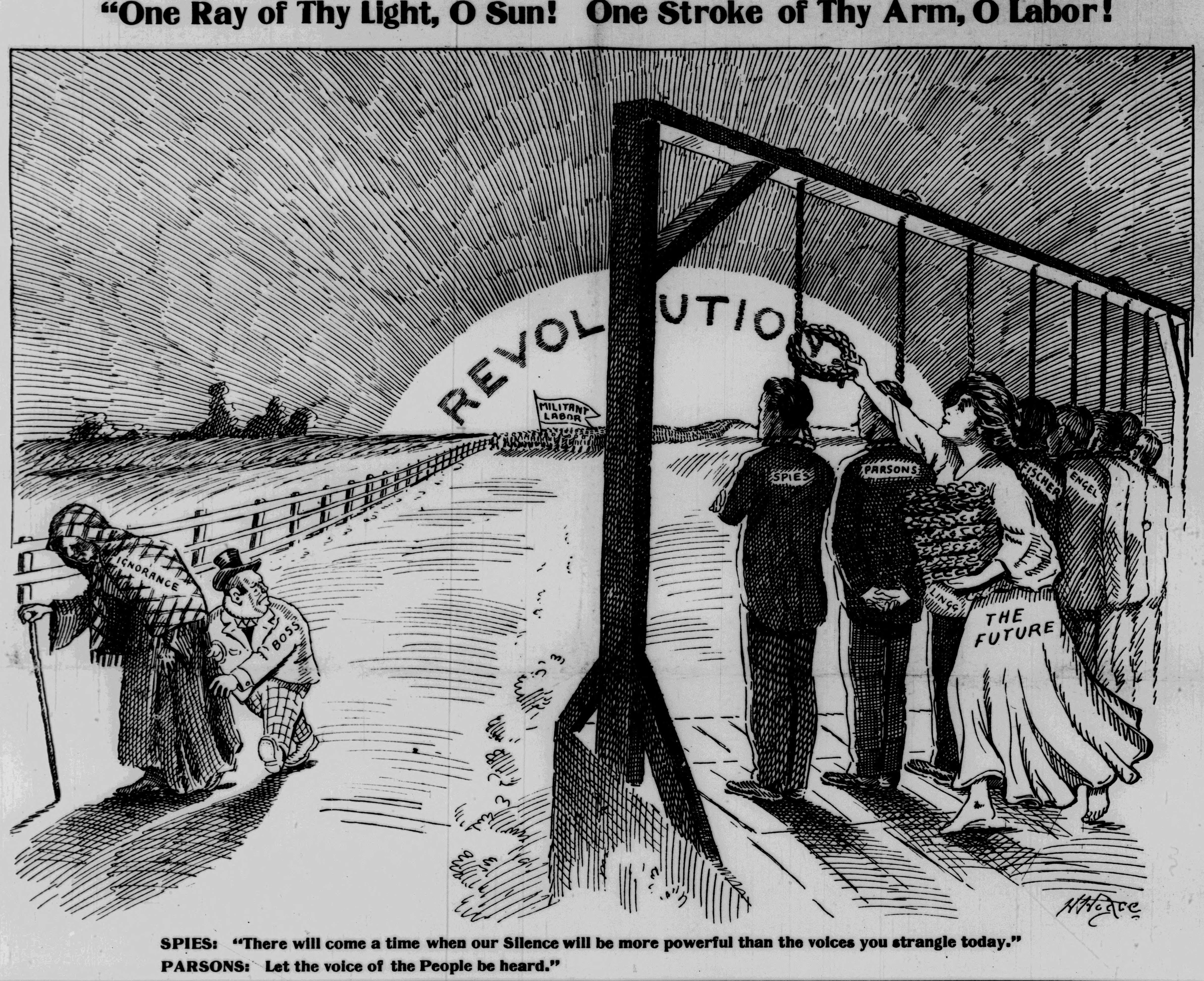
The Red Month of November sees the anniversary of the martyrdom of the Haymarket defendants, the judicial murder of Joe Hill, and the killings of wobblies in Centralia, and many others. The Seattle I.W.W. opens its hall for the 40th anniversary of the November, 1887 execution of the Haymarket accused for a moving memorial in dedication to finishing the fight of the dead.
‘Memorial Held for November’s Labor Martyrs’ from Industrial Worker. Vol. 9 No. 47. November 26, 1927.
With an audience that packed the I.W.W. hall in Seattle to its fullest capacity, a memorial meeting was held on the night of November 17th in memory of November’s victims of the class war. Tribute was paid to those who were killed on the decks of the Steamer Verona in Everett. Washington, harbor on “Bloody Sunday,” November 5, 1916; to the victims, living and dead, of the Centralia broadcloth mob on Nev. 11, 1919; to Joe Hill, murdered by the Mormon church of Utah, Nov. 19, 1915; to the Haymarket martyrs, hung for their loyalty to the working class, in Chicago, November 11, 1887, and others.
The program was opened by the Rebell Girls singing “The Red Flag:” Katie Phar at the piano. Then the chairman, Fellow Worker Tom Murphy, introduced Arthur Boose as the first speaker. Fellow Worker Boose stated that we are not here to mourn, but to pay our respect to the memory of our fighters who have died for the cause, and our tribute to the living who are in jail for the cause. He carried us back 40 years to the Haymarket trouble, which occurred when he was 11 years old; he told us of Albert R. Parsons, August Spies, Adolf Fischer, George Engel and Louis Lingg who died for the 8-hour day, and of their comrades, Oscar Neebe, Samuel Fielden and Michael Schwab who went to prison for it; he said we were nearer the 8-hour day then than we are now, and declared these men fought for the same thing the I.W.W. is fighting for today. Economic action by workers on the job.
Daisy Rochfort then sang a solo, “Hold the Fort,” accompanied by Katie Phar. Emil Herman, of the Socialist party, was the next to speak. He said the Chicago martyrs never lost sight of the ultimate goal, the emancipation of the working class, and he quoted the statement of one of them made to the judge who sentenced him: “The day will come when our silence will be more eloquent than the voices you strangle today,” and said that day has arrived. He quoted Joe Hill’s last message to the workers, “Don’t mourn–organize,” and regretted that this advice had not been more intensively followed. He spoke of Frank Little, murdered in Rutte, Montana, by a mob of “business men”
August 1st, 1917, and told of the Verona at Everett and described how the I.W.W. went to the aid of the striking shingle workers resulting in the massacre “Bloody Sunday.” He touched on Centralia, and the Mooney and Billings case and said, “While we honor the dead let us not forget the living who are in jail.” He mentioned the present strike in Colorado which the capitalist class is calling “illegal, and said in the class struggle the capitalists are always “legal” and the working class always “illegal,” and urged all workers to organize and act for industrial freedom.
Katie Phar then sang a solo. “Farewell, Joe,” accompanied by Myrtle Walton on the piano.
“Though they stilled your rebel heart with lead,
And sealed with death your lips, our Joe.
Those words, the last you ever said,
Will bring to the masters ruin and woe.
We have shed no bitter tears for thee,
Nor have we sighed the mournful sigh;
We have fought the fight to make men free.
In the cause for which you had to die.” Ruth Ridgeway, Seattle Union Record” feature writer, spoke next, and told of the campaign she has started, and which she carries on each year, to help the Washington Branch of the General Defense raise Christmas funds for the class war prisoners. She spoke of women’s part in industry and the class struggle, and said that for 190 years a woman was not allowed to step within the door of the Boston Free Library; that the first woman in the United States who asked for a divorce: from her husband, because of his habitual drunkenness, was stoned to death in the street; that a factory in London with al German foreman, where she once worked tried to equalize the men and women workers and offered to pay the women as much as the men but could not do it because the men would not stand for it and threatened to strike against it. The Civil War in the United States, she said, had a serious effect upon working conditions; not only were millions of workers killed, the South impoverished, but the tramp was produced; Lincoln signed the contract labor bill, for which the farmers got the homestead law in exchange. She told of the 70’s and 80’s, when life was good with wages high and cost of living low, and said all this had been lost as the population spread westward until at last the I.W.W. made the final stand on the Pacific Coast, becoming the shock troops to stem the tide of the losing battle of labor and start the standard of living upward again; the Colorado strike is but one of the opening battles in the fight of the I.W.W. to regain the losres, bring back the good conditions and carry the victory back across the continent. She said the employing class always uses force and never relies upon law.
Violet and Rosie Rochfort sang “The Tragedy of Sunset Land,” with Katie Phar at the piano. Then Ed Delaney of the Washington Branch General Defense, described the Mormon tabernacle of Salt Lake City, with the bronze statue of the Angel Moroni surmounting its highest steeple and staring away to the eastward toward Battle Mountain where the Mormons were subdued by Federal soldiers, and in its gaze the angel stares across the courtyard of the State prison where, on November 19, 1915, Joe Hill was murdered, He told of Joe Hill coming as an immigrant. from Sweden, working his way across the continent from New York to San Francisco and back to Salt Lake City where, in 1913 he was working for the Utah Construction Company, a subsidiary of the Mormon church; how this singing worker, whose songs are famous, led a strike and obtained higher wages and better conditions for the workers, but himself was blacklisted. How in 1914 some one killed a grocery man in Salt Lake City; the authorities were Mormon, the storekeeper was Mormon and Mormon blood spilled calls for more blood. In this crisis the Utah Construction Company, which had not forgotten the profits Joe Hill had taken away from them, suggested that they get Joe Hill. He was arrested and tried, not for murder but for alleged disrespect to the American flag–against which they themselves had fought at Battle Mountain–was convicted and sentenced to death. He was led out into the yard across which the Angel Moroni stares, gave his last message to the working class, disdained the blindfold, folded his arms and himself gave the order to fire. Delaney then told of Everett in 1916 and the five workers who lost their lives there, Felix Baran, Frenchman; Hugo Gerlot, German; Gustav Johnson, Swede; Abraham Rabinowitz, Russian Jew, and John Looney, Irish, representing many nationalities as does the working class of America and of such is the I.W.W. He told of many other brutalities perpetrated by the tools of the capitalist class against the workers and dwelt at length upon the Centralia tragedy and the ferocity of the mob as it was vented upon the body of Wesley Everest, and told of Wesley’s last message, “Tell the Boys I did My Best.” Wesley Everest was fiendishly murdered, but eight of his companions, Eugene Barnett, John Lamb, Loren Roberts, O.C. Bland, James McInerhey, Ray Becker, Britt Smith and Bert Bland, though living, are buried alive in Walla Walla prison.
The Rebel Girls then sang, “November Nineteenth,” with Katie Phar playing the accompaniment: Oliver Carlson, of the Workers Communist Party, was the last speaker. He urged the workers to take to heart all the things they had been listening to and not forget them for 364 days, remembering them only on one day of the year when they meet together for a memorial. He said the working class can remember baseball scores for fifty years back; the names of all the winning race horses, the home runs of Babe Ruth, the scores of Red Grange; but when it comes to remembering how and why the martyrs of the working class have died their memories are abominably short. He scored the apathy of the workers and their habit of looking back upon past accomplishments,
and stressed the point, “Don’t mourn–organize!” Don’t look back–go forward. Hatred for the class that can do such deeds as those told about here tonight is justified, he said, and they will continue as long as we permit them; just so long as we mourn and don’t organize.
The Rebel Girls closed the program by singing “The Internationale.”
PDF of full issue:

