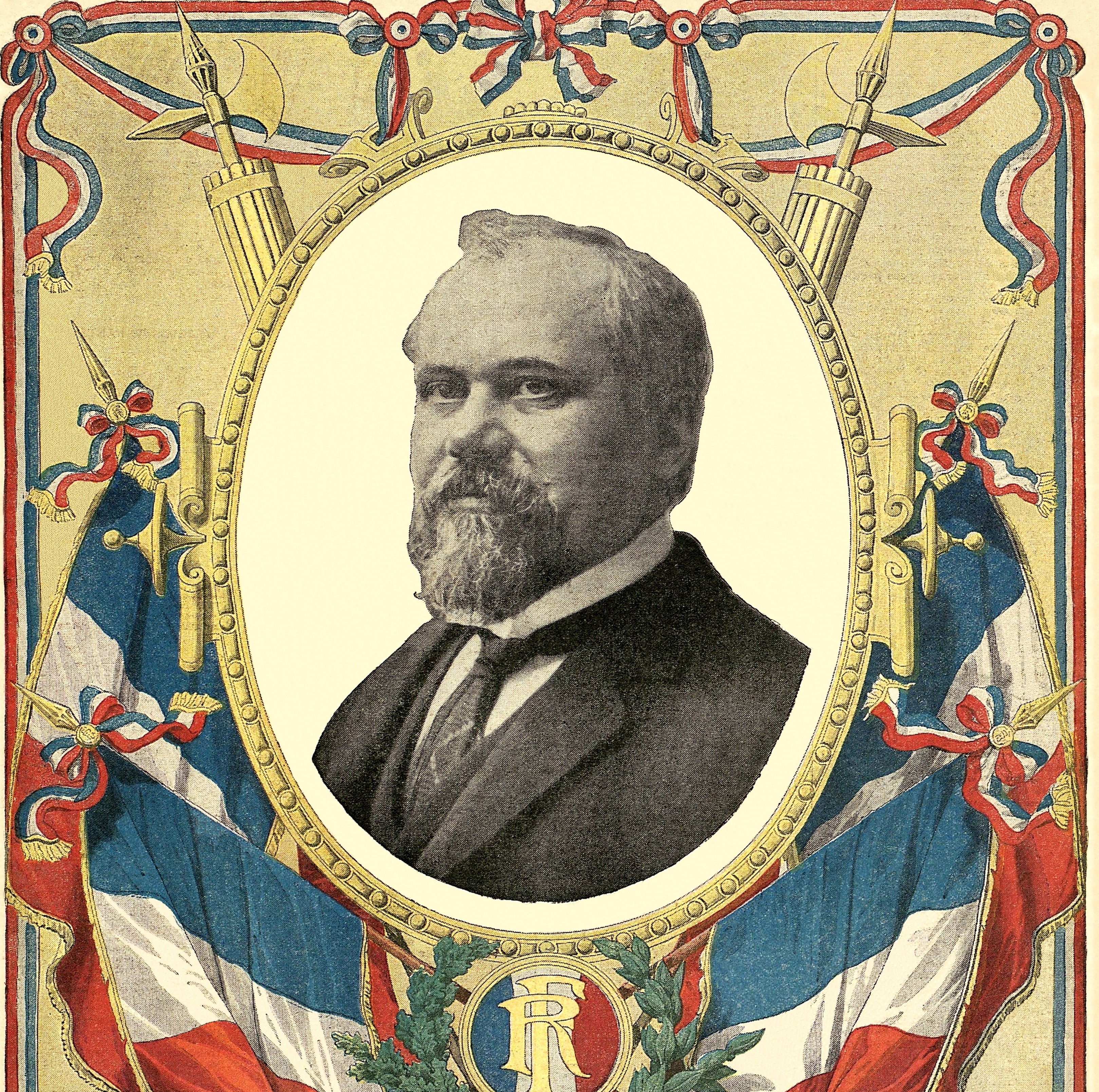
Another illuminating and informative article on the politics of pre-war France from Paul Louis, this on the election to the presidency of Raymond Poincaré, whole would lead French imperialism through the First World War.
‘The Presidential Election In France’ by Paul Louis from New Review. Vol. 1 No. 8. February 22, 1913.
France has a new “President of the Republic.” January 17, 1913, exactly one month before the expiration of M. Fallieres’ term of office, the Congress meeting at Versailles elected M. Raymond Poincaré, President of the Council and Minister of Foreign Affairs.
It is of course known that there are noteworthy differences between the conditions of a Presidential election in France and those obtaining in America. Equally different are the prerogatives of the First Magistrate installed at the Elysée and the one who sits in the White House.
The French President is elected by a joint Congress of the members of the Chamber of Deputies and of the Senate, the combined bodies numbering at present 897 electors. The people have no voice in the selection of the Chief of the State. Among the senators who use the ballot at Versailles are some who hold office for life and are independent of any electoral sanction from the people; of the others, a third were elected in 1906, another third in 1909, the remaining third in 1912. At these elections nobody knew who would be the candidates before the Congress on January 17, 1913. The deputies who make up two-thirds of the Congress have been in office since May, 1910. The electorate at that time could take no account of the change of power to follow three years later. Thus both senators and deputies voted in the Presidential election according to personal preferences without worrying about the opinions of their constituents, of which, for that matter, they were generally uninformed. It is true that a large portion of the bourgeoisie openly favored M. Poincaré, but the working classes, which constitute the vast majority of the nation, evidenced only a slight interest in the choice about to take place. The Presidential election in France is a strictly parliamentary affair and is worked out in the lobbies of the Chambers.
This is thrown into greater relief by the fact that aspirants for the office of President reveal their candidacy only at the last moment, and so public opinion, ordinarily very slow in formation, is not at all aroused. France never offers the spectacle of oratorical Presidential campaigns to which America has become accustomed. Candidates are not called upon to present themselves to the people, to traverse thousands of miles haranguing millions of people. Their task simply is to win over to their cause a few party leaders and at the start a few score of parliamentarians. It is a matter of dinners and receptions, of secret advances and promises of cabinet appointments. These negotiations remain unknown to those who do not live in the government circles.
The prerogatives of a French President are likewise quite different from those of a President of the United States. Cabinet officers are responsible not to him but to Parliament. He must appoint them from the majority party and with reference to the wishes of the majority. He can, of course, before sanctioning laws that have been passed, require a new consideration of them, but of this right no use is made. He can likewise communicate with Parliament, and so with the people, by delivering a message. Here again is a privilege that has lain idle. He can finally, with the support of the Senate, dissolve the Chamber of Deputies and order a new election; but since MacMahon, in 1877, no President has had recourse to this measure, and such an action would now seem almost revolutionary.
Indeed, in the eyes of many people of the capitalist class, the President of the Republic in France has only a decorative function, namely, that of receiving ambassadors, paying visits to foreign rulers, and unveiling statues. The Socialists have always contended that it is ridiculous to support a politician, at the cost of $250,000 a year, to perform such a superfluous function.
On the eve of the election of January 17, 1913 (we may recall in passing that the successful candidate sits for seven years in the Elysée), the theoreticians of the “Do-nothing Presidency” were at swords’ points with the theoreticians of the “Active Presidency.” The latter already had their candidate in view, and they maintained that the first magistrate should derive his prestige not from his office, but from his own personality. They considered it essential that he should be a man well known throughout the nation, that he should even be popular in one way or another, that he should have some intellectual distinction. and especially that he should be gifted with some energy, in order, should occasion arise, to resist Parliament. On this theory, the President would become a sort of elective sovereign, who would not limit his activity to signing bills as a matter of form, but would have on them his own personal opinions.
The others held that the President should not express ideas peculiar to himself. Let him rather spend his time hunting, let him live in one of the government buildings and entertain the Tsar of Russia or the King of Bulgaria. Let him be invariably submissive to the dictates of the parliamentary majority. If, above all, he pay close attention to the opinions of the majority leaders, everything will go smoothly.
We should observe that the theory of the “Do-Nothing President” has more or less continually prevailed. Grevy, who was to come to such an unhappy end in 1887 through the scandals of his son-in-law Wilson and who was forced to resign, has been the only President between 1875 and 1913 to play any part in the affairs of the country. I mean, any serious part before entering the Elysée. In 1848, under the empire and after the fall of the empire, he had been a militant of the Republic, not of the social but of the bourgeois Republic. He was especially famous for having proposed in 1848, before the Constituent Assembly, an amendment that, if passed, would have prevented the Second Empire. His successor, Carnot, had no other merit than that of a celebrated name. Casimir-Périer, the representative of a coalition of reactionary large capitalists, was far from being a man of the first calibre. He had been selected because his tenacious, even violent character, was attractive to the bourgeoisie, at that time much concerned over the growth of Socialism. But Casimir-Périer resigned his office after a few months, because his ministers kept him aloof from important affairs. Félix Faure, whose mentality was not superior to that of the petty bourgeois so well described by Marx, was only an upstart. Believing himself the direct descendant of Napoleon I, or better yet, of Louis XIV, he conceived the notion of having a presidential uniform made for him. He was the personification of brazen self-sufficiency. Loubet and Falliéres belonged to that class of born politicians who have no use for ideas, and who develop their careers within party cliques with a dexterity to be explained only by a total absence of definite opinions. These men were the realizations of the dream of a “Do-Nothing President.”
In short, the fighting spirits of the Third Republic–I speak of the bourgeois republicans have never attained to the highest magistracy. Neither Gambetta (who, to be sure, died young), nor Jules Ferry, nor Goblet, nor Waldeck Rousseau, nor Henri Brisson knew the glories of the Elysée. M. Poincaré, who indeed has a mind of high quality but who has never been a fighter, not even a fighter for the bourgeois republic, has been more fortunate than these men. In him the partisans of the personal presidency have scored a victory. It is worthwhile therefore to see who M. Poincaré is, what ideas he brings along with him and to what he owed his election.
M. Poincaré comes from the old Opportunist party, the moderate party founded by Gambetta. He shares the tendencies and the preferences of this party. M. Poincaré, that is, in spite of his taste for literature and art, in spite of his personal uprightness, which no one questions, has never stood for the complete emancipation of politics from business interests. He is a member of the French Academy through the tolerance, not to say complaisance, of the Royalists and Bonapartists. We cannot say that he played into the hands of the Monarchists, or even of the Clericals. It is certain only that he filled a very lukewarm role in the fight on the Roman Church. Social reforms, even the most moderate, have found in him an adversary rather than a champion. He represents in the supreme degree the upper bourgeoisie. He incarnates their hatred of Socialism, their deference to plutocracy, their chauvinism. Many people felt that since the upper bourgeoisie is still predominant, it was best to place in office, as its personification, a man of real worth.
Let us not deceive ourselves. M. Poincaré, in many respects, is less a man of “the people” than his predecessor, M. Fallières. He will be much more inclined than M. Fallières to vigorous measures against the working classes, and he will especially champion with much greater enthusiasm an energetic and militant policy in foreign affairs.
Nothing has contributed more to his election than his Lorrainish origin (Lorraine having been cut in two by the Treaty of Frankfort which ended the France-Prussian war of 1870-71). The upper bourgeoisie, from economic interests, the lower bourgeoisi, because it expects vaguely from an act of national vengeance some renewed industrial and commercial vitality, have both become imperialistic again, and are fondly caressing the idea of a war. Well then, M. Poincaré as Minister of Foreign Affairs, succeeded in creating the impression that he had talked back to Germany much more firmly and loudly than his predecessors, an impression, by the way, that is quite inaccurate. Under his ministry came the restoration of the nocturnal military marches, which so delight the hearts of the professional patriots. By a skillful manipulation of jingoism, by flattering the upper bourgeoisie in its permanent program of reaction, by wheedling little by little the public press, by seducing the intellectuals of unstable opinions, M. Poincaré has managed to overthrow the obstacles scattered in his path by tenacious adversaries.
These adversaries were quite numerous. Among them were M. Antonin Dubost, President of the Senate; M. Paul Deschanel, President of the Chamber of Deputies; M. Ribot, formerly President of the Council and at present Senator; M. Pams, Minister of Agriculture–all belonging to the same environment, to the propertied class of which they represent different cliques. They all strove to unite under their various candidacies those people whom Marx sixty years ago used to call the “Tricolor” republicans (and who still deserve that name), and the partisans of governments that have fallen. It would be extremely difficult to differentiate these candidates from one another, or from M. Poincaré, by examining their social characteristics. They have all grown up in the posts they have occupied or still occupy through the support of large capital. The Senate, which placed M. Dubost at its head, comprises manufacturers with the highest incomes, directors of mines, administrators of powerful trusts, business agents who have secured election to the Senate the better to further the interests confided to them. M. Paul Deschanel is the son-in-law of one of France’s most famous men, and his virulent attacks on Socialism, more than any other effort of his, have contributed to his notoriety. M. Ribot represents the old provincial bourgeoisie, who would gladly restore suffrage on a limited property basis, and who would deprive the people of all influence over legislation. M. Pams, finally, was entirely unknown to the public three years ago. But he is very rich, making, it is reported, some $200,000 a year in the manufacture of cigarette paper. As proprietor of a chateau and a steam yacht, he had the means of making himself attractive to his colleagues in Parliament, and he was not afraid now and then to come to the rescue of those among them whose expenditures happened to exceed their salaries of $3,000. In the election, chauvinism, the appeal to business interests, contempt and fear of the working classes, the most cynical corruption, all played their respective parts. Once more we have been able to gauge the degree of degradation into which the French parliamentary world has fallen through its submissiveness to the owners of capital. M. Poincaré, of all the bourgeois candidates, was not only the one who presented the highest personal qualities, he was the one who, by disposing of patronage over the numberless offices of the French bureaucracy, possessed also the most efficient means of exerting influence. In a bourgeois democracy like that of France, everything is up at auction. The election of M. Poincaré seemed far less scandalous than that of M. Pams, and Socialists expressed the opinion that if they were to choose, they would exclude M. Pams rather than M. Poincaré. As a matter of fact, the Socialists were but slightly interested in the whole business. They were certain, at best, to find in the Elysée one of their adversaries, and furthermore the choice of an occupant of the Presidency has little importance in relation to the problems of social life.
The Socialist party likewise had its candidate, but purely as a matter of form, “of protest,” as the phrase goes. It was M. Vaillant, a private citizen and one of the most vigorous propagandists of French Socialism. In the eyes of the working classes, M. Vaillant worthily exemplifies the Commune of 1871. The fact that our party entered the Presidential campaign in no way implies that it supports the maintenance of this office, which it has always considered useless, not to say harmful, and for the suppression of which it has always striven. The party desired rather to consolidate its forces in the Congress and prevent, in addition, the scattering of its votes among the other candidates. M. Vaillant received 63 votes on the first ballot, and 69 on the second. There are 72 Socialist deputies in the Chamber, but none in the Senate. Defections, therefore, did occur, but fortunately they were few in number.
In the Socialist delegation, some cast their ballots for M. Pams, the candidate most favored by the Radicals and also the one most suspected of financial corruption. Others inclined towards M. Poincaré, who, however, derived his principal strength from the Moderate Republicans and the Monarchists. The general attitude of the Socialist party can only be approved in every respect.
As regards its effect on social evolution, this election has only insignificant importance, whether the successful candidate be a radical or a conservative. It makes very little difference also to the proletariat. For a long time past the Radicals and the Moderates, while still preserving distinct labels for the convenience of their ministerial deals, have mingled forces and unified their programs of action against Socialism. M. Poincaré was finally elected by 483 votes against 290 for M. Pams. After all, the policy that M. Pams would have followed if elected, would have been identical with that of Poincaré.
The class struggle in France has taken on an increasing acuteness, just in proportion as industry has consolidated and as the proletariat has become conscious of its interests and its rights. In days past, the struggle was between the Republican party and the Monarchists; then it was between laic society and the Catholic Church. The whole history of the Third Republic is made up of these combats, which were only recently ended by the law compelling the separation of Church and State. It was at that moment that the Socialist factions came together in harmony along the lines of the International, and at that moment also that syndicalistic organization came to the front. The capitalists then felt themselves in danger and more than ever called for vigorous action against the Socialists on the part of the State. To-day we are in the thick of this struggle. On the background of this immense conflict, the competitions for the office of President dwindle almost to insignificance.
New Review was a New York-based, explicitly Marxist, sometimes weekly/sometimes monthly theoretical journal begun in 1913 and was an important vehicle for left discussion in the period before World War One. In the world of the Socialist Party, it included Max Eastman, Floyd Dell, Herman Simpson, Louis Boudin, William English Walling, Moses Oppenheimer, Walter Lippmann, William Bohn, Frank Bohn, John Spargo, Austin Lewis, WEB DuBois, Maurice Blumlein, Anton Pannekoek, Elsie Clews Parsons, and Isaac Hourwich as editors and contributors. Louis Fraina played an increasing role from 1914 on, leading the journal in a leftward direction as New Review addressed many of the leading international questions facing Marxists. The journal folded in June, 1916 for financial reasons. Its issues are a formidable archive of pre-war US Marxist and Socialist discussion.
PDF of full issue: https://www.marxists.org/history/usa/pubs/newreview/1913/v1n08-feb-22-1913.pdf

