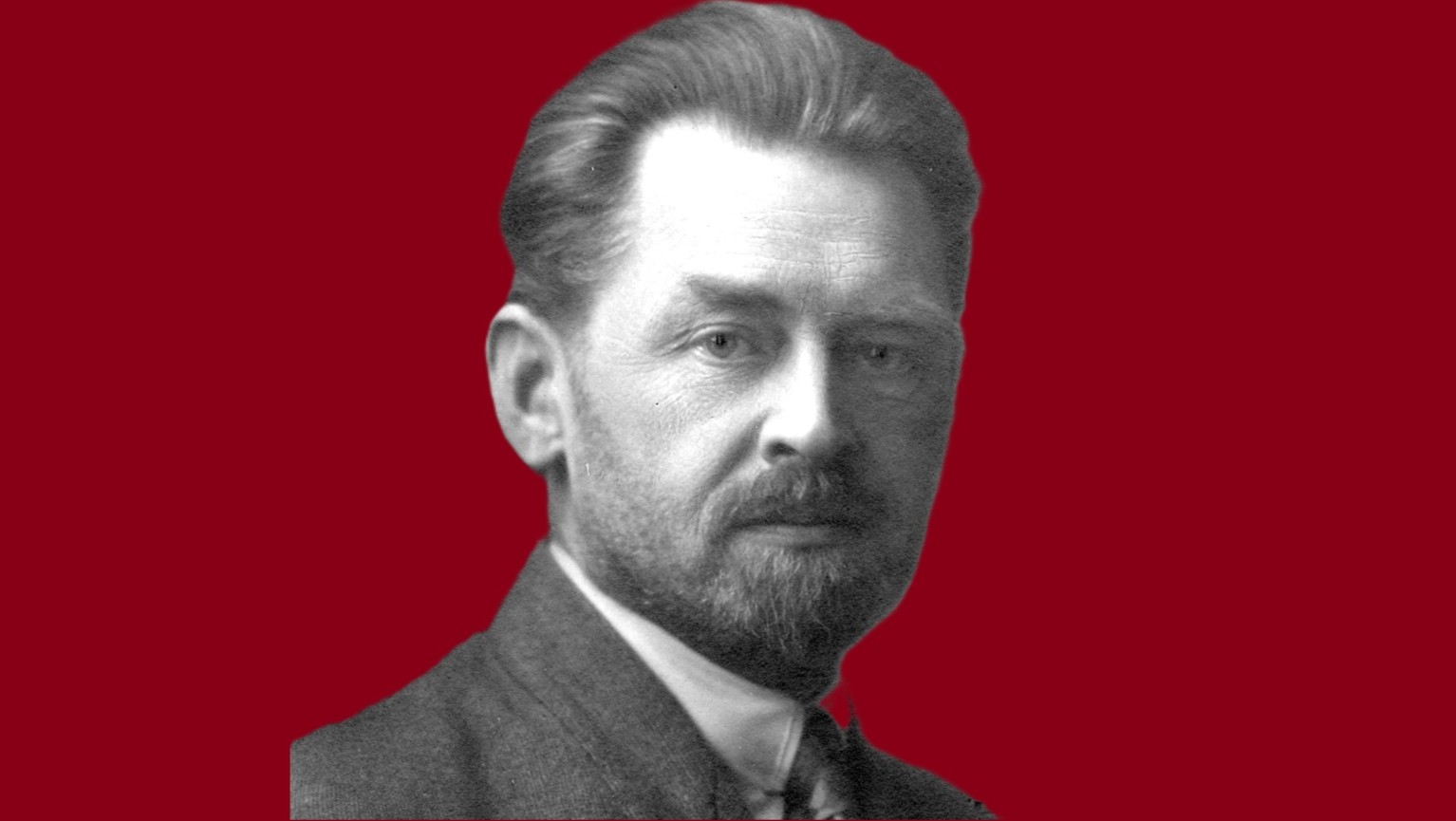
With his arrival to the States in 1915 there was no voice of the U.S. left more consistently internationalist in the face war and the collapse of the International than that of revolutionary Dutch Marxist S.J. Rutgers. Here he lambasts those who fear a ‘premature’ peace.
‘Premature Peace?’ by S.J. Rutgers from The New Review. Vol. 3 No. 18. December 1, 1915.
THERE is a general feeling among belligerent Socialists against what is called “premature peace,” a feeling that seems also to prevail in neutral countries.
In Germany, this feeling expresses itself in the demand for war until British naval supremacy is destroyed: among the Allies, it assumes the form of “War to the finish” against German militarism. And each group argues that its victory alone will liberate Europe from future wars.
Most workers will admit, that the destruction of British “Navalism” would simply give to some other nation or group of nations the power to rob the world, and that Imperialism and future wars would not cease. But there seems to be a feeling that there is a magic power in crushing German militarism. If we ask for the reasons of this feeling, we are most likely to hear great noise about Kaiserism, junkerism, absolutism, barbarism, etc., against which civilization and democracy are supposed to be fighting. By this democracy is meant the corrupt financial plutocracy of France and the hypocritical and aristocratic government of England. And although few socialists will deny that those democracies have only a slight resemblance to real, proletarian democracy, there will often be expressed a feeling, that this at least might be a beginning of something better. It seems to me, that this “illusion” is a rather dangerous one, and that it has done much to vitiate socialist opinions about the future.
Already before this war broke out, there was a tendency away from democracy. Where the form of a middle class democracy remained, there was a rapid change towards the supremacy of financial capital with its imperialistic tendencies. Imperialism, the cause of the present war, is the reverse of democracy; and, it is not likely that an Imperialistic war should end in an approach to democracy.
Whatever may be the outcome of this war, financial capital will become more dominant, with more Imperialism and less democracy. That the war will lead to the ruin of many small capitalists and to an enormous concentration of capital under control of the large bankers, needs no proof. This financial capital has the tendency to conquer the world for profits, regardless of civilization and without any scruples as to robbery and murder. Recent events all over the world prove this. And if it should happen, as some believe, that an important part of concentrated capital will be under the direct control of the state, it will but strengthen the Imperialistic and anti-democratic tendencies.
How can we expect democracy and permanent peace under such circumstances? A still more illusory form of democracy, is all that can be expected, and that would be worse than direct government by plutocracy, even worse than a capitalistic government using a feudal class in its service. The results will be the same, only it will be still more difficult for the workers to recognize the fraud and to fight it
Peace between the nations under capitalism could be possible only if the robber-capitalists all over the world combine in one organization against labor. But this situation, which would be most disadvantageous to the working class, is by no means to be expected in the near future, because there is too much difference of interests between the capitalistic groups and because there are no other means for dividing the world than power, a power that is changing every day with the changing economic development of the different nations.
In the period of commercial colonialism there could be to a certain degree, some automatic relation between the economic development of a nation and its commerce. Our modern colonial problems are in the first place problems of investments and monopolies, and as soon as there are important modifications in the relative economic power of nations or groups of nations, a new orientation is possible only by an appeal to power, which under the circumstances may lead to war.
Only in a future, much farther away than the end of the present war, can there be imagined a development of capitalism all over the world to such a degree of equality, that there would be one nation of capitalists against the workers all over the world. If socialism will prove unfit to get into power before this fatal situation will be reached, labor will most probably have to go through a series of wars of which the present war is the fearful prelude.
There is only one force, that can stop this disastrous fate, if it puts to this gigantic task the whole of its energy: the international proletariat. But then the workers need an insight into the general lines of development. There must be no optimistic idea about this war being the last war, or that only one or another nation should have to be crushed. Let us acknowledge that labor failed all over the world to oppose Imperialism with the existing national organizations, and let us learn from this defeat to resist the next war as one international organization.
From this point of view, it is not so much important what the national results of this war will be, but it is most important that the working class should not be weakened to the extent that it will be unable to perform its future task. This does not mean that the issue of the present war is of no concern to labor. But the proletariat must have its own way of fighting and cannot gain by supporting capitalistic wars. It is the same as with politics. Even if it should be a concern of labor whether the democratic, the republican or the progressive party should be victorious, this would not prevent socialists from voting their own party, whatever the direct results might be.
Labor must oppose every form of militarism, because militarism in its present state of development is one of the most important expressions of capitalist interests, the centre of imperialism. And granting that we have to fight militarism, we surely cannot stop fighting it because it assumes its most aggressive form of actual war.
Labor failed all over the world in its fight against militarism, but this should be no reason for putting our hope on the results of this war, that we vainly tried to prevent. Labor failed and surrendered to capital, but this very fact makes it rather worthless to talk about socialist peace programs, behind which there is no power and which are doomed to have no practical effect.
To regain influence, labor first of all will have to regain its class-consciousness, its fighting power against the capitalist class on the national as well as on the international field. This means to put an end to the “Burgfrieden” (civil peace) and to protest against national war in the press as well as on the street, which no doubt would result in the suspension of socialist papers and the shooting of the proletarian protestants. But at the same time the fighting spirit in the trenches would stop, so as to make peace the only possible issue.
This is the way labor could have a real influence and such a peace never would be premature. Even if this should result in a defeat of the capitalistic interests in the country where the socialist spirit should prove strongest, such a defeat would mean a big victory for Socialism. Conditions in the leading European countries have developed far enough to make it utterly impossible, that one nation should keep another as a vassal state on account of the latter being too far advanced in socialist feeling. Moreover such a spirit can only develop in mutual support, internationally.
If we expect that labor will not recover during the present war, so as to push forward its own way of forcing peace, all we can hope is, that it will immediately regain its self respect and fighting power after the war. No doubt the chances will be far better then, and the sooner we get this better chance, the earlier our victory. But for this kind of peace we cannot depend upon the battlefield and economic conditions beyond our control; and it is dangerous to cherish the illusion of power while neglecting the power labor could actually have.
New Review was a New York-based, explicitly Marxist, sometimes weekly/sometimes monthly theoretical journal begun in 1913 and was an important vehicle for left discussion in the period before World War One. In the world of the Socialist Party, it included Max Eastman, Floyd Dell, Herman Simpson, Louis Boudin, William English Walling, Moses Oppenheimer, Walter Lippmann, William Bohn, Frank Bohn, John Spargo, Austin Lewis, WEB DuBois, Maurice Blumlein, Anton Pannekoek, Elsie Clews Parsons, and Isaac Hourwich as editors and contributors. Louis Fraina played an increasing role from 1914 on, leading the journal in a leftward direction as New Review addressed many of the leading international questions facing Marxists. The journal folded in June, 1916 for financial reasons. Its issues are a formidable archive of pre-war US Marxist and Socialist discussion.
PDF of full issue: https://www.marxists.org/history/usa/pubs/newreview/1915/v3n18-dec-01-1915.pdf

