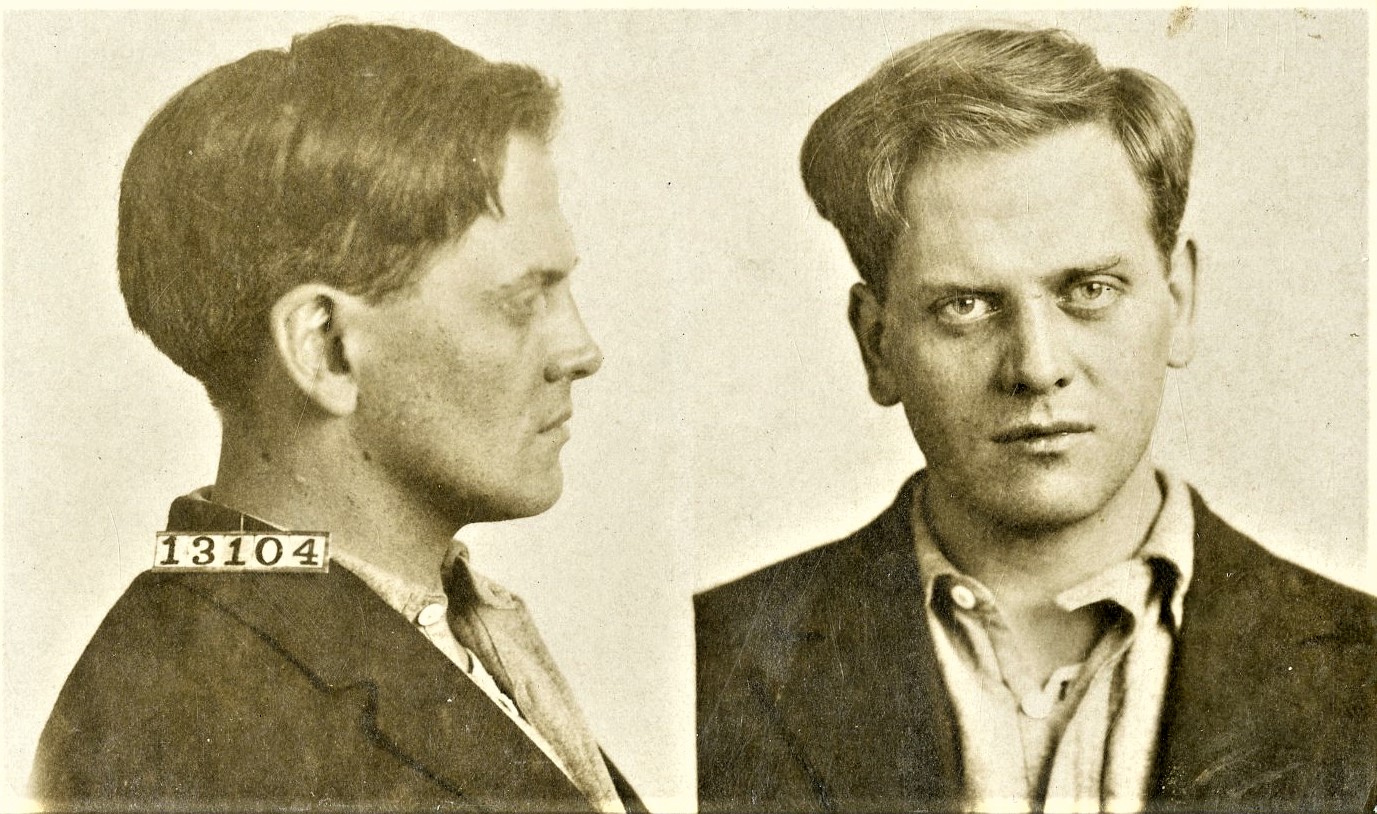
Debs, himself not long out of federal prison, denounces the ‘disciplining’ of fellow political prisoner Ralph Chaplin by Leavenworth’s sadist authorities.
‘Ralph Chaplin Disciplined’ by Eugene V. Debs from The Seattle Union Record. Vol. 5 No. 145. October 5, 1922.
The first word I had of the brutal indignity to which Ralph Chaplin has been subjected by the warden of the penitentiary at Leavenworth came to me through David Karsner’s vivid and breezy column in The Call. My blood boiled instantly. Most anything may be expected from prisons, for they are built and maintained to commit outrages against the helpless, who cannot resent them; but there is special reason for indignation on account of this particular outrage against a man who incarceration in the pestilential hole at Leavenworth is and will forever remain a damning disgrace to the government of the United States.
The vitriolic comment of Karsner upon the cowardly and infamous conduct of the warden in taking Chaplin’s paltry prison privileges from him, and reducing him to the most menial service, without the slightest provocation, is more than richly merited.
Karsner scores the cheap political hireling, Biddle by name, in temporary charge of the Leavenworth blackhole, and by contrast with Chaplin makes him appear as a gopher hole to a mountain peak; but words are inadequate to do justice to such an abomination.
Ralph Chaplin is a great-souled poet, a courageous, high-hearted fighter for freedom and justice, whose name will be written in letters of gold in the world’s history, while his keeper, one Biddle, of whom no one ever heard outside of his precinct, is a cheap-skate country editor and political time-server, of whom the best and worst that can be said is that he is fit to be the warden of a present-day penitentiary.
Biddle, of course, hated Chaplin, as all petty creatures hate the great souls that tower above them, and, having Chaplin at his mercy, he did what all petty creatures do with their brief authority by “punishing” his shackled victim, slapping his face, as it were, thereby exhibiting his innate brutality and at the same time making a perennial ass of himself.
Biddle, in his stupidity, thinks he has “punished” Ralph Chaplin by chucking him into the laundry, among the foulest dregs of the prison hole, and forbidding him to write to his wife and child. He does not know enough to know that it is beyond his power to punish a man who is true to his ideals. He is too pitifully blind and ignorant to know a man when he sees one; and, as for an ideal, it is only necessary to say that he is the warden of a penitentiary that holds Ralph Chaplin and his I.W.W. brothers, who today tower above the dome of that castle of brutality–the bravest men in America.
All that Chaplin did was to send a perfectly polite and proper telegram of inquiry in behalf of himself and associates to the pardon attorney at Washington. That is all. Absolutely all! And for this crime of daring to address a public servant the wrath of Biddle fell, and Ralph Chaplin may no longer hear from his devoted wife and child.
Now, I want to ask everyone who reads this to drop a line to W.I. Biddle, prison warden, Leavenworth, Kan., and let him know what you think of his action, and then to drop another line to the attorney general at Washington and tell him frankly what you think of a department of justice that perpetrates such a heartless outrage upon a man who is serving a sentence of 20 years for his uncompromising manhood and self-respect in standing up for his rights and the rights of his fellow citizens under the constitution of the United States.
Let them both hear from you in plain terms, for you are the people and they are your servants.
The Seattle Union Record was the paper of of that city’s Central Labor Council begun as a weekly in 1910. For most of its life the paper was edited by long-time Socialist activist Harry Ault, who had participated in the Washington State Socialist Party’s factional struggles before leaving in 1910. A progressive labor paper, the Union Record grew along with Seattle’s labor movement. Becoming a daily in 1918 it is best known as the record of Seattle’s 1919 General Strike when the print run reached 80,000 an edition in 1919. Continuing as the paper of the C.L.C. until 1924 when Ault purchased the paper, it ran until 1928.
Access to full issue: https://washingtondigitalnewspapers.org/?a=d&d=SUR19221009

