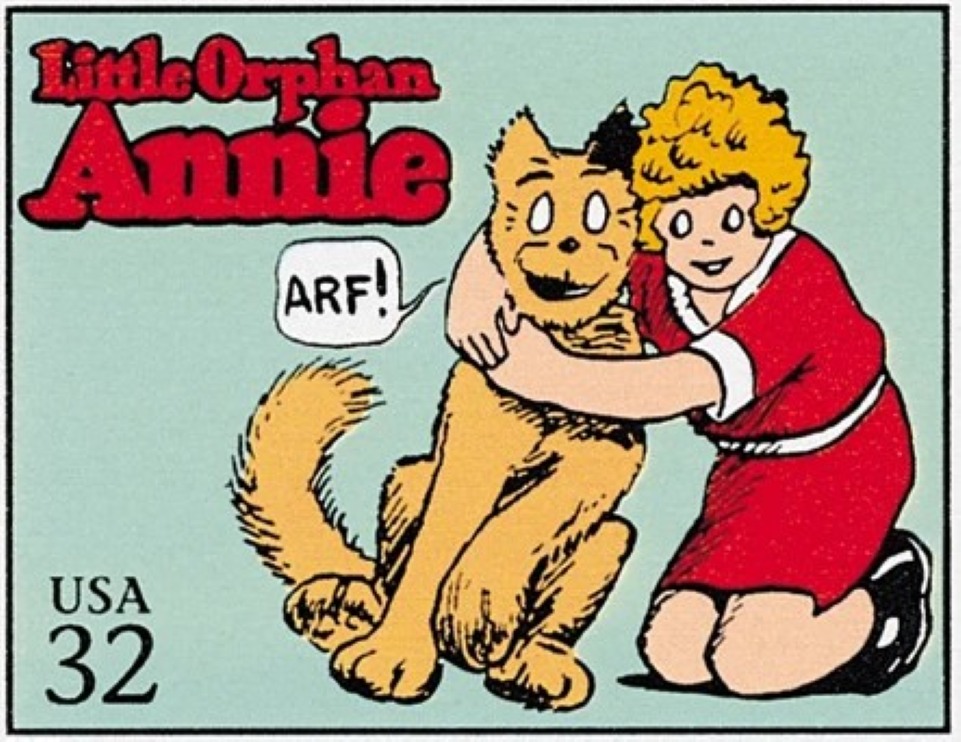
The reactionary ideology behind the ‘beloved’ cartoon.
‘Little Orphan Annie, Fascist’ by Ralph McKinley from New Masses. Vol. 18 No. 8.February 18, 1936.
HAROLD GRAY, creator of the country’s No, 1 fascist comic strip, has come forward publicly with a group of theses which should explain to those amazed by the recent antics of “Little Orphan Annie,” the ideology behind his “arts.” In the January issue of Quill, a monthly magazine for writers, editors and publishers, Mr. Gray contributes the following apothegms:
1. Comic artists have a right to express convictions. on any side of any important issue.
2. There is no use for the Newspaper Guild.
3. A man is worth just exactly what he can get.
4. Life is a battle, with victory for the brave and strong-hearted alone.
Mr. Gray, in his article entitled “I’ve Learned about Comics from Her,” frankly admits making a practice of “violating the standing rule against editorializing,” because without such “raids” Annie alone would soon pall terribly.” He reveals that contrary to a report in Time he was not told to stop editorializing and received no comment of any sort from his syndicate. Moreover, having counted on “Americanism outweighing wild-eyed radicalism in this country” he is proud to report that even if a West Virginia paper did cancel his comic strip, his list of papers jumped (“carrying my royalty checks pleasantly higher, of course”).
Mr. Gray’s method of attack, as he explains it, is more calculating than it is brave. He sets the stage for a raid for several months and then, in his own words, “sneaks up” on the main story, comes into the open and drives through “the real action” within four weeks. Then comes the sporting part. He gets “cleanly out of the way and onto safe ground before the deluge” of protest. There is plenty of protest, but those who find his anti-union propaganda objectionable are “professional protesters” and it is better not to give them a chance “to get set.”
The Gray brand of Americanism is approved and applauded by solid citizens, the artist points out, but at the same time it must be dished out “at carefully spaced intervals.”
Otherwise the protest from “little labor union headquarters” might become cumulative and of sufficient force to cause trouble.
Those unfamiliar with Gray’s exposure of “labor racketeers,” which the artist refers to in the autobiography of his rise, need study only the “Annie” release of July 17, 1935, to understand why the chronicle of “just a simple orphan kid” should have aroused “vituperative and viciously abusive mail.”
On that day in Gray’s comic strip we finds three well-bearded fanatics (the type Red-baiting cartoonists have presented as Bolsheviks ever since 1917) discussing the organization of a union of workers in the Eonite plant owned by Daddy Warbucks— to whom Little Orphan Annie is a sort of juvenile Peaches Browning, The organizers are anxious for unionization because that means “initiation fees,” “fines,” “assessments.” “We cannot even bomb the plant—” one laments, “there are too many guards.” These agitators, enlisted by a villain named Slugg, want to get Eonite away from good old Warbucks. But those who are bent on the evil of organizing the workers, take a smearing. On August 3, under the general title “The Workers Arise,” a gang of “loyal” company men dispose neatly of the Reds. Mr. Gray here demonstrates his fine Americanism. His is the Ku Klux brand of patriotism. When one of the hirsute radicals cries, “The hour has struck—the time has come to act,” a true “American” cries “I’ll say it has” and the following sentiments are heard:
“Have you got that tar boiling, Jerry?
Who’s got the feathers?
Arise, eh?
See how you like arising on that rail—:
This is just an old American custom, boys—and the organizers are promptly tarred and feathered. The incident is captioned: “Our Feathered Friends.”
The artist establishes clearly on August 8 that the imminent attack by workers who have been aroused by “fulminators” (although said workers were satisfied with working conditions on July 17 and showed their satisfaction by the use of tar and feathers five days ago) threatens not only Mr. Warbucks but all mankind, Daddy’s speech to Annie on August 8 is another lyric:
“Suppose the mob should destroy the plant and deliver the secret of Eonite into Slugg’s hands—that would mean ruin and slavery for the whole human race instead of the prosperity and happiness that I am trying to bring to all.”
However, the whole human race takes it on the chin four days later, when the mob destroys the Eonite plant and kills off old Eli Eon, the inventor, in the bargain. But the National Guard arrives to handle the situation. On the 13th the colonel of the guard, a handsome, broad-chested fellow with a mustache like that of Mr. Esquire, reports on the telephone to Daddy W.:
“There’s a little sporadic fighting—a few wild-eyed remnants of the mob still insist on having their skulls cracked—but everything is well in hand.”
And the mob which wrecked the plant is described, through Mr. Crackbrain:
“They were mad—their eyes were glazed—their faces contorted and bestial.”
Patriot Gray’s attack on the American Newspaper Guild, like his drawing and writing, has the grace and charm of a dancing elephant. “I admit complete ignorance of any use for the American Newspaper Guild,” he writes, bringing up the subject in connection with a letter he received from a Guildsman. “From my contacts with members of the Fourth Estate, a man who has what it takes doesn’t need any Guild or Union, nor will he fail to collect every dime he is worth from a delighted and grateful public.”
In the next paragraph come other deft epigrams, one right after the other:
“I have always felt, even passing through the $15-a-week stage, that a man is worth just exactly what he can get. No Guild on earth can make a stupid reporter brilliant, or even capable and self-reliant.”
The axiom that a man is worth what he can get heaps kudos on Al Capone and—makes Jesus Christ look like a piker, because he got practically nothing.
While your friend McKinley doesn’t know about all the Guilds on earth, as a member of the American Newspaper Guild he can’t recall a single instance wherein the A.N.G. promised to make a stupid reporter brilliant, or even capable or self-reliant. As a rule, stupid, incapable and unreliable reporters are not in a position to join the Guild, since such men are not ordinarily hired or maintained by bright executives.
That victory-for-the-brave Gray should openly announce his intention of continuing to malign the labor movement at carefully-spaced intervals and that he could boast of his syndicate’s silent approval of his editorializing, should be of interest to all unions, editors, reporters and even some publishers. Maybe this time the professional protesters can “get set” for Mr. Gray.
Already the Springfield, Mass., Guild is set for Daddy Warbucks and the little orphan girl. The Guildsmen in that city took Gray’s Quill article to the editor-in-chief of The Springfield Republican, in which the comic strip is appearing. Said the editor: “Thank yous” I’ll watch the strip carefully in the future.” But the Guild is pressing to have the strip removed on the strength of its past record, plus Mr. Gray’s credo.
Those who find Annie poorly drawn and devoid of anything resembling humor, should not conclude that the artist can’t be funny. He can, even without trying. In a concluding paragraph to his success story in the Quill, Mr. Gray writes:
“Whatever else I may ever attempt to do with the strip, you may be sure it will always remain clean and decent.”
That’s very funny, Mr. Gray.
The New Masses was the continuation of Workers Monthly which began publishing in 1924 as a merger of the ‘Liberator’, the Trade Union Educational League magazine ‘Labor Herald’, and Friends of Soviet Russia’s monthly ‘Soviet Russia Pictorial’ as an explicitly Communist Party publication, but drawing in a wide range of contributors and sympathizers. In 1927 Workers Monthly ceased and The New Masses began. A major left cultural magazine of the late 1920s and early 1940s, the early editors of The New Masses included Hugo Gellert, John F. Sloan, Max Eastman, Mike Gold, and Joseph Freeman. Writers included William Carlos Williams, Theodore Dreiser, John Dos Passos, Upton Sinclair, Richard Wright, Ralph Ellison, Dorothy Parker, Dorothy Day, John Breecher, Langston Hughes, Eugene O’Neill, Rex Stout and Ernest Hemingway. Artists included Hugo Gellert, Stuart Davis, Boardman Robinson, Wanda Gag, William Gropper and Otto Soglow. Over time, the New Masses became narrower politically and the articles more commentary than comment. However, particularly in it first years, New Masses was the epitome of the era’s finest revolutionary cultural and artistic traditions.
PDF of full issue: https://www.marxists.org/history/usa/pubs/new-masses/1936/v18n08-feb-18-1936-NM.pdf

