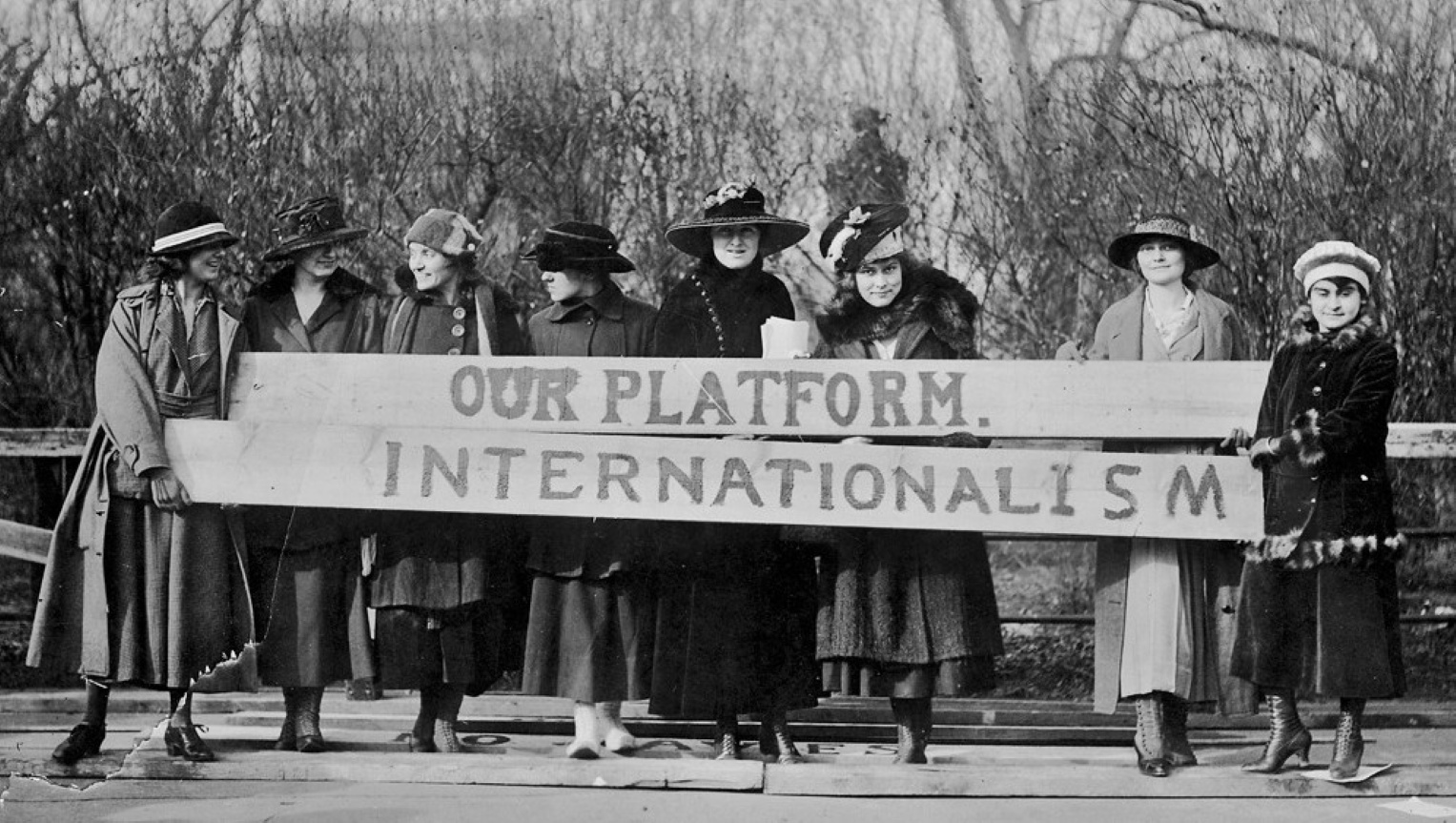
Bruce Rogers with an internationalist critique of the S.P. national leadership on the question on the war and reasserts the internationalism fundamental to the Socialist project. A leftwinger in the Washing State Socialist Party, which he served as State Organizer, Rogers was a labor lawyer who made his position clear on the S.P.’s anti-industrialist turn in 1912 by regularly defending I.W.W. activists.
‘Internationalism Most Necessary Quality of the of the Revolution’ by Bruce Rogers from The Northwest Worker. No. 264. January 27, 1916.
No sooner had the great war in Europe begun than it was echoed by a great detonation and war of words in this country. This monotonous combat of words had but fairly commenced when the sickly realization stole over us that had our party in America faced a similar crisis it would have played as sorry and humiliating a role as did our party in Germany, in Belgium, and in France. Our “leaders” here, not being under the stress and madness of actual blood conflict, failed as ignominiously as did our “leaders” there who were under much more severe test.
At once it became evident that our anti-war program and our anti-militarist propaganda was of the coinage of middle-class sentimentalism and ideals, if not actually of middle-class national interests. From Mr. Morris Hillquit, our greatest herder of sheep, came the nationalist heroic, “A workingman has a country even before he has a class,” etcetera, ad nauseum.
In all this confusion there was one paper whose voice rang true and clear above all the clash and clangor of the war and its echoes. That paper was and is our own Northwest Worker. It sounded the clear note that labor the wide world over is already invaded, torpedoed, marauded, and that as between the capitalist governments the working class has no choice and should have no preference. All bosses look alike to the class-conscious wage slaves. Socialists advising the class of a particular government in the matter of war and militarism make a disappointing spectacle. War is not apart from capitalism, but is an integral phase of capitalism itself or of any other competitive social order. In short, war is the ultimate word of competition. The function of every movement on earth is to manage the larger affairs of its particular capitalist class, and it is the plain duty of all such governments to arm to the teeth and to prepare for war with all possible haste, else expect to be wiped off the map. But the working class of any particular government can have no part so long as its dominion is capitalistic. In all such governments the workers are subjugated to the uses of its capitalists. They should take no concern with the military or other troubles of the government, unless to regard its distress as their special opportunity to rebel. One government is not better or worse in the long run than the others so far as labor is concerned, although conditions of living do vary, due to other causes. The world today is one large prison for labor and the governments may be looked upon as but so many sections of the same huge prison wall. Com. Untermann ought to see that if the workers broke down one place in this wall the other governments would instantly repair it that its own workers might not escape. The Socialist, no matter how learned or sincere he may be, who imagines that “Socialism can come” in any one of the intertrading nations without “coming” in all at or near the same time, most pitifully deludes himself. You might as well try to make an acre of a salt ocean fresh.
It follows that internationalism is an indispensable fundamental of our movement.
Without it ours would truly become as a house of cards and the usefulness of our party to the workers would be at an end. Revolutionary Socialism under one name or guise and another already forms an inter-nation, staggering and wobbly on its pins, but just the same an inter-nation and the sole hope of labor. “Workers of the World Unite!”
But how shall the workers fight and prepare to fight the common invader, capitalism? On the pacific or political field we should make good use of such political means and occasions as we have available, never deluding ourselves and never forgetting that they are the chief means of the bourgeoisie. But directly, on the violent field, the actual field of our existence? I would arm myself against a thug or a wolf and feel it the proper thing to do to kill, but to arm as a class and expect to win, never. It is impossible and ridiculous to conceive. We could have no concert of action and it would all mean that we would simply be hunted and shot like beasts. It would be the signal for bloody pogroms the like of which have never been, and right royal sport it would make.
No, I can think of nothing more preposterous than that revolutionists will shoot capitalism to pieces and shoot Socialism into the world. But how shall the workers fight and in what manner shall we proceed? Organize industrially, internationally, as well as politically, to be able to enforce the political changes we contemplate, and then–(I am forced to delete the balance of this thesis because of Article 2, Section 6 of the Socialist “National” constitution. Bruce Rogers.)
The Washington Socialist was a weekly newspaper of the Socialist Party of Snohomish County published in Everett, Washington and edited by Maynard Shipley, the paper ran for only 18 months when it was renamed The Northwest Worker with Henry Watts as editor in June, 1915, and again Co-Operative News with Perter Husby as editor in October, 1917. Like virtually all of the left press, the Co-Operative News was suppressed in June 1918 under the Federal Espionage Act.
PDF of full issue: https://washingtondigitalnewspapers.org/?a=d&d=NORWWORK19160127

