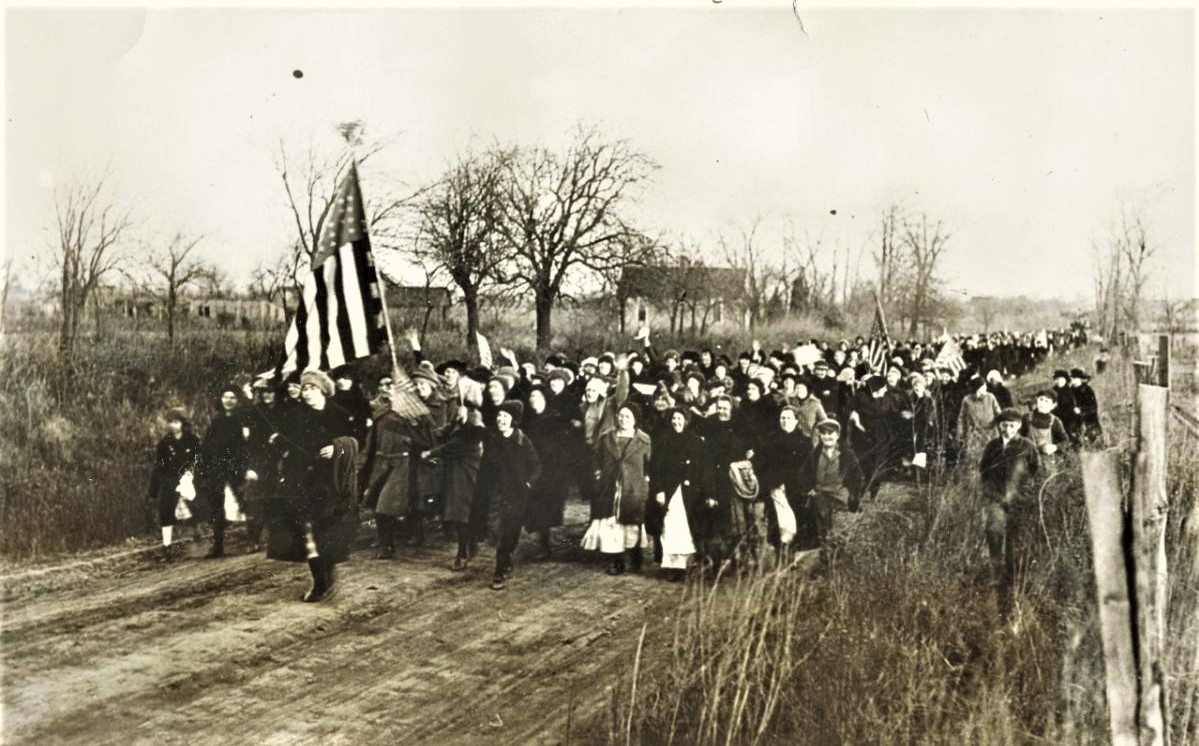
Mass dawn raids by U.M.W.A. women shut down Kansas’ scab coal mines in a day. The heroic story below.
‘Kansas Women Close Coal Mines’ by Art Shields from The Seattle Union Record. Vol. 4 No. 203. December 19, 1921.
PITTSBURG, Kan., Dec. 14. The greatest women’s raid on strikebreakers which American coal fields have witnessed since the dramatic struggles in the anthracite fields 25 years ago, took place in Alexander Howat’s district this morning when 2,000 wives and daughters of the strikers drove all the strikebreakers out of the eight mines which the operators were attempting to start up under the provisional government set up by International President John L. Lewis.
It was a raid, or rather a series of raids, that will go down in the labor history of Kansas, never to be forgotten. It will go down as the turning point in one of the most class-conscious strikes that have ever been called in America–a strike not called for shorter hours or more wages but for the freedom of two men who would not sign away the rights of the workers who elected them.
Every strikebreaker is now swept out of the northern half of the district since the women’s raids began Monday morning, and the women say that the district will be entirely swept clean by the end of the week.
Tuesday’s coup was carried out with amazing suddenness, yet it was carefully organized. Every division of the army knew where it was to go and what it was to do.
The first center of attack was the string of five mines owned by the Central Coal & Mining Company near Ringo, Crawford county. These mines are the key to the northern half of the district. They normally employ 1,000 men, and had been entirely shut down till three weeks ago, but by Tuesday morning the number of strike-breakers had grown to 150, largely imported from other states.
Arriving there in the darkness before dawn, in hundreds of automobiles provided for the purpose, the women mobilized into two main divisions and three smaller ones. The two larger bodies stood guard at mines 45 and 51, where most of the work was being done, and the rest scattered along two miles in front of the other three miles owned by the company.
They were a picturesque looking crowd in their shawls and cloaks of half a dozen European nations and native Kansas, when Sheriff Hilt Gould and his deputies came on the scene about 5:30.
A woman waving one of the many American flags in the crowd led the cheers for the sheriff and invited him to stay and watch them protect their husbands’ jobs.
Just keep off the company’s land,” broke in the sheriff.
A big French woman laughed and assured him in broken English that God made the land, not the company.
Then the first interurban car of the morning came up and 50 men alighted, swinging the dinner buckets that carried the meals they intended to eat underground.
“Ah, the scab! Lewis’ traitors!” cried hundreds of voices, and the next moment you couldn’t see overalls for petticoats.
Things happened fast then. The first man to break away, minus his hat, was seen to reach for his hip. Touch that gun and you die,” shouted a miner escort nearby–one of several hundred.
The next moment a woman tripped him up and he was disarmed, pleading that he had not intended to use it. Every strikebreaker before he was released was thoroughly searched, and several revolvers and a good many knives were found. Every dinner bucket was taken away for fear that weapons might be concealed within.
The men were finally paroled on their promise not to do any more work in District 14 till the strike was over.
Down at the other mines Just as effective work was done. The women split into three directions. One set of 800 motored to the Sheridan Coal Company, 10 miles away. The whistle of No. 19, the only one of the eight working, was blown, and when the men came to the top to see what it was all about they were likewise captured and paroled. Another group shut down operations near the Weir Fuel Company in like manner. A third division took care of three strip or surface mines. Altogether 350 strikebreakers were separated from their jobs in the two days, leaving less than that number still remaining to be handled. Latest reports were that many of these men were quitting of their own accord without waiting for the militant ladies.
The miners are triumphant, but the operators and the rival union officials who are abetting strikebreaking program on theory that this is an “outlaw” strike are nonplussed at the direct action tactics that have turned the tables so completely.
The Seattle Union Record was the paper of of that city’s Central Labor Council begun as a weekly in 1910. For most of its life the paper was edited by long-time Socialist activist Harry Ault, who had participated in the Washington State Socialist Party’s factional struggles before leaving in 1910. A progressive labor paper, the Union Record grew along with Seattle’s labor movement. Becoming a daily in 1918 it is best known as the record of Seattle’s 1919 General Strike when the print run reached 80,000 an edition in 1919. Continuing as the paper of the C.L.C. until 1924 when Ault purchased the paper, it ran until 1928.
PDF of full issue: https://washingtondigitalnewspapers.org/?a=d&d=SUR19211219-02

