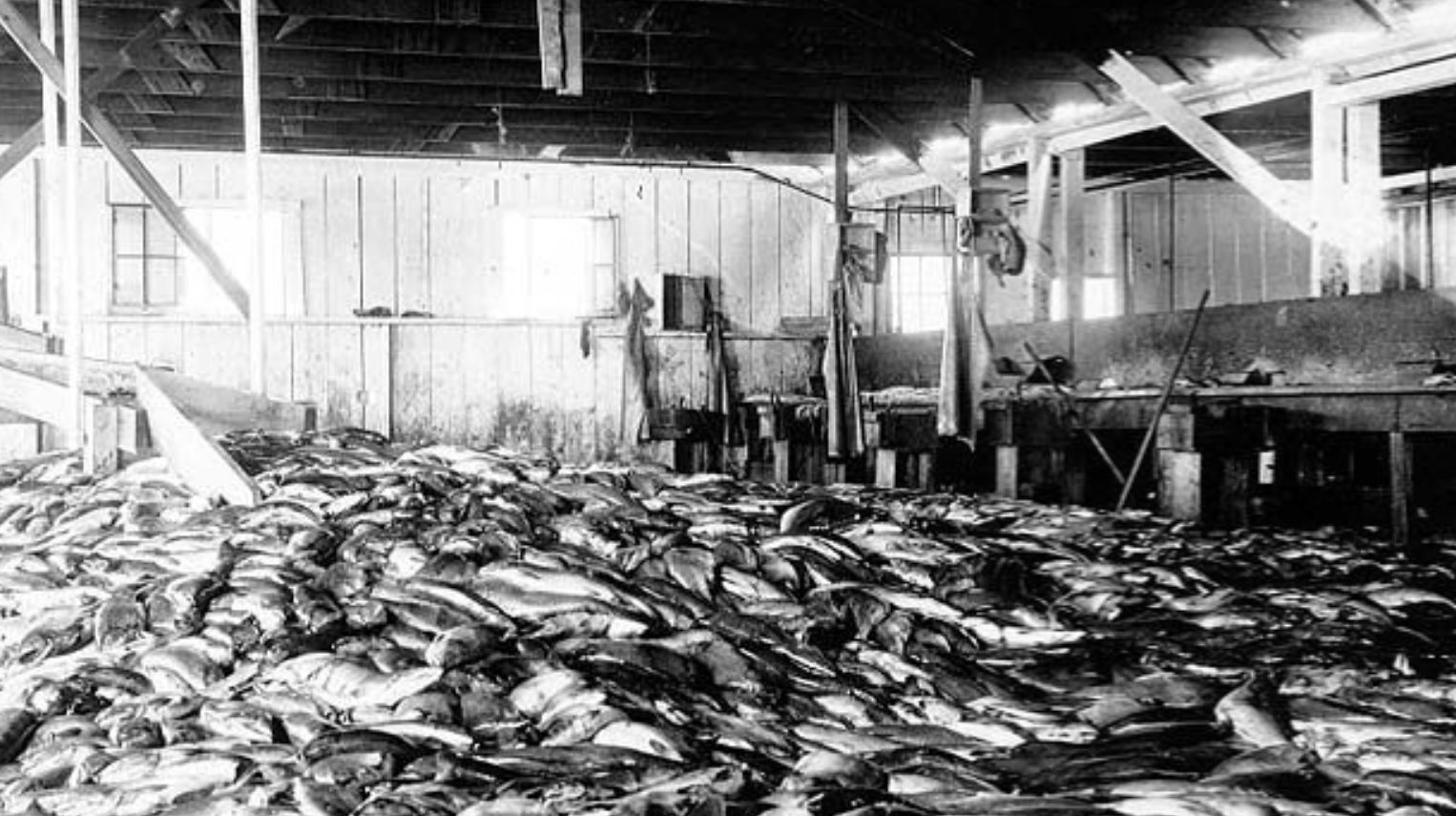
A look, by the numbers, at the canning industry and its mostly Native workers as it was in Point Ward, Alaska during the 1924 season.
‘Salmon Measured in Terms of Labor’ by Fred Mariner from Industrial Worker. Vol. 6 No. 43. August 2, 1924.
POINT WARD, Alaska. A salmon boat came to the cannery here with an unusually large catch of fish. Their catch tallied 2500 fish. The “Mary Malony” also came in this morning with a catch of over 3,000. The salmon catch this year is far below that of last year. Some days the fishermen do not average over 200 fish.
These fishermen are paid at the rate of 8 cents per fish. The boat and fuel is furnished by the cannery operator. But out of their financial returns, the fishermen must buy their food and clothing. The boat affords them with shelter.
In the actual canning of the salmon mostly native labor is employed. A few Filipinos are also employed here, but they have no part in the work of canning. Of the employed native help, women are the majority. They are paid at the rate of 35 cents per hour. Ten hours is the length of their work day; the same for all other help. When the canning machinery is not in operation, the women are idle; they receive no pay for their enforced idleness. The Filipino labor is paid on a monthly scale. Other work is found for them when the machinery is not in operation so that they are not idle (as is the case with the women) during the ten hours.
One woman is employed to cook for about six foremen. She is paid $85 per month with board and lodging furnished. Two firemen are also employed. They receive $125 per month, board and lodging included. Their work day is ten hours. A few white women are also employed, and they receive the same pay as the natives. (There is no difference in the pay of the whites and the natives in this cannery or in any other cannery in Alaska.)
When this cannery is in operation the entire day it can produce approximately 500 cases of canned salmon. But if the work of labeling the casing was done at the same time, it would only amount to about 200 cases. But this work is done, as stated above, by the Filipinos when the machinery is idle.
The cannery has not, until this year, been in operation since 1921. The present operator has leased it for the season. No other employment is within 50 miles. Point Ward is about 50 miles from Petersburg or Ketchikan.
It would be interesting to note that it requires about five average size salmon to fill a case of 48 cans of one pound net each. The operator receives $4.75 per case from the jobber. In retail stores the same salmon may be purchased for about 25 cents per can.
Sanitation is a thing overlooked at this particular cannery. The floors are scrubbed once each season and then it is only done with salt water. Occasionally oil gets into a can of salmon when the machinery is oiled. The actual salmon season is only two months long, but from the time the cannery opens until it closes about four months will have elapsed.
The Industrial Union Bulletin, and the Industrial Worker were newspapers published by the Industrial Workers of the World (IWW) from 1907 until 1913. First printed in Joliet, Illinois, IUB incorporated The Voice of Labor, the newspaper of the American Labor Union which had joined the IWW, and another IWW affiliate, International Metal Worker.The Trautmann-DeLeon faction issued its weekly from March 1907. Soon after, De Leon would be expelled and Trautmann would continue IUB until March 1909. It was edited by A. S. Edwards. 1909, production moved to Spokane, Washington and became The Industrial Worker, “the voice of revolutionary industrial unionism.” A victim of finances and internal disputes, the IW ceased publication in 1913, only to be revived in 1916 and surviving as a weekly, sometimes more, until 1931. Easily among the most important working class newspapers in U.S. history and an essential resource on the wobbly, and larger radical labor experience.
PDF of full issue: https://washingtondigitalnewspapers.org/?a=d&d=IWW19241115

