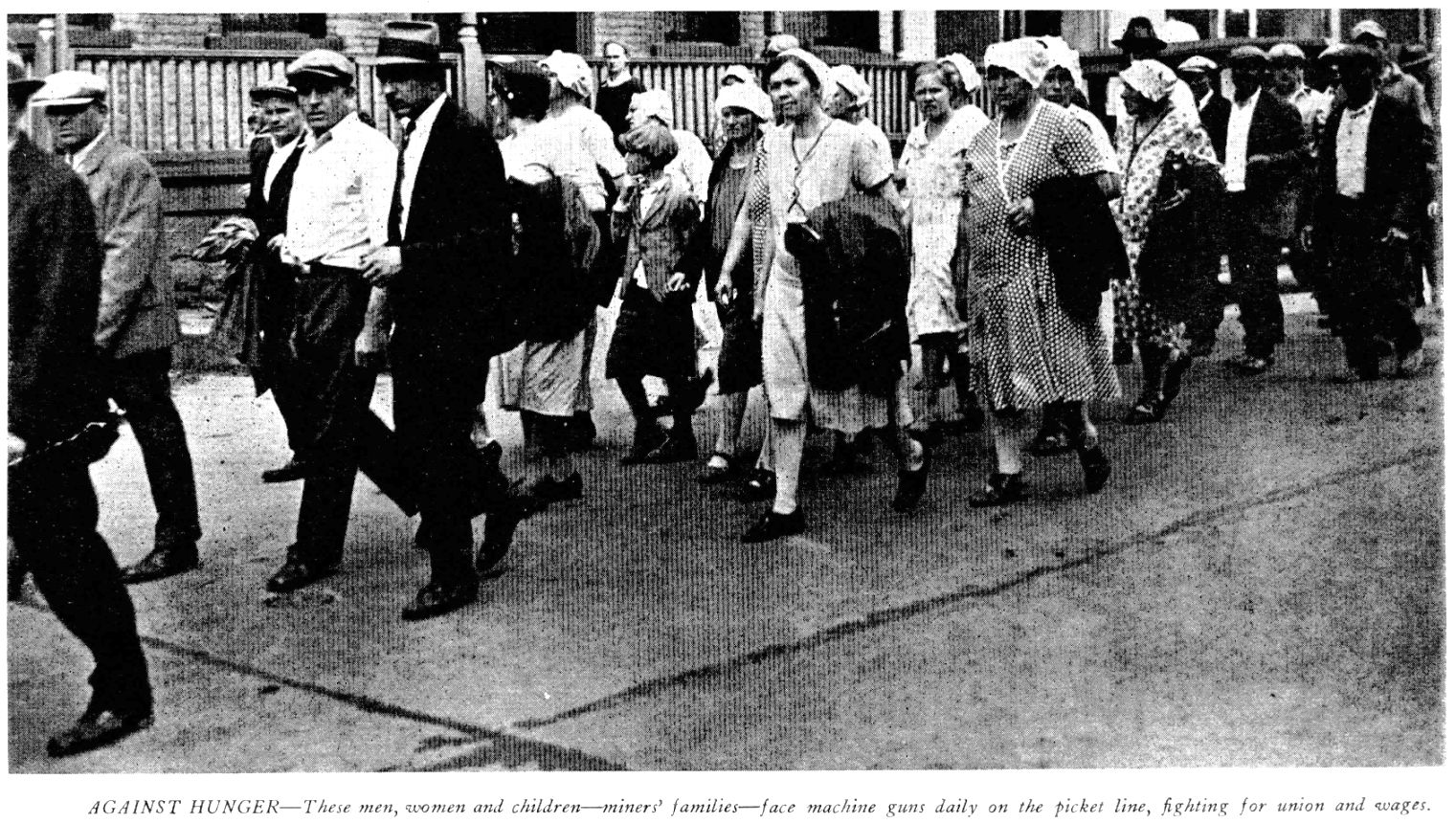
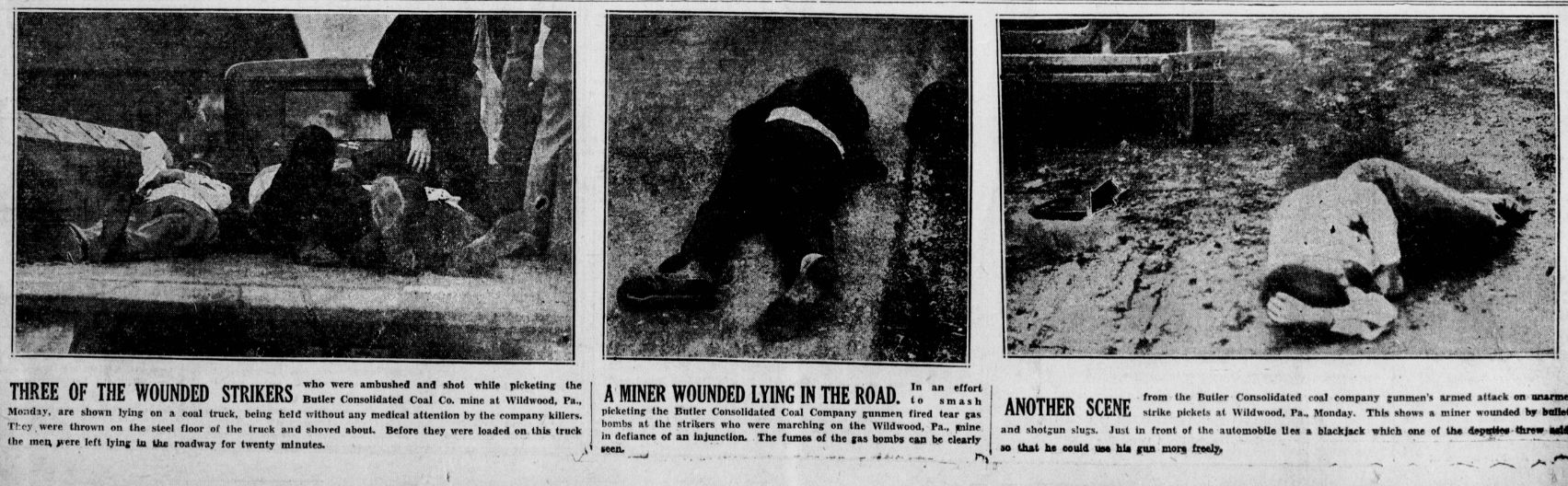
Police fire into a crowd of striking workers at the Bulter Consolidated Mine on Wildwood Road in rural Allegheny County on June 22, 1931 killing 46-year-old Yugoslav-born Spiro ‘Pete’ Zigaric and wounding others. The strike saw a split between the U.M.W.A. and the T.U.U.L.’s National Miners Union with the U.M.W.A. abetting, and sometimes carrying out, assaults, including murder, on the ‘Red Union.’
‘The Wildwood Massacre: Blood on the Coal’ by Vern Smith from New Masses. Vol. 7 No. 2. July, 1931.
Six hundred pickets of Wildwood mine of the Butler Consolidated Coal Co. were marching this morning to picket the mine. They were coming up the road approaching the company property but not on it, and with the post office and company store in sight.
Without a word of warning, about 30 deputized mine guards, guards who were not deputized, and petty officials of the company, opened fire on them with pistols, machine guns, sawed off shot guns, and “pump guns.” The killers were in ambush in the post office, in the store, and in the bushes alongside the road.
At the same time, clouds of tear gas from bombs thrown by the gunmen spread over the road. And shots continued to volley into the masses of strikers choking and stumbling in the haze of gas. Nearly 200 shots were fired into this crowd of unarmed men, women and children. One man, Peter Zigaric was killed, four are seriously wounded. The wonder of it is that the crowd stood fast, with men and women falling right and left, and answered the hail of bullets with another hail of stones; they stuck in the unequal battle for fifteen minutes, and then were broken. The Butler Consolidated, most mechanized mine in the world, was strike breaking in the same efficient manner it mines coal, and with the same disregard for the lives of its miners.
Butler consolidated got out the first injunction in this strike of 40,000 men in three states. The injunction prohibits picketing even on the public highways, and prohibits advising any one to either strike or picket. The capitalist press here, which now publishes the news of the Wildwood massacre with headlines like this: “Foster Leader of Wildwood Attack—Eight Strikers, One Deputy Injured In Exchange of Shots,” hailed the injunction as “the most drastic and wide-reaching ever used in an industrial conflict.”
The miners think so too. Five thousand met Sunday, the day before the picketing at Wildwood, and they met on historic ground. They met in the same field at Cheswick, where on August 22, 1927, thousands gathered to protest the execution of Sacco and Vanzetti, where state troopers gassed, clubbed and shot them down, where one trooper was killed by his immediate victim, and the Cheswick and Accorsi cases resulted.
They met not far from Wildwood, and cheered Foster’s speech, which pointed out that this is a strike against starvation, a life and death battle, and strikers simply can not permit the right to strike to be taken away.
These thousands pledged to march on Wildwood, and they were marching, although the roads in all directions were barred with machine guns. But the first contingent, from Wildwood itself, was the one that was ambushed.
Now scores of Pinchot’s state troopers are on the scene, and any future killing in this section will proceed under the direction of that most “progressive” governor.
This strike, covering Western Pennsylvania, extending into central Pennsylvania, eastern Ohio, and northern West Virginia, with an outlying post in the 2,000 striking at West Frankfort, Ill. is a fight for wages by men who have been getting no wages at all. Thousands of pay slips show that every cent made by the miner at 30 to 40 cents per ton of machine coal, goes for his food, rent, lodging, and clothes, which the company sells him. He works in actual peonage. Now he demands 55 cents a ton, in cash, not company money good only in the company store.
The strike started about June 1 the first miners around Avella walking out against further cuts in wages that have already been cut seventy per cent in the last two years. It is a strike against starvation.
It is not a strike led by the United Mine Workers of America. Hated even more than the operators, the “yellow dog” (deputies) or the coal and iron police of the companies, are the “organizers” of the U.M.W. Pat Fagan, Pittsburgh district president of the U.M.W. and the international office of the U.M.W. hold conferences under the protection of Governor Pinchot to make scab strike-breaking agreements in the name of the miners, and the miners send such a loud voiced committee to denounce the attempt, that the U.M.W. and the operators have to retreat, to wait, to try to corrupt first.
Fagan went two days ago without his gunmen to California, where the Vesta mines are, and the women of the miners’ families chased him out with their brooms.
Fagan came with four state troopers and four carloads of privately hired gunmen to his own home town, Castle Shannon, where there is a struck Pittsburgh Terminal mine. None came to hear him, but a crowd of 1,000 men, women and children marched on him, and stoned him out of town, with a cut face and his automobiles smashed with rocks.
This is not a U.M.W. strike, with passivity, expulsions of militants, and a sell-out at the end. This strike is led by the National Miners Union and the Central Rank and File Strike Committee, a delegated body of over 300 representatives of local strike committees. It is a strike of heroic efforts, of ten and fifteen mile marches. Today’s shooting was not the first: seven men have been shot already, all miners, and four of them were shot by the state troopers. Ninety percent of these strikers voted Pinchot into office—let him come and ask them for votes again!
The strikers will not be terrorized, they will spread and consolidate their strike. Yesterday there were mass meetings which prepared marches that brought out five new mines on strike today. This is what they are like:
Yesterday I attended a meeting of strikers of Vesta Coal Co. Mines 4 and 6, held on the grass and under the trees of a hillside overlooking the little mining town of California and the Monongahela River. There were about 1,200 of them, mostly men but with a sprinkling of women and children.
Rank and file speakers, one after another, a Negro, a woman among them, rose and pledged the crowd, amidst applause, to march the next day on Vesta No. 5, ten miles away. Trucks would come through California at two o’clock in the morning to carry part of the pickets up near Vesta 5. From two other directions, similar marches were to descend on Vesta 5. With the exception of Vesta 8, a small mine down near the West Virginia border, Vesta 5 with its 1,600 men at work, was the only unstruck mine of this company. (It may be noted that we have just been telephoned that 800 struck at Vesta 5 this morning when they saw 2,000 pickets there).
“This strike is no vacation and no picnic; you can’t stay in bed until eight or nine o’clock and win it,” say the speakers, scolding the laggards. “A good striker is on the picket line every morning and every evening,” they say.
“The sheriff forbids women and children from picketing, but they must picket with the men,” says the woman speaker. “The woman’s place is at the battle front with her man, for this is her strike no less than his.
“Don’t believe Pinchot when he says he is a progressive, the friend of the miners,” say others. “Pinchot says he will dissolve the coal and iron police, but he sends in more state troopers, and they are as bad as the yellow dogs!”
“Worse!” shouts the crowd.
Such meetings are taking place all over the coal fields particularly on Sunday. They mobilize for the supreme effort on Monday, but the fight goes on ceaselessly every morning the mines try to work.
A special crew to go into West Virginia is organized. The relief and defense committees are built up and strengthened. Arrangements are made to get the necessary trucks, to borrow them locally, for these strikers, leading their own struggle, under the leadership of the National Miners Union and their own strike committees, local, sectional and central.
This is the spirit that wins, and guns will not stop these men. Starvation, if it lasts long enough, may. There is the greatest need for, relief. The Pennsylvania-Ohio Striking Miners Relief Committee is organized, with headquarters at 611 Penn Ave., Pittsburgh. There must be the fullest response to its collections in all the large cities. Food, clothing and money are needed. The miners have been half starving since 1927 they are actually starving now.
Pittsburgh, June 22, 1931.
PDF of full issue: https://www.marxists.org/history/usa/pubs/new-masses/1931/v07n02-jul-1931-New-Masses.pdf

