U.S. imperialism’s Monroe Doctrine of hemispheric rule.
‘Our Own Little League of Nations’ by Manuel Gomez from Workers Monthly. Vol. 4 No. 8. June, 1925.
We have our own little League of Nations in the western world, with the Monroe Doctrine as its unratified but effective “protocol” and the U.S. government as supreme council, court of arbitration and police force rolled into one. Membership is obligatory for all Latin-American nations. The requirements are simple: unqualified submission to American imperialism.
It would be superfluous to dilate on the manifest advantages of this cozy little association. The beneficiaries are strictly limited but their gains are all the more abundant. Anybody in Wall Street can talk about them in glowing terms.
Take the case of Tacna and Arica for instance. For 45 years Chile and Peru have been at loggerheads over these two provinces, which Chile seized from Peru following the war of the 80’s. The treaty of 1883 provided for a plebiscite within ten years but the plebiscite was never held: instead, Chile simply moved in, bag and baggage, carrying out a systematic policy of deporting Peruvians and importing Chileans.
What has all this got to do with Wall Street? Very simple. The financiers who control our government followed their time-honered policy of playing one nation off against the other. War preparations were speeded up. Costly armaments were disposed of to both nations by our munitions manufacturers. Military and naval “advisers” were kindly lent by our government, which having dispatched a fulsome corps of officers to Peru could scarcely do less for Chile. Diplomatic “influence” was exerted by our state department, amiably but decisively, in the well-known spirit of the Monroe Doctrine. Finally it appeared that the United States had so successfully insinuated itself into things that the dominant factor in the Tacna-Arica situation was neither Chile nor Peru, but Wall Street.
American Envoys Seized Advantage.
“The idea of arbitration,” says Barron’s Financial Weekly, “began to be harbored at both Santiago and Lima, where the American ambassadors quickly took advantage of the improved outlook. Secretary Hughes immediately dispatched notes to the two governments, offering to welcome their representatives in Washington to the end that such representatives might settle existing difficulties or arrange for their settlement by arbitration.”
The invitation was not an invitation but a command. In due course the representatives arrived in Washington. But they were not prepared to abdicate their authority entirely. The above-quoted financial weekly declares that “the disputants, having at their disposal the great prestige and efficiency of the United States department of state (!) chose to limit its co-operation to an interpretation of one article of the Ancon treaty, signed in 1883.” Proving that while Latin-Americans may fail to appreciate the value of Yankee prestige and efficiency, they still have some sense left.
No Appeal from Coolidge!
But what are such diplomatic reservations in Our Own Little League of Nations? President Coolidge decided that a plebiscite must be held in Tacna and Arica and forthwith appointed General Pershing to take charge of carrying it out. Peru’s protests were overruled with the curt reply that there could be no appeal from the decision. The plebiscite committee will meet in Tacna on Sept. 4.
Of course the plebiscite will favor Chile, which has been in possession of the territory for 45 years, has had complete control of press and schools and has to a considerable extent displaced the original Peruvian population by Chileans. But, as usual, the real beneficiary is Wall Street. Just as American policy in relation to Mexico is dominated by the consideration of oil, so American policy in the south Pacific Coast area is determined by copper and nitrates. Chile is enormously rich in nitrates, her territory yielding $173,000,000 worth of nitrate of soda yearly, which is 95 per cent of the world’s mined supply. And the nitrate properties are controlled by Americans. The existence of this profitable mineral and its control by Americans has been the source of all the trouble between Peru and Bolivia on the one hand, and Chile on the other. American interests actually precipitated the war of 1879-82 which gave the nitrate fields, to Chile and which started the feud over Tacna-Arica. The nitrate fields are situated in the north of Chile, in territory which she took outright from Peru and Bolivia in the war. Tacna-Arica lies still further to the north. It contains no nitrate, but it does contain the port of Arica, connected with the nitrate fields by direct railroad line, and a natural shipping center for nitrates.
How the War Started.
War broke out between Bolivia and Chile in 1878 following the refusal of the American-owned Chilean Nitrate Co. to pay the duty levied by the Bolivian government of 10 cents on each hundredweight of nitrate exported from Antofagasta. Peru was drawn in as an ally of Bolivia. In this simple way did the American nitrate magnates solve their “taxation problems.”
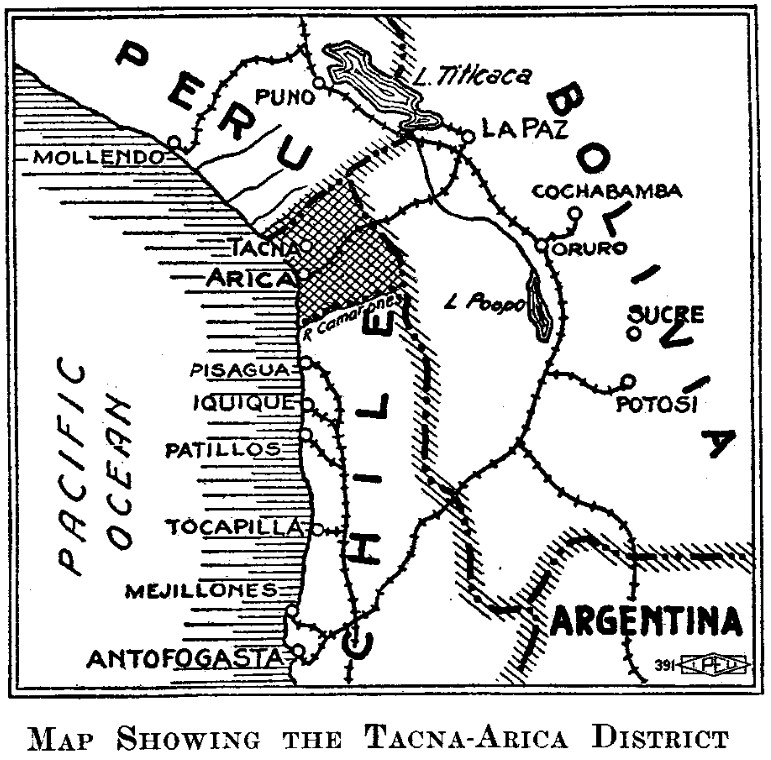
But American policy is many-sided. Peace has its victories no less than war. The United States now steps forward as the amiable pacifist, earnestly desirous of arbitrating between “the turbulent Latin-American nations.” And all because Arica is a most important nitrate port, intimately linked up with the “Chilean” nitrate industry—so intimately that it would be a shame to have to pay an additional export tax, as would perhaps be the case if Arica should belong to Peru! Which explains President Coolidge’s decision.
More serious than the decision itself is the implication that goes with it—the assumption of absolute authority over all the nations of the western hemisphere. The Monroe Doctrine licenses everything. Only the feeblest pretense is kept up that this doctrine is now maintained to protect Latin-America against Europe. The Monroe Doctrine is the theoretical cornerstone of American imperialism, and all Latin-America knows it.
United Front Against Wall Street.
In weakly accepting the interference of the United States government in their affairs, the governments of Chile and Peru committed treason to the peoples of their respective countries. What is needed is not the dictates of a supreme arbiter which sets one nation against the other with the ultimate purpose of enslaving them both in its own private little league of subject nations, but an appeal to the solidarity of the Chilean and Peruvian peoples to join hands against the common exploiter.
The Workers Monthly began publishing in 1924 as a merger of the ‘Liberator’, the Trade Union Educational League magazine ‘Labor Herald’, and Friends of Soviet Russia’s monthly ‘Soviet Russia Pictorial’ as an explicitly Party publication. In 1927 Workers Monthly ceased and the Communist Party began publishing The Communist as its theoretical magazine. Editors included Earl Browder and Max Bedacht as the magazine continued the Liberator’s use of graphics and art.
PDF of full issue: https://www.marxists.org/history/usa/culture/pubs/wm/1925/v4n08-jun-1925.pdf

