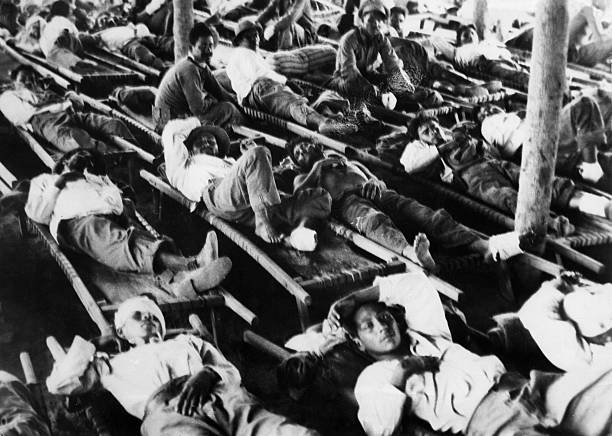
One of the bloodiest conflicts in South America history was the Chaco War fought between Bolivia and Paraguay (the machinations of imperialist banking interests naturally playing their central role) between 1932-5. One year into the conflict and the deprivations imposed on the Paraguayan working class begins to create resistance.
‘The Revolutionary Movement in Paraguay Growing in the Fight against War’ from International Press Correspondence. Vol. 13 No. 34. September 29, 1933.
Letter from Asuncion (Paraguay)
That the war with Bolivia is unpopular in Paraguay is a notorious fact. The first series of easy “victories”–victories for the big landowners and the bourgeoisie of Paraguay, who are allied with the foreign imperialists; defeats for the masses who are slaughtered at the front and for the masses at home who are suffering under the shameful regime of starvation and terror–have been followed by long months of privation and misery, starvation and death. Not only the workers are against the war, deserting in masses and rebelling (about seven officers at the front have been killed by their own men), but even the petty-bourgeoisie are no longer putting up with the war in silence, and their discontent has found vent in spontaneous outbreaks. Various students have delivered anti-war speeches to the recruits, and as a punishment have been sent to the firing line, since when nothing more has been heard of them.
Every day 50 to 70 soldiers die in the hospitals, some from their wounds, others from disease (yellow fever, tuberculosis, etc.). At the beginning of the war, convalescent soldiers were given 50 pesos and their fare home. As very many of them deserted while on leave, the military authorities no longer allowed them to go home, but, before they had hardly recovered, sent them again to the front, or kept them in concentration camps, which are real prisons. The food is not only quite inadequate, but is also impure and the cause of many of the sicknesses from which the soldiers suffer. Many soldiers have already been shot, as a warning example, for protesting against the bad treatment, bad food, etc.
Formerly soldiers who had been called up could travel on the railways, tramways, etc., free. Now they have to show a card from the War Ministry–which all of them do not receive–and those who do not possess one must travel at their own expense.
In spite of every difficulty imaginable, revolutionary propaganda has been able to find its way to the soldiers, and leaflets against war have been distributed almost in the firing line, and various revolutionary literature distributed. Up to the present, however, the actions against war have not been very numerous and have had a spontaneous character, a fact which is to be attributed largely to the influence of the anarchists, who regard desertion as an effective means of combating war.
Since the declaration of a state of war and the placing of the workers’ organisations (sailors and railwaymen), with the sanction of their leaders, under government control, the situation of the proletariat and the working masses in general has become desperate. Those who have not been called up must work patriotically, i.e., for no pay in the workshops, docks, etc., and if they do receive a miserable wage it is of no use to them, for they cannot, as before the war, obtain credit at the provision shops, etc. The families of those who are sent to the front receive hardly any support scarcely four kilograms of meat in a month. Compulsory labour, pompously described as “patriotic work,” has been introduced. Special commissions go through the towns, waylay the workers at the exits of the few workshops and factories which are still working, and bring them to the docks, where they have to load and unload ships under supervision without any pay.
Espionage is indescribable. The anti-war and Communist propaganda has frightened the ruling classes of Paraguay, and the most drastic measures have been adopted in order to prevent it. Under the pretext of fighting against the yellow fever, the authorities visit the houses of workers during the night and carry out the most thorough house searches.
Large numbers of revolutionary and Communist workers are pining in the prisons. Obdulio Barthe, a Communist student leader, has been almost tortured to death on account of the protest which he and a group of comrades made against the bad treatment and bad food they received.
Under the auspices of the government a white guard has been formed, the aim of which is to “liquidate” subversive elements. The Communists have replied by forming self-defence groups.
The plight of the petty-bourgeoisie (small shopkeepers, etc.) is increasing from day to day. Like the peasants they are systematically robbed by the Red Cross bandits.
The position of the peasants is even worse. They have had to deliver up all the meagre stores of maize, etc. they had, not to speak of the cattle which was confiscated at the beginning of the war. At the same time all the peasants must continue to work their farms in order to help “their country.” The fact that plantations and small farms have had to be given up to a great extent, and the best cultivated districts have been visited by a plague of locusts, faces the whole of the working population of Paraguay with the grim spectre of famine.
This situation has already called forth numerous risings of the peasants and their armed resistance to the requisitions. Recently many of them have refused to cultivate their land. In many parts of the country the peasants have formed armed groups which resist the police and prevent them from entering on their farms. Recently the peasants near Villa Encarnacion derailed a train which was proceeding to the front, seized the supplies of food it was conveying, and helped the recruits, who were to go to the front, to escape.
In Asuncion, the capital town, there are many groups of workers which carry on anti-war agitation in the various workshops and factories. The same is true of some towns and villages in the interior of the country, such as Villa Rica, Encarnacion, Alberdi, Villeta, etc. These groups are in contact with the troops at the front who are against the war. Although working under the most difficult conditions, with very little experience in illegal work, and with considerable remnants of anarcho-syndicalist forms of work (the workers who now form the Communist Party come for the most part from the anarcho-syndicalist camp), their influence is increasing and offers prospects of the formation very soon of a firm Communist movement and a revolutionary trade union movement in Paraguay. The Central Committee against war in Paraguay is a mass organisation which enjoys great prestige and has numerous sections at the front as well as a wide network of sub-committees which render valuable support to the work in the interior of the country. Numerous leaflets and appeals have been published, which have been very well received by the workers and peasants of Paraguay. In all these groups there exist Communist fractions or elements which exercise a guiding influence over them, and this is approved by the masses. A remarkable fact demonstrating the militancy of the masses of Paraguay is that part of the delegation from Paraguay to the Congress in Montevideo made the journey, lasting 15 days, in a rowing boat on the river Parana, covering in this way a distance of 1,500 kilometres.
At the present moment, when the inner situation is becoming more and more acute, it is more imperatively necessary than ever that the proletariat of America and the whole world support the revolutionary movement which is commencing in Paraguay.
International Press Correspondence, widely known as”Inprecorr” was published by the Executive Committee of the Communist International (ECCI) regularly in German and English, occasionally in many other languages, beginning in 1921 and lasting in English until 1938. Inprecorr’s role was to supply translated articles to the English-speaking press of the International from the Comintern’s different sections, as well as news and statements from the ECCI. Many ‘Daily Worker’ and ‘Communist’ articles originated in Inprecorr, and it also published articles by American comrades for use in other countries. It was published at least weekly, and often thrice weekly. Inprecorr is an invaluable English-language source on the history of the Communist International and its sections.
PDF of full issue: https://www.marxists.org/history/international/comintern/inprecor/1933/v13n43-sep-29-1933-Inprecor-op.pdf

