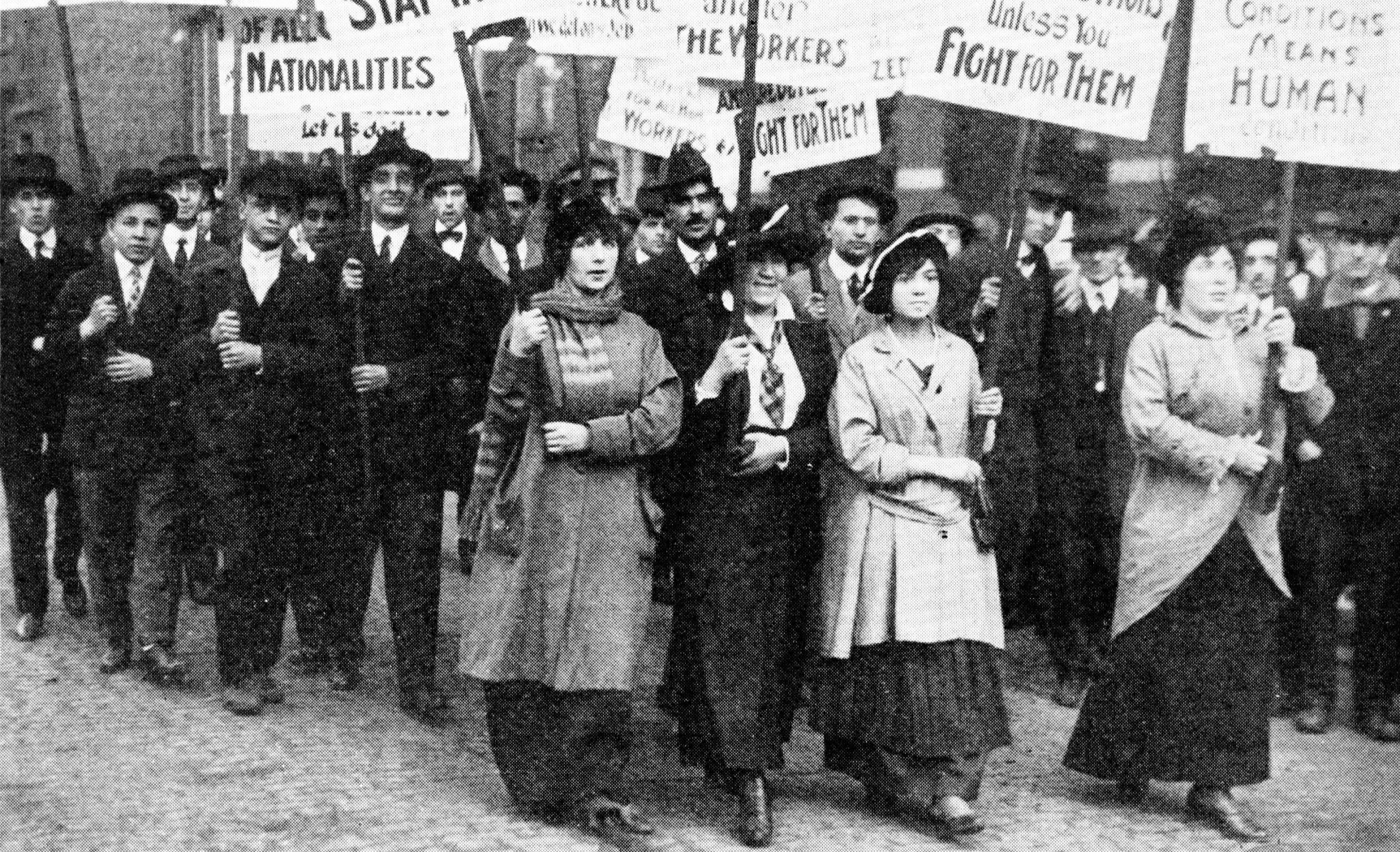
Strikes and struggles expose he contradictions in the leaderships of the Amalgamated Clothing Workers and the Ladies Garment Workers Unions, with the T.U.E.L. trying to build a militant opposition.
‘Ferment in the Needle Trades’ by A. Simon from Labor Herald. Vol. 3 No. 6. August, 1924.
THIS summer has seen three movements going on in the clothing industry of New York City, involving thousands of workers and their families. After years of struggle and sacrifice to establish union conditions, the needle trades workers have, during the past years, seen union control gradually lessened, the sweat-shop system becoming ever more strongly intrenched, and with it long periods of unemployment, unsanitary conditions, and cut-throat competition among the workers. This condition of affairs could not continue. As a result of the left wing organization under the leadership of the Trade Union Educational League, a movement started in the respective trades to make expiration of the agreements the occasion of a real struggle to gain back the losses suffered.
The most important of the three movements now in progress from the point of view of a real struggle, is the strike of the Capmakers. Due to the continuous propaganda of the T.U.E.L. in the Capmakers’ Union, some of the most important problems were forced to the front in the negotiations with employers. These problems are: 1) A guarantee of 42 weeks work during the year, with security from the employers to serve as unemployment insurance should the employers fail to supply the number of weeks of work stipulated in the agreement. 2) Every shop is to employ a full set of workers of every craft, so as to eliminate the little companies and family shops employing one or two skilled workers with the rest of the work being done by the employer and his family.
An agreement has been concluded with the large manufacturers. In it the union has won significant concessions. Namely, for the first time in the industry the employers are forced to recognize their responsibility in maintaining the workers of the industry at the expense of the employers during periods of unemployment. This is an accomplishment of the T.U.E.L.
It is true that the Amalgamated Clothing Workers was the first of the needle trades unions to have raised the issue of unemployment insurance in Chicago. The difference between its plan and that of the Capmakers, however, is that the former relates more to the particular shops and is jointly administered, while the plan of the Capmakers calls for a three percent contribution from the employers to make up the fund controlled exclusively by the union. The second demand of the Capmakers also was granted after considerable pressure. And again it was an accomplishment of the left wing led by the T.U.E.L.
T.U.E.L. Against the Sweat-Shop
The strike as it now stands is directed principally against the small bosses, many of whom will be forced out of the industry if the fight is prolonged. They constitute about 50 percent of the trade, and their elimination will benefit the workers. The final importance of these gains, especially the second one aimed at abolishing the sweat-shop, will depend largely on the determination of the leaders of the Capmakers’ Union in continuing the fight–and this, in turn, depends upon the persistence of the left wing pressing the membership and the union on to the struggle. Any compromise with the small bosses would rob the Capmakers of the concession given by the large manufacturers. The left wing must vigilantly oppose any concession to the little sweat-shop bosses. Such surrender will imperil the whole industry.
The strike of the Amalgamated Clothing Workers was more of a defensive struggle than one aimed at new concessions. The men’s clothing workers have gone through a serious crisis during the past year. The leaders of the A.C.W. have pursued a tactic that could but weaken and interfere with proper union control. They failed to take the rank and file into their confidence, a serious error which naturally begets mistrust among the membership. The demoralized condition of the trade encouraged the employers to force serious reduction of wages upon the workers. In such a situation a taint of union bureaucracy is most harmful.
It was imperative for the Amalgamated to call this strike to reorganize its forces and halt the epidemic spread of wage reduction. But the T.U.E.L. pointed out that to accomplish this task it was also necessary to put forth–besides the slogans of “No reductions”, new demands to raise the enthusiasm of the workers, to draw into strike activity these militants of the T.U.E.L., who today have the confidence of the great mass of workers.
The agreement the A.C.W. concluded with the manufacturers thus far is by no means satisfactory to the militants of the Trade Union Educational League, since it is not in line with their original demands. Nevertheless, it registers some gains, such as unemployment insurance funds and minimum wage, etc. But the extent these will be of value to the workers will depend on the strength and determination of the union administration, the officials’ willingness and ability to exercise proper union control, which was lacking before the strike. While the T.U.E.L. renews its original demand, it also insists that nothing gained in the present struggle be lost.
The Betrayal of the Cloakmakers
Since the reactionary program of the “socialist” officials of the I.L.G.W.U. began, of expelling the left wing, especially the members of the Trade Union Educational League, the Sigman gang felt it necessary to counteract the great revolt of the rank and file which spread all over the country. So they lifted the ten demands originally formulated by the Trade Union Educational League and with great ceremony made them into a sort of program known as the “Ten Commandments.” But this did not mean, of course, that they wanted these demands granted or intended to fight for them, and before the strike the T.U.E.L. warned the membership that the officials would not fight for these demands.
Under the present leadership things have been going from bad to worse. Thousands and thousands of cloakmakers have been unemployed for many months. The so-called “social shop” has spread like wild-fire. Working standards have become a thing of the past while the only thing visible of the I.L.G.W. has been the iron hand of the Forward gang choking every progressive and critical voice.
The time arrived on June 1, when the agreement with the bosses expired. For 4 months the officials carried on conferences with the employers behind closed doors. Finally the members were called upon to cast their ballots, and by referendum they voted 31,000 to 500 in favor of a strike for the “ten commandments,” originally the demands of the T.U.E.L.
During this period negotiations were still going on, and the leaders at every conference on their own initiative kept cutting down the demands, without consulting the membership. The T.U.E.L. prophecy that the Sigman gang would not fight for these demands proved true. On the other hand the bosses kept refusing even the modified demands. The bosses knew these “leaders”; they knew that they made “deals” before with these officials of the union–with the workers always the losers. The bosses understood that the diplomacy carried on at present by the leaders was really not for the demands at all, but was merely grand stand play.
So it happened that instead of calling a strike, the officials called for arbitration from the Tammany governor of New York! The governor called all factions together and after some deliberations the employers asked for mediation instead of arbitration. Again the yellow socialist Sigman gang surrendered without even referring it to the membership.
Again came a grandstand play by the officials before the commission to mediate. The officials made pleas that carried nothing for the workers since they had already surrendered the original demands in the previous conference. Again came the closed-door diplomacy and the decision against each and every demand of the workers by the governor’s Commission. The only thing left in the decision was phrases and phrases. Before the results of the Commission were given out the Sigman gang met and decided at once to accept the recommendations as a great “victory”. But the employers were not so hasty, and knowing the kind of “leaders” they dealt with, they refused to agree even to these ridiculous recommendations.
The Mountain Brought Forth a Mouse
So the great “strike for the ten demands” has been led into a blind alley. As the T.U.E.L. claimed, no strike was intended. But with the refusal of the bosses to grant even this practical defeat to the union, the workers were called out of the shops on “stoppage.” A stoppage, a strike, to enforce a virtual defeat for the workers! A fine goal, indeed! It is nothing but staged camouflage to make possible the collection of dues, since the old treasury has been bled white by the gang which knows how to ruin a union but not how to build one. There has been no strike, there will be none and the ten demands are farther than ever from realization.
In the meantime conditions of the Cloakmakers are becoming worse daily. But the betrayal has opened their eyes. Many who were blind are now seeing the character of the traitors who expelled the only fighters in the union the militants of the T.U.E.L. Many more ever day realize that the union never will function for them until the expulsion policy is wiped out, the traitors turned out of office, and militant left wingers put in charge of leading the struggle.
The revolt is spreading rapidly, and the militants in the union must endeavor to deepen the resentment against the betrayers of the membership. Already the angry membership responded to the call of the T.U.E.L. in a mass demonstration in front of Sigman’s office. The traitor is also a coward, and in fear and trembling called the police to protect his yellow hide against the justified indignation of the rank and file. Such “leaders” must go. The workers now in the I.L.G.W. have a problem to solve and there is no one but themselves to solve it. They must see that the Sigman-Forward gang goes and that new and revolutionary leaders take control.
The Labor Herald was the monthly publication of the Trade Union Educational League (TUEL), in immensely important link between the IWW of the 1910s and the CIO of the 1930s. It was begun by veteran labor organizer and Communist leader William Z. Foster in 1920 as an attempt to unite militants within various unions while continuing the industrial unionism tradition of the IWW, though it was opposed to “dual unionism” and favored the formation of a Labor Party. Although it would become financially supported by the Communist International and Communist Party of America, it remained autonomous, was a network and not a membership organization, and included many radicals outside the Communist Party. In 1924 Labor Herald was folded into Workers Monthly, an explicitly Party organ and in 1927 ‘Labor Unity’ became the organ of a now CP dominated TUEL. In 1929 and the turn towards Red Unions in the Third Period, TUEL was wound up and replaced by the Trade Union Unity League, a section of the Red International of Labor Unions (Profitern) and continued to publish Labor Unity until 1935. Labor Herald remains an important labor-orientated journal by revolutionaries in US left history and would be referenced by activists, along with TUEL, along after it’s heyday.
PDF of full issue: https://www.marxists.org/history/usa/pubs/laborherald/v3n06-aug-1924.pdf

