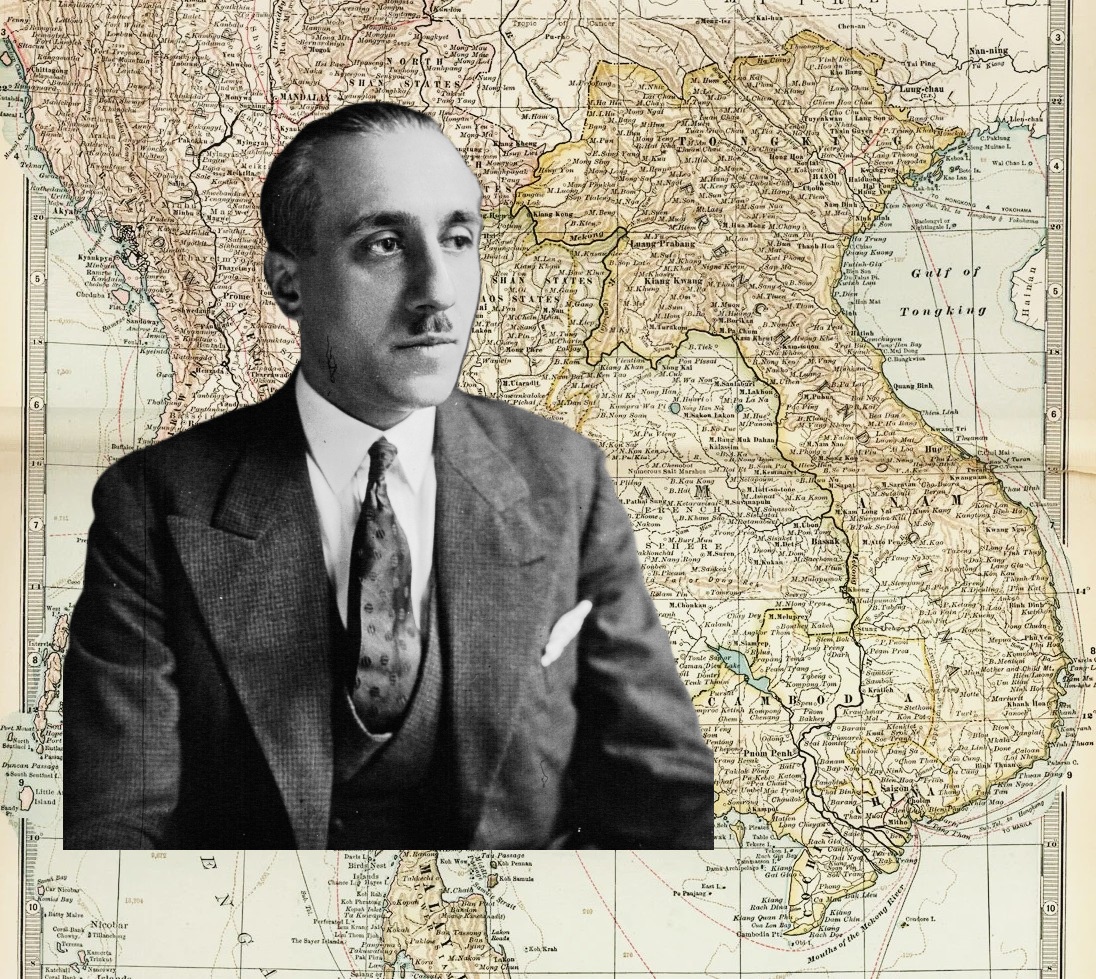
Communist parliamentarian Gabriel Péri reports on a solidarity trip organized by France’s International Labor Defense in support of those suffering under French colonial repression in the aftermath of recent anti-imperialist uprisings in then Indo-China. Peri himself would die as a member of a resistance at the hands of occupiers, shot by the Nazis outside of Paris in December, 1941.
‘The Workers’ Delegation in Indo-China’ by Gabriel Péri from International Press Correspondence. Vol. 14 No. 33. June 8, 1934.
The workers’ committee of investigation sent by the French section of the International Labour Defence and the revolutionary trade union federation of France (C.G.T.U.) to Indo-China has now been back in France a month. The committee has reported on the results of its investigations in public meetings in Paris and throughout France. On the basis of the material provided by the committee’s report the French section of the I.L.D. has now opened up a campaign of agitation and propaganda throughout the country to demand a general amnesty for the people of Indo-China. Over eighty meetings are being organised to this end.
The Committee, which left Marseilles at the end of last January and returned to France in the second half of April, had a double aim. In the first place it went to investigate the complaints made by the relatives of the victims of French imperialist oppression in connection with the great trial which opened on May 7, 1933, and resulted in the passing of terms of imprisonment totaling nine hundred years. And, secondly, it went to investigate the extent of the crisis and its effects on the working masses of Indo-China.
Naturally, the delegates of the French proletariat were subjected to all sorts of chicanery and sabotage on the part of the authorities. They were refused permission to enter two of the French protectorates, namely, Annam and Tonking, and wherever the delegates went they were followed by a mob of special police and detectives who dogged their footsteps. Instructions were given by the authorities to prominent personalities in Indo-China not to receive the delegation, and the natives were forbidden under pain of severe reprisals to hold any converse with the members of the delegation. The delegation was forbidden to give a public report of its doings at a meeting in Saigon. With all these measures the Governor-General hoped to make the work of the delegation impossible of performance and to cause its members to break off their visit without having achieved their objects. However, the delegation refused to permit itself to be sidetracked and remained the appointed period in Indo-China. Despite all the measures of the authorities the members of the delegation succeeded in getting into touch with the relatives of the victims of French imperialism, and they succeeded in studying the conditions of the toiling masses in Cochin-China, if not in Annam and Tongking. Despite all the efforts made to isolate the delegation, its presence and its activities rapidly became known all over the country, and again and again the native population expressed its sympathy with the delegation by displaying bunting with slogans of welcome at prominent points and by hoisting red flags. There is no doubt that the activity of the delegation–the first of its kind–did much to encourage the national-revolutionary fighting spirit of the toilers of Indo-China.
The Governor-General at first announced loudly that the delegation would be able to achieve nothing, thanks to the police measures which had been taken, but after a time the press changed its tone, and during the last few days of the delegation’s stay regret was expressed that it had ever been allowed to land in the colony and endanger public order and security.
Another fact which indicates the effect of the delegation’s visit was that during its stay the Governor-General felt it wise to publish an official statement denying the charges which have been levelled against the French administration by the Amnesty Committee on behalf of the people of Indo-China. This fact alone is enough to prove the anxiety and discomfort caused in the ranks of the colonial exploiters by the solidarity action of the working masses in the motherland. During its stay in Indo-China the workers’ delegation expressed this solidarity in the most concrete fashion.
At the end of its investigations the delegates drew up a list of demands on behalf of the people of Indo-China and forwarded them to the Governor-General. Many newspapers were compelled to publish the demands. The chief demand put forward was for a general and unconditional amnesty for all the victims of imperialist oppression in Indo-China. The memorandum issued by the delegation gave details of the horrible conditions prevailing in the prisons and on the notorious island of Poulo-Condor.
Prior to the granting of a general amnesty the delegation demanded treatment as political prisoners for all the victims of imperialism and the punishment of all police and other officials who have been implicated in the torture and maltreatment of prisoners.
The delegation also strongly condemned the wage-cuts, the system of fines in the factories and the imposition of corporal punishment. It demanded a weekly day of rest for the coolies, free medical assistance, unemployment insurance at the cost of the State and the employers, and the abolition of the prevailing system of compulsory arbitration under the dominance of the police.
Despite all difficulties placed in their path, the delegates of the French workers were able to study the working conditions prevailing on the plantations and the miserable conditions under which the coolies live who are compelled to work in the Hevea forests. On their behalf the delegation demanded the abolition of compulsory contracts, the abolition of the forced recruitment of labour and the abolition of the compulsory labour quota which keeps the coolies chained to the plantations.
Cochin-China has been hit most severely by the crisis owing to the drop in the demand for rice. The district is almost wholly dependent on the rice crop, and the economic crisis has ruined the rice peasants, who are in consequence in a state of ferment. The poor peasants, the seasonal workers, and the small lease-holders, who are the chief figures in Indo-China, are threatened with increasing misery and even starvation. It was clear to the delegation that these categories could be saved only by the immediate adoption of various measures, including the abolition of the lease- hold system, the quashing of usurious loans and the arrears, the prohibition of the seizure of the peasant land and foreclosures, no imprisonment for the non-payment of taxes, taxation to be borne by the well-to-do and not the poor, the distribution of the municipal lands to the peasants under the control of peasant committees, the distribution of the rice stores amongst the indigent, the distribution of the government subsidies and grants to the peasants and not to the plantation owners.
The rapid development of the economic crisis in Indo-China threatens to cause the collapse of the whole colonial system. Seventy years ago France gained a hold on Indo-China, and ever since the apologists of French imperialism have announced that French rule has developed the productive forces of the colony, and that there has been increasing prosperity for twenty millions of people as a result.
These two excuses which have served French imperialism for over half a century to justify its robbery have now been completely robbed of all justification. Above all, French imperialism in Indo-China has developed only those branches of industry which were calculated to make the colony dependent on the motherland and to turn it into a market for French goods and a basis for French imperialism in the Far East. French imperialism has, however, carefully avoided any attempt to utilise the natural resources of the colony in iron ores, etc. At the moment the chief natural product of Indochina is rice, which represents 70 per cent. of its exports. Forty per cent. of this was sold to China via Hongkong. Since 1930, however, the price of rice has steadily fallen and Indo-China has also suffered from the effects of the world economic crisis.
However, the policy of French finance capital, the policy of imperialism, has intensified the consequences of the rice crisis. The French authorities have replaced the old silver plaster, which had the same value as the Hongkong dollar, with a gold piaster, which is worth two Hongkong dollars. As a result, the rice peasant of Indo-China saw his income halved, whilst his expenditure, his debts and his taxes were still reckoned in the same number of piasters as before. As a result, the budget of the rice grower and small leaseholder simply will not balance, and they become the easy prey of the Bank of Indo-China. The purchasing power of the rice peasants has been cut away to nothing, and during the past three years no less than 350,000 hectares of rice land have been let go out of cultivation.
There is no doubt, however, that a return to the old silver piaster would not solve the problem, because the rice crisis is one of the consequences of the world economic crisis, because Indo-China not only sells, but also purchases, and because the improvement brought about by the greater facility to sell goods abroad had as a counterweight the increase in the cost of living at home. However, it is a fact that the stabilisation which has been carried out, and which has so worsened the situation of the Indo-Chinese working masses, had one main aim, namely, to guarantee and protect French capital investments in the colony. The rice fields may stand bare and twenty millions of people may go hungry so long as the interests of the capitalist speculators are protected.
The aim of French imperialism was further to strengthen the bonds between the colony and the motherland, to place Marseilles in the place of Hongkong, and to place the French firms, Denis Frères, Distilleries Fontane, etc., in place of the Chinese merchants who previously controlled the major portion of Indo-Chinese trade. The measures of French imperialism have disorganised the internal market of Indo-China. Ninety thousand Chinese have left the country, and Cholon has been almost completely ruined and presents a picture of closed and dilapidated shops. In other words, the colonial policy of finance capitalism, of imperialism, is ruining Indochina.
In its report the French workers’ delegation has not failed to stress this cardinal fact, and it urges the necessity for the proletariat of France to support the toiling masses of Indo-China and their Communist Party in their efforts to obtain the independence of Indo-China.
The Communist Party of Indo-China is subjected to fierce repression and persecution, but the blows which have descended upon it have not crippled its fight. After every bloody orgy of French imperialism it has succeeded in mobilising and organising its forces to continue the struggle. The Party lives in close touch with the heroic Communist Party of China, whose glorious example serves as a beacon to the Communist Parties of the East, like the Communist Party of the Soviet Union to the Communist Parties of the West.
International Press Correspondence, widely known as”Inprecorr” was published by the Executive Committee of the Communist International (ECCI) regularly in German and English, occasionally in many other languages, beginning in 1921 and lasting in English until 1938. Inprecorr’s role was to supply translated articles to the English-speaking press of the International from the Comintern’s different sections, as well as news and statements from the ECCI. Many ‘Daily Worker’ and ‘Communist’ articles originated in Inprecorr, and it also published articles by American comrades for use in other countries. It was published at least weekly, and often thrice weekly.
PDF of full issue: https://www.marxists.org/history/international/comintern/inprecor/1934/v14n33-jun-08-1934-Inprecor-op.pdf

