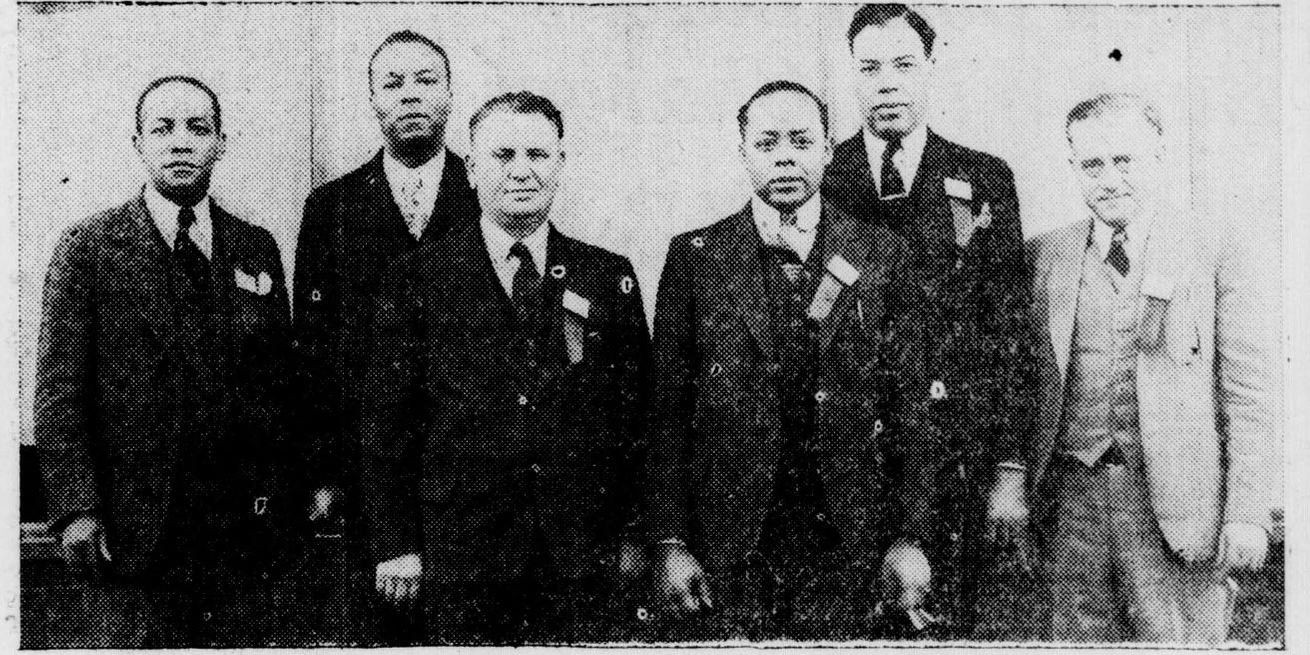
Successfully organizing the largely Black food workers on the country’s rail lines was a major step forward in Black unionization, and of service workers generally. Within a few years the Council would encompass nineteen locals representing over 20,000 workers, larger than the Brotherhood of Sleeping Car Porters and Maids, who helped to sponsor it. For years the two unions were the largest majority-Black unions in the U.S. A descendant represents Amtrak workers today as UNITE-HERE Local 43. The story of the beginnings of the Joint Council of Dining Car Employees below.
‘Dining Car Unions Form National Council’ by Bobbie Turner Davis from Western Worker. Vol. 6 No. 90. November 11, 1937.
Plans Laid By Parley–Oakland Leader Named to National Office
(Special Correspondent for National Conference of Dining Car Employees) OMAHA, Nebr.–Eleven out of 13 dining car employee unions affiliated with the Hotel & Restaurant Employees’, Intl. Alliance & Bartenders’ League of America, and one unaffiliated group from the Northern Pacific Railroad, were represented at the National Conference of Dining Car Employees held here last month, and made plans for a national council within the international union providing for the establishment of machinery to deal with the problems of dining car workers on a national scale.
Flory Elected
Flanked with the able assistance and advice of A. Philip Randolph, president of the Intl. Brotherhood of Sleeping Car Porters and president of the National Negro Congress, the conference opened its meeting by choosing Solon C. Bell, president of Local 465, Omaha, whose efforts, jointly with Local 456, awakened the consciousness of the need for national organization among workers in dining car work, as chairman.
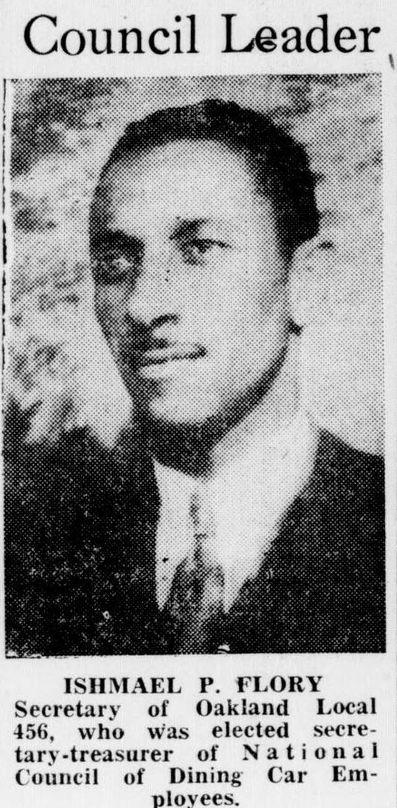
Ishmael P. Flory, of Oakland, Calif., correctly termed “a dynamo of energy and industry” by Mr. Randolph, was selected secretary-treasurer. Never before have dining car employees had adequate machinery to meet their problems on a national scale. In the past, each local union has had to depend upon itself alone in negotiating for conditions with the powerful carriers. Each of them alone was obviously not in a position to strike the best possible bargain with the carriers. This weakness resulted in the creation of sharp wage differentials, differences in hours of work and in working conditions throughout the nation.
Seek One Agreement
It is hoped that by unifying dining car employees on a national scale, through a central negotiating committee, one uniform contract can be secured from the carriers as a group to correct those differentials.
Bell and Flory were elected temporary chairman and secretary-treasurer of the National Council set up, pending granting of a charter by the international union.
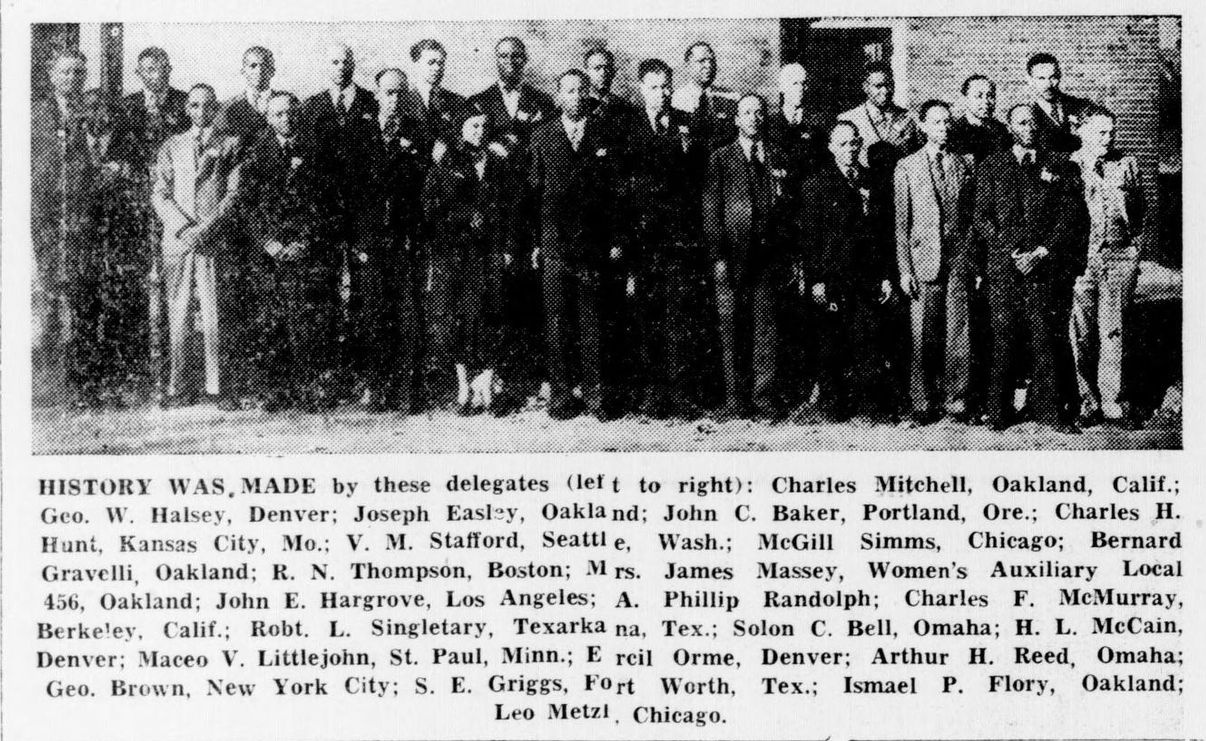
The twenty-two delegates present represented an actual membership of 5562, a potential membership of 12,057, and came from all major railroads throughout the country.
Score Tipping System
The conference also outlined a major program to bring about uniform wages, hours and working conditions, pending securing of a national contract. The tipping system came in for condemnation by the conference. Depending upon the public to augment the meagre salary of waiters by tips, was branded as economically unsound, humiliating and lowering to the dignity of the service.
It was unanimously agreed that a fight should be prosecuted for a real eight-hour day or 196 hours per month, instead of the present nine-hour and sixteen-minute day, or 240-hour month, now required. It was also brought out that dining car employees must press the carriers for increased pay at a living wage.
A. Philip Randolph, invited to advise with the delegates, emphasized necessity for the conference to establish machinery within the international union to deal with the highly consolidated and organized railroad industry on a national scale and urged formation of a National Council within the International Union of Culinary Workers. He emphasized the need for a national medium to educate dining car employees on the problems facing them as a group and facing the entire labor movement.
Great Constructive Step
In an interview, Randolph issued the following statement: “The National Conference of Dining Car Employees held in Omaha, was historic and epoch-making. It marks a great and constructive step in the development of economic power among Negro workers in general and dining car employees in particular.
“As a result of the national set-up, the dining car employees will be able to exercise effective influence, not only in changing the wage rates, hours of work and working conditions for their benefit, but also upon the labor movement as a whole in helping to break down the color bar in the trade union and advance the liberation movement through unity of the Negro people.
“The conference was composed of men of fine vision, courage and ability. The national set-up will move forward successfully because of the splendid personnel which will guide it.
“Solon C. Bell, president of the Protective Order of Dining Car Waiters, who was selected as chairman, represents a leader of high integrity, trade union understanding and ability. Ishmael P. Flory, who typifies a veritable dynamo of energy and industry, possesses the training requisite to make the job a force and power in the trade union movement among black and white workers in the country.”
In an interview, Clarence R. Johnson, of Los Angeles Local 582, California international representative of the Culinary Alliance, referred to the conference:
Vital for All Labor
“Another important movement for mass action, which will have a far reaching effect, not only in the interest of a particular group but for the great mass of Negro citizens and the whole of labor, was the National Conference of Dining Car Employees.
“Along with many other progressive forces, these workers, like the Brotherhood of Sleeping Car Porters, must and will make a definite contribution toward liberalizing forces of American labor and furnishing at new inspirational leadership for the labor movement as a whole.” The spirit of the convention was manifested by the following resolutions:
Progressive Resolutions
Urging the International Union of Culinary Workers to use its influence in the passage of the Wagner-Gavagan Anti-Lynch Bill; a resolution urging dining car unions to affiliate with the League Against War and Fascism and the National Negro Congress; condemning the refusal of the Supreme Court to review the Haywood Patterson Case, one of the Scottsboro Boys, and urging the international union to place pressure for its review, and others.
National headquarters of the council will be established in Chicago upon the return of Mr. Flory from the Pacific Coast.
Western Worker was the publication of the Communist Party in the western United States, focused on the Pacific Coast, from 1933 until 1937. Originally published twice monthly in San Francisco, it grew to a weekly, then a twice-weekly and then merged with the Party’s Daily Worker on the West Coast to form the People’s Daily World which published until 1957. Its issues contain a wealth of information on Communist activity and cultural events in the west of those years.
PDF of full issue: https://www.marxists.org/history/usa/pubs/westernworker/1937/v6-n87-95-nov-1937.pdf

