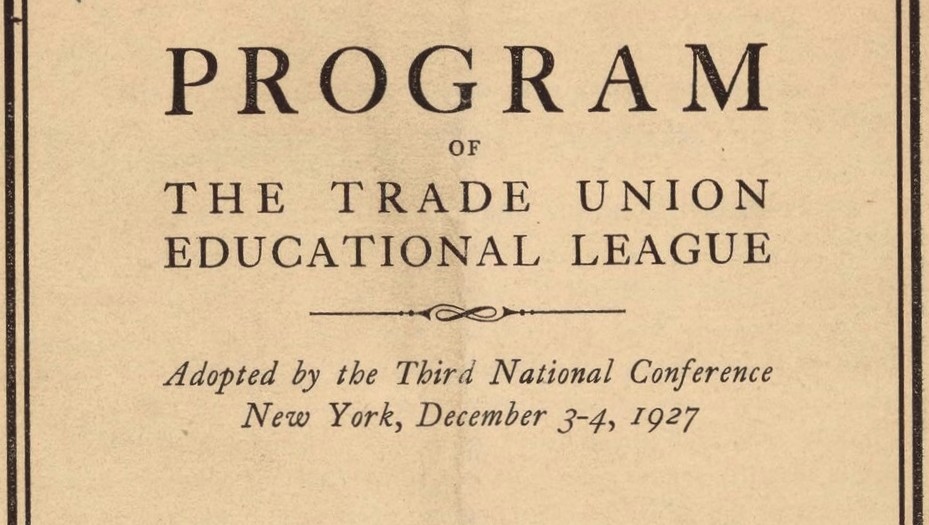
At its third, and final, national conference held in December, 1927 the T.U.E.L. adopted a new program to face a changing situation. The 1920s had been a disastrous decade for the labor movement, with the official unions around the A.F.L. playing dead in the face of the post-war capitalist offensive and industrial rationalization, losing hundreds of thousands of members. Its skilled, ‘white’, craft union myopia meant failure to organize new jobs, Black workers, immigrants, women, the South, and the ‘unskilled’, leaving all basic industries but coal unorganized. In coal the U.M.W.A., the largest and most powerful working class organization in the country, was in a near-terminal crisis as the John L. Lewis bureaucracy destroyed all opposition, sometimes with bullets, and sacrificed whole districts of the union to downsizing at the end of the Jacksonville Agreement. At the same time, 1927 saw the beginnings of a shift internationally as the workers movement shifted to the left and the colonial liberation struggles exploded in China and Indonesia. Meanwhile small, but important, insurgencies in textile, rail, and mining hinted at a revival in the U.S. Still seeing itself as the left-wing of the existing labor movement, the T.U.E.L. did not yet embrace a break to establish Red Unions. However, within a year, as the U.M.W.A. engaged in mass expulsions and restless textile workers presented new opportunities, and the political ground in the Communist world shifted, the first group of those new unions would be built.
‘Program of the Trade Union Educational League Adopted by the Third National Conference.’ Published by Labor Unity, New York. 1928.
Adopted by the Third National Conference. New York, December 3–4, 1927.
PROGRAM OF THE TRADE UNION EDUCATIONAL LEAGUE
The Offensive Against the Labor Movement
The trade union movement is in the deepest crisis of its history. At this time, while the Third National Conference of the Trade Union Educational League is meeting, the great attack against the labor movement is being renewed with redoubled vigor. The employers are openly battling to increase working hours, decrease wages, break down protective regulations, and smash all effective trade unionism. The railroad shop unions have been largely replaced by company “unions,” while the 8-hour day on the railroads is being rapidly undermined. The trade unions have been driven out or reduced to impotence in the basic and key industries. More and more, the A. F. of L. is being narrowed to skilled and privileged workers, whose interests the bureaucratic leaders seek to protect at the expense of the basic mass of the workers. The much-heralded “prosperity” of 1925–26, which never reflected itself in prosperity for more than a very small number of workers, is now near its end; unemployment is rapidly becoming acute; the capitalist class of America sees its opportunity to complete the union-smashing campaign which was only partially carried out in 1920–23.
The union-wrecking drive reaches its apex in the present efforts of the employers to smash the Miners Union. Aided by the treacherous leadership of the Lewis regime, the coal operators, in the past few years, have destroyed district after district of the union, which has lost some 200,000 members. Now in this strike the operators are crushing the union in the three key districts of Western Pennsylvania and Ohio. Should they succeed the U.M.W.A. will be broken nationally. Such an employers’ victory would stimulate the open shop movement in every industry. The attack would be intensified everywhere against the workers’ standards and organizations. The employers by sweeping injunctions and drastic repression would seek to outlaw and destroy the unions generally, except perhaps a few skilled workers’ unions. The situation is highly critical. The trade union movement is in the gravest danger of its existence. The great task of the workers is to rally to save and rebuild their threatened trade unions.
Government by Injunction
In the attack against Labor, the employers are using not only their special and private weapons (labor spies, company unions, thugs, blacklist, lockout, “welfare” schemes, stock-ownership plans, etc.), but also they control and use the machinery of the Government. This is glaringly illustrated in the use of injunctions, court orders which replace even the ordinary laws which themselves are written in the interests of the employing class, and substitute the arbitrary rule of appointed judges, tools of the employers, in a naked dictatorship of the employing class over the working class. Injunction Law has been buttressed by a system of anti-labor legislation (anti-picketing laws, criminal-syndicalism laws), and special anti-labor institutions (State Cossacks, militia, “industrial” police, industrial courts and commission, etc.), which immediately deprive workers of all civil rights and liberties whenever a dispute with the employing class occurs. Political oppression grows more intense each day. The Government in all its branches acts as the executive arm of the bosses.
Union Leadership in Retreat and Surrender
For more than five years the unions, instead of making progress, have been losing ground. For the first time in American labor history, a period of high industrial production has been accompanied, not by a strengthening of the labor unions, but by retreat, defeat, loss of membership and militancy. Now with the beginning of industrial depression and renewed assaults by the employers, this threatens to become a disaster and to jeopardize the whole trade union movement.
One of the principal contributing causes for this crisis is the surrender of the official leadership of the trade unions to the employers, and their rejection of a policy of militant struggle. To further their own individual and group interests, they sacrifice the interests of the workers and become tools of the bosses.
The employers have united themselves into ever greater trusts and anti-labor associations; the union officials have divided even more than before the fighting forces of labor (refusal of amalgamation, conducting partial strikes with some unions officially scabbing on the others, as in the 1922 railroad strike, etc.)
The employers have launched company unions, the union officials have replied by making trade union policies similar to company unionism, by adopting the principle of non-strike, B. & O. Plan, and similar schemes, and have set themselves to “company unionize” the trade unions, setting up the argument to the employers that trade unions will be more profitable to them, better instruments for exploitation of the workers, than company unions, instead of making the unions so powerful that the employers are forced to deal with them. They try to dignify their policy of surrender with the high-sounding name of “The Higher Strategy of Labor.”
While the capitalists enormously increase their foreign investments and thus their control over workers in other lands, and perfect their international organization against labor, the official labor leaders adopt the foreign policy of the State Department of Washington and utilize their connections with the workers in other countries to further the plans of American Imperialism. On the political and industrial fields at home and abroad, the trade union officialdom has made itself a part of the machinery of American Imperialism.
Cooperation With Capitalists—Struggle Against Workers
The surrender-policy of the trade union leadership, resulting in weakened unions, loss of conditions, wage reductions, etc., is arousing more and more protest and resistance among the workers. The more progressive and militant among them strive for a fighting policy against the employers and for the demands of the workers. This is evidenced by the strong opposition movements in many unions (miners, clothing, machinists, etc.). But the union officialdom, the bureaucracy, involved in its relations with the workers’ enemies, is determined at all costs to force over its reactionary policy. Therefore, instead of struggle against the exploiters and oppressors of the working class, today the union machinery is used everywhere against the progressive and militant workers in the trade unions. Unity with the employers means betrayal and repression of the workers.
Progressive and militant workers, in opposition to the surrender-policy of the Executive Council of the A. F. of L., have formed groups throughout the labor movement. The leading center of this opposition movement is the Trade Union Educational League. In warring against the T.U.E.L. and other opposition groups, the A. F. of L, officialdom have not hesitated at the most drastic measures. They have resorted to expulsions, individual and en masse; doing their utmost to destroy the most advanced sections of the labor movement (Furriers, Garment Workers, Kansas and Nova Scotia miners, etc.); they have broker down almost completely the machinery of inner-union democracy; they have not stopped short of destruction of whole trade unions in order to destroy the opposition to their surrender-policy. In this war against the workers, the officialdom are collaborating closely with the police, the employers, and the capitalist-controlled courts, including the use of injunctions which place the unions under the control of the hostile capitalist courts. Step by step the trade union members are finding their organizations taken out from their control and aligned with their enemies, the employers.
Program of the Left Wing
The left wing in the labor movement has the task of exposing the treacherous policies of the present officialdom; of bringing before the working class a comprehensive and realistic progressive and militant trade union policy, for the labor movement as a whole and for each separate industry and locality; of developing a new leadership for the labor movement around this program and wresting control of the trade unions from the reactionary officialdom; and, above all, of bringing about the organization of the unorganized workers, more than 20 millions of whom are ignored and neglected by the reactionary officialdom. This program is fundamental to meet the present crisis.
The great masses of workers are exploited, underpaid, and discontented. Harassed by speed-up systems, low wages, unemployment, and industrial autocracy, they only become increasingly ready for organization and militant action. Passaic and Colorado prove this. Likewise the discontented members in the unions. The task of the left wing is to give organization, program and general leadership to this eventually irresistible mass and to break up the capitalist offensive by a counter-offensive of the workers.
I. FOR A MILITANT TRADE UNION POLICY
The present trade union policy of collaboration with the employers, which is the surrender of the workers’ interests, must be replaced by a policy of aggressive, militant class struggle. The unions must be built up, developed and used as a mighty instrument for the struggle against the employers along the lines of the following general program:
(a) Shorten the Hours of Labor: Progressive decrease of the hours of labor is fundamental in the program of the working class. Progress in this direction has, however, been checked, and hours of labor, with a few exceptions, are being increased, the 8-hour day has been established only for a minority of the workers. Renewed progress in shortening the work-day must be a first demand in rejuvenating the trade unions. The 8-hour day must be gained as an absolute maximum for all, with six and seven hours for especially dangerous or disagreeable work; the Saturday half-holiday must be fought for and protected; and wherever possible, the five-day, 40-hour week must be demanded.
(b) Fight for Higher Wages—Strike Against Wage Cuts: American real wage levels are lowest in the world when compared with the productivity of labor; for common labor even the real wage is little higher than in Germany and England. The illusion of the “American High Wages” used to browbeat the workers into quiescence, must be overthrown, and the trade unions must embark upon a militant policy of demanding higher wages, fighting for these demands, and resisting by all means every attempt to reduce the present wage. Attempted wage cuts, which will multiply with the growing unemployment, must be countered by strike movements.
(c) Against the Speed-up Systems: American workers suffer much from excessive intensification of labor, brought about through speed-up systems, the stop-watch, group piece-work, bonus system, so-called efficiency engineering, the conveyor (belt) system, straight line production and other phases of mass-production and rationalization. These methods enormously increase productivity, drain the energies of the workers, throwing millions out of work; increase exploitation of those at work, strengthen the employers and undermine the power of the workers. The trade unions must establish, in an organized manner, strict regulation of methods of work, resolute opposition to speed-up systems, and set up protection for the workers from the bad effects of the technical advances of mass-production.
(d) For Relief of Unemployment: Unemployment has become a permanent feature in America, the land of “prosperity.” Increased productivity has reduced the number of workers in the factories while production jumped to its highest known level. The recession in industry which has begun in recent months, is intensifying the growth of unemployment. Part-time and full-time unemployment has become widespread. Unemployment has thus become a permanent weapon in the hands of the employers to break unions and reduce living standards. The fight against unemployment must be established as a serious task of the trade union movement, by means of (A) decreasing the hours of labor; (B) establishing governmental insurance against unemployment, at union rates, administered by the workers and financed by tax on profits and concentrated wealth; (C) temporary measures of relief (special works, etc.) pending achievement of more fundamental measures; (D) organization of unemployed workers to demand protection and relief, in close co-operation with trade unions and other workers’ organizations.
(e) Fight Against Injunctions—For Civil Rights: The very existence of the trade union movement is menaced by the rule of injunction law, together with other methods of depriving the workers of all civil rights. The immediate weapon of struggle against injunctions is, above all, by mass violations of all court orders which take away from the workers their hard-earned civil rights of organization, of striking, assemblance, picketing, press, etc. The T.U.E.L. calls for a well-organized campaign of mass-violation of injunctions against labor, and for all forms of intensive political struggle against injunctions.
II. FIGHT AGAINST CLASS COLLABORATION
(a) Destroy the Company Unions: Company unionism is one of the most dangerous menaces against the labor movement. The T.U.E.L. calls for a militant fight against all its manifestations both inside and outside of the bona fide trade unions. The company unions established by the employers must be destroyed, if necessary by strikes and organization campaigns from the outside, and sometimes by working within them. The attempts of the reactionary officialdom to company-unionize the trade unions must be resisted, all class-collaboration theories must be fought against, and the trade unions made militant fighting organizations.
(b) Abolish the B. & O. Plan and Similar Schemes: A part of the general surrender-policy of trade union officialdom has been the adoption of the so-called Baltimore & Ohio Plan and similar schemes (including laws for collaboration, against strikes, etc. such as the Watson-Parker Law). Such plans, intruding the authority of the employer into the union machinery, transforming the union into an instrument of speeding-up workers and preventing strikes, constitute a perversion of unionism, a process of “company-unionizing” the trade unions, which, if continued, will ultimately destroy the labor movement. We must abolish the B. & O. Plan and similar schemes.
(c) Against Trade Unionism Capitalism: Establishment of so-called labor banks, investment companies, insurance corporations, land speculations, etc. (“trade union capitalism”), has been a source of corruption and degeneration of the trade unions. Very often these schemes turn out to be the purest swindle and robbery, despoiling the workers of their hard-earned savings (as in the Engineers’ Bank, “open shop” coal mine, and Florida land swindle); and in all cases they tend to degenerate the unions into business institutions, union officials are transformed into contented bankers and business magnates; the unions are entangled into joint operations with capitalist enemies, and thoroughly corrupted. The T.U.E.L. exposes these frauds; fights for either their liquidation completely, or their separation from the trade unions and reorganization upon genuine workers’ cooperative lines. True workers’ cooperatives must be carefully distinguished from “trade union capitalism”; cooperatives must be supported and developed, but trade union capitalism must be combatted energetically.
(d) Expose Class-Collaboration Theories: The so-called “New Wage Policy” of the A. F. of L. is a theoretical justification for the surrender-policy and class collaboration of the officialdom, and the best example of the anti-labor theoretical foundation of reactionary leadership, maintaining that the interests of workers and employers are identical, and that wage increases are to be secured through increasing productivity, obtained through cooperation with the unions in production. How false and destructive is this theory, may be readily seen by examination of the mining industry, where productivity has been raised to four times that of Europe, and where, instead of being able to secure wage increases the union is fighting to retain the Jacksonville scale. Partly as a result of this fact, the miners’ union is in immediate danger of destruction. This increased productivity has. rendered “superfluous” 300,000 miners who would otherwise find steady employment; this condition, accepted by the union officialdom in a most cowardly and treacherous manner, has given the coal operators the weapons they required for a successful “open shop” drive. The same process goes on in other industries. The theory of class collaboration, such as expressed in the “new wage policy,” must be exposed and combatted as abandonment of effective struggle for better conditions, and as treachery to the labor movement.
III. BUILD THE TRADE UNIONS
(a) Organize the Unorganized Workers: This is the principal task of the labor movement at the present time. Less than 3½ million workers, from a total of 26 millions, are in the trade unions, and even this small percentage is principally in the less-developed less-mechanized industries. The trade unions must, at all costs, be made to include the increases of workers in the basic and key industries, such as steel, automobile, rubber, textiles, chemical, transportation, mining, which are now either partially or entirely unorganized, Special efforts must be put forth to organize the unskilled women, youth, Negro, and foreign-born workers. Wherever possible, the unorganized must be brought into the existing unions; where no unions exist or where the existing unions refuse to organize the masses, the progressive workers must organize new unions, and struggle for admission into the general labor movement as well as fight the immediate battles of their members. The struggle for organization will develop a militant policy and fighting leadership. It will shift the labor movement’s center of gravity from the lighter, competitive industries into the heavy and key industries. The fate of the labor movement depends upon the accomplishment of the tremendous task of organizing the unorganized.
(b) Amalgamation, Industrial Unionism: A fundamental weakness of the labor movement is the prevailing system of craft divisions, to which the present reactionary leadership clings so desperately. This craft division is so extreme that in some industries the workers are required to separate themselves into 50 different organizations, as a condition of joining the labor movement. It is little wonder the masses of workers, especially in modern industries, cannot be organized by such obsolete machinery. The existing craft unions must be amalgamated into powerful industrial unions, departmentalized to meet the needs of each section, but also centralized upon the principle of a single union authority for each shop, each employer and each industry. In the great industries, now unorganized, industrial unionism must be the principle of their organization from the beginning, as the only system which can successfully withstand the opposition of the employers.
(c) Democratization of the Unions: The destruction of the inner-union democracy, now being practiced (packing conventions, expulsions, disfranchisements, fraudulent elections, gangsterism, etc.), must. cease. Restore the full rights of the membership to nominate and elect their own leaders; establish free speech in the unions; open the union journals to the membership. The excessive power of the officials must be curbed; their enormous salaries, which make capitalists of many of them, must be slashed. Corruption, which now permeates the unions, must be driven out mercilessly. The old leadership, corrupted and acting as agents of the employers, must be replaced by men and women who are free from all alliances with the enemy, who are pledged to a fighting program, and who are themselves workers. Abolish all discrimination against women, youth, Negroes, and foreign-born workers.
(d) Against Racial Discrimination: The trade unions must include wage workers regardless of race, creed, sex, age or color. The trade unions must declare for the removal of all bars against Negroes, Chinese, Filipinos, Japanese, Mexicans and other races and national groups which are being discriminated against in entering the trade unions. It must demand the abolition of all Jim-Crow laws, practices and discriminations, and the elimination of lynching.
The A. F. of L. and independent unions must be convinced of the necessity of initiating an active campaign to organize the Negro workers, and demand that they be given equal pay for equal work, and extend them the utmost protection of the trade unions.
IV. FORM A LABOR PARTY
A basic cause of the general weakness of the labor movement is the fact that the workers have no mass political party, no labor party. The union officials are in alliance with the two capitalist parties. This corrupts them and spreads demoralization throughout the ranks of the workers generally. The A. F. of L. “non-partisan” policy of rewarding “friends” and punishing “enemies” on the old party tickets is an instrument of the employers to subjugate the workers, and the labor leaders are their tools by advocating it. The workers can gain nothing through the capitalist parties. No real political progress can be made by the masses until a complete break is made with the capitalist parties and the workers set up a mass party of their own based on the trade unions. The labor party, organized around a program based upon the burning needs of the workers, is the next great step necessary in the political development of the working class. It will greatly stimulate class consciousness and class organization in all directions. The T.U.E.L. calls upon the left wing and progressive forces throughout the labor movement to unite to win over the labor movement for the establishment of the labor party. Victory in establishing the labor party means the defeat of the most reactionary and corrupt forces in the labor movement.
V. ORGANIZE THE LEFT WING
The above program has arrayed against it all the forces of reaction, the employers, the government, and the ruling officialdom of the trade unions. Its program can be realized only through struggle against the combined reactionary powers. Such struggle requires the mobilization of the masses of workers in an organized manner, the organization and training of an alternative, militant leadership to supplant the corrupt officialdom. In order to put into effect the above program, the left wing forces must have an organization, and establish closest contact with the whole membership of their organizations; they must acquaint themselves with all the problems of their industries, large and small; they must demonstrate to the masses that the left wing members are better trade unionists in every sense than are the reactionaries; they must speak to the masses in the most responsible manner, with the greatest accuracy, and with proposals for action that are realistic, well thought out, and supported by the clearest arguments. The left wing does not rely upon abuse and epithets in place of arguments, but neither will it hesitate promptly to brand treachery with its proper name and expose it before the workers. Organizational measures for mobilizing mass support for the left wing program must on no account be neglected or shoved into the background. Not only must the T.U.E.L. be built up organizationally, but also broader movements upon local and industrial issues—must be built up to include in a united front with the left wing, those progressive elements who are ready to fight for some measure of progress.
VI. INTERNATIONAL LABOR UNITY
The question of international labor unity becomes even more important for the workers. American capitalists are the strongest in the world; more and more their foreign investments reach into every land, laying tribute upon the labor of other peoples; more and more American Imperialism establishes political domination over weaker peoples in order more effectively to exploit them (China, Philippines, Latin-America). Finance capital, controlling foreign as well as domestic policy, exploits the cheap labor of other lands directly and indirectly against the interests of the American working class.
Conflicts in world politics, the struggle for reapportionment among the rival imperialist powers of the world markets, etc., bring ever closer a new world war, more deadly, more destructive than the late war of 1914–18, a war opposed to the interests of the toiling masses of every land, and which will further swell the already bloated fortunes of American finance-capitalists.
These facts, together with the constant attack of the capitalists of all lands against the world’s working class, makes the question of international labor unity especially acute. The American working class, because of the high technical standards of this country and the dominating position of American capitalism, has an especial interest in promoting international working-class unity. But the most stubborn and resourceful enemy of this unity is the present official leadership of the American Federation of Labor.
The present “international” policies of the A. F. of L. leadership are the policies of the U.S. State Department, applied to trade union affairs. When American Imperialism repudiated the League of Nations the A. F. of L. withdrew from the International Federation of Trade Unions (Amsterdam); the A. F. of L. followed the State Department in boycotting and maliciously slandering the Workers’ Government of the Soviet Union; when American Imperialism launched its post-war drive for further conquest of Latin-America, the A. F. of L. applied its “Monroe Doctrine of Labor” by setting up the Pan-American Federation, supporting the military, political and economic subjugation of the republics to the South by Wall Street. The A. F. of L. officialdom supports the international organ of allied imperialism, the Labor Office of the League of Nations; it opposes most bitterly the real international organization of labor as expressed in the Red International of Labor Unions; it rejects the project of a world unity labor congress; it tries to destroy all attempts to unite the labor movement with the struggle for freedom of the oppressed peoples of the world, such as the Pan-Pacific Trade Union Conference.
The vital interests of the American working class demand a struggle for international labor unity. To this end, the T.U.E.L. puts forward the following international program:
(a) Close Relations with Workers of the Soviet Union: Establish close fraternal relations with the great trade union movement of Soviet Union; send official and unofficial delegations of workers to Soviet Russia; demand the unconditional recognition of the Soviet Union by the U.S. Government.
(b) Support the World Unity Program of the R.I.L.U.: Which unites the most advanced sections of the world’s working class, and which has shown the road to victorious organization of the world labor movement. Oppose the “Amsterdam International” which is so corrupted by its rival capitalist masters, that it cannot maintain even its public semblance of unity; an “international” which, at its latest Congress, broke up in a scandalous brawl.
(c) Expose the Role of the Pan-American Federation of Labor: Which is used as a tool for extending the power of Yankee Imperialism in Latin America; support the struggle of the colonial and semi-colonial peoples for freedom from the yoke of Wall Street; support a union of Latin-American workers for national and class liberation.
(d) Support the Pan-Pacific Trade Union Conference: Which has begun the unification of all workers in countries bordering on the Pacific Ocean (Australia, China, India, Japan, Korea, Indonesia, Soviet Russia, Philippines, etc.); support the magnificent struggles of the Chinese trade union movement; participate actively in the Pan-Pacific Congresses; carry on a systematic educational campaign regarding the problems of the Pacific, and the role of the Pan-Pacific Trade Union Secretariat.
Organize the masses of workers!
Struggle against capitalism!
For a Victorious Working Class!
The Trade Union Educational League addresses itself to the masses of workers, to the working class. It is not a political party, nor is it affiliated to any political party; it includes all workers of every political tendency, who are really fighting against the employing class, who strive to make the trade union movement an organ of struggle for the benefit of the workers. It calls upon the workers to take control of their own organizations, to organize themselves more completely, to throw out the misleaders from office, in order that the above program may be realized through the power of the workers themselves.
Never was the need for such a program more burning! The miners’ lock-out, the multitudinous injunctions, the anti-labor laws, the massacres of workers, the smashing of unions, threaten the labor movement with the greatest defeat in its history. The labor movement is in a crisis. The T.U.E.L. points out the way for the solution of this crisis in the interests of the working class for saving and rebuilding the unions, for the establishment of a victorious working class, holding power and wielding it for the upbuilding of a better life for the masses, for the reorganization of society upon a working-class basis.
Defeat the capitalist offensive against the workers!
Save the trade unions!
Organize the unorganized!
Form a Labor Party!
World labor unity against the war danger!
Access to original: https://digital.library.pitt.edu/islandora/object/pitt%3A31735061538843?search_api_fulltext=educational%20league

