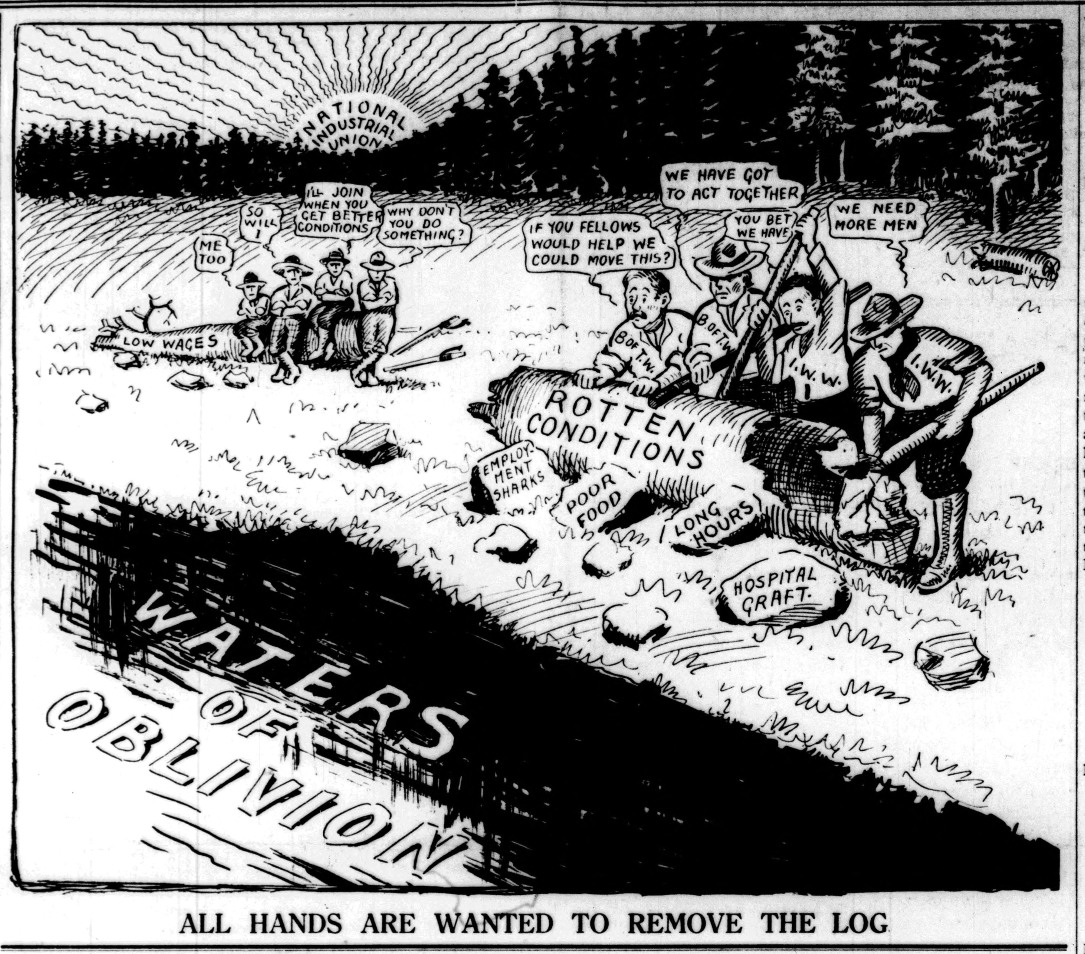
The I.W.W. confronts the many obstacles to organizing lumber workers that the craft unions were unwilling and unable to confront. A call from William Trautman and Vincent St. John to build the Lumber Workers Industrial Union.
‘Address to All Lumber Workers’ from Industrial Worker. Vol. 3 No. 35. November 23, 1911.
MANIFESTO.
To All Woodsmen and Workers in the Lumber Industry.
Deep in the woods where the lumber worker drifts from camp to camp following his hard and arduous toil, isolated from the large communities for weeks and months, he feels as keenly as the workers in industrial centers the oppressive hand of the employing class. He has less chances to resist the condition he suffers from, because he is separated from the other workers in factories and workshops.
Concentration of the control of capital into fewer and fewer hands has resulted in an increase in the misery of the workers in the woods. All land covered with timber today is owned and controlled by gigantic corporations. Although operating under different names in various parts of the North American continent, the grasping hand of that octopus has established a monopoly, not only in the United States but in Canada and Mexico as well. The organized employers own all the means by which the workers make a living: they have used the weakness of the toilers to rule with iron hand in the domain they survey, and working conditions have been rendered almost unbearable.
Competition among employers in the working of lumber possessions is eliminated. Competition among workers for jobs has become more keen; the speeding up of work, the introduction of modern machinery for cutting and preparing lumber for the market, has destroyed former human skill. Well paid jobs have been abolished. Better paid workers are crowded out and displaced by lower paid labor–the latter have not learned yet, that the hand of friendship offered by the agents of the employers conceals the dagger by which dissatisfied workers are cut out of their jobs, if they refuse to be contented with conditions that the employers impose, conditions which the workers are forced to accept because of the lack of understanding and co-operation with all other workers in the same industry. While the capitalists have organized and concentrated their power to reap all the benefits of advanced methods of production, the workers are separated from each other, and for the most part disorganized.
Those in Eastern Canada and Maine, working for the same employers, have no connections with the thousands in Louisiana, Texas and the southern states. The latter again are separated from their fellow workers in the big lumber districts of Montana, Oregon, Washington, British Columbia and other western sections of the North American continent.
Bent under the heavy load of capitalist oppression, the workers in the industry are rapidly being driven to a common level of peonage. By long hours of toil, in these days of fabulous profits, created by the workers for the corporations, the workers help to keep a reserve army of toilers on the labor market. This reserve army, competing for jobs, help the employers to keep wages down so that those at work can hardly earn enough to provide for the necessities of life for themselves and their families.
The employers no longer care whether a worker is white, yellow or black; whether a “free born American,” French-Canadian or Hindoo emigrant, so long as they are satisfied to work under the most appalling conditions. The employer treats them all alike and fights them all alike if any of them try to resist the outrages that the workers are compelled to suffer.
In the treatment of their wage slaves, the employers know no nationality or color–it is the muscle, the strength of the body that they need so that production for profit may continue.
Long, hours of toil and low wages are not the only wrongs the lumber workers endure; other abuses help to make life a burden of misery and despair. They are compelled to pay for all risks and insurance which the corporations establish in order to shift the expense of caring for the victims of reckless exploitation on the shoulders of the workers themselves.
The employers have had undisputed control over the life affairs of the workers because they have the power of possession, and all their institutions are well organized to function in the protection of their interests. They have reduced the expenses of production. With the increase of the immense profits that their possessions yield, they have lowered the standard of living of the hundreds of thousands who create all their wealth–millions of dollars flow into their pockets every year, pressed from the maimed and crippled bodies of the wage workers. Lumber workers in efforts to escape the grinding pressure of unlimited exploitation, have drifted into new fields, only to find that the corporations rule is supreme, no matter where they set their feet. There is no hope and no solution except the oppressed resolves to assert their rights and use the means at their command to enforce their claims.
Lumber workers have combined and in their efforts of resistance they have stood and fought together. But when united here and there the agents of the employers, disguised as labor leaders, forced one portion of them to stay at work producing goods for the same corporation, while in other parts they were bleeding to death in hopeless struggles to force a stop to the, appalling conditions under which they toiled.
The experience of the past must not go unheeded.
Whenever lumber workers organized for a struggle with the oppressors they always succeeded in bettering conditions for thousands in the industry. All the achievements of previous conflicts were snatched away every time they allowed the employers to divide them and force them into organizations which the employers could use to protect themselves against injuries to their game of profit making.
Thousands of lumber workers in Montana had reduced their hours of work, more men were given employment. Better wages were paid because the unemployed ceased to be an enemy of the men with a job. All this was accomplished when the lumber workers organized into an industrial union–when they used the fighting tactics of the Industrial Workers of the World.
The employers alarmed, fearing the consolidation of all workers in the industry throughout the width and breadth of the land, sought to escape by dividing the workers. Organizers of the American Federation of Labor accomplished for them what the employers themselves could not accomplish. They signed iron-clad agreements with the employers of labor by which all previous gains of the workers were lost. When the lumber workers rebelled against such outrageous infringement of their established conditions, when they struck together to retain the right to be united in one union, the “Labor Leaders” furnished strikebreakers to fill the places of the strikers.
Lumber workers who refused membership in the American Federation of Labor by order of the employers were discharged and black-listed and union strikebreakers helped to enforce the will of the employers and their allies of the American Federation of Labor. Clubs and guns of hired Hessians were used by the traitors to compel obedience to their mandates. The workers were thus deprived of the results of previous struggles for better things. When organized in some of the sections of the country, lumber workers had to tie themselves by contracts with employers! not to support their fellow workers in other parts who were engaged in a struggle for better working conditions. The skilled worker would be separated from the less skilled; the shingle weaver organized in a union of his own would have nothing in common with the other saw mill and lumber workers. Each of them had a separate craft organization, they were separated in their struggle against bad conditions. Even in the same camp or mill, members of one union would not support those of other crafts when they were on strike or locked out by the employers. In such unions the workers are not united. Therefore no union at all is better than to be organized for constant defeat. Where all now suffer under the same oppressive conditions, efforts to gain advantages of a few at the expense of the many, would tend only to divide the workers still more. Misery and abuses would not be abolished by such methods or by organizations organized to promote such ends.
Unity, solidarity–ONE BIG UNION–is the command of the rising working class.
Lumber workers all over the country have sounded the keynote for a new call to action. They are coming together, in the west, the south, the east and the north to organize all workers in the woods and in the saw mills into one big union.
The organizations are founded on the program of the Industrial Workers of the World, an organization that is at war with the employing class for the good things of life and aims to make the wealth producers of the world masters of their own destiny. They are banding themselves together to get a larger share of the products of their toil; they are preparing to free themselves from the yoke of the wage system.
They have formulated a program of demands which will bring the workers in the woods and mills together in an organization so thorough that the aim may be accomplished. The lumber workers demand:
A general reduction of the hours of work to eight hours a day. More work will then be distributed among workers now out of jobs. Competition for employment will be decreased, wages must rise and better living conditions be secured. Equal pay for the same kind of work will be enforced through the combined efforts of the workers organized in all lumber districts.
With more time for recreation, the workers will elevate the condition of life outside of the place of employment–they will learn to be conscious of their rights. The meetings of the organizations will be the place where the workers will enlighten themselves, will drop the spirit of selfishness and foster the spirit of solidarity and brotherhood with all fellow workers.
With the combined efforts of the working class, of which the organization of lumber and forest workers will be a part, they will establish freedom for the workers and the abolition of a system under which a small class of idlers takes the results of the labor of millions of toilers.
With these demands as an outline for the future work and activity, we call upon all workers employed in the woods, that is, all employed in shingle mills, saw mills, lumber camps, etc., to organize and come together, so that they will be able to send delegates to the First National Convention of Forest and Lumber Workers for the formation of the National Industrial Union of Forest and Lumber Workers.
The said convention will be held in the city of Seattle, Wash., Sunday February 12th, 1912 at 211 Occidental avenue. The first day’s session will open at 9 o’clock a.m. Representation will be as follows:
Each local union will have one delegate for each 200 members or less and one additional) delegate for each additional 200 members or majority fraction thereof.
Each delegate shall have one vote for the first fifty members and one additional vote for each additional fifty members or majority fraction thereof.
Local unions that are not affiliated with the Industrial Workers of the World will be allowed a vote provided they are instructed by the body which they represent to install the organization as a part of the National Industrial Union of Forest and Lumber Workers, to be formed.
Providing they are not so instructed, such delegates will be allowed a voice, but no vote.
HOW TO ORGANIZE!
Every worker in a lumber camp, in saw and shingle mills in a given locality, can become a member of a branch of a “Lumber Workers’ Industrial Union” with headquarters in a most centrally located town in a given district. Each camp or mill elects delegates to the “Lumber Workers’ Industrial Union.” All the delegates who come together in meetings at regular intervals from the administrative body of the industrial union, and they interchange the news and reports from the various camps and mills and take action on all matters that that affect the interests of all workers in district. The officers of the local industrial union are nominated by the delegates and are elected by the votes of the members in all branches comprising that industrial union of lumber workers.
The initiation fee for every member shall be not less than $1.00 and never more than $5.00. Monthly dues shall be 50 cents, of which 15 cents will be paid into the treasury of the National Industrial Union of Forest and Lumber workers for purposes to be outlined in the general constitution of that organization.
All local industrial unions and their branches are part of a National Industrial Union of Forest and Lumber Workers, which organization will formulate its constitution at the coming general convention, to which all local industrial unions of lumber workers will send delegates.
Workers in the lumber industry, Get Together. Organize for victory! Where there is no organization, organize with a few fellows for the start. The others will follow when they see that a few courageous workers unfurl the banner of the Industrial Union of Lumber Workers.
Issued by the General Executive Board of the Industrial Workers of the World.
Attested: (Seal.)
W.E. TRAUTMAN, General Organizer. VINCENT ST. JOHN, General Secretary-Treasurer.
The Industrial Union Bulletin, and the Industrial Worker were newspapers published by the Industrial Workers of the World (IWW) from 1907 until 1913. First printed in Joliet, Illinois, IUB incorporated The Voice of Labor, the newspaper of the American Labor Union which had joined the IWW, and another IWW affiliate, International Metal Worker.The Trautmann-DeLeon faction issued its weekly from March 1907. Soon after, De Leon would be expelled and Trautmann would continue IUB until March 1909. It was edited by A. S. Edwards. 1909, production moved to Spokane, Washington and became The Industrial Worker, “the voice of revolutionary industrial unionism.”
PDF of full issue: https://www.marxists.org/history/usa/pubs/industrialworker/iw/v3n35-w139-nov-23-1911-IW.pdf

