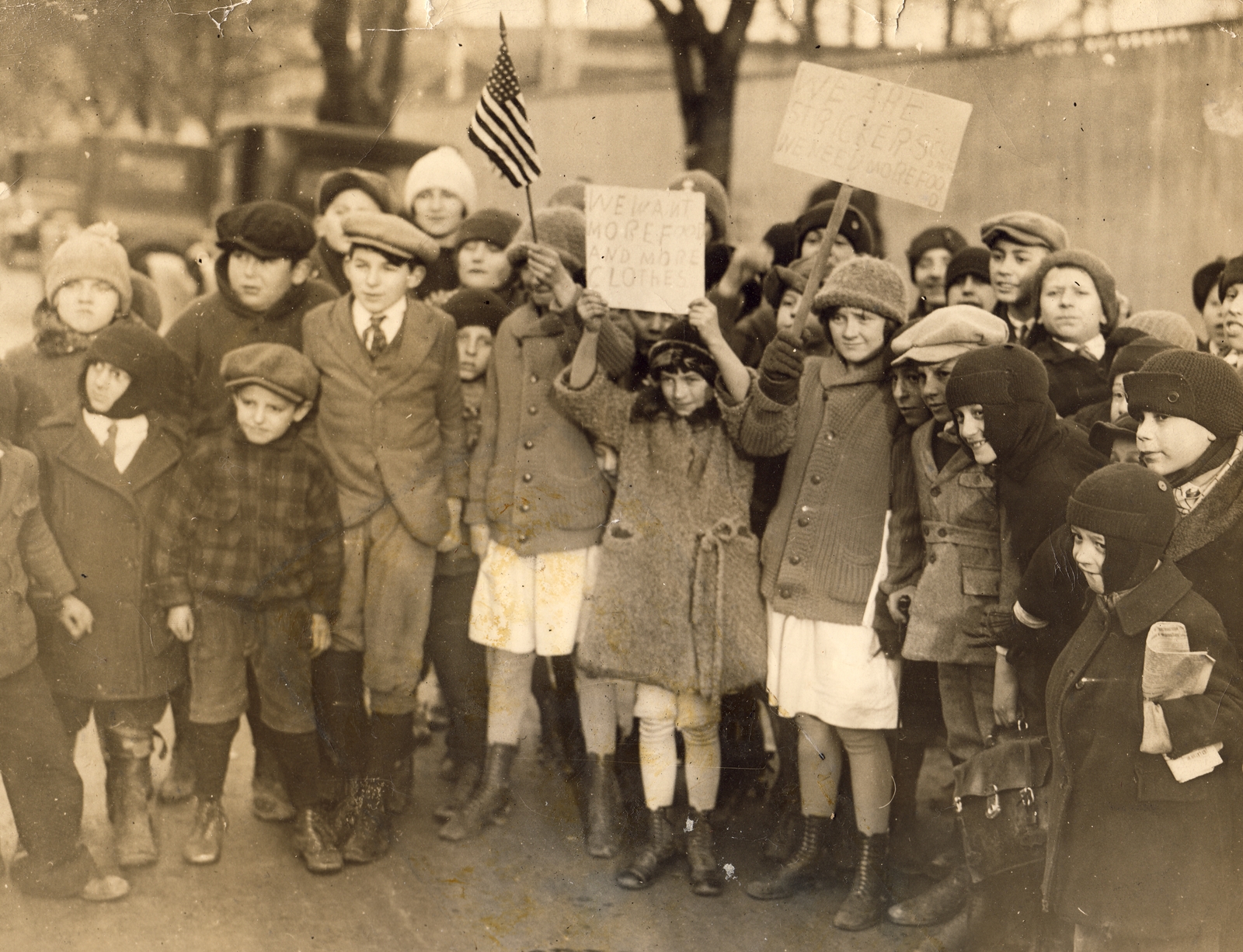
Nat Kaplan, who came into politics through the Young People’s Socialist League and helped lead many from that organization to the new Communist movement, was Secretary of the Young Workers League’s Junior Section, later the Young Pioneers, when he made this appeal to ‘militant parents.’
‘A Word to Militant Parents’ by Nat Kaplan from the Daily Worker Saturday Supplement. Vol. 2 No. 112. May 23, 1925.
IN the Communist Children’s Movement, the Junior section of the Young Workers’ League the basis for the new, more realistic, relationship between adults and children is being laid.
This is demonstrated on the one hand by the methods used by the group leaders (in the main members of the Y.W.L.) in the development of the initiative and self activity instincts of the child; the development of its observing instincts thru which it acquires material for its self instruction, etc., and on the other hand, by drawing the parents into the life and struggle of the children, thru the creation of parents’ conferences and proletarian parents’ school councils.
Why raise this issue of a new relationship between adults and children? Simply because the old relationship—the one in force at the present time is an utterly false one, is based on the bourgeois conception of the “right of the stronger,” and as such must be completely discarded. The wielding of an unpremeditated, nonsensical discipline over the child, by virtue of the economic and physical domination of the adult over the child, in no wise can be conceived as the guiding of the child along a correct line of procedure. In only one sense can the adult gain superiority over the child for the safe of guiding its actions and that is by acquiring a greater knowledge and a more keenly developed mentality than the child itself. Hence, Herbert Spencer in addressing himself to parents at large has ably remarked: “In brief, you will have to carry on your higher education as the same time that you are educating your children.” One of the first lessons to be learned in this course of “higher education” is that adults and children must meet on an equal plane of comradeship, that only to the extent that the adult is able to win the confidence and friendship of the child, is he able to guide and lead that child in the acquiring of knowledge and in its general activities.
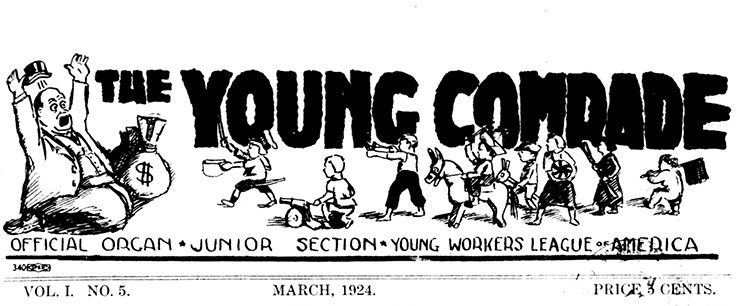
Militant Parents Must Line Up.
For the Communist parents and the militant parents of the labor movement there can be no better start made in this direction than by acquiring a knowledge of the principles at work in the Communist children’s movement. Once this is realistically undertaken, we will no longer hear of the many cases of radical parents who have obstructed the class struggle activities of the young rebels by a parental treat, a castigation, or even by depriving the child of a meal.
We will then see the parents taking the initiative in the creation of school councils. We will see them setting up committees to visit the school authorities and presenting the demands of the children. We will see them helping in every manner possible to strengthen the school organization of the children—the school nuclei of the Junior section and even helping to lead the concerted actions of the children against the school authorities, against the nationalist and religious dope peddled under the guise of “education” and against the general miserable conditions of the proletarian child in our citadels of learning. The American bourgeoisie has long recognized the necessity of coordinating the home life of the child with its life within the public schools. For this purpose they have set up powerful parent-teacher associations which are decidedly reactionary in character. The answer to the American bourgeoisie on this field must be the united front between the proletarian parents and their offspring in the children’s struggle and the class struggle at large.
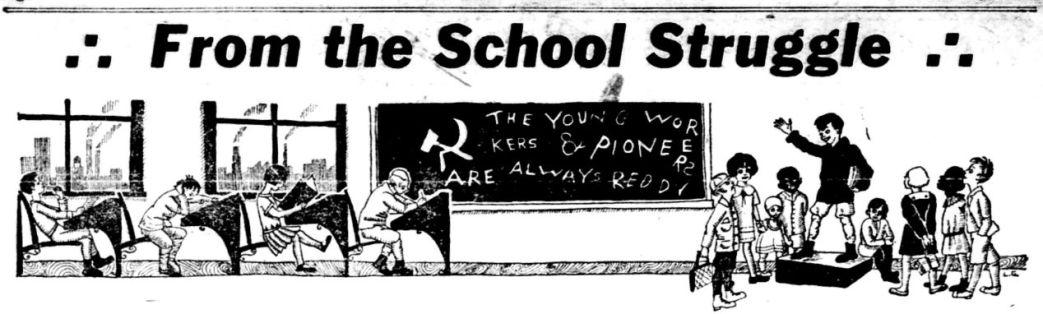
Wherein the Principles Are Contained
In order to make this start the militant parents will have to acquaint themselves with the literature on the Communist children’s movement The international theoretical and practical publication of the Communist children’s movement is known as “The Bulletin for the Leaders of Communist Children’s Groups” and is published by the executive of the Young Communist International. Volume No. 2. Issue 3-4 of the Bulletin (Ten Cents, Y.W.L., 1113 W. Washington St.) has just arrived from the publishing house. This issue is decidedly up to its standard. Under the title: “The Character of our Work in the Communist Children’s Group,” Comrade Gertrude Graeser has a very clear article dealing with the systematization of the educational work in the C.C.G. She divides the subject into two main features: (a) The training of the leaders, and (b) The education of the children. The important feature of this article is the plan of educational work that the writer presents us, which is especially adaptable to the 12 to 14-year-old children (Those who are about to leave public school and are entering the Young Communist Movement).
Comrade Sigi Bammatter writes in this issue on the necessity of “A closer organizational form for the C.C.G.” The American Junior section comes in for special mention as having maintained a compact, centralized organizational form for its children’s movement from the very start.
Other important and interesting features of the issue are: A discussion statement on the reorganization of the Communist children’s groups on the basis of school nuclei. An article by Comrade Rosa Moeller on the New Generation in Soviet Russia, a contribution to the question of the “New Humanity,” which clearly describes the lot of the child in the U.S.S.R. at the present time; an article dealing with the formation of the Young Spartacist League in Germany to replace the loosely knit Communist children’s groups. Two highly instructive articles on the functions of the Young Pioneers in Soviet Russia with its 700,000 young members. Two interesting reports from Great Britain and America and an article portraying the literary achievements of the children in accurately picturing the conditions of the workers’ children in the capitalist countries. You should not miss the opportunity of securing your copy at once.
The Daily Worker began in 1924 and was published in New York City by the Communist Party US and its predecessor organizations. Among the most long-lasting and important left publications in US history, it had a circulation of 35,000 at its peak. The Daily Worker came from The Ohio Socialist, published by the Left Wing-dominated Socialist Party of Ohio in Cleveland from 1917 to November 1919, when it became became The Toiler, paper of the Communist Labor Party. In December 1921 the above-ground Workers Party of America merged the Toiler with the paper Workers Council to found The Worker, which became The Daily Worker beginning January 13, 1924. National and City (New York and environs) editions exist
PDF of full issue: https://www.marxists.org/history/usa/pubs/dailyworker/1925/1925-ny/v02b-n112-supplement-may-23-1925-DW-LOC.pdf

