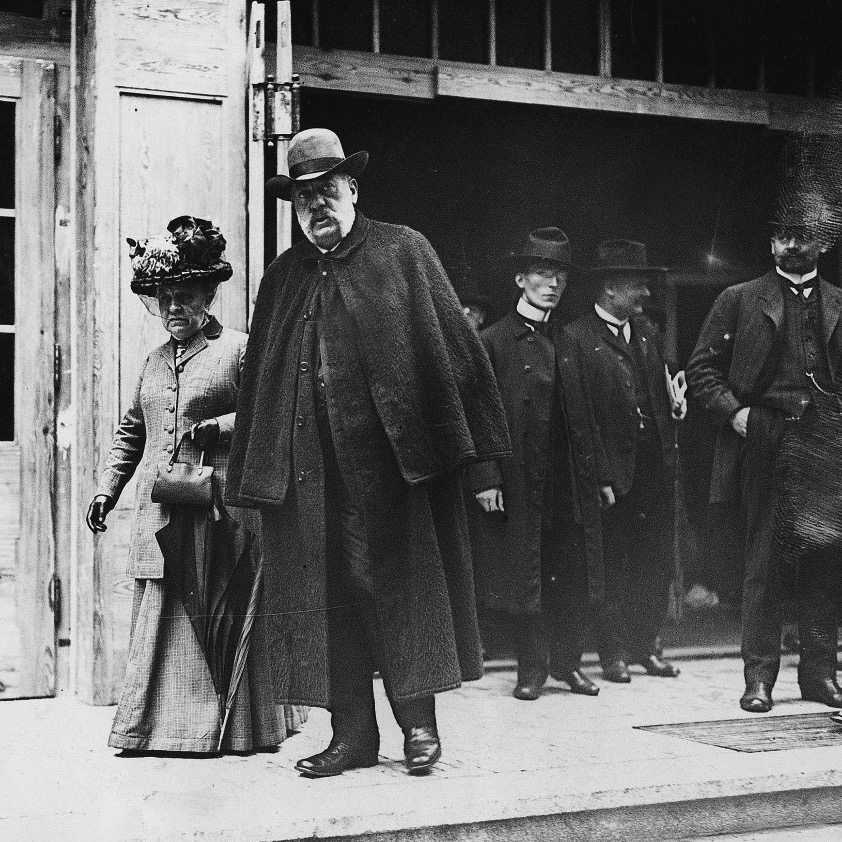
A U.S. correspondent from ‘The Comrade’ visits one of the giants of German Social Democracy.
‘A Chat with Paul Singer’ by Richard Kitchelt from The Comrade. Vol. 1 No. 12. September, 1902.
If mere quantity is a title to greatness, the city of Berlin may justly claim it; for it is the fourth city of the world in point of population, containing within its limits nearly two millions of human beings. But it would be unjust to the workmen whose brains and hands planned and built its palaces, parks and monuments to declare that the city had no other claim to greatness than the mere number of its inhabitants. There is much in Berlin that is both great and beautiful; and even its slum districts are not quite so hideous as those of New York, Chicago or Paris.
Perhaps this is because the poor of Berlin have more representation in the municipal and national governments; for Berlin, the capital of the German Empire, is at once the brain and heart of the largest and best organized body of revolutionary Socialists the world contains. Here are to be found the nestors of the political and revolutionary movement- the master minds which, with tongue and pen, from lecture platform, newspaper press and legislative hall, mold the opinions of their followers.
It is here that the greatest power to which political Socialism has yet attained, finds expression, and, through the number of its supporters and the ability of its representatives, commands a respect and attention which is potent to accomplish reforms for the amelioration of the condition of the working class. The best known of the German leaders, August Bebel, had gone on a vacation to Switzerland to rest after the past year’s labors; but your correspondent was fortunate enough to secure an interview with the not less able Paul Singer, whose work in the Reichstag and on the “Vorwærts,” the leading Socialist organ of Germany, is second to that of no man.
Herr Singer was found in his study at his home, a modest flat in the middle-class district of the city, busy with a batch of the morning papers.
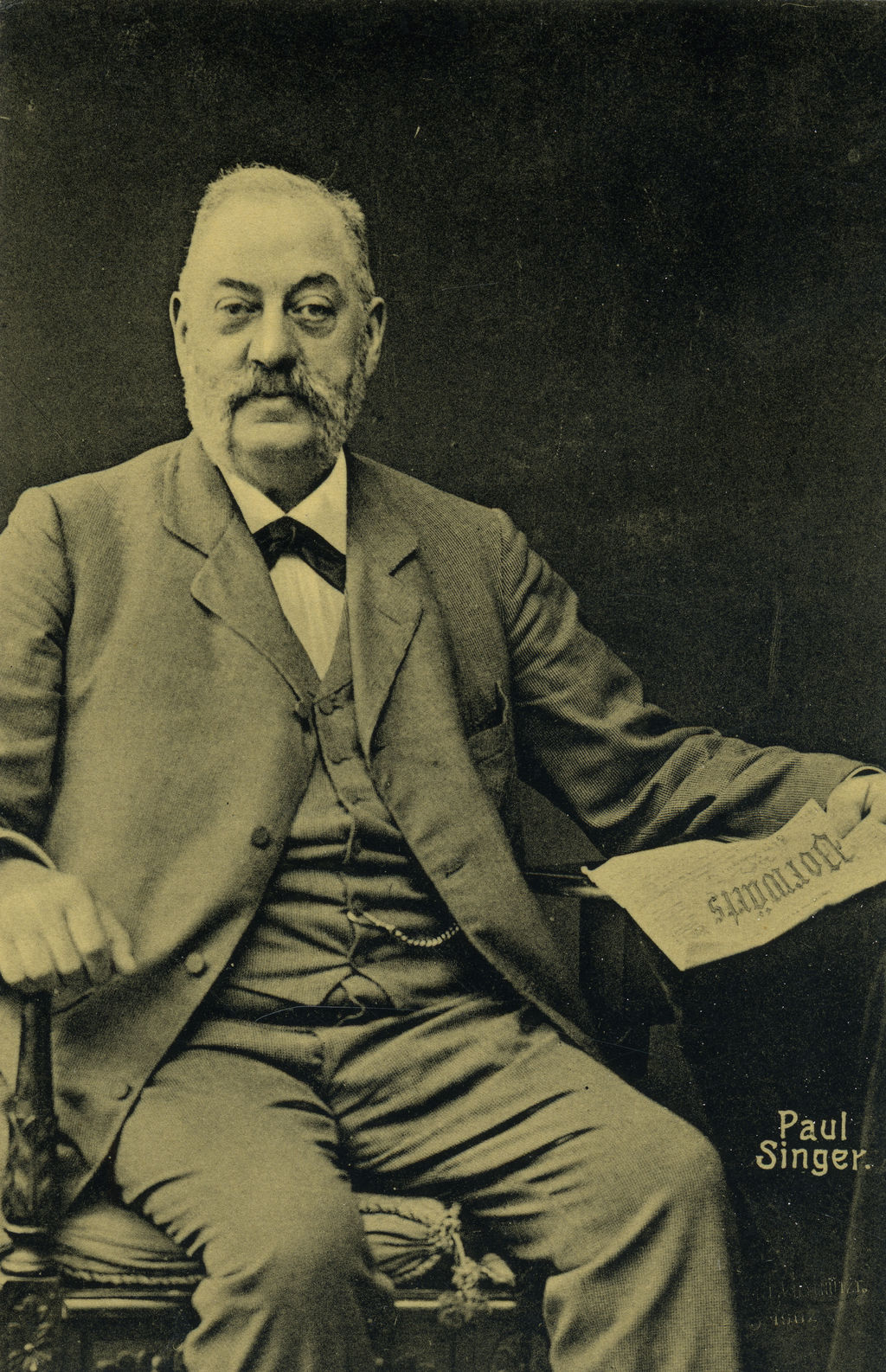
He is a large man, past middle age, with gray whiskers and rather prominent eyes. His voice is deep and full, and he handled the rotund and sonorous German tongue with a mastery which indicated the probability of oratorical power.
But Herr Singer refused to be interviewed. His words had been so frequently distorted and his opinions misrepresented that he had resolved never again to express any views for publication unless he could read the proof sheets. Evidently newspaper correspondents in Germany have their limitations as well as those in the United States.
So your correspondent found it necessary to disavow the intention to interview, but in the course of conversation which began with observations on the facilities for. travel in various countries and continued with a discussion of economic conditions in the United States, secured expressions of opinions on various subjects, some of which may interest the readers of THE COMRADE. “What do you think of the Independent Labor movement?” Herr Singer was asked, after the present status of that movement had been explained to him.
“It seems to be a good sign of the growth of a class conscious sentiment among the workers. They seem to be beginning to recognize that they have interests different from those of the capitalists. Your trades unionists in the United States seem to have very little understanding of their class interests; they form powerful unions, but they vote for the capitalist parties at every election. I do not imagine your Independent Labor people even when elected will be able to do much. Your city governments have no power as I understand it. I do not believe much of any importance can be accomplished until the working class controls the entire government.”
“Then you do not believe in immediate reforms?”
“Surely. We should do all possible to improve the condition of the working class; but we should be careful to keep the main principles always uppermost; the minor reforms will take care of themselves.”
“It has been suggested that with the growth of discontent the capitalists will make concessions to the workers, reduce their hours of labor, raise their wages and employ more of their number more steadily, endeavoring thus to satisfy the workers and establish more firmly the modern plutocracy?”
“If the capitalists do that it will merely help Socialism. Concessions do not make the workers contented. It is a peculiarity of human nature that the more people have the more they want. When the workers receive more pay for shorter hours they will be more inclined to rebel than ever. The hardest subject for Socialism is the most downtrodden. workman. The German Social Democratic Party tries to improve the present condition of the workers as much as possible, believing that thereby it helps its cause.”
“With this growth of Socialist sentiment will not the capitalist parties offer reforms in order to stem the tide toward the Socialist party?”
“That is a question which has ceased to interest the Socialists of Germany. Their party has become so strong and its uncompromising character so well known, that the other parties make few attempts to alienate those who vote for it. It is known as the representative of the working class and those who desire working class reforms already vote for it in preference to parties which do not stand for that class.”
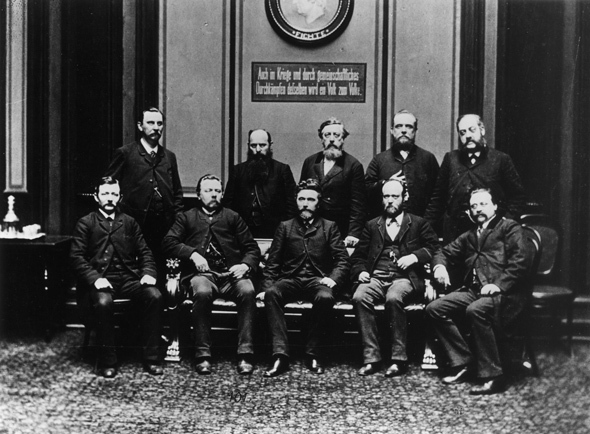
“Herr Bebel has written that a very large number- perhaps two millions of those who vote for the Socialist party in Germany do so because they desire the reforms which it advocates rather than because they seek the establishment of the co-operative commonwealth.”
“I have not seen that statement. It is no doubt true that a very large portion of the Socialist vote is due to the immediate reforms the party is striving for and because it is recognized as the only party which does anything for the working class. At the same time it is certain that very few of those who vote for the Socialist party do not desire, and believe through it ultimately to establish, the co-operative commonwealth. We get all we can now, but we keep the goal before us.”
Pressed for an expression of his views on the question of the Church and Socialism, and also as to what he would consider the wisest course of action to be pursued in the United States, Herr Singer refused positively to offer anything. On the former, because the matter was one of such intricacy that he was sometimes willing to write about it, but never talk; and with reference to the latter, because he was not sufficiently familiar with conditions in the United States.
At this point the arrival of other visitors compelled the termination of our conversation; but in parting Herr Singer expressed the desire that his highest regards be conveyed to his co-workers in the United States and voiced the encouraging opinion that the concentration of industry in this country was bringing it to Socialism more rapidly than Europe could hope to attain to that desired state.
The Comrade began in 1901 with the launch of the Socialist Party, and was published monthly until 1905 in New York City and edited by John Spargo, Otto Wegener, and Algernon Lee amongst others. Along with Socialist politics, it featured radical art and literature. The Comrade was known for publishing Utopian Socialist literature and included a serialization of ‘News from Nowhere’ by William Morris along work from with Heinrich Heine, Thomas Nast, Ella Wheeler Wilcox, Edward Markham, Jack London, Maxim Gorky, Clarence Darrow, Upton Sinclair, Eugene Debs, and Mother Jones. It would be absorbed into the International Socialist Review in 1905.
PDF of full issue: https://www.marxists.org/history/usa/pubs/comrade/v01n12-sept-1902-The-Comrade.pdf

