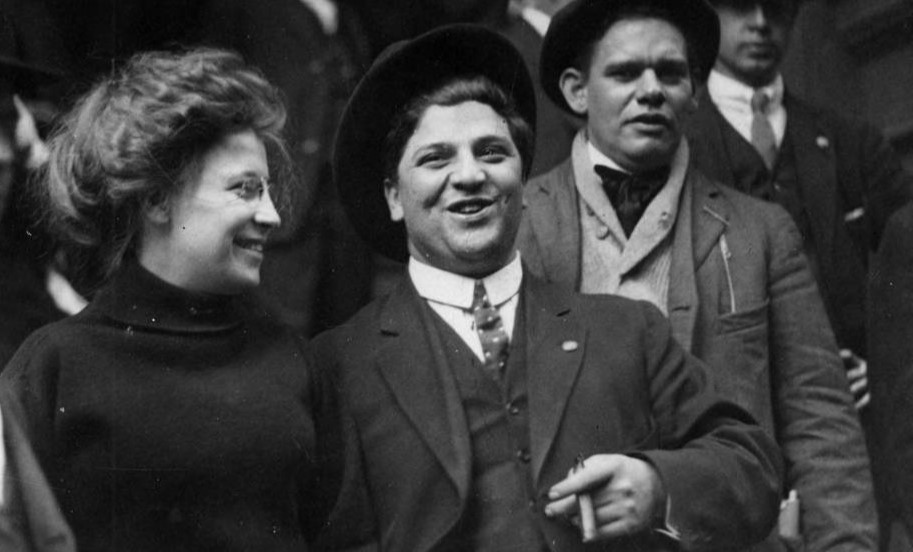
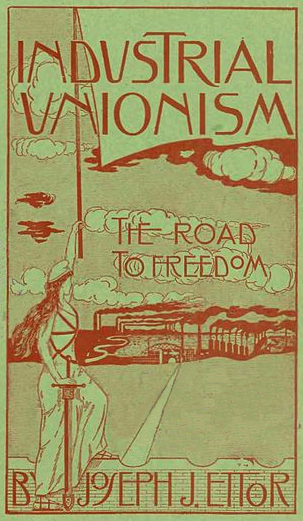
It must have seemed Joseph J. Ettor was everywhere for several years. A paid wobbly organizer at the center of some of the highest profile strikes in the I.W.W.’s most influential era. His activism in 1912’s Lawrence Strike led him to be charged with murder along with Arturo Giovanitti, for which he potentially faced death leading to a mass campaign in their defense. Both were acquitted in November of 1912. Justus Ebert looks at his life and character.
‘Who Joseph Ettor Is’ by Justus Ebert from Industrial Worker. Vol. 4 No. 9. May 23, 1912.
The name of Joseph J. Ettor is now heard throughout the land. It is on the lips of workingmen and women in, the remotest parts of the country. It is indissolubly connected with the great Lawrence strike and the Industrial revolt in New England which began there. It is a name that is destined to become famous in conjunction with the attempt of reactionary capitalism to kill revolutionary industrial unionism by means of the infamous legal doctrine of “accessory before the fact to murder,”—a doctrine from which even despotic Russia is free.
Despite the widespread use and the historic connection of his name, despite the fame which posterity is likely to bestow upon him, little, very little is known of Joseph J. Ettor, the man. The question is accordingly often asked: Who is Joseph J. Ettor? What is his personality like, anyhow? How did he become so well-known? These questions are all well put. Any innocent labor leader whom it is desired to put to death in the interests of capitalism and according to its most oppressive legal perversions, is a man of merit and worthy of intimate working class acquaintance
Joseph J. Ettor is a native of the United States. His parents are Italian. He is slightly over 26 years of age, and unmarried. Though short and stocky, he walks with the quick, nimble step of a woman. His hair is black and flowing. His eyes are dark brown, his cheeks, fat and rosy. His whole manner is open, candid and boyish. His attire, at best, with his big soft hat worn jauntly on one side and his big flowing windsor tie and natty blue suit is suggestive of the prosperous bourgeoise or the artistic Bohemian-though Ettor is neither of these, being sound and substantial in many respects.
Ettor has lived most of his life in the West. In addition to the audacious, quick-witted enthusiastic temperament inherited from his Latin ancestors, the West has given him practical fortitude and an indomitable spirit. There is nothing absolutely volatile and effervescent about Ettor. His is a light and gay spirit united with many sturdy qualities both of head and heart. He is an energetic, bright, courageous young man of ideals.
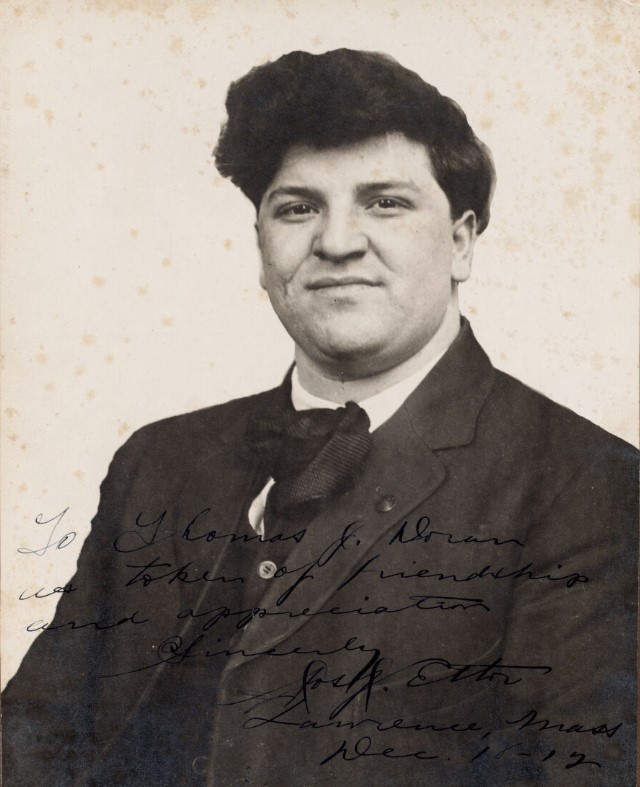
Ettor’s birth-place is Brooklyn, N.Y. Few things but churches, grave-yards and bed-chambers are known of Brooklyn. But it has within its confines, some of the biggest industrial trusts and plants in the country, and now it can claim the honor of having been the city in which this modern labor leader first opened his eyes. Ettor was not allowed to enjoy the sight long. His parents left funereal and somnolent Brooklyn shortly after he was born.
They migrated westward. His father, a laborer, was in Chicago. during the great eight hour strike of 1886. He was struck in the back with a brick, during one of the many melees attending this epochmaking period in the history of the American labor movement. The youngster, Joe, as he is fondly called by those nearest to him, often heard his father recount the foregoing incidents. “The old man,” as Joe affectionately refers to him, “was proud to be a striker; in those stirring times.” It was from his father that Joseph J. Ettor first imbibed the revolutionary spirit.
We next hear of Ettor on the Pacific coast. Miss Jane A. Roulston–the “Red Virgin” of Jack London’s “Iron Heel”–writes of him: “When I first knew Ettor in San Francisco, he was hardly more than a child, a big fat boy, member of the socialist party of which I did not then approve on account of my membership in the socialist labor party. The Industrial Workers of the World brought us together. My first impressions of him are as to his capacity for quick action, practical expedient action, without premeditation. I remember his writing a resolution in a few minutes, which would have taken the rest of, us several hours of thought, and his resolution was just right, though perhaps not perfectly grammatical.
“In many cases he showed great presence of mind in sudden crises. He is essentially an emergency man.
“After the earthquake of 1906, the I.W.W. men lived together in a tent; Joe was made organizer. Although other labor was well paid, the debris workers who were many, worked for a mere pittance. Ettor organized them. He DISAPPEARED. We had some trouble finding him, as the prisons were shaken down and the authorities were using make-shifts of all kinds. At last we found him in one of them. He had been secretly arrested with one companion on the ridiculous charges of threatening some boss’s life, and prevented from communicating with his organization. We got him out. The case never came up, there was no case, in fact.
“During the early days of the earthquake season, I mean while the city was in a state of fear and excitement, though the quake was over, we used to hold large street meetings and the stricken town was full of Pinkertons. At one of our street meetings, several of them tried to make trouble by starting little personal fights. Joe “spotted” them at once and gave warning: but at last, they did get up a little row and one of THEM Tell through a large expensive glass window of an adjoining store. Joe at once jumped on the box, called the crowd around him, called off OUR men, and so explained the trouble, in such clear, terse language (calling also for witnesses from outsiders) that the affair was never referred to and the glass was replaced early the next morning (Sunday, too). It was not replaced by the owners of the store either.” This youthful beginning of an eventful career is typical. Ettor has repeatedly been arrested for his resourcefulness and courage in the interest of the working class; once at Reading, Pa.; now at Lawrence.
While in Frisco Ettor was employed as an iron worker in the shipyards of the city. He left the Golden Gate city some four years ago to travel up and down the Pacific coast as an organizer of the I.W.W. In this capacity. Ettor visited mining, lumber and railroad construction camps and became acquainted at first hand with the rigorous capitalist exploitation and oppression prevailing in them. He is familiar from practical experience with the company police, company stores, blacklist, stockades, and other methods used by the big corporations to keep their wage-workers in slavery. He has been forced more than once to leave on threat of being killed and often at the point of the gun. Many tales does he tell of meetings of miners held in secret, frustrated by spotters; of how, when employed in a mine or a lumber camp he was often discovered and discharged unceremoniously. Ettor doesn’t know the class struggle because he talks it; he talks it because he knows it.
Ettor first came eastward during the great McKee Rocks, Pa., strike three years ago. In this battle which ended in the defeat of the Press Steel Car Company, he displayed his usual courage and resourcefulness in company with many other notable leaders of a like type. The McKees Rocks strike was remarkable in that it was waged almost entirely by foreigners and unskilled workers. Also for its use of new tactics, such as mass picketing and aggressive defensive measures. It was the only strike in which the State Constabulary, or Cossacks, were ever tamed and defeated. Louis Duchez, writing in the International Socialist Review, November, 1909, says the “McKees Rocks strike, without doubt is the most revolutionary event that has transpired in this country. In no strike of such proportion in this country at one place has there been less blood-shed than at McKees Rocks.” The six thousand workers were victorious. They gained more wages, half Saturday holiday, no Sunday work and many beneficial changes in conditions.
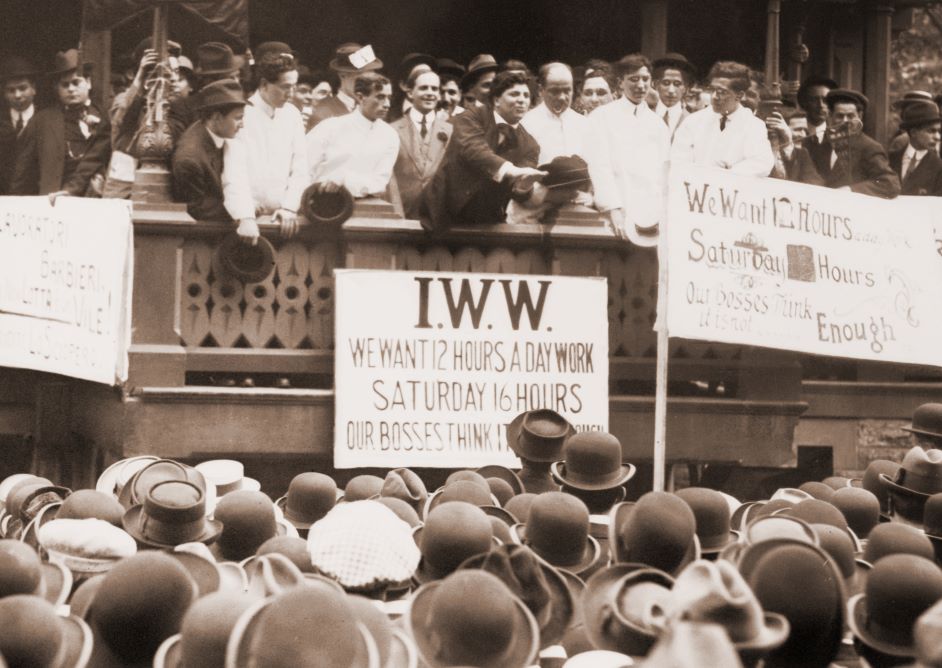
Ettor contributed largely to this victory. Besides speaking English and Italian fluently, he also understands Polish and Jewish and some Hungarian. At the close of this strike, it was mainly on Ettor’s shoulders that the work of sustaining the organization thus established fell. And it was during this period that he incurred the hatred of the capitalists for his aggressive activity on behalf of the workers. They blamed Ettor for being the one man who stood in the way of their subjugation of the working class in McKees Rocks. They accused him of all the diabolical crimes on the calendar. His articles in the McKees Rocks Leader of that period make extremely interesting reading.
Ettor was also acting in the big strike in Schwab’s Steel Works at South Bethlehem, Pa. In company with Joseph Schmidt, he called big mass meetings, inaugurated mass picketing, introduced tactics that defeated the state constabulary, the Cossacks, so-called, in their attempts to ride down ad break up the ranks of the strikers, thereby turning what looked as a disastrous defeat into the promises of a victory. The A.F. of L. stepping in and organizing the industry according to crafts, Ettor and Schmidt withdrew and the strike ended in failure.
The big coal strike at Westmoreland, Pa., was also one of many scenes of Ettor’s activity. Here, two mounted Cossacks, smarting under his condemnation of the brutalities of the state constabulary, rode toward him in a menacing manner, when Ettor warned them to keep their places. Said he to them “I am speaking here within my constitutional rights. I know my rights and possess the determination and the backing of my organization to maintain them. I defy you to interfere with me.” The Cossacks were cowed, they kept their hands off of Ettor.
Ettor has also labored in the anthracite regions, and is well known in Scranton and vicinity. He would be a danger to the coal trust if at liberty. This is an additional reason why he is imprisoned.
Some of Ettor’s methods were employed in the Brooklyn Shoe Workers’ strike, where he next became known. The mass meeting and the mass action were here invokes with good results. Ettor would urge all hands out on the picketing line, and like a true leader, he goes where he urges his followers to go. He was foremost on the picketing line, encouraging the men, indicating to them how best to conserve their interest, with a camera under his arm, taking snapshots of incidents showing the line-up between masters and men. At the mass meetings, he utilized the various phases of the strike to drive home their economic significance. He showed, for instance, that industrial development had created the Leather Trust, the Shoe Machinery Trust and the Shoe Manufacturers’ Association, all united by financial ties into one big organization in opposition to the interests of the shoe workers; that the shoe workers must organize on similar lines: that they could no longer divide into crafts, but must organize as their industry is organized. To the cutter, finisher, turn sower, etc., must be united the engineer, fireman, and teamster employed by the firm or corporation. Ettor, on one occasion, taking up the various national, religious and other devices by which the workers are divided by the bosses, said in part:
“In the shop there is no flag. In the shop there is no religion. In the shop there is no party. In the shop there is no nation.
“In the shop there is only work and workers. In the shop the workers must get together on the basis of their work and attack their exploiters.
“In capitalism, all over the world, there are only two nations, the workers and the capitalists. Your place is with the workers and in the Industrial Workers of the World.”
On another occasion he said, “You cannot make shoes without shoemakers. Your shoe factories may be ever so well built and stocked. Your machinery may be of the very latest kind. You may have the best brains in the world directing your plant. Still you cannot make shoes. To make shoes requires shoe workers. It is the shoemakers who made your plants productive, who give value to your stock and who make your executive ability profitable. The shoemakers are the shoe industry and to them should the shoe industry belong. We want not only more wages, but industrial control.”
These are samples of Ettor’s “incendiary speeches.”
Ettor is an object of Pinkerton persecution. They dog his steps day and night, yet Ettor is not bitten by the Pinkerton magot. He does not see a Pinkerton in everybody who disagrees with him or acts in a manner detrimental to the interests of the working class. This is well reflected in an incident that occurred in the Brooklyn shoe strike. A Jewish fitter was accused of having betrayed his fellow employees to the boss, and on his appearance at one of the meetings, there were cries of “throw him out of the window. He’s Pinkerton.” Ettor refused to allow such a thing to occur. He said, “Boy’s, let’s hear what the lad has to say for himself. Give him a show to be heard. And if he makes good, we’ll forget what he has done.” Accordingly, the man was heard, and though his confession was damaging, he expressed contrition, and was permitted to attend the meetings and take his place in the ranks. Though often dogmatic, even a boss, as the circumstances may require, Ettor is none the less a tolerant and broadminded leader of men.
Ettor’s next appearance in the class struggle was at Lawrence. Lawrence is too recent to need much retelling. Even the capitalist press admit that Ettor was a factor for the preservation of peace on his appearance on the scene. The Brooklyn “Tablet,” a Catholic paper, says of Ettor, in describing his activities at the time referred to: “He had a personality that was winning in its way. He spoke English and Italian fluently. He soon had all the active spirits in the strike believing in him absolutely and ready to do his slightest bidding.” Such is the man who helped to defeat the Woolen Trust and to inaugurate an industrial revolt in New England, resulting in wage increases amounting according to various estimates, from five to fifteen million dollars annually, not to mention the improved conditions also introduced.
The “Tablet” is at great pains to malignantly and maliciously misrepresent Ettor and everything the has done, accusing him despite the statements of the capitalist press of Lawrence and Boston to the contrary regarding Ettor’s peaceful influence, as having inaugurated a reign of “terrorism of an undefined, undefined, widespread, all-pervasive kind.” It must have been very much “undefined” to have escaped the more accurate analysis of the acute mentality of the Jesuit who edits the “Tablet.” But be that as it may; let us hear what Ettor himself has to say on this point.
In the special Lawrence Strike edition of the New York Call of February 15th, a statement by Joseph J. Ettor appears on page 1. Referring to the attempt to flatter him into a betrayal of the strikers he says: “Arbitration boards, veiled invitations to dinners at Young’s Hotel in Boston, etc., failed to accomplish their purpose, so they changed tactics. At once I ceased to be a ‘good leader’ and became ‘inconsiderate.’ Riots took place, place, smashing cars, with police and militia present, and yet no interference. One of our girl strikers was shot dead by a bullet coming from the direction of the police.”
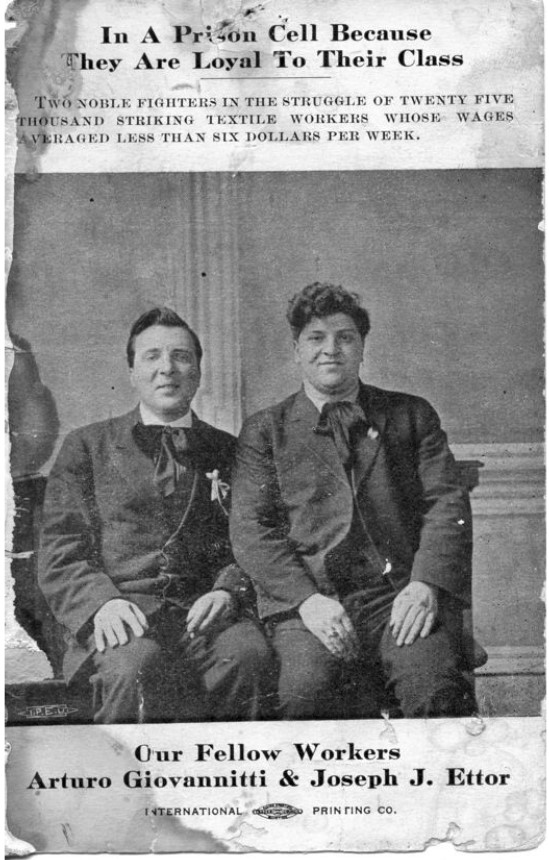
And now, the Woolen Trust magnates are going to electrocute Joseph J. Ettor for killing this woman who was done to death by their own police after Joseph J. Ettor had refused to do as they would have desired him to do. They have revived the old legal doctrine, used with such deadly effect on the innocent victims of the Chicago Haymarket episode of 1886, that is, the doctrine of “Accessory before the fact to a murder;” to a murder in which he had no part and which occurred when he was miles away from the scene, and for which no principal has been arrested to date. The whole thing is villainous and preposterous. Charles Edward Russell, in a recent-issue of the Coming Nation, says: “If that doctrine can be upheld, then any man anywhere that says anything not relished by any persons of power and influence is in peril, for almost any death, accidental or caused by a madman, can be charged to any man that opens his head on any vital issue.
“No more effective gag upon free utterance was ever devised. It arms the police at once with a power to suppress and silence discussion such as no tyrant has ever exercised in a monarchy. It is the most potent instrument of oppression that could possibly be invented and there should go up against it such a protest as the Woolen Trust would not dare to disregard.”
It now remains for the working class to make this protest and thus save the man who Bill Haywood says is one of the best labor leaders this country has ever produced.
The Industrial Union Bulletin, and the Industrial Worker were newspapers published by the Industrial Workers of the World (IWW) from 1907 until 1913. First printed in Joliet, Illinois, IUB incorporated The Voice of Labor, the newspaper of the American Labor Union which had joined the IWW, and another IWW affiliate, International Metal Worker.The Trautmann-DeLeon faction issued its weekly from March 1907. Soon after, De Leon would be expelled and Trautmann would continue IUB until March 1909. It was edited by A. S. Edwards. 1909, production moved to Spokane, Washington and became The Industrial Worker, “the voice of revolutionary industrial unionism.”
PDF of full issue: https://www.marxists.org/history/usa/pubs/industrialworker/iw/v4n09-w165-may-23-1912-IW.pdf

