
‘The Wave of Fascism in France’ by A. Bernard from International Press Correspondence. Vol. 5 No. 89. December 24, 1925.
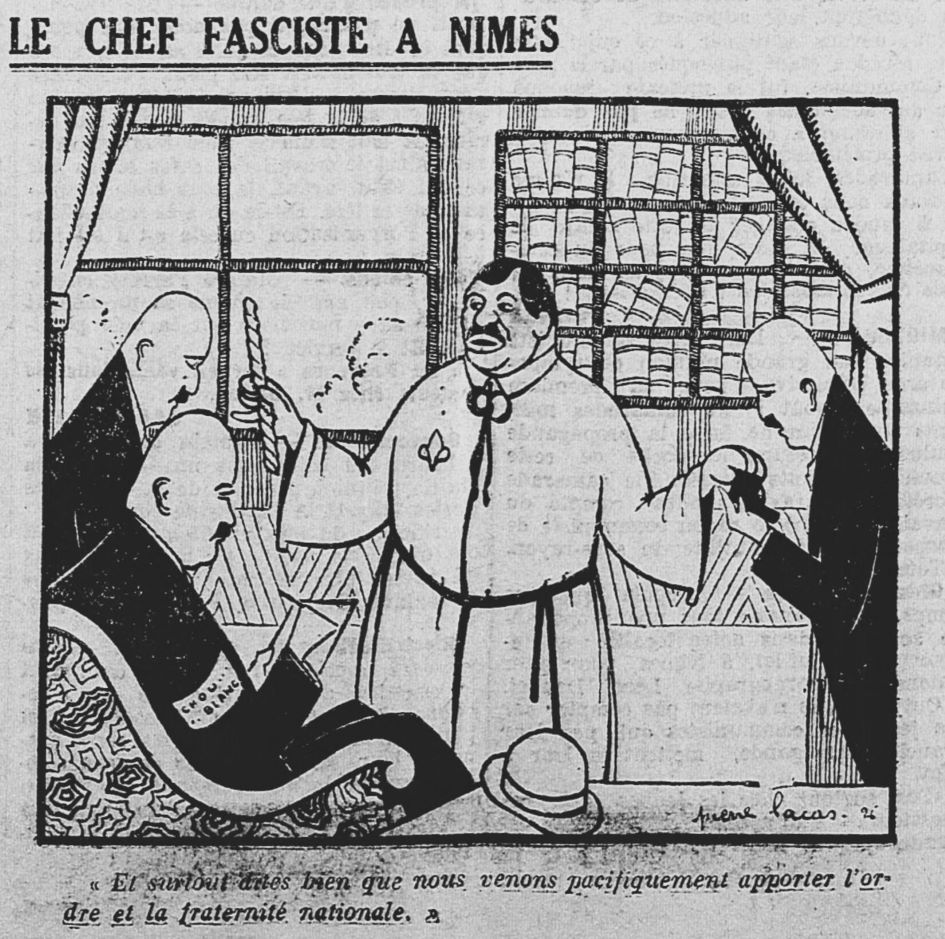
The month of November has enriched the political life of France with a new element. Various organisations of a Fascist character, the majority of which were founded a year ago, displayed considerable activity during last Winter but then quietened down; now they are once more beginning to show signs of intensive activity. The first “Fascio” in France was ceremoniously founded on Nov. 11th, at a meeting in the Lunapark. About 10,000 persons took part in these ceremonies. A week later, the same group organised a grand parade of “blue shirts” (costume of the French Fascists) in front of the “Arc de Triomphe” at the grave of the “unknown soldier”; 6,000 blue shirts took part. Blow followed on blow. There was the meeting of the “Jeunesses patriotes”, a meeting of the “Action francaise” (royalists) and meetings and demonstrations in the provinces. Two great Fascist newspapers “l’Avenir” and “l’Eclair” amalgamated, in order to “unite forces for the coming fight”. A new great Fascist daily paper is being founded, the “Nouveau Siecle”; giant posters have covered the walls of Paris for days, millions have been spent for this purpose. Two great “neutral” papers for the information of the public, “Journal” and “Matin” are opening a campaign for the glorification of the success of Fascism in Italy.
This new wave of Fascism was called forth by the event which has for weeks been determining the whole political situation of France the crisis of the petty bourgeoisie.
The further reasons for this crisis are the decline of imperialist France, the dissolution of the ties which for decades bound the petty bourgeoisie to the imperialistic policy of the banks which export capital. The economic basis of the old small investors’ State has disappeared. The new economic powers, the new financial capital, which is entering into an alliance with the new heavy industry, have not yet been able to carry through a regrouping of forces. France is in a serious crisis of transition
The more immediate reasons for the crisis of the petty bourgeoisie are to be sought in inflation, in the increase in the cost of living and the colonial wars, which are unpopular because they do not maintain the level of private incomes, but decrease them.

The crisis finds economic expression above all in the transition to the practice of hoarding; the small property owner, especially the peasant, no longer invests his money in State bonds but in material values (purchase of land, increase of his stock of cattle, agricultural implements, buildings, artificial manure). Beyond this, there is a general tendency to avoid State investments. These two phenomena have produced the result that the difficult but not insoluble financial position of France has become a serious financial crisis; the petty bourgeois masses of creditors of the National Debt are pressing for payment!
The crisis first expressed itself politically in a tendency of the parties of the Left Bloc to move towards the Left. At first the socialists and then the radicals formulated a vague “radical” programme; taxation of capital, immediate peace. The swing of the petty bourgeois masses to the Left however, took place with greater rapidity. The backward masses of workers and small peasants in particular, urgently demanded a decisive change of policy. The consequence of this was a break up of the Left Bloc. Under the pressure of the masses, the socialists were forced to take up a more and more “radical attitude.”
The multitudinous “re-arrangements” of the Government have not solved the crisis in the least. The Government is still, as it always was, under the dictatorship of the banks, and all its financial projects are unvaryingly directed towards the same aim, that of fleecing the middle classes and the working population through inflation and enormous new taxes.
The masses of the petty bourgeoisie (when we speak of the “petty bourgeoisie” we always include that part of the working class which is bound to the bourgeoisie economically, personally and also ideologically and politically as a result of having followed its lead for decades) these masses are on the move. Their movement has split up the Left Bloc. In what direction are these masses pressing?
Their movement has so far no definitive direction!! They are trying to find one. A socialist paper (Vincent Auriol’s “Midi socialiste”) was perfectly right when it recently wrote: It is the “striving for new methods, for new principles of Government” which inspires these masses!
What is the attitude of the socialists to this wave of discontent and seeking after new methods which is sweeping through the bourgeoisie? They are juggling with revolutionary phrases. For one moment they were intoxicated with the plan of taking over the government all by themselves. (This was immediately after the second fall of Painlevé). But when the bourgeoisie declined the socialist adventure, these knights of the doleful countenance unmasked themselves; they declared that the bourgeoisie would one day regret having declined to put to the test the “moderation and loyalty” of the socialists who had “offered their help in order to save them from plunging into the abyss.” This policy of empty words is now beginning to bear fateful fruit; for many long weeks, the movement of the discontented bourgeois who are seeking a way of escape, has crystallised round the programme of the socialists: taxation of capital and immediate peace. But this programme is merely empty sound! It is not followed by deeds!
This is the moment when disappointment is seizing the masses of the petty bourgeoisie! And this is also the moment when the soil is being prepared for Fascism.
The various organisations which at present represent in France the germ cells of the Fascist movement, have shown that they quite understand their task. The first signs of commencing disappointment among the masses called them on to the scene. The cadres of Fascism which are still weak but are liberally supported by industry, are now carrying their demagogic propaganda to the petty bourgeois masses. The various organisations of which we first spoke, are devoting themselves to this aim What are the prospects of the development of Fascism in France?
Two essential factors are in its favour: 1. the need of heavy industry to change over to a policy of violence with regard to the workers; 2. the commencing disappointment of the petty bourgeois masses which are beginning to stir.
Other important obstacles however interfere with the development of Fascism.
1. It is only a part of the bourgeoisie which thinks that a return to stabilisation and the inauguration of a policy of violence as regards the workers, will solve the crisis. The part which is probably at the moment the more powerful wishes to carry on a policy of concessions to the proletariat.
2. The mood of the petty bourgeois masses, even when they are disappointed, is not directly favourable to Fascism. Democratic traditions are a serious obstacle to Fascism penetrating into these masses. Furthermore, their discontent is to a large extent determined by the colonial wars, and they are well aware that Fascism means the continuation and extension of these wars. Finally, the peasant is not immediately accessible to Fascism, for Fascism gives nothing to him. The catholic religious demagogy of which one part of the Fascists makes use in the villages, creates internal contradictions.
3. America and England have no interest in a Fascist adventure in France; it might too easily burst the frame-work at Locarno.
Finally, the action of the Communist Party is of decisive significance. The awakening of Fascism was for it a signal; it took as the centre of its activity a wide action for a united front and chose as its aim for the fight in a united front, the central points of the programme formulated demagogically by the socialists: taxation of capital (solution of the financial crisis at the expense of the rich) and `immediate peace, supplemented by the demand for the dissolution and disarmament of the Fascist leagues.
This action, in which the united front represents the “new method” which the masses are seeking, and in which the worker and peasant government appears as the “new form of government” to which we must fight our way through, may prevent Fascism developing into a mass movement.
International Press Correspondence, widely known as”Inprecorr” was published by the Executive Committee of the Communist International (ECCI) regularly in German and English, occasionally in many other languages, beginning in 1921 and lasting in English until 1938. Inprecorr’s role was to supply translated articles to the English-speaking press of the International from the Comintern’s different sections, as well as news and statements from the ECCI. Many ‘Daily Worker’ and ‘Communist’ articles originated in Inprecorr, and it also published articles by American comrades for use in other countries. It was published at least weekly, and often thrice weekly.
PDF of full issue: https://www.marxists.org/history/international/comintern/inprecor/1925/v05n89-dec-24-1925-inprecor.pdf

