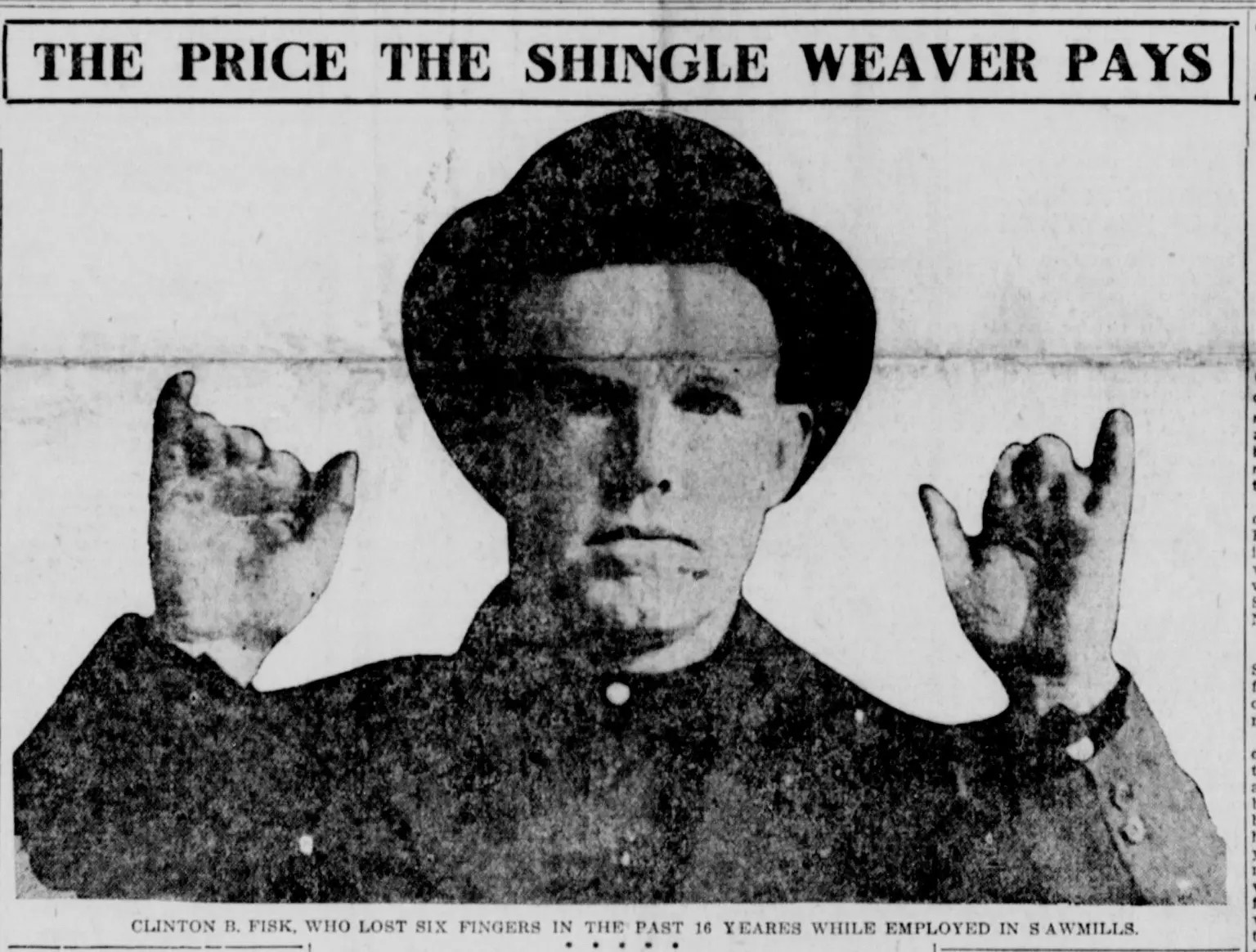
‘Shingle Weavers and Their Work’ by Three Fingered Ole from The Toiler. Vol. 146. November 20, 1920.
The manufacture of shingles is one of the largest branches of the lumber industry. In northern California, Oregon and Washington there are many hundreds of shingle mills employing from half a dozen to two hundred men.
The work is exceptionally dangerous and the cedar dust is a cause of lung diseases. Shingle weavers become victims of “shingle weavers asthma”, a disease that has sent many of our craft to an untimely grave. The chief danger of the trade however, lies in the risk of losing fingers, hands and whole arms by coming in contact with the saws. Sawers, knee-bolter men, cut-off men, knot -sawyers and clippermen run constant chances of being mangled in this manner.
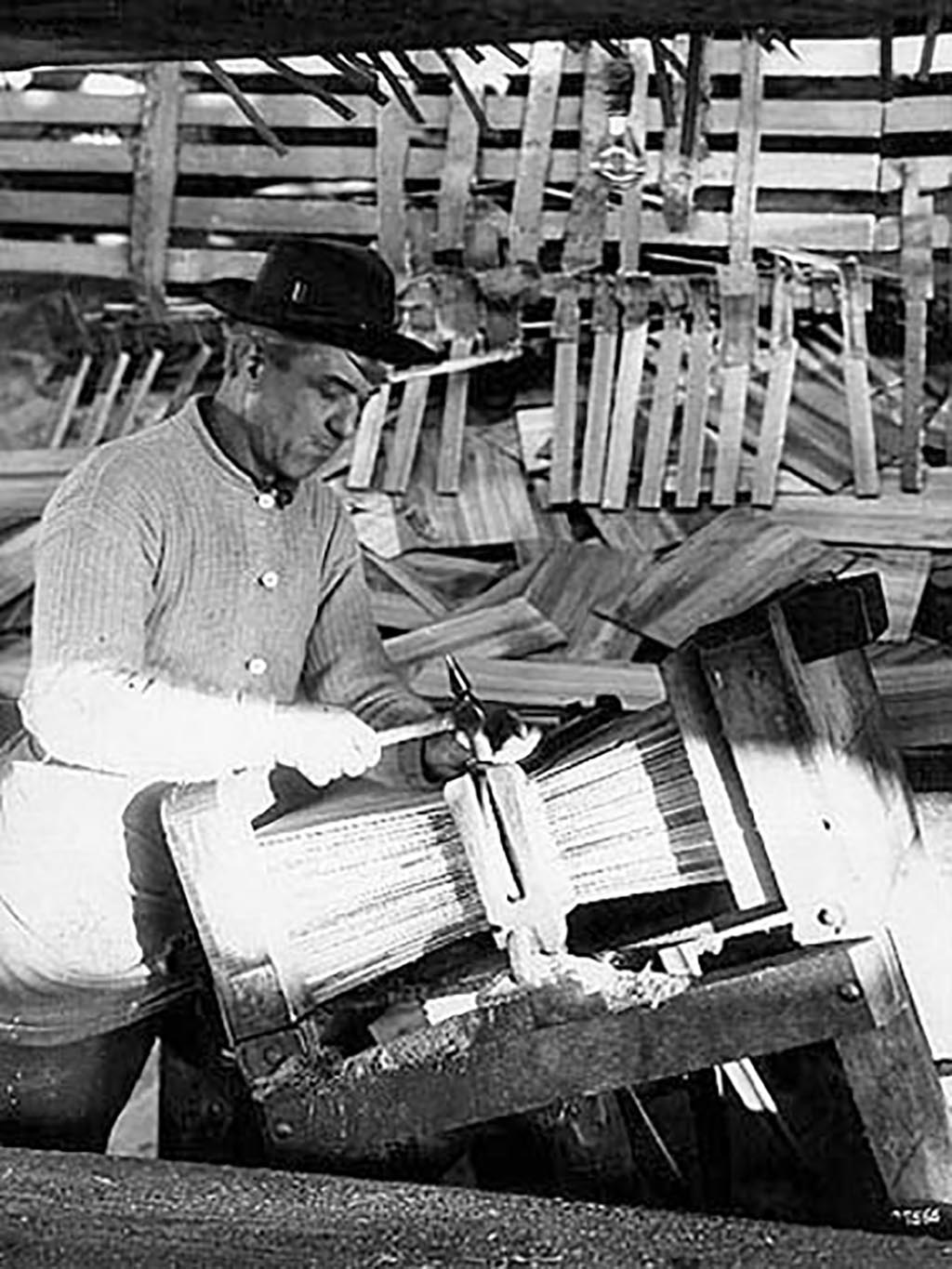
Owing to the piece-work system that prevails in this industry the machines are speeded to the limit of human endurance. The machine sets the pace, the men keep up if they can. Day labor is practically unknown. When you consider that we must work with our hands within touching distance of the saws, at a terrific rate of speed, you realize the risk to our fingers. The shingle weaver who has not lost at least one finger is the exception, those who have lost several are the rule.
In this state, Washington, we have a State Industrial Insurance which sometimes pays us as much as 80 or 40 dollars for a finger. One of our boys just got back to work after six months lay off due to losing four fingers and half his thumb. He got $350.00 and cannot work as efficiently as before, and certainly not at any other trade. The insurance is paid out of a tax collected from the employers based on a percentage of their yearly payroll. This method fools some weavers into believing that the State is their friend–until they lose a finger or two.
The greatest battle was for the eight-hour day in the summer of 1917. Previous to this date the 10-hour day had prevailed. But in justice to all the boys who helped win that fight I should go a little way into another branch of the lumbering industry, that of the logging operations in the woods and also in the sawmills.
Up to within a few years before 1917 the workers in these three branches of one industry were as far apart as the poles. Only the weavers were organized. The lumber mill men and the loggers were considered by the weavers as hopeless and unorganizable. They associated little together in spite of the fact that they were often living in the same camp. The weavers were a proud lot and more independent in action.
But the activity of the I.W.W. with its message of Industrial Unionism had been steadily undermining this separatist condition and at this time had pretty thoroughly saturated these three groups; to such an extent in fact, that many weavers held both an A.F. of L. and I.W.W. card.
The I.W.W. had succeeded in organizing the un-organizable. They had outposts in every logging camp, on every skid road could be met the job delegates–coming and going, going at the orders of the boss–and coming in from the employment office. The I.W.W. had completely turned these loggers and mill men into militant agitators.
Of the two organizations, the I.W.W. in the woods was the far stronger of the two and more revolutionary. The Industrial Worker, then edited by fellow worker McDonald, now in Leavenworth, did splendid constructive work just previous and during the strike which occurred in July.
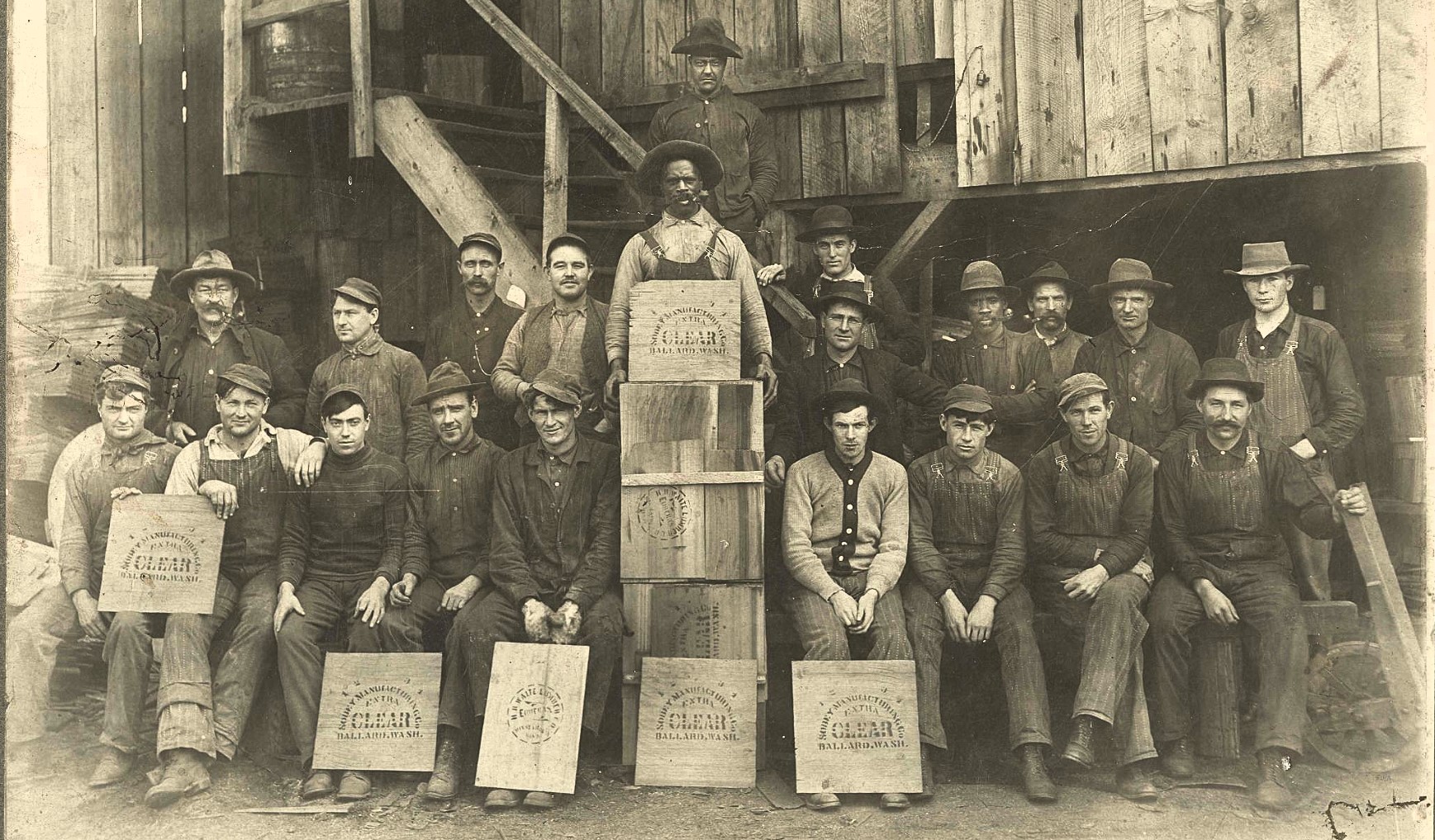
Altho the voters of the state had renounced the eight-hour day at the previous election, the workers in this industry were ready at this time to try for it on their own strength. The strike was called, the weavers going out first, followed instantly by the I.W.W. in the lumber mills and logging camps. With the supply of raw material cut off by the loggers, there was no possibility of the strike being lost thru the hiring of scabs. It was the greatest display of solidarity ever seen in this industry and within two months the eight-hour day was the regular thing, and the men were making more per day than before under the ten-hour regime.
Owing to the I.W.W. organization, we had an industrial strike and of course our chances for success were multiplied many fold thereby. The shingle weavers may thank this much maligned organization for the fact that we now work two hours less each day–and live all around better lives for it.
The Toiler was a significant regional, later national, newspaper of the early Communist movement published weekly between 1919 and 1921. It grew out of the Socialist Party’s ‘The Ohio Socialist’, leading paper of the Party’s left wing and northern Ohio’s militant IWW base and became the national voice of the forces that would become The Communist Labor Party. The Toiler was first published in Cleveland, Ohio, its volume number continuing on from The Ohio Socialist, in the fall of 1919 as the paper of the Communist Labor Party of Ohio. The Toiler moved to New York City in early 1920 and with its union focus served as the labor paper of the CLP and the legal Workers Party of America. Editors included Elmer Allison and James P Cannon. The original English language and/or US publication of key texts of the international revolutionary movement are prominent features of the Toiler. In January 1922, The Toiler merged with The Workers Council to form The Worker, becoming the Communist Party’s main paper continuing as The Daily Worker in January, 1924.
PDF of full issue: https://www.marxists.org/history/usa/pubs/thetoiler/n146-nov-20-1920-Toil-nyplmf.pdf

