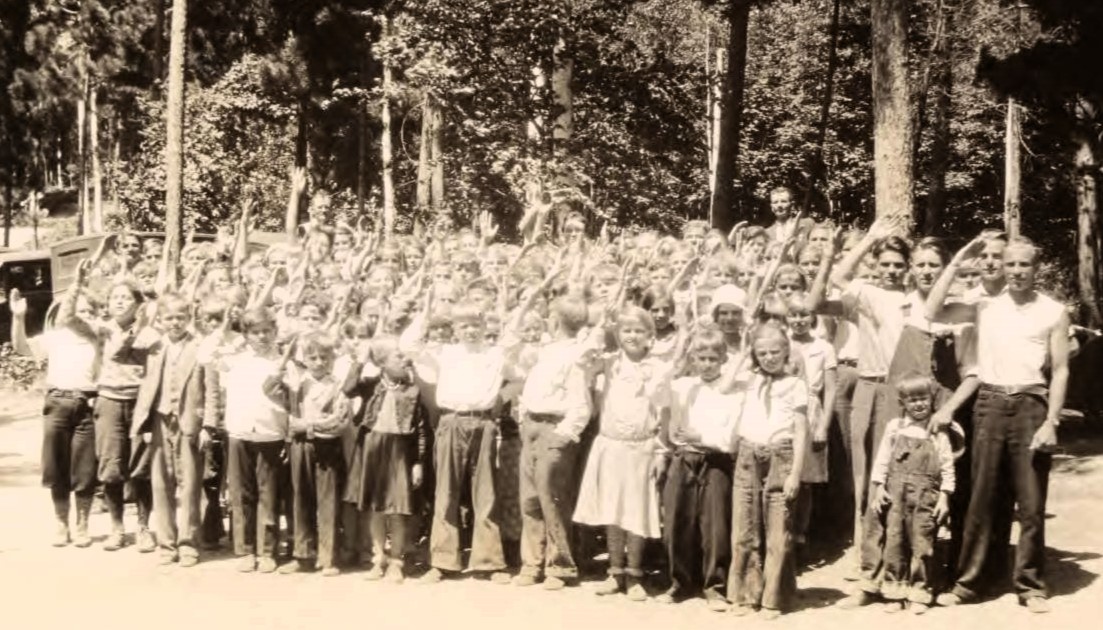
The first in a series by then leader of the C.P.’s Junior Section discusses the pedagogy of raising Communist children and the lessons learned from the Socialist Party’s Sunday School program. In 1924, a twenty-year-old Shacthman, himself a ‘red diaper baby’ who had been in the Y.P.S.L., was working full time for the Communist Party’s Young Workers League as head of its Juniors section, and editor of both ‘Young Worker’ and ‘Young Comrade.’
‘Keeping Them Young and Red’ by Max Shachtman from the Daily Worker Saturday Supplement. Vol. 2 No. 204. November 15, 1924.
NOTE: This is the first of a series of three articles to be published in 10 magazine section on the Communist children’s movement. In the two articles to follow, Comrade Shachtman will write on The Group Leader, Teacher of the Future, and The New Relations Between Old and Young. Editor.
HOW many of the adult Communists in this country know of the existence of an organized movement of revolutionary working class’ children, numbering almost 5,000, formed into regular units, school fractions, city central committees, and having their own national organ?
Of those few that are aware of this movement, I am willing to wager that an even smaller percentage have come into closer contact with it than having listened to one of these Communist children recite a revolutionary poem at a mass meeting to the tune of murmured: “How sweet! How cute!”
And yet the formation, activity and education of these 5,000 members of the junior groups of the Young Workers’ League is one of the most interesting examples of Communist pedagogy and organization, a completion of the revolutionary principle that the workers are exploited, in one form or another, from their childhood; that it is therefore, imperative that they be organized and trained for the struggles of the day and the morrow.
Train Wage Slaves.
The keen bourgeoisie, unlike its predecessors, has realized almost from the beginning of its rule, the importance of gaining the youth, for its own purposes, of course. Besides the steady flow of poison it administers to the children in the public schools, it has conscientiously subsidized organizations like the Boy and Girl Scouts, numerous young people’s religious leagues, and social and sport clubs. The purpose of the sum total of these institutions has been to make efficient wage slaves out of the workers’ children, to believe firmly in the eternity of that which is, and to have a holy horror and hatred towards any radical movement. Based on the old Jesuit principle of controlling the education of a child up to a certain age, the success of the bourgeoisie has been capped with a big measure of success.
Socialists always recognized the necessity of counteracting the influence of capitalist education upon proletarian children, and various ways and means were devised to accomplish this. The problem that then confronted them was: Is it possible to make the child class conscious without at the same time depriving him of the joyful innocence of youth?
Socialist “Sunday Schools” Fail
The fact that this “joyful innocence of youth” was being taken from the children by every hour of class room teaching was not considered; and the good old social-democrats forthwith cut the Gordian knot with the establishment of socialist Sunday schools, which neither made the children rebels nor kept them youthful. It did, however, leave them in joyful innocence of the class struggle.
The adult leader of the school would discipline the children as sternly as the average old hatchet face in the public school. The curriculum consisted either of painfully “simplified” discourses on theoretical subjects or else of lectures on the brotherhood of man, peace on earth and the horrors of class strife. In the Sunday schools the child was never made a rebel. He left it with a vague feeling of the necessity of brotherhood and an admonition on the wisdom of joining the socialist party when he came of age. They were never told to—
“…stick a mental pin in this-
“The warfare of the classes isn’t honey or molasses;
“And you’ll need a sharper weapon than a kiss!”
The training of the children in the young Communist groups is based on an entirely different principle. The junior groups are not intended to give the workers’ children a “liberal” education, with a so-called broad-minded, tolerant view of things. Not at all. They are formed for the purpose of making working class, revolutionary fighters out of the children, teaching them to regard all things from the point of view of the working class. The aim of the Communist children’s groups is to make the proletarian child a participant in the class struggle! Not merely one who understands what the class struggle is all about, not one who can repeat a few well-learned revolutionary phrases, but one who forms as definite and important a part of the working class children as the adult Communist does among the adult workers.
The achievement of this state of affairs is no mean task. It requires more of the group leader than it does of the child.
Communist Leadership.
In the simplest manner does the leader of a junior group train the children in the elements of the class struggle. By taking the children thru the proletarian and bourgeois districts of a city, by skillful questioning of the children on their impressions of the contrast, there is instilled in the children the knowledge of the existence of classes.
Not only is the child given an understanding of the fact that the class struggle exists, but in that understanding is embodied the principle that the child himself must participate in the struggle. This does not mean that his participation shall be limited to aiding in strikes, lockouts, demonstrations, political campaigns, and other activities of the adult workers; it means also that the child shall be a fighter for his class where it affects him directly: in the school.
In the school the child is made a receptacle into which is regularly dumped bourgeois refuse. Be it mathematics or history, it is the ruling class viewpoint that is rammed into the minds of the children. In the higher grades, the study of history, “current events” and “civics” in particular is the occasion for the vilest attacks and misinformation about the labor and revolutionary movement. The mildest reformers, if they are alive, are painted the deepest black and pointed to as horrible examples of evils to be shunned; if the reformer happens to be dead, and his ideas already embodied in the status quo, his “constructive” side is emphasized and his more revolutionary outlook is depreciated, excused, perverted or ignored.
The School Struggle.
It is the struggle against this bourgeois miseducation that the Communist children groups carry on. Sometimes this struggle takes on the relatively mild form of distributing their official paper. At other times, when the movement is sufficiently strong and the grievances are felt more than usual, the activity of the red children ranges from interpolations to the teacher in the class room, to the calling of school strikes.
To the bourgeois heroes and jingoes like Roosevelt, the children oppose working class or revolutionary heroes like Joe Hill or John Reed, John Brown or Jacob Leisler. To the anti-labor teachings of the instructor with regard to strikers, Communists, jingoism, and the like, the children oppose their verbal and written protests, open up discussions and ask questions that serve to enlighten the children and confound the teacher. Where teachers are expelled for their sympathy to the workers, the children conduct an agitation for reinstatement. In the numerous instances where children are subjected to the brutal tyranny of corporal punishment, the children are. shown how to carry on a mass struggle for its abolition, for the establishment of children’s councils for the regulation of discipline.
Learn Thru Struggle.
In all of these activities, which bring the child into conflict with some institution of capitalist society, the child is educated in the spirit of an active soldier in the army of the workers, fighting in the class struggle. Thru this personal participation in the fight, the child learns more of the sway of the dictatorship of the bourgeoisie, of the existence of classes, of the necessity of revolutionary organization–than he would in a hundred lectures. In the Communist children’s groups, the working class child prepares himself for the sharper struggles, first in the Communist youth organization and finally in the Communist Party.
In struggle there is life and youth. It is in the struggle that the children are enabled to become revolutionists without foregoing their “youth.” Their minds are not stultified with a hard and fast dogma; they are not burden- ed with the necessity of repeating high-sounding revolutionary phrases; they are not cramped or hampered by the existence of their older leader, who, far from imposing himself or his discipline upon them, far from being their obvious instructor, seeks as much as possible to obliterate himself from any prominence, to permit the children to work out their own reactions to the phenomena of the class struggle, to educate themselves to the ideal of service to their class under capitalism and to the community under Communism.
For Service to Working Class.
Their very games, while chosen and composed for the purpose of strengthening the class solidarity, and ideas of the children, are used to give free play to the combination of reality and imagination that keeps the spirit of youth in the class struggle. In these games, in their dramatics and socials, the aim is always to remove the mental servitude imposed upon them in school, to free them from the choking influence of discipline and the obliteration of the individual child in favor of the manufacture of goslings; to inculcate in the child the essence of free childhood: service to his class in order that he may be able to serve the community; the emancipation of humanity in order to accomplish the emancipation of the individual; work, play and study in the spirit of the struggle!
The Saturday Supplement, later changed to a Sunday Supplement, of the Daily Worker was a place for longer articles with debate, international focus, literature, and documents presented. The Daily Worker began in 1924 and was published in New York City by the Communist Party US and its predecessor organizations. Among the most long-lasting and important left publications in US history, it had a circulation of 35,000 at its peak. The Daily Worker came from The Ohio Socialist, published by the Left Wing-dominated Socialist Party of Ohio in Cleveland from 1917 to November 1919, when it became became The Toiler, paper of the Communist Labor Party. In December 1921 the above-ground Workers Party of America merged the Toiler with the paper Workers Council to found The Worker, which became The Daily Worker beginning January 13, 1924.
PDF of full issue: https://www.marxists.org/history/usa/pubs/dailyworker/dw-hr-1924/v2a-n204-nov-15-1924-DW-RIAZ-op.pdf

