With complicated stories, competing organizations, and multiple lefts and rights, it can be daunting to wrap our heads around the history of the needle trades unions–and thereby miss their centrality to the history of the U.S. left. Arguably, no sector of the labor movement was as influenced by Socialist and Communists (often in sharp conflict with each other) than the needle trades, with radicals winning genuine mass leadership of the working class. One of those radicals was J.B. Salutsky, who here provides an excellent introduction to the sometimes Byzantine politics of the International Ladies Garment Workers Union, the Amalgamated Clothing Workers of America, and the Fur Workers International Union in anticipation of their 1922 biennial conventions for the T.U.E.L. audience.
‘Constructive Radicalism in the Needle Industry’ by J.B. Salutsky from Labor Herald. Vol. 1 No. 3. May, 1922.
Problems before the coming conventions of the I.L.G.W.U. and A.C.W. of A. analyzed.
THE two largest units of the needle industry, the International Ladies’ Garment Workers’ Union and the Amalgamated Clothing Workers of America, are about to hold their regular biennial conventions. The I.L.G.W.U. will meet in Cleveland on May the 18th, and the A.C.W. of A. will gather in Chicago, May the 8th. Also another one of the five trade-unions composing the needle industry, the relatively small Fur Workers’ International is to meet in convention shortly after the big conventions. Thus the bulk of the organized workers in the industry will be legislating their immediate industrial future in the course of the coming month or two. A brief review of what’s what in the industry may therefore not be amiss.
The Labor Movement Interested
The interest in the problems facing the workers in the needle industry is more than of passing or local interest. The problems which the needle workers are confronted with are largely movement problems, such as concern the organized unions all over the country, with the exception perhaps, that some unions encounter these problems later and some sooner. True the needle industry does not belong to the aristocratic industrial group designated as basic. The life and security of the population do not depend on the normal and uninterrupted run of the needle industry, as it is the case with the railroads or mines. A strike or the breakdown of industrial machinery in the needle industry will not provoke the stir, that the very mention of a rail strike will. And important as the industry is, with its 350,000 people employed and the total output of $3,000,000,000 the year, it is on the whole not a problem of the first magnitude in the economic life of the country.
Yet the recent years have seen the needle industry climbing up to the pinnacle of public interest, constantly attracting the keenest attention of the student of economic problems, of the socially-minded observer and forcing the old-line trade union leadership to “sit up and take notice.” Federal and State Departments of Labor and Economic Faculties of Universities produced a library of volumes, devoted to the study of the problems of organizations, the methods of leadership, and the modes of contractual relations in the needle industry. The needle unions have caused the creation of an elaborate industrial literature, to even a larger degree than many another, economically more important, industrial unit.
“Rule of Reason” and “Law and Order”
One will readily recall the nation-wide interest that the so-called “Protocol of peace” regime in the ladies’ garment industry had provoked but a few years ago. The “rule of reason” of the protocol regime later subsided to clear the way for the “law and order” and “constitutional government” embodied in the “impartial machinery” operative presently in the men’s clothing industry. Now, the “impartial machinery” is showing unmistakable signs of dislocation. “Law and order” is gradually packing up to join in with the “rule of reason.” But other modes of industrial relationship are forcing their way to the fore, and none will be surprised to find out some next day that the latest “find” on the path of industrial and contractual adjustment has been substituted once more, by another “find,” still more promising and most likely just as short-lived.
The intensity and susceptibility of thought and the ability for swift and at times abrupt changes in methods of action manifested in the leadership of the workers in the needle industry is the real cause of the unabated interest which is maintained in the general public and in the wide- awake elements of the labor movement toward the needle unions.
Conventions Set Landmarks
Whether the coming conventions of the largest needle unions will bring about a new word in the solution of the problems before them no one can safely tell. But it is a certain guess that the gatherings will be interesting. These conventions always are interesting. One might say about these conventions as about the industry: it may not be an important industry but it is a live one.
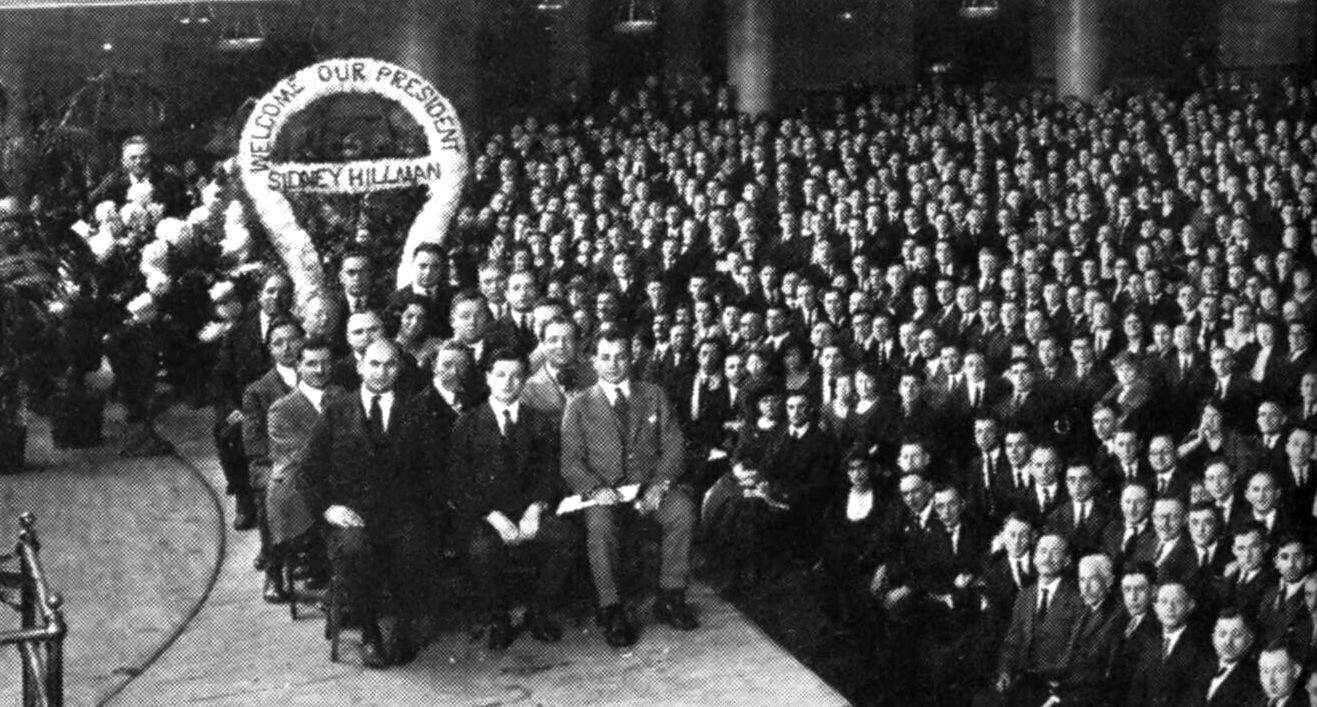
To be sure, conventions are not setting new departures in the life of a labor organization. Nor do they create something new out of nothing. The best a convention can do is to mark and to give shape to what has actually ripened in the movement the convention speaks for. A convention is in the life of a labor union what a legislative body is in the life of the country. Legislation is fixing in terms of law changes that social life and struggle have actually brought about. Conventions are writing down in terms of constitution, resolutions and executive powers, what has become imperative, unwritten law in the life of the industry. But just because conventions are not as a rule, a venture in dreams, they are of paramount interest to the active participants in the economic struggle. One studies conventions as barometers as indicators of the unspoken, perhaps subconscious, yet real in the inner life of industry.
Struggles Rich in Experience
Both, the I.L.G.W.U. and the A.C.W. of A. come to their conventions enriched with experience. Both will have to check up on a great number of things.
In the last two years nearly every unit of the needle industry went through an intense struggle, in some cases, virtually a struggle for life. Thus, the Fur Workers’ International fought a battle royal in the summer and fall of 1920, a struggle which lasted thirty weeks and tested every ounce of vitality of the union. It survived, has recuperated and is now on its feet, once more, vigorous and assertive.
And the I.L.G.W.U. met face to face its employers, and for over two months the contest was on, bitter, ferocious. The International scored a victory, though the contest is not finally settled and a new clash is not improbable by the time the convention will have started in.
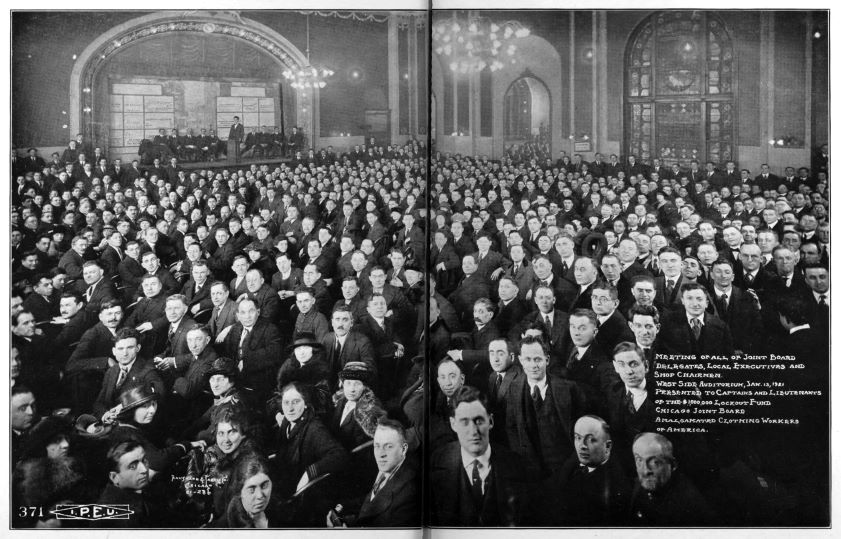
The Amalgamated, again, went through its military baptism in the supreme struggle of 1920-21. For fully six months the lockout of 60,000 New York workers kept in the balance the fate of the union. The onslaught made by the “open shoppers” on the Amalgamated was as thorough and concentrated in method of fighting as it was unscrupulous and reckless in choice of means. The Union smashed the open-shoppers and now after not fully one year of peaceful, contractual relations, with “impartial” methods of healing wounds, the New York manufacturers’ Association itself closed its doors. And as sequel to it came the other day the renewal of the agreement on satisfactory terms between the Amalgamated and the employers of Chicago and Rochester.
The conventions will check up on the experiences made through the recent struggles. The past will either weigh heavily on the future, if former mistakes will be incorporated in new laws, or the future will profit by past performances if proper lessons will be drawn, and new legislation will legislate out what is obsolete or decidedly wrong. For let there be no mistaken expectation the future of the needle industry is not paved with roses, the situation is pregnant with struggle, and fight is not an impossibility. The whole fabric of organized labor in the United States will have to put up a scrap, or it will be put out of its own. So let no complacency take place of vigilance.
“Lefts” and “Rights” in Needle Industry
The elections of the delegates to the conventions of both, the I.L.G.W.U and the A.C.W. of A. were marked with serious internal discord. Particularly so in the case of the New York locals of the I.L.G.W.U. In the largest local unions of the I.L.G.W.U. the administration candidates were badly beaten. The president of the International did not “run” from his own local and his slate was snowed under by opposition ballots The General Secretary-Treasurer of the International was outvoted heavily as dele- gate to the convention. The opposition carried locals 1-9-3-22 and many others in toto or partly. In the case of the Amalgamated the contest did not include the national administration. The division was designated as between right and left, and the group calling itself left has scored many victories.
One would naturally turn to the programs advanced in the electioneering to find the key to the coming conventions, to determine the possible psychology of the debate on the points at issue. But it would all be in vain.
The “lefts” in the A.C.W. of A. presented no program whatsoever. They went on their record of support given the National Administration in its recent fight on the corrupt ringleader- ship of the Children’s Clothing trade, a spiritual off shoot of the defunct United Garment Workers. The Jewish Socialist Daily Forward, for reasons of political expediency, saw fit to take the side of the ringleaders, and the lefts had stood unqualifiedly by the General Officers of the Amalgamated in the fight for decency and clean methods in unionism. However, all this, important and valuable as it may be, is not a program.
The nearest to a statement of principles could perhaps be found in the declaration made by the candidates of the opposition in the I.L.G.W.U. Candidates of locals, 1-9-22 declared for–
(1) Proportional representation at conventions.
(2) Officers shall hold no office longer than two years.
(3) General Executive Board Members shall not appoint themselves to paid offices.
Real Issues In the Convention
Not going into the merits of the points advanced one is forced to discard them as a program. At least, not a program for the coming conventions, where by far larger stakes are in sight. One who knows the industry and its problems would ask in surprise: Why are not such issues in the front of the discussion as, for instance, the following:
(1) The problem of organization, such as shop-representation instead of, or in addition, temporarily, to the system of organization by locals which has, to say the least, become obsolete and inefficient.
(2) The question of the use of injunctions in disputes with capital, as a means of defense and attack, and the propriety of labor standing up for the principle of inviolability of agreements.
(3) The readjustment of relationship between leadership and rank and file.
(4) The amalgamation of all needle unions into one consolidated union.
Incidentally, a point of importance which should interest the conventions, is the case of the staggering costs of strikes in recent years. The strike of the Fur Workers in New York in the summer and fall of 1920, which lasted six months and engaged from six to nine thousand people involved the expenditure of over one million dollars. The lockout in the men’s clothing industry fought by the Amalgamated during the winter and spring of 1921 consumed fully two million dollars. And the strike of the I.L.G.W.U. to force the manufacturers in the cloak industry to stand by its agreement with the union. lasted nine weeks and cost the organization fully one million dollars. Not because anyone entertains any doubts as to the propriety of these huge war costs is the issue noted. Seemingly the costs are inevitable. But means are to be found to finance such wars, and improved methods by which these budgets can be taken care of, particularly, in such a way that no one shall doubt the possibility to raise such funds again, as the necessity may and will arise.
However, whether these issues were raised in the pre-convention campaigns or not, they will force their way to the attention of the delegates. The conventions will have to meet the issues, to face them.
Before a more detailed statement is made on some of the issues involved the following observations, however, may not be out of the way.
The Inner Weakness of Radicalism
All the needle unions are known as progressive labor unions. The I.L.G.W.U. is considered a radical union within the A.F. of L.
The Amalgamated is definitely known as a radical union in the American Labor movement. The Fur Workers’ Union has an established reputation as a socialist union, that is: a union whose policy is determined by a socialist trend of mind. How then is this fight between the “lefts” and “rights” accountable? And the struggle at the polls was rather intense, at times too intense.
One suggestion lends itself readily, namely the radicals in these radical unions are entirely too radical. But the examination of the programs, in as much as they were in evidence, denies this claim. Another suggestion, which one can hardly escape is that the radical reputation of the unions in question is rather exaggerated. And so it is largely. It is a case of overestimation of attire at the expense of substance.
The issue raised by a number of the locals in the I.L.G.W.U., namely that of “democracy” by means of “rotation in office,” by not allowing one to hold office longer than two years, is of doubtful value. A radical should just think in terms of this policy as applied to Soviet Russia, for instance, and he will most likely discard the reform as reactionary, or he would recall Lenin and Trotsky, because they occupy their offices for more than two years. The much heralded sort of radicalism that Emma Goldman represents may want this kind of reform, but at the expense of efficiency and effectiveness in the struggle. If the unions are to be, as they ought to be, fighting units, then it is essential that every ounce of capable energy be preserved and kept in the service of the organization as long as it had not outlived its usefulness. To play with the pretense of democracy, instead of studying strategy, in a fight for life and death is nothing short of stupidity. Of course, there is more merit in the demand that the G.E.B. members shall not appoint themselves to paid offices. There is the danger that the elected machinery of legislation may turn, by the process of self-appointment, into an organ of administration. But the way of a blanket prohibition is not the best way of preventing misuse.
There is this general fault to be found with the trend of mind exhibited by the opposition, at least in so far as formal declarations show it. The opposition does not take too seriously its own chances for victory, and because of it, thinks not in terms of victory and responsibility.
The late S.P. radicals pursued this policy to sufficient and evident disadvantage. The perennial demands of the S.P. delegates in the A. F. of L. conventions for the election of A.F. of L. officers by referendum vote was a case in point. And one did not have to be unusually well versed in the problems, facts and psychology of the labor movement to know that a referendum vote would produce more unexpected and still poorer results than the election of officers by the method practiced at present. The S.P. itself discarded the method of electing its national secretary or chairman by a referendum vote. And it did so out of experience, because it had seen in practice that the popular election is not the better way of electing administrators. Nevertheless, it advocated that mode of elections, and that in the case of such important offices as the President and Secretary of the American Federation of Labor. It knew well that when called upon to vote for candidates of whom they knew nothing, the people would. vote machine-like and to the liking of the machine. But the Socialist Party radical never thought in terms of attaining results. The S.P. delegates in the A.F. of L. conventions considered themselves a hopeless and prospectless minority. So they could safely advocate any policy which they themselves in their own case would not stand for.
The fault with most people belonging to or leading in our opposition wings is that they do not take themselves seriously as opponents of the existing regime, and they do not therefore take seriously their own proposals. They do not criticize seriously enough their own methods and programs, which is no less necessary than criticizing the other side.
A Constructive Program Suggested
The minority delegates in the coming conventions, whether they are doomed to remain a minority or not will have to take a stand on the four points raised above, and the following may be said briefly for each of these points.
(1) The reorganization of the unions on the basis of shop representation. The local unions are largely political clubs, and mostly lifeless in addition thereto. Usually a local with a membership of 10,000 can boast of no better attendance than 100. These hundred members represent nobody but themselves. By a system of shop representation the life of the unions could be re-invigorated. As an immediate approach to the attainment of the end, the permanent organization of the shop chairmen, as part and parcel of the union organization, is to be welcomed. In the most cities where the Amalgamated is actually alive to its task, the shop chairman are constitutionally recognized. They meet twice a month, and pass motions, which go to the Joint Boards. In the recently concluded agreement with the Chicago manufacturers in Chicago, the Shop-chairman is recognized as the union representative. Of course, the shop-chairman is but one, and proper shop representation ought to make room for more representatives. Yet it is a step forward.
(2) As to the use of the injunction as the means of Labor in the struggle with Capital. There could be no two answers to the question. It is to be discarded. Even the fact that Brother Gompers is against it does not make it any better. The one progressive idea that the average American union man has conceived and accepted is his negative view on the injunction. Will the radicals sanctify the injunction? Hillquit’s meek defense of the injunction in the recent strike of the I.L.G.W.U. will mislead no one. Its seeming usefulness in that strike and comparative ease with which it was attained must not fool anyone. Purely political influences made it possible that the Union should get the injunction, and it really solved nothing. The union will yet meet the issue, temporarily laid on the table by the injunction order. And it will meet it at the expense of another strike, more severe, more costly, and in the near future. Or the union will avoid a strike by giving in to the manufacturers. But then of what immediate use was the injunction? It is true, that the injunctions don’t manufacture clothes. It is equally true that injunctions don’t win strikes or give workers employment.
(3) The problem of leadership and rank and file. The meat of the issue is responsibility, on both sides. Vigilance on the part of the rank and file can not be incorporated in constitutions. And just as little will “rotation in office” safe- guard it. The immediate approach to the solution lies in the organization of shop-representation and in a virile system of educational activities. Not college liberals’ bunk, but working class spirited education.
(4) The Amalgamation of the needle unions into one consolidated union. It would be futile to attempt the revival of the defunct Needle Trades Alliance. It died at its inception because it manifested not a step forward. The method of loose federation, that was laid at its foundation, is a dead principle. As it is, without any federated alliance the needle unions are sufficiently near one to another to make the formal proclamation of this closeness unnecessary. What is wanted is an actual consolidation. They ought to form one closely-knit organization with the present separate unions forming simply departments of one Industrial Needle Union, with one treasury and one administration. Only under such a plan will the amalgamation be valuable, will actually increase the fighting strength of the 350,000 workers in the industry. The problem of amalgamation is essentially a problem of power, of more power for the men and women engaged in making clothes. And a really consolidated union of all the needle workers will prove to be a generous source of creative power for the good of these people. A loose alliance is in fact a dangerous undertaking, at least in the clothing industry. It would not add one iota of actual strength to the side of the unions, but it would forcefully wake up the employers and stimulate an even stronger degree of consolidation in their ranks. The opponents would be provoked to unite without an adequate and corresponding strengthening of the workers’ union. And, what is not of least consideration, a real consolidation of labor in the industry would eliminate waste, duplication of effort, and over-lapping in administration. While it would not eliminate or lessen the number of officers it would add to the tasks of each officer, and make the union more effective. And, think of a fight where the employers would have to meet with an array of all the power and determination to win, which all the unions, acting separately now, possess. Guerilla warfare in the industry would be a matter of the past. The employing interests would either be ready for reasonable argument or accept war that would inevitably spell ruin for them. This is the issue of Amalgamation in the needle industry. Will the two conventions speak up for it? The radicals in the conventions have a truly constructive program on their hands.
The Labor Herald was the monthly publication of the Trade Union Educational League (TUEL), in immensely important link between the IWW of the 1910s and the CIO of the 1930s. It was begun by veteran labor organizer and Communist leader William Z. Foster in 1920 as an attempt to unite militants within various unions while continuing the industrial unionism tradition of the IWW, though it was opposed to “dual unionism” and favored the formation of a Labor Party. Although it would become financially supported by the Communist International and Communist Party of America, it remained autonomous, was a network and not a membership organization, and included many radicals outside the Communist Party. In 1924 Labor Herald was folded into Workers Monthly, an explicitly Party organ and in 1927 ‘Labor Unity’ became the organ of a now CP dominated TUEL. In 1929 and the turn towards Red Unions in the Third Period, TUEL was wound up and replaced by the Trade Union Unity League, a section of the Red International of Labor Unions (Profitern) and continued to publish Labor Unity until 1935. Labor Herald remains an important labor-orientated journal by revolutionaries in US left history and would be referenced by activists, along with TUEL, along after it’s heyday.
PDF of full issue: https://www.marxists.org/history/usa/pubs/laborherald/v1n03-may-1922.pdf

