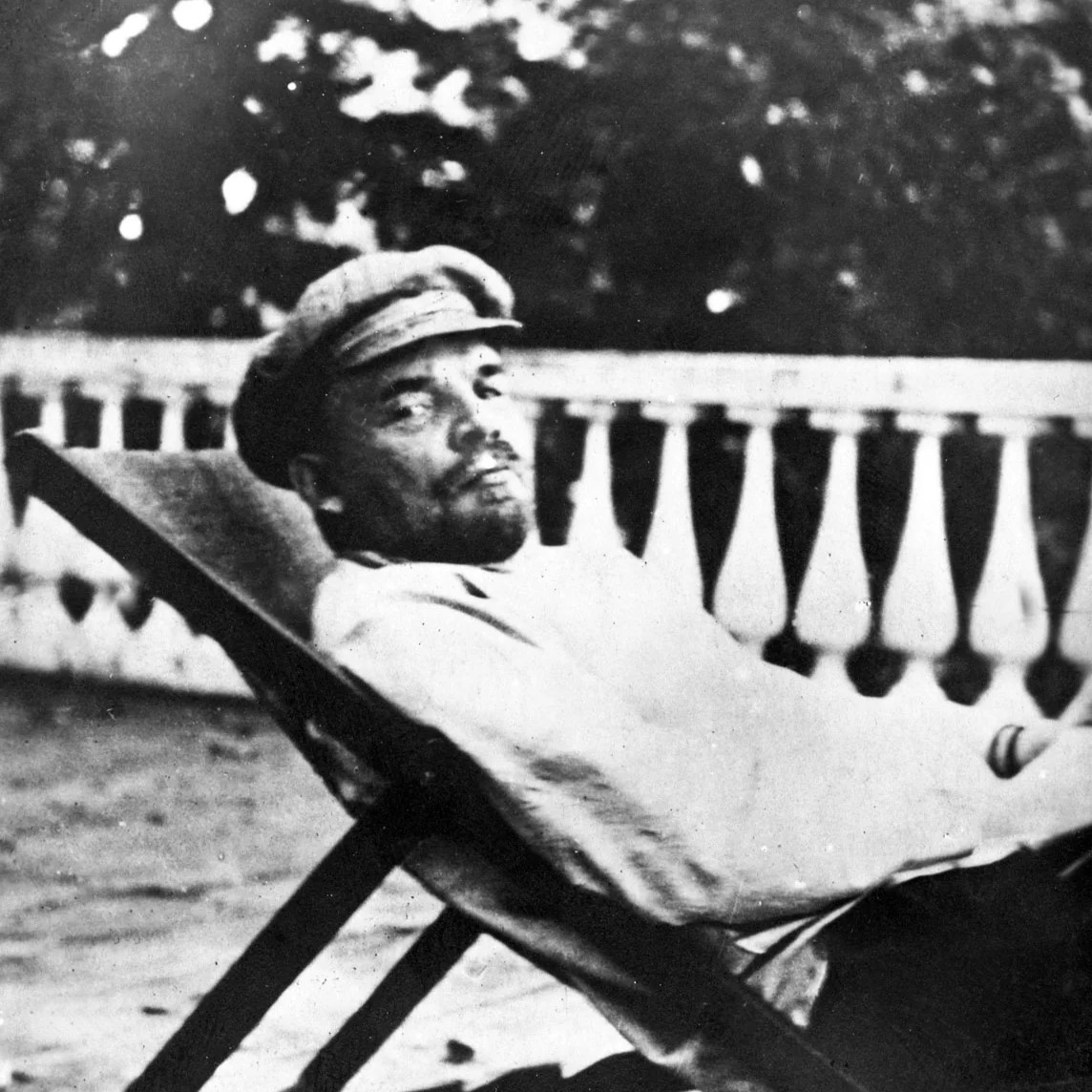
Written between Lenin’s second stroke in December, 1922, and the March, 1923 stroke that left him speechless, this January 1923 article is among his very last. In it, Lenin returns to the ‘fantastic’ ideas of Owen and urges use of co-operatives under the N.E.P., particularly among the peasantry, as a transition to a socialized economy. Published in Pravda in March, 1923 below is the original English translation.
‘On Co-operation’ by N. Lenin from International Press Correspondence. Vol. 3 Nos. 44 & 47. June 21 & 28, 1923.
The following article on Co-operation was written by Comrade Lenin on the 4th and 6th January of this year. Some days ago the article was published by Comrade Krupskaya, Comrade Lenin’s wife, in the Moscow “Pravda”. Ed.
I.
It seems to me that we are devoting too little attention to the Co-operative Movement. Everyone cannot grasp that now, since the October revolution, and unprejudiced by the New Economic Policy (on the contrary, in this respect we must say; thanks to the New Economic Policy) co-operation has attained a unique significance in Russia. The founders of the old co-operatives mingled much imagination with their dreams. They have often been ridiculously imaginative people. And why have their dreams been mere imaginings? Because these people have never grasped the fundamental significance of the political struggle of the working class for the overthrow of the exploiting class. Here in Russia this overthrow has been accomplished, and much that appeared fantastic, or even extravagantly romantic, in the dreams of the old co-operators, has become a complete reality.
Here in Russia, where state power is in the hands of the working class, where all means of production are the property of the state, the sole task remaining to us has been the real co-operative alliance of the population. Once given the prerequisite of a maximal co-operation of the population, that socialism which hitherto, and rightly, evoked at most an indulgent smile from those who were convinced of the necessity of class struggle of the struggle for political power, etc. has obviously attained its end. But none of our comrades are taking sufficient account of the fact that co-operation has acquired enormous significance in Russia. With the New Economic Policy we made concessions to the peasant, to the merchant, to the principle of private trade; contrary to what is generally supposed, precisely this gives rise to the immense importance of co-operation. All that we essentially need is the union of the Russian population on a sufficiently broad co-operative basis during the rule of the New Economic Policy; for we have now attained such a degree of unification of private commercial interests, of their supervision and control by the state, and of their subordination to the interests of the general public, that we may claim to have realized what was formerly a stumbling block to very many socialists. For is not the actual power of the state over all the most important means of production, this state power in the hands of the proletariat, the alliance of this proletariat with many millions of peasants and small holders, the secure and leading role of the proletariat in relation to this peasantry, etc.–is this not all that is required to enable us to build up, with the aid of co-operation, solely with the aid of that co-operation which we formerly treated as petty shopkeeping, and which we may still so treat, from one point of view, under the New Economic Policy, the complete structure of socialist society? This co-operation is not in itself the structure of socialist society, but it is everything that is required for this structure.
It is precisely this circumstance which is underestimated by many of our practical functionaries. Co-operation receives too little attention from us; its extraordinary importance is not realized, first and foremost, in relation to the means of production as state property, and secondly, with regard to the transition to a new order on the simplest, easiest, and (for the peasantry) best attainable lines.
And just this is the main point. It is one thing to indulge in all sorts of imaginings about labor associations for building up a socialist structure, but it is another matter when it comes to practically building up this socialism so that every small holder may have his share in it. We have already reached this stage. There is no doubt whatever but that we, having reached this stage, are not making full use of it.
We were too hasty at the time of our transition to the New Economic Policy, not in the sense that we granted too great concessions to the principles of private industry and free trade, but in the sense that we forgot to think of co-operation, which we still underestimate, and whose tremendous significance, in relation to the two sides of this question mentioned above, we are already beginning to forget.
I want next to discuss with my readers what can and must be done now, practically, starting from this “co-operative” principle. Along what lines can and must we now set to work, in order to so develop this co-operative principle that its socialist significance becomes clear to everyone?
Politically, the co-operative question should be so treated that co-operation is not only granted, always and everywhere, certain facilities, but these facilities must be purely financial. (Amount of bank rate, etc.) Co-operatives must be supported by state credits exceeding–if not greatly, at least somewhat–those granted to private undertakings or even the heavy industry.
Every social order owes its existence solely to the financial support of a certain class. It is not necessary to mention those hundreds and hundreds of millions of roubles which the birth of “free capitalism” cost. But we must not forget it, and in actual practice we must realize that at the present time the social order to which we are to lend more than the average need of support must be a co-operative order. And we must support it in the true sense of the word, that is, it is not sufficient if we understand by such support the support of any co-operative enterprise; by this support we must understand the support of a co-operative enterprise in which real masses of the population participate. It is no doubt a correct formula to give a bonus to the farmer who takes part in co-operative enterprise. But his participation must be examined with respect to its consciousness and quality that is the main point in question. When the operative member comes to a village, and opens a co-operative store there, the population has no share in this, strictly speaking. But for the sake of its own advantage it will speedily endeavour to have one.
There is therefore another side to the question. From the viewpoint of the “civilized” European (above all from that of everybody who can read and write) we have not far to go before every single individual can be induced to participate in co-operative operations, not merely passively, but actively. Actually there is “only” one further step necessary: to render our population so “civilized” that it will realize all the advantages of personal participation in the co-operative, and proceed to participate. “Only” this one step. But to realize this “only”, implies a great stride forward, the covering of a wide stretch along the road of the cultural development of the whole mass of the people. Therefore we must make it our rule: as little philosophizing as possible, as little tomfoolery as possible. In this respect the New Economic Policy is a sign of progress in so far as it accommodates itself to the level of the lowest peasant, and demands nothing higher from him. But to utilize the New Economic Policy for the purpose of inducing the whole population, every separate individual, to take part in co-operation–this requires a whole historical epoch. We may pass through this epoch in one or two decades. But it will still be a distinct historical epoch, and without this historical epoch, without everyone’s being able to read and write, without adequate insight, without having educated the population to the extent that all can make some use of books, and without having created the material basis for this, without a certain security, let us say, against bad crops and famine–without all this we cannot attain our end. Everything now depends on whether we can supplement that revolutionary elan, that revolutionary enthusiasm which we have so often successfully proved, by a capacity–I might almost say of acting like a sensible and experienced shopkeeper, which is all that is required from a good co-operator. By commercial capacity I understand the capacity to be a civilized businessman. This distinction must be learnt by those Russian people who think: if one trades, that means that one possesses the qualities of a trader This is entirely wrong. One must know how to trade in the European manner.
I conclude: A number of economic, financial and banking privileges for co-operation: this is the form to be taken by the support of the New Organization Principle by our socialist state. But this only draws the broad outlines of our task, for the whole actual contents of this task have not here been practically detailed; that is, we must understand how to find that form of “bonus” (and the conditions under which it is granted) which we shall accord to co-operation, the form of “bonus” which adequately aids co-operation, the form of bonus by the help of which we can educate civilized members of co-operatives. And the organization of civilized members of co-operatives, given common ownership of the means of production on the basis of the class victory of the proletariat over the bourgeoisie–this is Socialism.
II.
Whenever I have written on the New Economic Policy, I have invariably referred to the article written by me in 1919 on State Capitalism. This has frequently aroused doubts among some young comrades, but their doubts have been mainly directed to the abstract political theory.
They have been of the opinion that we cannot speak of a state of society as state capitalism, when in this state the means of production belong to the working class, and state power is also in the hands of the working class. But they overlook the fact that in the first place I made use of the term “state capitalism” for the purpose of establishing the historical connection between our present position with the position taken in my polemics against the so-called “left” communists. Already at that time I pointed out that a state capitalism would be a higher form than that of our present economics. For me it was of the greatest importance to show the inherent connection between ordinary state capitalism and that extraordinary, indeed quite extraordinary, state capitalism of which I was speaking when I introduced the New Economic Policy to my readers. In the second place it is the practical aim that has always been important to me. And the practical aim of our New Economic Policy was: to obtain concessions. But under our present conditions the concessions would represent the purest type of state capitalism. This was the point of view from which I considered State Capitalism.
But there is yet another side from which we can make use of state capitalism, or at least of something analogous. This is the question of co-operation.
There is no doubt that co-operation within the capitalist state is a collective capitalist institution. And it is also beyond dispute that under our present economic conditions, now that we are uniting private capitalist undertakings–but only on land which is our common property, and solely under the control of the state power belonging to the workers–with undertakings of a consistently socialist type (in which the means of production, the ground on which the undertaking is erected, and the undertaking itself, all belong to the state), it is beyond all doubt that here the question of a third form of undertaking arises, one which formerly possessed no profound, independent significance–the question of the co-operative undertaking. Under private capitalism, the co-operative undertakings have differed from the capitalist undertakings in being collective enterprises. Under State Capitalism the co-operative undertakings differ from the state capitalist undertakings, first in being private enterprises, and secondly in being collective. Under the present order of things in our state, the co-operative undertakings differ from private capitalist undertakings in being collective, but they do not differ from the socialist undertakings, if they are based on the principle of state property, that is, on the principle that the land and the means of production are the property of the working class.
This circumstance is not accorded sufficient attention when cooperation is spoken of amongst us. It is forgotten that our unique form of state, imparts an exclusive importance to co-operation in our country. Apart from the concessions, which, by the way have never developed to any important degree, co-operation is perfectly synonymous with socialism under our conditions.
I shall explain this. Why were the plans laid down by the old co-operators, beginning with Robert Owen, so fantastic? Because they dreamed of the peaceful transformation of the present state of society into a socialist one, without giving any thought to such fundamental questions as class warfare, the conquest of political power by the working class, the overthrow of the rule of the exploiting class. And therefore we were quite right in seeing nothing but foolish and romantic imaginings in this “co-operative” socialism: mere dreams for the conversion of class enemies into class co-operators, of class war into class peace (civil peace), simply by the spread of co-operation among the population.
There is no doubt whatever that we have been in the right from the standpoint of the fundamental task of the present day. For without the class struggle for the political power of the state it is impossible to realize socialism.
But let us consider how matters have changed since the state power actually came into the hands of the working class, since the political power of the exploiters was overthrown, and all means of production (with the exception of those placed voluntarily and temporarily in the hands of the exploiters, on terms of concessions) belonged to the working class.
We have now the right to say that the growth of co-operation (with the “slight” reservations mentioned above) is for us synonymous with the growth of socialism. At the same time we must admit a fundamental alteration in our whole point of view with regard to socialism. This fundamental alteration consists in the fact that hitherto we have rightly laid the greatest emphasis on the political struggle, on the revolution, on the conquest of power; but how the time has come to attach the greater importance to peaceful organizatory “cultural” work. I might say that our attention must now be concentrated on the work of culture, apart from international relations, where the highest importance has to be attached to our duty of defending our positions against the world. But if we set aside this consideration, and limit ourselves to our internal economic relations, the centre of gravity of our work lies in cultural activity.
We are faced by two great epoch-making tasks. First, the task of reorganizing our apparatus which we have completely taken over from the past epoch. During five years of fighting we have not succeeded, and in the nature of things could not succeed, in accomplishing anything here. Our second task consists in cultural work among the peasantry. And cultural work among the peasantry, as an economic aim, is precisely one of the things accomplished by co-operation. Once given complete co-operation, we should already have a firm foothold on socialist ground. But the attainment of these conditions of complete co-operation assumes such a state of culture among the peasantry that this co-operation is impossible without a cultural revolution.
Our opponents have often told us that we have thoughtlessly undertaken the realization of socialism in a country of defective culture. But they are entirely mistaken if they consider themselves justified in reproaching us for not having begun the work at that the end at which, according to theory (of various pedants), it should have been begun. For us, the political and social revolution was merely the forerunner of that cultural revolution on whose threshold we are still standing.
This cultural revolution is all that is needed for us to become a completely socialist country. But this cultural revolution demands enormous efforts, not merely in purely cultural spheres (combatting illiteracy, etc.), but also in material respects, for the necessity of transforming our land into a cultural land implies a certain development of material means of production, a certain material basis.
International Press Correspondence, widely known as”Inprecorr” was published by the Executive Committee of the Communist International (ECCI) regularly in German and English, occasionally in many other languages, beginning in 1921 and lasting in English until 1938. Inprecorr’s role was to supply translated articles to the English-speaking press of the International from the Comintern’s different sections, as well as news and statements from the ECCI. Many ‘Daily Worker’ and ‘Communist’ articles originated in Inprecorr, and it also published articles by American comrades for use in other countries. It was published at least weekly, and often thrice weekly.
PDF of full issue: https://www.marxists.org/history/international/comintern/inprecor/1923/v03n44-[26]-jun-21-1923-Inprecor.pdf
PDF of issue 2: https://www.marxists.org/history/international/comintern/inprecor/1923/v03n47[27]-jun-28-1923-Inprecor-stan.pdf

