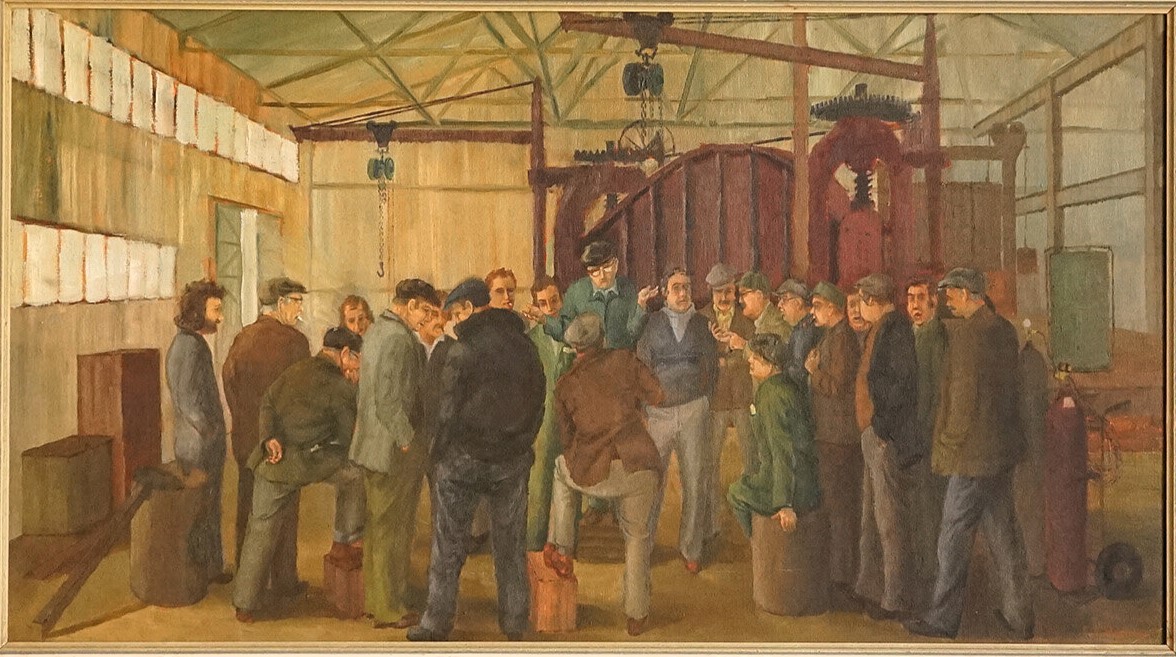
Shop rules adopted by Paterson N.J., Branch of Textile Workers Industrial Union No. 100 of the I.W.W.
‘Rank and File Control’ from The Toiler. No. 135. September 3, 1920.
I. SHOP ORGANIZATION
1. Each shop should select one of the workers to act as Shop Chairman. The election should take place in regular manner at a shop meeting. Whereever possible, a new chairman should be chosen every three months or oftener. It is the duty of the chairman to preside at shop meetings and to serve as a member of the Shop Committee.
2. The shop should also choose a Shop Committee of two or more members, in addition to the Shop Chairman. The Shop Committee should be changed regularly, at least one new member being elected every month. As far as possible, every worker in the shop should be required to take his or her turn on the Shop Committee.
3. The shop should select a recording secretary to keep the minutes of shop meetings, also two delegates to represent the shop at Shop Delegates Meetings.
4. It shall be the duty of the Shop Chairman to see that all union books are paid up regularly. Every worker shall show his book to the Chairman on demand.
5. New workers coming into the shop shall be approached by the Chairman or by a member of the Shop Committee and required to show their union books or sign an application to join the Union. In special cases, the Shop Committee may allow a new member to pay the initiation fee in installments, but the entire sum must be paid not later than the first payday after entering the shop.
Note: When the weavers in any shop are organized 100 per cent in the I.W.W., a new weaver shall be required to join the I.W.W. In shops where the I.W.W. has only a majority, a new weaver shall join the I.W.W. unless he has been a good standing member of another union for at least three months. When a shop first organizes, no one who is already a good standing member of a union shall be required to change his book.
II. SHOP MEETINGS
1. Each shop should hold a regular meeting at least once a month and special meetings whenever necessary.
2. A special shop meeting may be called the Shop Committee at any time, and MUST be called by them when 25 per cent of the workers demand it.
3. Special shop meetings should not be called for unimportant matters that could wait until the next regular meeting.
4. Meetings should not be held in the shop unless absolutely necessary. Whenever possible they should be held at union headquarters.
5. Shop meetings should not be called dug working hours, except when a special emergency requires prompt action.
6. All voting at shop meetings shall be done openly. A secret ballot shall not be allowed under any circumstances.
7. Notice of a regular shop meeting should given at least one day in advance. Notice of special meeting should be given as early as possible.
8. A shop shall have the right to impose fine of a reasonable amount on workers who absent themselves from a shop meeting with good excuse, provided this has been voted in regular manner at a previous shop meeting and notice of the fine was given in the call for the meeting. A worker who refuses to pay the fine shall be required to leave the shop.
9. When two or more shops are owned by same boss, a joint meeting shall be held, whenever possible, before a strike is declared or any action is taken that is likely to affect more than one shop.
Note: The union should always be notified in advance when a shop is going to hold regular or special meeting.
III. GRIEVANCES
1. When a worker has any trouble which he cannot settle satisfactory with the boss, he should report it to the Shop Chairman or to a member the Shop Committee. The Shop Committee shall take the matter up and try to settle the difficulty. If they are unable to do so, they shall lay the matter before the shop at a regular or special meeting.
2. If the worker is not satisfied with the action of the Shop Committee, he shall have the right to appeal to the shop, and, if not satisfied with the decision of the shop, he may appeal to The Executive Board or to the membership of the branch.
3. If the boss wants to discharge a worker, the worker shall remain on his job until the Shop Committee has investigated and decided whether the discharge is justified. Any worker habitually making had work or otherwise causing unnecessary trouble shall not be entitled to protection.
4. When the question of the discharge of a worker has not yet been finally settled (see rule above) any workers who takes his job shall be ed by the Shop Committee that it is a [sic] job.
5. Neither the Shop Chairman nor a member of the Shop Committee nor an official of the union shall talk with the boss about any trouble in the shop unless one or more members of the Shop Committee are present as witnesses.
6. If a worker is prevented from coming to work for any reason, he should notify the boss and the Shop Committee as soon as possible. When he returns to work he shall get his old job back if he wants it. Any worker who takes his place while he is away must be informed by the Shop Committee that it is a sick job.
7. The Shop Chairman should keep a list of the weavers in the order in which their warps run out, so that they may get new warps in their proper turn.
Note: When a worker has trouble with the boss, he should not take his tools and quit, but should give the shop a chance to take action in his behalf.
V. MISCELLANEOUS
1. Overtime is SCAB TIME and shall never be allowed.
2. No weaver shall be allowed to run more than two looms under any circumstances.
The Toiler was a significant regional, later national, newspaper of the early Communist movement published weekly between 1919 and 1921. It grew out of the Socialist Party’s ‘The Ohio Socialist’, leading paper of the Party’s left wing and northern Ohio’s militant IWW base and became the national voice of the forces that would become The Communist Labor Party. The Toiler was first published in Cleveland, Ohio, its volume number continuing on from The Ohio Socialist, in the fall of 1919 as the paper of the Communist Labor Party of Ohio. The Toiler moved to New York City in early 1920 and with its union focus served as the labor paper of the CLP and the legal Workers Party of America. Editors included Elmer Allison and James P Cannon. The original English language and/or US publication of key texts of the international revolutionary movement are prominent features of the Toiler. In January 1922, The Toiler merged with The Workers Council to form The Worker, becoming the Communist Party’s main paper continuing as The Daily Worker in January, 1924.
PDF of full issue: https://www.marxists.org/history/usa/pubs/thetoiler/135-sep-03-1920-Toiler-LOC.pdf

