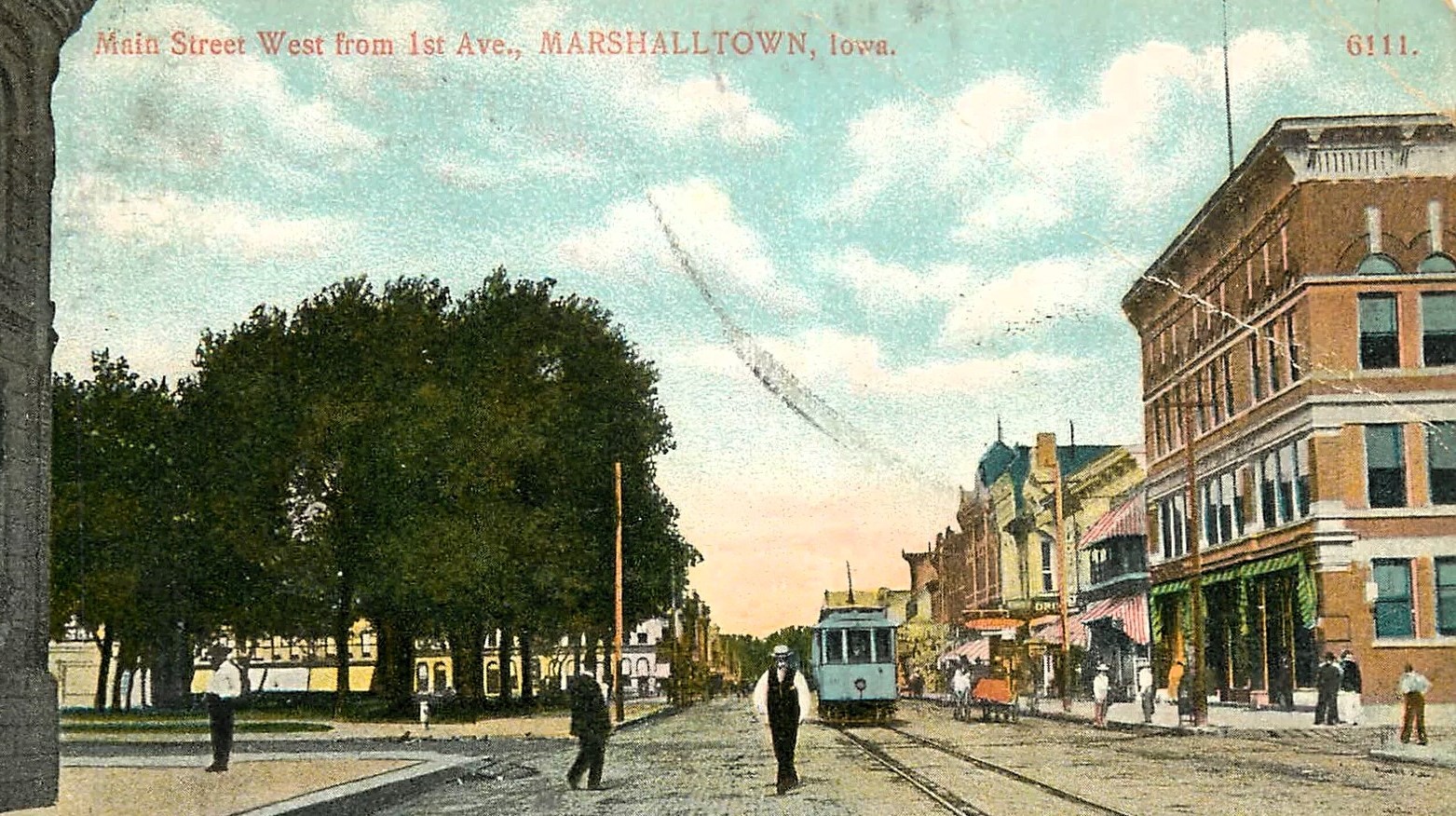
The Workers (Communist) Party journey to the small town of Marshalltown, Iowa in 1925 after noticing their relatively high vote there in the 1924 election. The local vicars are horrified and the Klan aroused. Below are three articles on the failed attempt to bring the Good News to the ‘Babbits’ of Iowa.
‘Marshalltown, Iowa Will Soon See Bolsheviks’ from the Daily Worker. Vol. 2 No. 23. February 7, 1925.
Meeting on Friday, 13th at Labor Hall
MARSHALLTOWN, Ia., Feb. 6. This is one of the oldest towns in Iowa state but has failed to keep pace with the towns who have coal mines or gypsum rock in their locality. It has grown, but only as the farm lands have developed and to serve their needs. It has something like sixty small factories employing about three thousand workers, and the M. & St. L.R.R. shops about 1,000. They also claim the largest steel furnace plant in the world.
Lots of Sinners.
The population is about 16,000 and they boast of twenty-two churches: many of them massive structures. The visitor is impressed with them and can think of nothing but 40 times 40, the number of churches in the Moscow of the czar. This does not include the salvation army, gospel mission, etc., which are all represented, as are also the various creeds patronized by the Negroes. There surely must be many sinners in Marshalltown.
Bossed and Preached At.
This small town is bossed by three or four men. Their daily newspaper, which they boast is the largest in the country for a city of its size, is owned by one of the richest men in own; he is a “democrat” in politics but a reactionary republican editor! He controls the Lenox Furnace company, the largest employer of labor outside the railroad hops, and is also a big landowner.
During the railroad shopmen’s strike the friendly merchants could be counted on one hand. There is a commission form of municipal government here, and the mayor, who is a doctor and colonel in the medical corps, tries to run the city on military lines.
About five years ago they had a packinghouse in Marshalltown. The workers had a strike and they closed the plant for all time.
The townspeople are preached at and bossed but the town seems to get along pretty well just the same. There are comparatively few unemployed.
About 20 Unions in Town.
There are thirteen locals affiliated to the Trades and Labor Assembly which, with the railroad unions, and others, make about twenty locals. There is little or no activity among them to improve conditions or build up membership. There are also a number of women’s auxiliaries who help maintain the feeling of comfort by serving cake and coffee at the meetings.
Life in this small town appears like that of the limited circle of the czar’s nujiks, allowing for the American dress and personal appearance, and is obvious to the observant visitor.
The Bolsheviks Are Coming.
Into this atmosphere of reaction two organizers for the Workers Party will enter by holding à meeting at the Labor Hall on Friday evening, Feb. 13. An attempt will be made to reach the large number of voters who supported Foster and the Workers Party ticket at the last election in Marshall county.
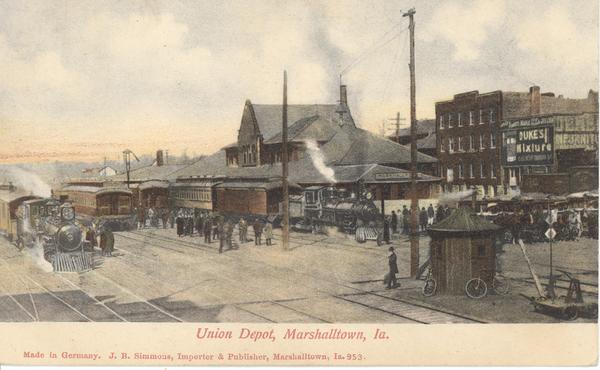
‘New Ideas Not Relished by Iowa Babbits’ by David Coutts from The Daly Worker. Vol. 2 No. 35. February 21, 1925.
MARSHALLTOWN, Ia., Feb. 19. It is a long way from Marshalltown, with its sixteen thousand population, to New York and Madison Square Garden. Such are the extremes of this country that even a few miles gives us sharp contrasts in economics and psychology.
Back on Main street in Marshall town the Workers Party rented a hall at the Labor Temple for a meeting. Along comes the International News Service, (A.F. of L.) with a story that the bolsheviks are about to kidnap the labor unions and drop them into Dante’s Inferno or some other hot place.
This dire threat was brought before the Trades and Labor Assembly the night before that scheduled for the bolsheviks to arrive. Then a political appointee, one of the delegates. had read an article in the DAILY WORKER which stated that four men bossed the town and twenty-two churches kept them mujiks under the sway of superstition.
St. George brandished his sword, the kluxers shook in their night shirts, the blind followers of Gompers and Green swore by their job trusts and sacred contracts and so the battled raged. There were three champions for progress who urged that as men of honor they should keep their promise to rent the hall. The night shirts, witch burners and others morons won a glorious victory for god and their sacred institutions. The infidels and bolsheviks were banished from the holy land of superstition and the czars of “Marshalltown. No meeting was held as the time was too short to make other arrangements.
This is in sharp contrast to the monster demonstration held recently at Madison Square Garden, New York, when twenty thousand bolsheviks and sympathizers, throbbing with protest against the power of the czars and heir retainers, cheered enthusiastically for Lenin, Soviet Russia and the overthrow of capitalism and superstition.
‘The Communist Debate in Main St.’ by Tom Matthews from the Daily Worker Saturday Supplement. Vol. 2 No. 47. March 7, 1925.
YOU haven’t seen Main Street, nor America, if you haven’t seen Marshalltown, the metropolis of Marshall County, Iowa.
They say that not so many years ago Main Street (beg pardon–Marshalltown) had its own unique brand of hospitality for itinerant workmen, more commonly known as hoboes. When one of these unfortunates strayed in the direction of Marshalltown and knocked at the door of one of her proud citizens, he was cordially greeted with a ticket reading “good for one meal” and directed to the marshal. If the “hoe boy’s” hunger exceeded his pride, he presented his ticket to the law, who provided the meal and a two hours’ job as well, usually in the nature of garbage removing, weed-cutting, or some equally pleasant task.
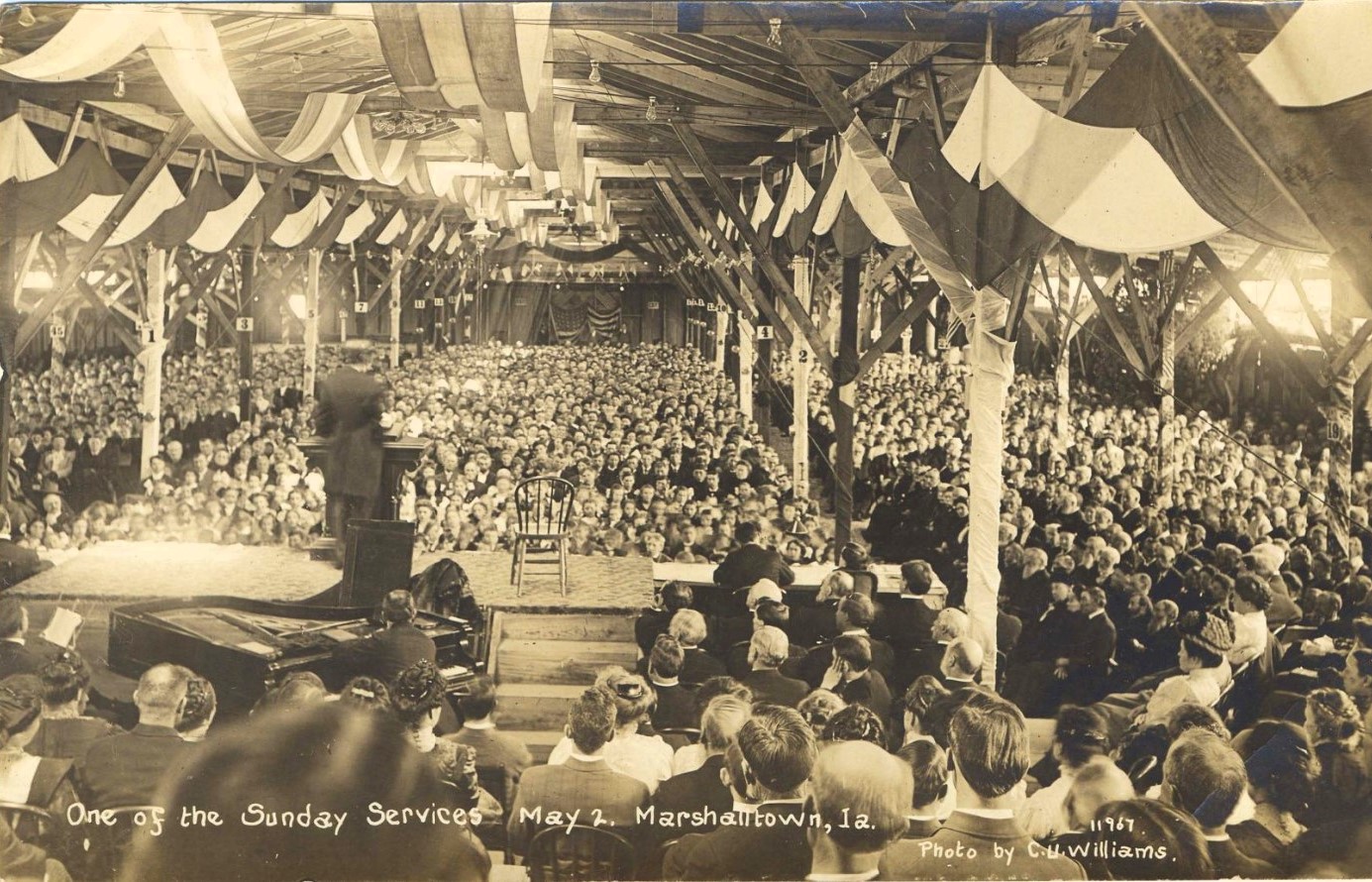
IT is not recorded whether this hospitality became too expensive or to what extent it drove away Marshalltown’s labor supply, but the citizens of this community no longer keep meal tickets by the door. Perhaps the reputation of “Marshal’s Town” became so widespread that the unshaved hobo no longer came around for a hand-out.
Be that as it may, the Communists have become the recipients of a different brand of Main Street “hospitality,” and in that connection hangs a tale, of how Communism came to be a subject of debate among the unionized employes of Babbit, and how the entire time of a Central Labor meeting was taken up discussing the dangers of discussing Communism.
IT is a “far cry” (and a long railroad haul) from New York to Marshalltown. In New York the high officials of the trade unions decry against the “menace of Communism” while the rank and file, fully 15,000 strong, fight their way into Madison Square Garden to express their solidarity with Lenin and to hear the “convicted Red” C.E. Ruthenberg. In Nev York the rank and file are stirring from their apathy and in ever larger numbers embracing the ideas of Communism, at least to the extent of sympathy, while the high officials carry out expulsions and campaigns of slander against the militants.
BUT things haven’t progressed so rapidly in Main Street. The rank and file of Marshalltown labor still read their weekly “labor paper” and digest its contents with the same faith as they do their gospel. So when the Workers Party organizers, J.E. Snyder and David Coutts, arranged a meeting to be held at the Labor Temple under the auspices of the Workers (Communist) Party, they reckoned without the contents of the little local labor paper. This consisted of the usual “International Labor News Service” (synonym for bunk in 29 letters) telling about the alleged efforts of the Communists, working under orders of Moscow, to destroy the American Federation of Labor, and of the action taken by the Chicago Federation of Labor in refusing to aid in the defense of C.E. Ruthenberg.
ENOUGH for Main Street! The men of Marshalltown will have no discussion of Communism in their Labor Temple (so they said) yet they proceeded to their Central Labor Union meeting and discussed it themselves, without any assistance from the naughty Reds.
Watch this! The Communists were defended in this debate by the president and the secretary of the Central Labor Union. The delegates on the floor, with one or two exceptions expressed their fear of Communist ideas–the fear which Main Street has of everything it knows nothing about.
THE bureaucracy of the American Federation of Labor does not exercise the direct power and control out in Main Street which it enjoys in New York. The officers of the Marshalltown Central Labor Union are from the rank and file. They are the militants of the unions in their locality, and it is for precisely that reason that they hold office in the labor movement. What the rank and file of Main Street recognize unconsciously, despite their fear of new ideas, they must sooner or later come to recognize consciously and accept—THE LEADERSHIP OF THE MILITANTS.
WHEN Marshalltown unionists debate Communism, they are recognizing Communism as an issue. One discussion leads to another. New vistas of progress are opened before them as the old barriers of superstition and prejudice melt away.
When these American unionists themselves participate in a discussion of Communist principles, they are stripping the brand of “foreign importation” from the Workers Party, despite all the efforts of the capitalist class and their henchmen to keep such a brand upon our movement. Their discussion of Communism means the recognition of our movement as American, as one, born from the needs of the working class in this country.
Instinctively, the rank and file look to the Communists for leadership. Instinctively, the great masses of the workers in this country look to us to show them the best means of struggle against the capitalist class and their henchmen.
ONE year after the death of Lenin 15,000 workers in New York meet to honor his work. One year after the death of Lenin, the trade unionists of Marshalltown gather in their Central Labor Union meeting to debate the ideas for which Lenin lived…
From Madison Square to Marshalltown–from the international metropolis to the heart of Main Street–Communism is the issue. As Marx would say:
A spectre is haunting American capitalism the specter of Communism. And that specter is embodied in a living, organized force–the Workers (Communist) Party of America.
The Daily Worker began in 1924 and was published in New York City by the Communist Party US and its predecessor organizations. Among the most long-lasting and important left publications in US history, it had a circulation of 35,000 at its peak. The Daily Worker came from The Ohio Socialist, published by the Left Wing-dominated Socialist Party of Ohio in Cleveland from 1917 to November 1919, when it became became The Toiler, paper of the Communist Labor Party. In December 1921 the above-ground Workers Party of America merged the Toiler with the paper Workers Council to found The Worker, which became The Daily Worker beginning January 13, 1924.
PDF of full issue: https://www.marxists.org/history/usa/pubs/dailyworker/1925/1925-ny/v02b-n023-NYE-feb-07-1925-DW-LOC.pdf
PDF of issue 2: https://www.marxists.org/history/usa/pubs/dailyworker/1925/1925-ny/v02b-n021-NYE-feb-05-1925-DW-LOC.pdf
PDF of issue 3: https://www.marxists.org/history/usa/pubs/dailyworker/1925/1925-ny/v02b-n047-supplement-mar-07-1925-DW-LOC.pdf

