A valuable document detailing the (old) Communist Party’s second convention, held in secret in New York City during June, 1920. The party had lost well over half of its membership in the repression, raids, and deportations since their previous conference a year before. Also, in April that year C.E. Ruthenberg had split with his supporters (said in this report to be no more than 28% of the organization) to join with the Communist Labor Party in the new United Communist Party. The attitude toward the U.C.P. to a boycott of coming election, and the functioning of an underground, illegal party were debated. I have added real names where I know them for the underground names used in the report. Also includes resolutions passed at the convention.
‘The Second Convention of the Communist Party of America’ from The Communist (Old C.P.A.). Vol. 2 No. 8. August 1, 1920.
Thirty-four delegates, including fraternal delegates attended the recent convention of the Communist Party of America. Two delegates were absent. The membership represented was more than 8,500, of which 6,500 actually participated in the elections.
The first session was held on a Tuesday night and the last session ended on the Sunday morning following.
It was a working body rather than a debating society, which large conventions usually tend to become. Tense situations developed, especially over the question of the Communist Party attitude towards parliamentarism and the question of appointments of officials all the way from district organizers to group captains, but in the main the work proceeded smoothly. The recent split had solidified and united the membership on nearly all questions of principles and tactics and on most questions, the discussions disclosed a remarkable unanimity of opinion.
Most of the delegates were workingmen who had left their shops in answer to the call of the membership to represent them. But they were veterans of the revolutionary movement both here and abroad. They knew their Communism as well as their leaders, even though their mode expression was difficult and clumsy, and their grasp of the English language was meagre. But they made up for it by their unflinching courage, resolution and expression.
The convention opened with all accredited delegates present except two, one from District A Credentials 4, and one from District 4C.
Committee was elected and brought in a majority report to seat all the delegates, and a minority report recommending that all delegates be seated except District No. 2, which it claimed was entitled only to seven of the eight accredited delegates. Investigation and discussion brought out the fact that there were 432 members (who participated in the elections) on strike or locked out, notably in the Waterbury section and Paterson, New Jersey, section, and who had not paid their convention assessment tax because of that fact. After a lively discussion the eight delegates were seated by a overwhelming vote.
On the second day, while the Rules Committee was preparing its report, the convention heard reports of delegates and district organizers These reports revealed that most of the members of the party had remained after the split, contrary to the false reports circulated by Damon & Co. [Damon is Ruthenberg, RN]
The Acting Secretary’s report revealed the extent to which Damon, the former executive secretary of the Communist Party had betrayed his trust; the unconscionable manner in which he had taken advantage of the confidence of his former comrades, and his duplicity and double dealing while a paid and trusted officer of the Party.
The Acting secretary submitted an itemized cash statement for the period September to December (which has already been published) and for Jan. 1, to June 30, which the secretary recommended be audited by a committee elected by the convention.
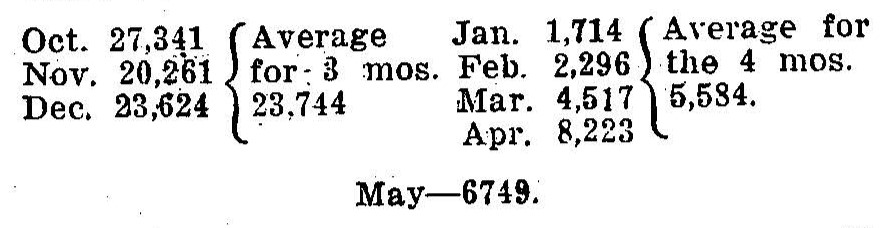
The secretary’s analysis of membership on the basis of dues paid to June 1, 1920, is as follows:
MEMBERSHIP.
Number of members for which dues were paid during and for each month since the first convention of the Party was as follows:
“Taking the highest number of dues paid since the January raids, the Party has lost through them and through the subsequent organization on underground basis about 15,000 members, or 65 per cent. of the initial membership. The Hungarian Federation and Michigan group (3,000 and 1,000 respectively) dropped out of the Party altogether. Russian Federation lost 4,000 out of their 7,000 membership. South Slavic and Polish Federation ceased to pay dues after February. If the split in our ranks had not been brewing ever since the raids, and if it had not come before the convention, the recovery might have come up to 50 per cent. of the October, November and December figures, but certainly not higher.
Let us see now what was the number of members that left the party in the split.
Taking the first number of dues paid we find that the highest month before the split was April with 8,223 dues; May, the first month after the split showed up with 6,749 dues; according to this, we lost in the split only 1,474 members, or 18 per cent. of the total membership before it. Taking the figures estimated by federations and districts, and verified by reports from these sub-divisions and by the number of members represented in our convention, we arrive at the following figures:
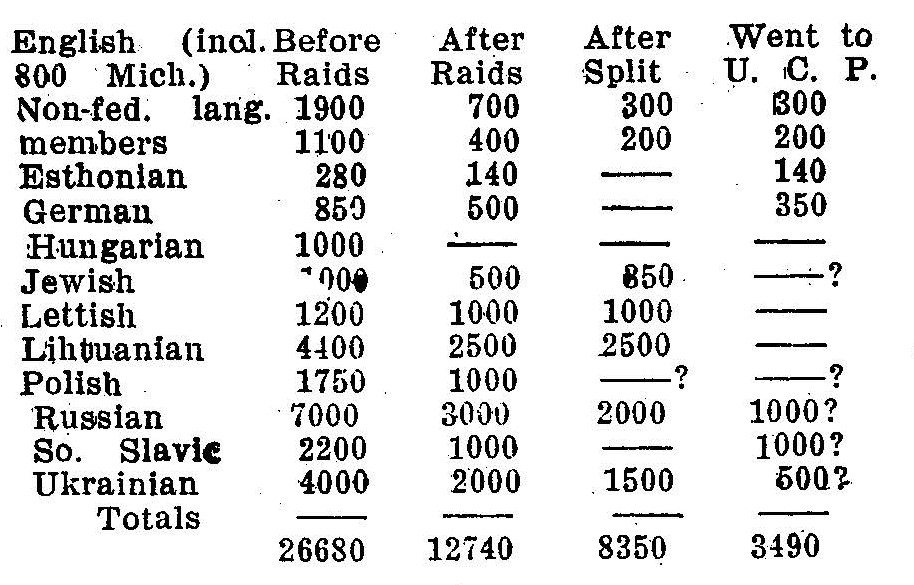
(Note: These figures are the secretary’s estimate. The report of the Secretary of the Russian Federation shows 2,600 paid members, and of the secretary of the Ukrainian Federation 2,000 paid members. Ed.)
“According to this we lose about 4,400 or a little over one-third of our members, but of this the “minority” carried with it into the U.C.P. by no means over 3,500, or positively not more than 28 per cent.
“These are fair and unbiased figures, and they prove beyond a doubt the fallacy of the claims of Damon & Co. that they split away with a majority of the C.P., or that they were justified on that account in taking the funds and records of the party with them.
“In all their statements they find it absolutely necessary to repeat this lie in order to justify their position and to maintain their standing with the former C.L.P. elements.
“We should expose this fraud fully to all the parties concerned and we should demand, on the strength of these figures, officially from the U.C.P. that they return to us all our funds and records. If they should refuse our just claims, we ought to present the case to the Third International, or take determined steps to serve drastic punishment upon those guilty of the flagrant breach of the discipline and trust of our party.”
This report was unanimously adopted, leaving the necessary action to the new C.E.C. after the convention.
Since this report was given to the convention the auditing committee has made its report (which will be submitted to the membership in due course) carrying the following comments:
“The Auditing Committee has examined the cash receipts and disbursements for the six months ending June 30, 1920, and has found the entries, vouchers and statements entirely satisfactory and correct, as far as the Acting Secretary is concerned.
“For a period from March 2 to April 10, when Damon was Executive Secretary, there ARE NO OTHER VOUCHERS FOR CASH RECEIVED EXCEPT STATEMENTS OF DAMON, AND THE SAME IS TRUE OF MANY ITEMS OF CASH PAID DURING THAT PERIOD. THE BALANCE WHICH DAMON TOOK AWAY WITHOUT AUTHORITY IS CORRECT STATED ON PAGE 27, $7,095.16.
(Signed) Auditing Committee, Ma. M.O., C.B.O., A.S.
Further comment is unnecessary as these signed statements impeach the honesty and integrity of the man who is now an official of the U.C.P.
A member of the C.E.C. then reported for the Central Executive Committee, dating from its first meeting after the first convention last September. Its activities were reviewed–giving a consecutive and coherent narration of the elements that composed it and controversies that ensued. Most of the facts are well-known to the members through the statements issued by the former C.E.C. during the split, and need not be repeated here.
This report was also accepted and then the convention settled down to take up the Program submitted by the Program Resolutions Committee.
Each paragraph was carefully and thoughtfully analysed, and the proceedings went along without hitches until the question of parliamentarism was reached.
Although the clauses in the program dealing with our attitude toward Parliamentarism had been adopted without dissenting vote, the discussion was precipitated in considering the minority report of one of the program committee, referring to the nomination of executive officers as candidates. After a lengthy and heated debate, the rules were suspended and a roll call taken upon a motion to endorse the position of the Third International upon Parliamentarism, which was carried unanimously. The following resolutions were then presented and debated:
Majority Resolution.
“Taking as a basis the position of the Third International of which the Communist Party of America is an integral part, we consider the use of the bourgeois parliament as of secondary importance and for revolutionary propaganda and agitation only. At the same time, due to specific political circumstances in the United States, the outlawing of our party and the prevailing reaction in this country, we are forced to boycott the coming elections.”
Minority Resolution.
“We endorse the stand of the Third International on parliamentarism and adapt it (as the Third International indicates) to the present political situation in the United States. The Communist Party of America sees no possibility of utilizing the parliamentary weapon either for the present or in the near future. If, at any time, conditions should warrant participation in parliamentary elections, we shall participate for purposes of revolutionary propaganda and agitation only. The Communist Party however, will propagandize the masses (through its literature, etc.) in every parliamentary campaign, in order to destroy their illusions on parliamentarism and the bourgeois state.”
A roll call was demanded on both resolutions and showed: for the minority resolution 4: against 16: voting present 4. For the majority 16: against 4: voting presence 4.
The debate indicated an attitude on the part of some delegates against parliamentarism under any circumstances, and was characterized as a syndicalist tendency, savoring of dogmatism rather than of Marxism dialectics. The anti-parliamentary position was presented weakly and incoherently and the issue confused. The position of the party, as expressed in the Program, was clear and convincing, so that several delegates with instructions against parliamentarism changed their position on this question during the discussion.
The rest of the Program, as presented by the committee, found little or no opposition. The party attitude towards trade and industrial unions and our attitude towards the I.W.W. found hardly any opposition and that of negligible character. The recent action of the I.W.W. at its last convention had disillusioned the great majority of the membership as to the revolutionary pretensions of the I.W.W. And the teachings of Lenin and other leaders of the Third International, on the use of economic organizations of the working class as a field for Communist propaganda, and not for the I.W.W. policy of “smashing the A.F. of L.” and reconstructing the trade unions, was apparent to all the delegates as the correct position to take on the perplexing question.
A sub-committee of the former C.E.C. had prepared and submitted to the Committee on Constitution, a draft of a constitution based upon the principle of appointment of all party officials below the C.E.C., including the group captains. This draft became the majority report of the Constitution Committee, with two minority reports: one for election of local organizers by the branch organizers, branch organizers by the group captain, and all group captains by the groups–other officials to be appointed– and another for the election of group captains only, all others to be appointed.
Before consideration of the Constitution, it was unanimously decided to discuss the principle of appointments or elections first; accordingly, a motion that appointments from the top to the bottom be the basis of our constitution. An amendment was brought in that elections be the basis of the constitution.
And then the discussion raged. For four or five hours the debate continued until previous question put an end to it. The discussion had been keen and spirited. A number of delegates who argued against adopting the principle of appointments argued from the point of view that the principle was correct for an underground organization, but it was premature to adopt it at this convention; that the rank and file were not yet educated to it and would rebel against it. Those who were for elections agreed to the appointment of district organizers and displayed a tendency to accept the appointment of sub-district organizers as well, but believed that beyond that point elections would serve as a check upon the higher officials and give the membership some measure of control.
Those who argued for appointments pointed out the necessity of building a highly centralized and well-disciplined underground organization in the face of the bitter persecution and suppression of the capitalist state, as well as the military character of the organization in the time of revolution, which would take the lead in destroying the highly centralized and armed capitalist state. That such a task required equally centralized organization and a well-disciplined membership who would be able to carry out the orders of the supreme body without any hitch. They pointed out that the Russian and Ukrainian Federations Conventions had already adopted this principle of organization in their constitutions, subject, of course, to the decisions of the national convention, as an indication that the membership would accept this principle without rebelling; that it made for the safety of the underground organization against spies, who might otherwise gain the confidence of the membership and thus advance themselves to positions of trust in the party; that election meant the creation of two machines in the party instead of one, each acting against each other, and thus diminishing the effectiveness of the organization; that the time had come for the membership to sacrifice any remnant of petty-bourgeois psychology which militated against the acceptance of appointments for the sake of learning self-discipline; that the membership were not in the party to raise their hands in voting as the highest expression of their duty, but to carry on Communist propaganda and agitation to work–to build up the Party, etc.
On a roll-call vote the first minority report (to elect captain) was voted down 23 to 3. The second minority report was lost by a vote of 12 to 12. The majority report was also lost by a vote of 12 to 12, and the convention automatically came to a deadlock.
Thereupon a motion was made to adjourn in order for both sides to consider their subsequent action. This motion carried and the meeting adjourned.
At no time was there any intention or the slightest reference to splitting or bolting the convention from either side. Both sides agreed on all fundamental questions of principles and tactics. Both sides were consciously Communist–had withstood the demoralization and persecution of the government raids and the subsequent disruptive tactics of the “minority” Centrists who had split away from the party. The disagreement was on an organization question, which though important in itself, could be solved by mutual agreement without in any way hindering the party work.
As a result of this both caucuses considered not the question of a split but the question of reaching a solution which would not interfere with the process of underground organization and propaganda. This solution was quickly reached the following morning and the convention resumed its sessions without further interruption. It was agreed by both sides to accept appointment of district and sub-district organizers and the election of local organizers by the branch organizers, the branch organizers by the group captains and the election of the group captain by the groups.
The constitution was quickly adopted with one important modification, namely: the election of four alternates, who could be chosen to fill vacancies in the C.E.C. in any order, and the right of co-operation after these alternates were exhausted, instead of the committee recommendation not to elect any alternates at all.
The Program and Resolutions Committee then submitted its resolutions (printed elsewhere in this issue), which were adopted with slight corrections and revisions.
The Committee brought in the following resolution on Unity:
“Communist Unity is based upon the organic unity of principles and tactics. Communist unity means unity with the rank and file and not with leaders. Our aim must be to separate the rank and file from their Centrist leaders.”
This resolution was carried and then the following resolution on Unity with the U.C.P. was submitted:
“Unity with the U.C.P. as a party of Centrists, is impossible. We can unite only with such membership, or parts of the U.C.P. that will repudiate their Centrist leadership and join the Communist Party on the basis of our principles, program and tactics.”
On the whole this constitution is a worthy companion to the program of the U.C.P. And the program and constitution are concrete proof of the Centrist character of the U.C.P. as an organization, and of the leaders who are in control of it.
An amendment was brought in as follows:
“We recommend that those groups or branches of the U.C.P. which repudiate officially their previous stand with the U.C.P. shall be admitted in the Communist Party. But we are absolutely against unity with the U.C.P. as a whole as represented by their C.E.C.”
The first resolution was introduced by delegates from District 1, under instructions, and the last resolution was introduced by the delegates from District 5, under instructions. Nothing could better illustrate the attitude of our membership on the question of Unity than these resolutions.
A roll call on resolution and amendment was demanded and sustained with the following results:
In favor of amendment: 3: against 20.
In favor of resolution: 20: against 4.
Those who voted against the resolution and in favor of the amendment did so only because they were under instructions to vote for it, and because they saw no difference between the two. But all the delegates were absolutely opposed to unity with the U.C.P.
The Ukrainian Federation sent greetings and $500 to the national convention.
The Lithuanian Sub-district of Philadelphia sent greetings and a $50 contribution.
The 1st Lithuanian Branch of Phil. sent greetings and $25.
The Russian Federation sent greetings. The Lithuanian Federation sent greetings. The Jewish Federation fraternal delegate and the Lettish fraternal delegate were not present, having missed connections.
The convention then proceeded to the election of a E.C.C. of 9 members and 4 alternates. The following were elected: C.E.C.: Sullivan [Alfred Edwards, Latvian Federation], Greenwald [Jewish Federation], Allen [Maximilian Cohen, Jewish Federation], Morris [J. Wilenkin, Russian Federation], Leon [Lithuanian Federation], Bain [Louis Shapiro, Jewish Federation], Johnson, Thompson, Baldwin [Oscar Tyverovsky, Russian Federation].
Alternates: Adrian, Larin, Wiley, Klints.
An auditing committee of five, were also elected to serve for one year: Book, Steinberg, Pavlov, Retap, and Narrow.
Thus closed the second convention of the Communist Party, just as it had begun, without flourish or ostentation, song or hysteria.
MOTIONS AND RESOLUTIONS ADOPTED AT THE SECOND CONVENTION OF THE COMMUNIST PARTY OF AMERICA
Greetings to the Communist International
In the name of the membership and the organization, we, the delegates assembled at the Second Convention of the Communist Party of America, send fraternal greetings to the Third International.
We stand firmly determined to fight under the Red Banner of the Communist International till the victory of the proletariat and the Communist ideal is attained.
Down with capitalism.
Long Live the Proletarian Dictatorship! Long Live the Communist International! Long Live the Communist Party of America! Long Live Communism!
Resolution on the Relation of Communist Parties to Soviet Government
Representatives.
The Communist Parties of the various countries are the direct representatives of the Communist International, and thus, indirectly of the aims and policies of Soviet Russia.
Representatives of Soviet Russia in various countries, engaging in political activities, should co-ordinate these activities in some form or other with the activities and policies of the respective Communist parties, so as not to harm the Communist movement in those countries; If, however, this co-ordination is impossible in case of commercial representatives, they should refrain from any political activities.
Our Attitude Toward Workers’ Councils (Soviets), Before, During, and After the Revolution.
Workers’ Councils are the organs of the proletarian revolution and are created the time of revolution, developing out of the revolutionary situation itself and through the Communist Party Shop Committees, which become the nucleus for the formation of Workers’ Councils.
Before the revolution the Workers’ Councils tend to degenerate into philanthropic and cultural institutions because they have no revolutionary function to perform. The Communist Party alone has a revolutionary function to perform before the revolution–the task of building up the revolutionary movement by means of Communist propaganda and agitation that will lead the working class to the proletarian revolution and proletarian dictatorship.
After the proletarian revolution the Workers’ Councils (Soviets) themselves become the proletarian state the organ of proletarian dictatorship (1) for the suppression and coercion of the capitalist class and (2) for the economic reconstruction of society.
Our Attitude Toward Legal and Other Workers’ Organizations.
We are opposed to legal cultural or educational organizations. Party committees, consisting of not more than fifteen in number, with approval of the C.E.C., may use the legal forms for special work.
Greetings to Soviet Russia.
We, the delegates assembled at the Second Convention of the Communist Party of America send our fraternal greetings to the proletariat and poorer peasantry of Russia through the Soviet Government–the Peoples’ Commissars and the C.E.C. of the All-Russian Soviets–led by the Communist Party of Russia–the revolutionary vanguard of the working class.
Your struggle has brought you great victories. In a comparatively short time you have defeated on the field of battle all the internal and external foes that fought against you. You have crushed the counter-revolutionary hordes of Kolchak, Denikin and Yudenitch.
Now you are hurling your heroic Red Armies against the forces of the Polish bourgeoisie and social-patriots, who with the support, both open and tacit, of the Allied Imperialists have decisively attacked you. We feel confident that you will defeat the Polish bourgeoisie and thus assist the Polish proletariat and poorer peasantry in overthrowing their bourgeois government and establish the proletarian dictatorship in the form of a Soviet Government of Poland. The victories of your Red Armies, backed by the awakening Western proletariat, may force the Allied Imperialists to accept peace in some form.
We feel confident that the proletariat and poorer peasantry will not expect such a peace to be permanent. Such peace can only be an armistice.
The world imperialists will not give up the fight against you. The proletarian world revolution alone will finally bring victory to the workers of Russia and the working class of the entire world.
The Communist Party of America will bend all its energies toward building up a strong revolutionary movement in this country that will lead the working class in their struggle against their own capitalist class and government–and play its part in the world proletarian revolution which will establish the proletarian dictatorship throughout the world and through it introduce the Communist Society.
Long live Soviet Russia!
Long live the Communist Party of America! Long live the Communist Party of Russia!
PDF of full issue: https://www.marxists.org/history/usa/pubs/thecommunist/thecommunist3/v2n08-aug-01-1920.pdf

