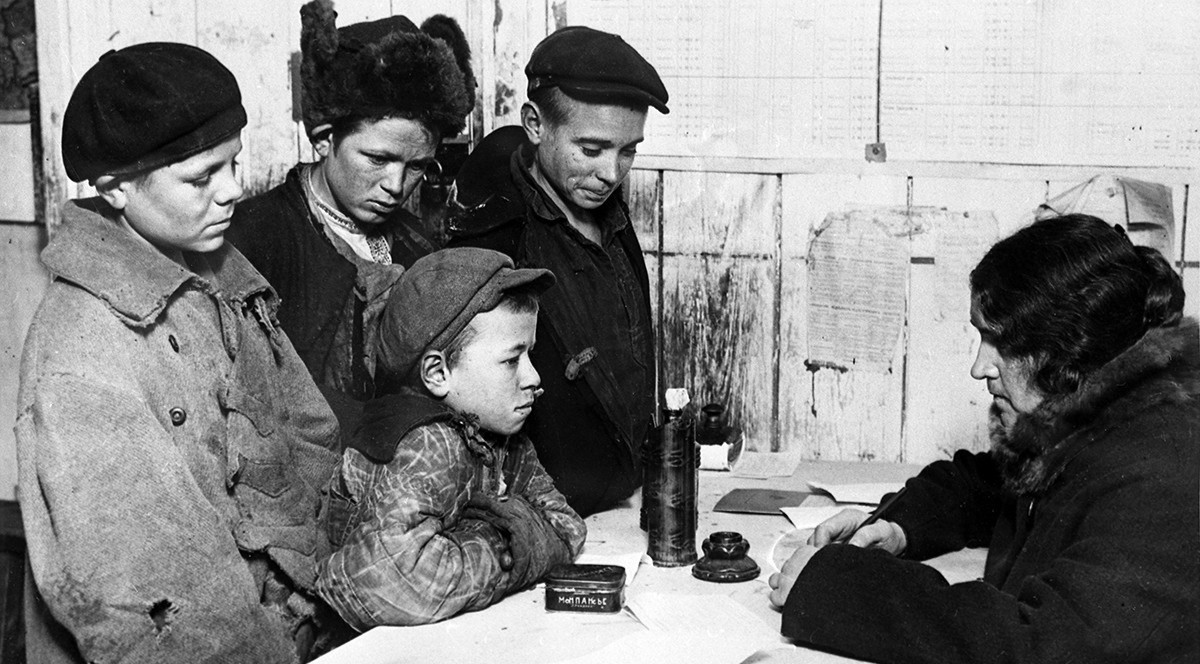
The People’s Commissar for Social Welfare describes what has been accomplished since the Revolution.
‘Social Maintenance in Soviet Russia’ by A. Vinokurov from Soviet Russia (New York). Vol. 4 No. 5. January 29, 1921.
BEFORE the November Revolution, the social maintenance of the workers in Russia was in a very pitiable state. The insurance of workers, which had been introduced during the Tsarist regime in 1912, embraced only a very small part of the workingmen (20 per cent), mostly in the big factories. The greater part of the payments was put upon the workers themselves. Salesmen, servants, transport workers, and agricultural laborers were deprived of the right to social maintenance.
Assistance was given only in cases of accidents or of illness. But the workers were not insured against old age, invalidity, or unemployment. The extent of the assistance was from one-fourth to two-thirds of the earnings.
The so-called “care for the poor” was not in a better condition in the period before the November Revolution. During the Tsarist period the organization of help for the poorer part of the population was in the hands of the charity organizations of the ex-empress Mary Fedorovna, of the Humane Society, etc. But they did not satisfy even a hundreth part of the needs of many millions of the poor.
After the November Revolution, the Workers’ and Peasants’ Government faced an immense task in the field of social maintenance. It was necessary to introduce perfect social maintenance for the workers, and to raise to a proper level the maintenance of soldiers and their families. It was necessary to break the whole system of the old “care” and to introduce the maintenance of invalids and the poor on Socialistic principles.
Social maintenance was declared to be not a charity, not a gift, but the right of every laborer, of every worker, or of officials who cannot work or are in need. A vigorous campaign was begun against the laziness and parasitism which were maintained by the old system. The right to social maintenance was recognized only for those who have lost their ability to work and have no other means of existence. Every healthy person is obliged to work. Everyone who has private means has no right to social maintenance. Instead of the system of beggary and charity, a rational social assistance was introduced. Those who have been wounded are healed and taught some useful trade so that they are not a burden to the state. The sick get assistance in the hospitals, sanatoria, etc. Helpless invalids receive shelter in invalid’s homes. Orphaned children are taken care of in nurseries, children’s homes, and in homes for the protection of childhood. Those who have lost their ability to work and are deprived of any other means of existence receive pensions, etc.
The Workers’ and Peasants’ Government has developed a great activity in the field of social maintenance along these lines.
1. The Social Maintenance of Workers and Their Families
The Soviet Government has issued a decree on the social maintenance of the workers. According to this decree, all workers and officials have the right to receive assistance in case of illness, disability, or unemployment, during pregnancy and confinement, and pensions in case of invalidity (on account of illness, old age, or disability). According to the project of the code of laws on social maintenance, free social insurance at the expense of the state embraces also poor peasants, artisans and handicraftsmen. In case of illness and disablement, and for women in case of confinement, they receive medical treatment by ambulatory treatment at home, or at hospitals and sanatoria. Assistance is given up to the amount of earnings. Nursing mothers receive additional assistance for themselves and for their babies; workingwomen are freed from work for eight weeks before and after confinement. Women who are occupied with office and mental work are freed from work for six weeks before and after confinement.
During unemployment, assistance is given to the amount of the minimum scale of wages.
Pensions are given according to the degree of disability. For complete disability which necessitates constant care—to the amount of one and one-half times the average scale of wages (in Moscow this amounts to 4,050 rubles a month). For complete disability which, however, does not necessitate constant care, the amount of the pension is equal to the average wage-scale. For partial disability the amount of the pension is equal to from one-half to three-quarters of the average scale.
Persons who have lost their ability to work and who have lived on the means of their family, receive, in case of the death of the provider of the family, a pension of 60 per cent of the average scale for one disabled member of the family, 75 per cent for two and 100 per cent for three or more disabled members of the family.
2. The Maintenance of Soldiers, of the Old and of the Red Army
The Tsarist Government and the opportunist government of Kerensky gave high pensions to officers and generals, but only beggarly pittances to invalided soldiers and their families. The pension of a complete invalid amounted to 216 rubles a year, and the family of a dead soldier received only 48 rubles a year. The Soviet Government, immediately after the November Revolution, raised this pension to 1,125 rubles a year, and raising it by degrees, made the pension equal to that of the workers, by October, 1919. In the same manner, the pension to families of dead soldiers, of the old, and of the Red Army, was made equal to the pensions to the families of the toilers after the death of their provider.
Besides the insurance of the Red Army men in case of disability and the insurance of their families in case of death, the Workers’ and Peasants’ Government is paying great attention to the maintenance of the families of persons serving in the ranks of the Red Army.
The families of Red Army men receive pecuniary assistance, and the additional “Red Star” food ration; they are exempted from paying rent; they receive agricultural assistance with seeds, inventory and labor, they are called to compulsory labor only in exceptional cases, etc.
3. Insurance in Cases of Elemental Distresses
Besides the above forms of social maintenance the Soviet Government has developed on a wide scale the insurance of those who have suffered during the civil war (from the White Guards, or from the counter-revolution) and from elemental distresses (fires, etc.). The insurance embraces the toilers of the cities and the villages. The assistance consists of extra help as to shelter, food, clothing, footwear, etc. Assistance and pensions are given to the disabled and to the families which have lost their providers. Besides, those who have suffered from elemental and social distresses are assisted in the reconstruction of the ruined households.
4. Establishments for Invalids
Besides provisions, there are a series of establishments for invalids in Soviet Russia. After the invalids have been healed, those of them who are still able to do work are sent to the organs of Registration and Distribution of Labor Power, where they are given work which they are able to do. Those who have lost all ability to work at their old trades are sent to workshops and schools distributed all over Russia. There are schools for carpentry, shoemaking, plumbing, basket-making, courses for accounting, bookkeeping, etc. For complete invalids there are special homes. These homes do not at all resemble the old houses for invalids. Here the disabled who are kept to their beds receive the opportunity to do work. Such are assigned to tasks of which they are capable, homes with artistic shops for drawing, sawing, carving, etc. The number of homes for invalids in Russia amounts to 2,000, and the number of invalids in these homes is about 150,000.
The Workers’ and Peasants’ Government is spending enormous sums on social maintenance. Thus, in 1920, about 50 billions of rubles were assigned to the deeds of social maintenance. Of these, 10 ½ billion went for pensions to workers and their families, 4 1/2 billions for pecuniary assistance to Red Army men, old-army men and their families, 18 billions for pecuniary assistance to the families of Red Army men, 1 ½ billions for the assistance of victims of elemental and social distress, and 6 billions for other kinds of social maintenance (homes and colonies for invalids, workshops and schools of professional training, establishments for the victims of elemental and social distresses, occasional assistance in kind, for those in need, etc.)
There is no other country in the world which carries out social maintenance on such a scale and spends for this purpose such sums as does Soviet Russia. Only a government of the workers and peasants, which has overthrown the regime of the landlords and capitalists, and has at heart the interests of the toiling masses, could accomplish this without regard to the greatness of the expense. Moscow, October 16, 1920.
Soviet Russia began in the summer of 1919, published by the Bureau of Information of Soviet Russia and replaced The Weekly Bulletin of the Bureau of Information of Soviet Russia. In lieu of an Embassy the Russian Soviet Government Bureau was the official voice of the Soviets in the US. Soviet Russia was published as the official organ of the RSGB until February 1922 when Soviet Russia became to the official organ of The Friends of Soviet Russia, becoming Soviet Russia Pictorial in 1923. There is no better US-published source for information on the Soviet state at this time, and includes official statements, articles by prominent Bolsheviks, data on the Soviet economy, weekly reports on the wars for survival the Soviets were engaged in, as well as efforts to in the US to lift the blockade and begin trade with the emerging Soviet Union.
PDF of full issue: https://www.marxists.org/history/usa/pubs/srp/v4-5-soviet-russia%20Jan-Dec%201921.pdf

