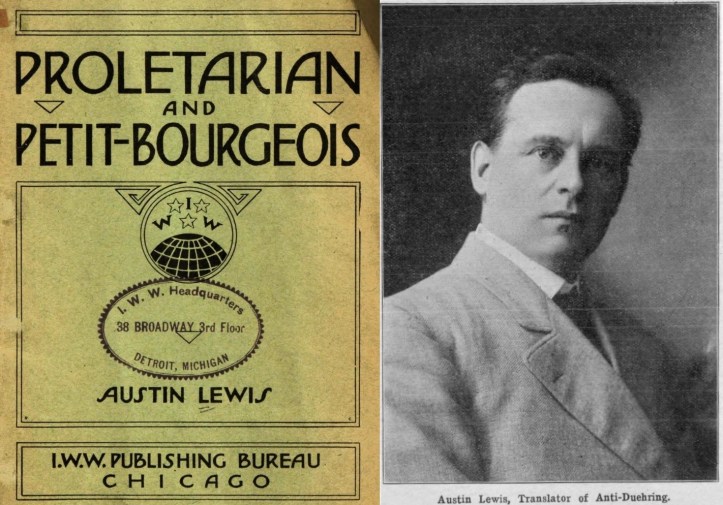
Austin Lewis draws a hard class line with one of the major Marxist texts on industrial unionism in the conflict between revolutionary and the reform wing of the workers’ movement that determined much of the debate in the decade before World War One. Lewis would side with William D. Haywood in the Socialist Party, was a key figure behind the ‘Revolt’ newspaper, and produced many of the theoretical arguments for the I.W.W., which as a lawyer he defended in innumerable legal battles. Full text of the pamphlet below.
‘Proletarian and Petit-Bourgeois’ by Austin Lewis. Industrial Workers of the World Publishing Bureau, Chicago. 1912.
Marxian Socialism predicates the formation of what is called the proletarian class. The process of the organization and development of that class is, in fact, the most striking phenomenon of the present industrial age, for on its organization and development depend the break up of the existing system, and the substitution for it, as a successor, of another industrial system, which for want of a better name is called socialism.
The term socialism at the present time has two distinct concepts, the one standing for the process by which the proletariat develops its political and industrial independence of the existing capitalistic regime, and the other a more or less hazy objective, which is sometimes called socialism and often the co-operative commonwealth.
We may ignore this latter as being a sort of apocalyptic vision.
How is the proletariat to obtain the supremacy?
According to Marx by the operation of two distinct processes—one, the growth of the proletariat itself, the rise and progress of class consciousness, with all the industrial and political manifestations flowing therefrom; the other, the automatic process of capitalism which necessitates ever more involved and complex industrial machinery, the coming into being, the development and the perpetuation of combinations.
This process of necessity implies the extinction of very large numbers of small competing capitalists, industrialists, and merchants, who formed the backbone of the present system in its earlier stages.
There can be no real doubt as to the correctness of the Marxian predictions with respect to capitalistic development, for we have now unquestionably the greater capitalism with all the legal and political problems which it involves. As a counterpart also we see the decline in importance of the smaller capitalism which in its turn has in all modern communities given rise to certain very distinct and easily differentiated political manifestations.
The question thereon occurs: Is the Marxian theory of the rise of a revolutionary proletariat correct?
Unless this can be shown the whole of the revolutionary theory topples, at least as far as the socialist propaganda is concerned.
So we are brought to an examination of the proletariat itself and to a somewhat close analysis of its component parts, that we may the better appreciate the substantial power which it actually possesses, with a view of determining its possible effectiveness in a revolutionary struggle.
It will be observed that the term “revolutionary” is used in the broadest possible sense and is not confined to those physical manifestations and ebullitions which are generally the concomitants and transitory expressions of politico-social movements but which are not to be confused with the movements themselves.
The Marxian classification broadly and very satisfactorily divides modern industrial communities into three broad sections—the greater and dominant capitalism, which is practically in control; the smaller capitalism which has lost control but which stubbornly and incessantly maintains the fight against the greater capitalism, and the proletariat which is practically, so far, a negligible quantity.
The Marxian theory predicates the destruction of the petit bourgeois and the forcible thrusting of that somewhat unpleasant individual into the pit of proletarianism whence he is to come forth as an avenging angel and to repay his sufferings at the hands of the greater capitalism by the destruction of the latter.
But here we encounter somewhat of a check for the beaten petit bourgeois does not to any extent take sides with the proletarian and does not furnish that leadership and brains to the proletarian movement which it was confidently expected that he would. On the other hand, the later decades have been marked by the growth of what is called “the new middle class” which is not revolutionary. Indeed, the whole Bernstein controversy which has occupied so much space and generated so much heat rests precisely on this undeniable fact.
If we look at the matter from a practical and concrete standpoint it is easily understood why this is so.
When a trust takes over the field of an industry it disposes of its opponents two ways. It buys them out and takes the best brains of the smaller industry into its own service, the rest it annihilates by sheer force of economic superiority. It is obviously true that the more vigorous portion of the petite-bourgeoisie thus assimilated by the trust does not become revolutionary. On the contrary, its interests are henceforth identified with the interests of the trust of which it has become employee.
Economically, the smaller capitalist has been crushed out by this process, he has become a proletarian in receipt of a salary. Obviously he cannot be generally described as a capitalist large or small, and, according to the Marxian idea, he ought to be ranged with the proletarian class, but, as a matter of fact, he is no proletarian. He becomes a good servant of his new master, he accepts the political views of his new master as a good servant should, and he is not to be reckoned as a force with the revolution but as a distinct acquisition to the power of his destroyer.
Besides this, large numbers of the middle class are shareholders in the greater capitalist concerns. The Pennsylvania R. R. has twenty-five thousand shareholders and the steel trust an even greater number. In fact, the capital of the great trusts rests largely upon the subscribed capital of middle-class stockholders. It is clear that the economic interests of these people are not with any other than the greater capitalism into which they have become merged.
The small fish swallowed is transformed into part of the shark, and the petit-bourgeois losing his economic identity is absorbed in the Nirvana of the greater capitalism.
With respect to the beaten small bourgeois, he does not count. There is no revolutionary effectiveness in a beaten class, and the defeated small tradesman either sinks into oblivion, buried in the slums, the cemeteries of the unfit, or perambulates the earth an uneasy ghost entirely out of place in society and tampering with reactionary politics, in the ranks of the Roosevelt pseudo-progressives or playing with the Socialist Party.
Really, this new middle class did not enter into the calculation of Marx. It could not have done so, for the economic facts of his time did not allow of such an anticipation.
He wrote in a milieu of which the dominant note was the petite-bourgeoisie, the philistines of the early Victorian era.
The great concerns were only just beginning to raise their heads above the welter of the competitive chaos. The mass of the workers, denominated proletarians, had no political representation, and had not even learned to organize trade unions on any effective scale, indeed, they were only just beginning to develop rudimentary forms of these organizations. Marx could see—and surely that is credit enough for one man—that the greater capitalism was the next order of the day, and that the proletarian class must remain as the only effective class with which a revolution could be made.
As a generalization the conclusion is correct. It remains practically unassailable in spite of the vehemence of the attacks made by the Revisionists, but it ignores a whole intermediary period through which we are passing at the present time. It leaves out of consideration the work of the petite-bourgeoisie in the political and social world; it does not take into consideration the tremendous efforts put forth by that class in antagonism to the dominant capitalism, efforts which are distinctly reactionary, though apparently progressive, and still less does it recognize the unexpected vulgarization of the socialist party by the same petite-bourgeoisie.
The British Reform Acts as well as the development of liberalism in Europe placed the old world on a practical level with the new as regards the influence of the petite-bourgeoisie. In Europe the old aristrocracy was more and more forced to make common cause with the capitalistic magnates and both landed and moneyed aristocracy, forgetting their old differences, were driven into the same fold.
The non-existence of those differences in the United States made the progress of the latter country in the direction of economic concentration more easy and the vastly greater opportunities afforded to the individual to prosper economically for a long time obscured the issue between the petite-bourgeoisie and the dominant class.
In Europe the process of bourgeois development was retarded by the complications of the fight for liberalism. On the continent that fight is still going on, though involved with the introduction of social ameliorative tendencies on a scale unknown to the liberalism of Great Britain until very recent times. But as time went on and as the inability of the small bourgeois to maintain a position on the economic field became more and more obvious, he was obliged to turn his attention from laissez faire of which he had formerly been the exponent to the very antithesis of liberalism, to-wit: state interference.
Thereupon he began to view with some complacency the socialist platform which by its denial of laissez faire and its demand for interference with those capitalistic activities which at the beginning had been the very basis of liberalism, served to offer some relief from the pressure to which he was subjected.
But it will be observed that the small bourgeois did not turn his attention to the socialism of Marx with its proclamation of the class struggle and its insistence upon the triumph of the proletarian. That would never have done. The petit-bourgeois was by no means anxious to become a proletarian. On the contrary, his grievance was that he was likely to become one under the pressure of the great capitalism.
Thus he sought a remedy in State Socialism, or collectivism and the Fabian Society of Great Britain became his exponent. He favored attacks upon rent, profit and interest above certain amounts, inheritance taxes, and heavy land and income taxes, extension of government works, and greater governmental control of franchises, and finally a form of collectivism which contemplated the expropriation of the private owners of the so-called public utilities.
This last form of public ownership was triumphantly heralded as socialism and a propaganda was set on foot by which the political fortunes of the petite-bourgeoisie came to be linked with those of certain sections of the working class.
As a matter of fact the prevailing influence in the socialist parties has therefore been not proletarian but petit bourgeois. Even the membership has borne the mark of the small trader though somewhat of a transformation is now taking place, but by far the most influential men in the socialist movement are not members of the working class, a very curious state of things in a movement which according to its founders rests primarily upon a proletarian base.
In proof of this an analysis of the membership of the Socialist Party in the United States published in the Socialist Party Official Bulletin for April, 1909, shows the following figures: Laborers, 20 per cent; craftsmen, 41 per cent; transportation, 5 per cent; farmers, 17 per cent; commerce, 9 per cent; professional, 5 per cent; housewives, 3 per cent.
Eliminating the 3 per cent credited to housewives, it gives 77 per cent non-proletarian as against 20 per cent proletarian in the membership of the Socialist Party itself, in which the proletarian elements might be considered to be the determining factors. It is clear that so far from the Socialist Party being a proletarian party, it is hardly a working class party, even, for the laborers and craftsmen combined only give 61 per cent as against the balance obviously and distinctly petit bourgeois.
It will be seen later, moreover, that the term working class by no means necessarily implies the term proletarian.
In fact the Socialist Party is just a rallying ground for the discontented petit-bourgeois and working class to coalesce. It is a cave of Adullam, as Robert Lowe would have called it, merely that.
It is very obvious that in this borderland we find but scant traces of that proletarianism which is to redeem the world.
We now shift our enquiry to the realm of the working class.
In Marx’s “Capital” we find “Productive activity, if we take out of sight its special form, viz., the useful character of the labor, is nothing but the expenditure of human labor power . . . it is the expenditure of simple labor-power, i. e., of the labor power, which on an average, apart from any special development, exists in the organism of every ordinary individual. Skilled labor-power counts only as simple labor-power intensified, or rather as multiplied simple labor, a given quantity of skilled being considered equal to a greater quantity of simple labor. Experience shows that this reduction is being constantly made.” (Vol. I. P. 51 Kerr’s Edition.)
The differentiation between skilled and unskilled labor is therefore, according to Marx, merely quantitative. The proprietors of skilled labor have, however, persisted in regarding it as qualitative and have considered the possession of this particular species of property, i. e., a skilled trade, as marking them off from the unskilled mass.
The trade unions were formed really in defense of the property of the particular craft in which the associated members claimed special skill. The protection is two-fold. First, against the employer, and seeks to regulate the wages and hours in the special craft, to make special arrangements with respect to the conduct of business, sanitary conditions, lighting, method of collecting wages and a host of other matters which necessarily arise in the course of the production of commodities. Second, against the unskilled mass on the outside, by the regulation of apprenticeships, both as to number and duration, the imposition of a high initiation fee, and the payment of a comparatively large sum as dues. Besides in some of the more highly specialized organizations there has always been a marked tendency to crowd out competitors even in the ranks of the unions themselves, so as to give the remainder a better hold on the jobs—in other words, greater security of property.
Protection at the hands of the employers has been sought by entering into contracts for the security of the union position during an agreed period of time, and, in the case of the more highly specialized unions, frequent conferences and gentlemen’s agreements have taken place in order to prevent the outbreak of hostilities and the declaration of strikes and lockouts.
In all this it will be noted there is no approach to that revolutionary attitude on the part of the proletariat predicted by Marx; on the contrary, there is no sign of proletarianism here at all. The laborer comes on the scene, not as a proletarian, but as the possessor of a specific property, to-wit: specialized skill. This property he has more or less protected by cornering the market, and he offers this property for hire or sale just as the employer offers his property. In fact, there is a labor market and there can be no labor market without the existence of objects of exchange, that is property on both sides.
The very phrases which have accompanied the labor movement show this to be the case. “A fair day’s work for a fair day’s wage” is nothing but a demand that the laborer should have the price on the market for which he is willing to part with his property. “Labor has rights as well as capital”—what is this but a recognition of the property in labor power? Under circumstances in which the capitalistic control of the government has become so apparent that the unions have considered it to be essential that they should make an effort to retrieve their position by the acquisition of political power, or where the unions have grown to such an extent that their economic power naturally seeks its political expression we get political platforms which express the views of these unions. An examination of these views will show that they do not differ essentially from those of the petite-bourgeoisie but are directed to the protection of themselves in terms of the existing system and do not offer any real revolutionary tendency.
The San Francisco Labor Party platform is one in point. In it the rights of capital are fully recognized and the claim is made that under the banner of trade union political victory all classes of the community will flourish, a statement which could be made equally well by any political party. In fact, the sole attack on the union labor administration by its enemies is that it is a political effort to protect the job, to-wit, the property of the union men, to the detriment of the property of other proprietors, the merchant, the manufacturer and the small capitalist. In England, where the unionists went into politics on their own account under the name of the Independent Labor Party, the essential unity of the union man with the petite-bourgeoisie has been shown in the fact that the Independent Labor Party has become little more than an appendage of the Liberal Party. Even the German Social Democratic Party cannot be shown to be other than of the same stripe, and its success in point of numbers has lain in the political sagacity of its leaders, which has effected the assembly of liberal elements on a large scale under the apparently revolutionary banner of socialism. Australia and other places furnish the same spectacle, and what is called the Socialist victory in Milwaukee is nothing but the triumph of the trade union property notion, as an examination of its platform will conclusively show.
So far then the unions have not made any revolutionary attack upon the existing system and the proletarianism which is to destroy it obviously does not proceed from them. Their political and even their economic action is vitiated by the recognition of their craft as a property. They make their fight against the capitalist enemy in terms of that property, and thus in terms of the present system. As if it were possible to upset a system in terms of the legal and political notions on which that system actually itself depends.
The truth of the above contention is apparent from an examination of the platform of the Socialist Party in so far as it contains the actual and practical proposals of that party apart from merely rhetorical flourishes.
It will be found to embrace demands which may be conveniently classified under the heads of collectivism; attacks upon the greater capitalism, fulfilling the aspirations of the petite bourgeoisie; and the recognition of certain legislative measures which would tend to make the path of the organized unions more easy, or at least to partially block the attack which the greater capitalism is making by judicial decisions upon the organizations.
The National platform adopted at the last National convention, and particularly the State platform of Wisconsin and also of the State of California, on which the last political contests were waged, are directly in point. You may study them carefully and fail to find anything of a revolutionary nature in them, if the high-sounding platitudes of the preambles are excepted.
We are forced then to the conclusion that so far the organized working class has not shown any marked tendency to the revolutionary attitude of the Marxian prediction.
Are we then to abandon the Marxian revolution notion as false to historic fact and therefore untenable?
By no means, the results so far merely show that the proletarian has not yet begun to operate either in the economic or the political field. But he is here and has to be reckoned with and will in the future begin more and more completely to prove the truth of the Marxian prediction.
For, what is a proletarian? He is one who has nothing but his labor power to sell, and in addition one whose labor power is incapable of being turned into property. In that respect he is differentiated from the skilled laborer who by association has to a certain extent been able to make his craft a property peculiar to the members of that craft, and to that extent interfere with free exchange in the market in terms of his particular commodity or property. The proletarian can only profit in terms of the profit of the whole class to which he belongs.
In the statement of Marx quoted above it is said that all labor is economically reducible to unskilled labor and may be expressed quantitatively in terms of ordinary unskilled labor.
But the truth is even stronger and broader than that statement. Skilled labor is being qualitatively reduced to terms of unskilled labor. The crafts are tottering and the future of the proletariat is no longer in the hands of the aristocracy of labor but is being transformed at an ever increasing speed into those of the common labor masses.
This comes about by the natural process of the economic system and the development of industrialism itself. The element of individual skill, which is the fundamental underlying base of the craft and upon which the craftsman relies for his superiority over unskilled labor, is being rapidly obliterated. Standardization and the control of technical processes which become more and more perfect with the increasing knowledge of scientific laws and mechanics fling the craftsman in ever increasing numbers upon the scrap heap and confiscate his precious possession, his particular little piece of property.
The present system which is the great confiscator of property and which in the name of preserving property rights destroys all inferior property rights, has him in its clutch and he has to go the way of the small bourgeois. He cannot save himself.
Every strike proves his position to be more and more precarious. The scab becomes more and more of a terror to the skilled laborer, even to the highly skilled laborer, for the scab can so much the more readily now take his place. It is not difficult to learn to operate the mechanism of modern production, and a few weeks of employment of men who began in total ignorance of an industry are sufficient to make those men competent to run an industry effectively enough, at least, to destroy any chance of the success of the strike.
The scab is for the most part an unskilled laborer. Against him the craftsman contends in vain and he has no real ground of appeal to him. For has not the craftsman looked down upon him hitherto as a person possessing no specialized trade and therefore no property and has he not also on these grounds forbidden him the advantages of unionism?
The unskilled man takes the place of the skilled one. If he does so in the iron trade today he will do so in the building trade tomorrow. In fact he will invade any trade where men are required and he stands a chance of making even an uncertain living.
A force even more powerful in the break up of the crafts than the progress of mechanism is the other factor on which Marx counted, the process of capitalist development itself.
The formation of the great concerns has broken down the dividing lines of the crafts and has transcended the old form of organization of industry in accordance with which the craft organization was formed. The small competing capitalist engaged in a specific and narrow part of the process of industry has been displaced by the combination of crafts which go to make up an industry.
The result upon unionism is not difficult to see. The striking craftsman finds himself confronted not by competing craft employers but by an entire industrial capitalistic organization in which the enormous resources of the combined industry are pitted against the feeble efforts of the craft. It is impossible except in very unusual circumstances for the craft to be able to meet the situation. It opposes to the united strength of the employers only such resources as it can bring to its aid under the circumstances of the particular case, and the result has been, in the majority of recent cases, crushing defeat. Then the craft organization, seeing that its property is gone, and desperate at the loss of that which it has relied upon as the only means of saving it from the pit, becomes angry, and the violence which is inseparable from strikes of this character supervenes.
It is obvious that the craft union is an individualistic manifestation. Now, physical violence is, as it always has been, the last resource of baffled individualism. To the absolutism of the trust the craftsman replies, as does the thwarted Russian revolutionist to the absolutism of the Czar, and the results are very much the same. Now and again the world is shocked by happenings in the trade union world, but the absolutism persists, just as in Russia, because there is no effective social attack upon it and because ineffectual acts of violence have precisely the same effect in trade disputes as in Russian politics of alienating public sympathy from the rebel, and strengthening the public belief that after all absolutism is the only protection from anarchy.
The craft unions are thereupon compelled to look in another direction and to turn their eyes towards industrial unionism as a remedy. Louder and louder the demand arises that the only way in which the working class can expect to achieve progress in face of the odds which confront it is by organization in terms of the capitalist industry, and that means the practical elimination of the crafts, as protectors of special property interests.
That this question is becoming one of first class importance even in the Socialist Party is to be seen from the following extract from a recent article by Eugene V. Debs. The tone of impatience with the present attitude of the Socialist Party will be readily noted:
“Voting for Socialism is not Socialism any more than a menu is a meal.
“Socialism must be organized, drilled, equipped, and the place to begin is in the industries where the workers are employed. Their economic power has got to be developed through efficient organization, or their political power, even if it could be developed, would but react upon them, thwart their plans, and all but destroy them.
“Such organization to be effective must be expressed in terms of industrial unionism. Each industry must be organized in its entirety, embracing all the workers, and all working together in the interest of all, in the true spirit of solidarity, thus laying the foundation and developing the superstructure of the new system within the old, from which it is evolving, and systematically fitting the workers, step by step, to assume entire control of the productive forces when the hour strikes for the impending organic change.
“Without such economic organization and the economic power with which it is clothed, and without the industrial co-operation, training, discipline and efficiency, which are its corollaries, the fruit of any political victories the workers may achieve will turn to ashes on their lips.”—International Socialist Review, January, 1910.
That the period when trade unionism, by which of course is meant craft unionism, could be considered a menace to the existing capitalist institution is past may be gathered from the following statement from a speech delivered before the Quill Club of New York by Mr. Paul Morton, President of the Equitable Life Insurance Company:
“The real object of a labor union should be the true and ultimate welfare of labor, of the employer, and of the country in which it does business. I am a great believer in organized labor, but it is a big mistake to misdirect itself by attempting to bring a good man down to the level of a poor man. Its aim should be to encourage the man who wants to work and who is efficient, and to undertake to educate the inferior man to become as good as the best and thereby increase the production of its organization as a whole. Personally, I think it should stand for and not discourage piecework. Organized labor and organized capital should both stand for efficiency and do everything possible to create wealth. I am sure there is no sensible man who will not entirely approve of a labor organization which has efficiency as one of its chief reasons for existing. Without co-operation between labor and capital we cannot meet the competition of the world.”—Outlook, January 7th, 1911.
As a commentary on the above the following extract from the speech of Warren S. Stone, Grand Chief of the International Brotherhood of Locomotive Engineers, is interesting. The speech was made at the last meeting of the Civic Federation on January 12th, 1911:
“Let me warn those who are attacking labor unions that they are attacking the greatest bulwark standing today between property rights and a wave of anarchy like that of the bloody commune which will sweep over the land if the radical spirits get control of American labor.”—New York Call, January 13, 1911.
When the greater capitalist finds approval for the craft union it is obvious that the latter can no longer be regarded as a very serious protagonist of labor.
It has ceased to have fighting capacity because that for which it seeks to fight is already doomed.
A new form of organization is taking its place. This new form, called Industrial Unionism, implies more than the possession of a more effective weapon by the working class.
In fact the advent of industrial unionism brings us back to the fundamental Marxian thesis which was the starting point of our discussion.
The new unionism is of necessity a revolutionary manifestation. This appears from an examination of its necessary structure.
It must include all the various kinds of labor required in a specific industry; labor of every kind which contributes to the production of the commodity for the making of which the industry exists; all the various factors which combine to form the marketable object.
By all the kinds of labor we do not mean merely all the crafts, but in addition factors which have been overlooked in the organization of crafts—factors which appear at each end of the productive apparatus—at the one end, clerks, salesmen, stenographers, telephone operators, telegraphers, and all the non-handworking staff which is essential to the practical handling of a great business, and at the other end the unskilled laborers who are equally essential but so far unorganized and unrecognized.
Both of these factors have been neglected by the trade union or rather have failed to come into the realm of operation of the union.
The former the union has so far been practically unable to affect, because, not being hand workers, they have looked down on the unions; the latter, the union has neglected because, not being craftsmen but merely unskilled hands, they have not been considered worthy of the recognition of the union.
Hence each industry has and now consists of a core of organized mechanics and operatives, surrounded by a rind of unorganized, and in the last resort the juice is squeezed out of the organized core through the unorganized rind.
It must be remembered also that even this organized portion is not a homogeneous body, and that even the crafts are not organized in terms of the industry in which they operate, but are separate entities. None can be brought to the assistance of its neighbor without much delay and the solution of involved jurisdictional questions. Consequently, we see the craft, even the highly skilled craft, engaged in a protracted struggle, expending money which it can ill afford and finally yielding to the greater force or even if it is able to secure such a compromise as enables the leaders to advertise a victory it is at such expense as to be a Pyrrhic victory.
The plan generally followed is to determine what amount of strike pay can be given to the men who come out and having settled that this strike pay can be found for at least a time to declare a strike.
Thenceforward the process follows a routine. The strikers picket, the employer imports scabs; physical conflicts arise which necessitate the employment of the police. Both sides engage a corps of lawyers. The scabs start up the industry. The unions keep on paying strike pay. Finally, one of two things happens, either the employer, by reason of the interruption to his business loses valuable customers and his business is attacked by competitors so that he is compelled to make terms, or the strike pay gives out and the striking union men are driven to return to work. It will be observed that the former alternative is less and less likely to occur with the growing concentration and the extinction of competition between employers.
All this time men not belonging to the crafts actually engaged in conflict go on with their work. I have known a building struck by one craft which picketed the building, and all the time the members of other crafts, each man with a union card in his pocket, have walked every morning past the pickets of the striking craft and gone to work on the building which was so picketed.
A more advanced form of trade organization would combine the crafts on that building and then all the crafts would go out on strike. That result has been achieved and so far progress has been made in certain industries. But the unskilled laborers are unorganized. Therefore, the unskilled swarm upon the task and complete it. With the present development of the machine industry it is quite possible to do this; though of course more expensive to the employers and in many ways not so satisfactory. These drawbacks, however, will gradually disappear in face of the machine industry, the further elimination of craft distinctions and the general progress of technique in production. This last consists in the constant subdivision of mechanical processes and a tendency to the repetition of monotonous acts even more easily and quickly learned by the average man without specialized skill.
Everything then combines to place the unskilled laborer in the strategic position in the labor struggle. He becomes the one vital factor without which no victory in the fight between the laborer and the capitalist can be won. He who has the unskilled laborer has the victory. If the employer is able to call to his aid the legions of the unskilled and unorganized his victory in the struggle is practically assured to begin with. If organized labor on its part can secure the unskilled its triumph becomes an assured fact.
The foregoing is simply explanatory of the statement that industrial unionism of necessity predicates the organization of the unskilled.
The organization of the unskilled in the industrial union at once places that class of labor in control of the situation. It can dislocate an industry whenever it chooses to do so. It can practically dictate the terms on which the so-called skilled trades must operate. Since it is largely migratory in character and is used to the ebb and flow of demand lack of employment does not have the same terrors for its members; it can manage without strike pay, and by frequent strikes of short duration can inflict a vast amount of damage upon the enemy without much suffering to itself. Indeed, in France, where the organization of the unskilled is being so effectively carried out by the Syndicalists, the long strike has become almost extinct. To win or lose in two weeks and go back with the organization intact is the aim of the leaders. The superiority of this method over the old fashioned long fought out struggle with the suffering of families and the expenditure of strike pay is obvious. Industrial conflicts tend to become shorter and sharper.
The unskilled laborer of today is the pure Marxian proletarian; he has nothing but his labor power to sell, and his labor power cannot by any possibility become property in any sense. He closely approximates to the definition in the Communist Manifesto.
“The proletarian is without property; his relation to his wife and children has no longer anything in common with bourgeois family relations, modern industrial labor, modern subjection to capital, the same in England as in France, in America as in Germany, has stripped him of every trace of national character. Law, morality, religion are to him so many bourgeois prejudices, behind which lurk in ambush just as many bourgeois interests.”
It is, of course, impossible in the course of a short paper to examine the testimony from which the above conclusions are reached. It may be noted in passing, however, that the unskilled laborer is not as a rule a voter; he can seldom stay long enough in one place to acquire residence. He is still more seldom a property owner, as so many of the craftsmen are, whose property represents so much impedimenta in the event of a strike, for it usually consists of a partly paid-up contract for the purchase of a house and lot. Owing to the present restrictions upon citizenship an ever increasing number of the unskilled must remain aliens, for it is very difficult even for a craftsman to find witnesses covering a period of five years and it is next to impossible for an unskilled laborer to do this.
The separation between the rest of the community and the unskilled laborer is therefore practically complete. His class stands as a permanently outlawed class. He has no part or lot in the existing social system. The occasions when he is interested in the present system are when he comes into collision with it and the officers of the law inflict every indignity upon him and render his necessary migration through the land as difficult and as dangerous as possible.
It will be noted that we are not speaking here of tramps or derelicts, of the social detritus which is continually being thrown off into the fetid pools of professional trampdom and of crime. This derelict or slum element is quite another factor with which we have no present concern. The unskilled laborers referred to are those who do the rough work of the world; who work hard where opportunity for work is afforded; who fill the contract camps and mines, harvest the grain and perform the thousand and one tasks upon which we are dependent, and who form the definite and indispensable substratum of every industry.
The theory in the United States at least is that such employment is permanent only for the unfit; that the best elements graduate out of it into more remunerative toil. The former history of the country goes far to establish that belief. But it is no longer tenable in face of the facts. The appropriation of the public lands, the practical closing of opportunity, the degradation of the crafts in face of the consolidation of industry, all tend not only to shut the avenue of escape for the unskilled laborer but to greatly increase his numbers.
This mass is already beginning to show signs of independent life. It is not waiting to be organized from above, it is trying to organize itself. Slowly and painfully it is trying its limbs and exercising hitherto unused functions. Within a few months that portion of the population which has been regarded with scorn and which has been considered unworthy of recognition by the regular organized trades has made McKees Rocks, Spokane, Lawrence, Little Falls, Canadian Northern, Paterson, Mesaba Iron Range, Fresno and Everett historic names in the American labor movement. The Industrial Workers of the World may be regarded as the first definite step in the organization of the real proletariat.
With the advent of the unskilled into the ranks of organized labor there can be no further blinking or obscuring of the real point at issue between the capitalist and the laborer.
The unskilled laborer knows without any telling that he is exploited at the point of production. No question of taxes can help him, municipalization or nationalization is no remedy for his ills, no scheme of municipal or other reforms can meet the circumstances of his case.
He challenges the whole structure of modern society at its base, the contract of employment. He matches his no-property against all the property of the dominant class, his no-law against the law of the industrial and commercial masters, his ability to starve against all the resources of civilization.
When the unskilled laborer enters the fight he drags the rest of the crafts after him. They must take up his fight. Even the respectable petit-bourgeois socialist must dance to his tune, as is seen in the French chamber where the Socialist representatives vigorously took up the cudgels for Durand, the syndicalist, unjustly sentenced for the killing of a scab.
What is still more remarkable he, by means of the industrial union, builds up a society within society, an “imperium in imperio.” He consolidates and harmonizes every branch of wage labor in the industry, until should he declare the present owners expropriated the industry would go along its accustomed course in the hands of the industrial organization without any shock or jar to the rest of us.
So the fullness of time and capitalistic development have at last brought about the Marxian proletariat.
Time, however, the great dispeller of illusions, has wrought its effect upon the mind of that proletariat. No longer will it satisfy itself with the belief that parliamentary action will bring the relief which it so earnestly deserves. On the contrary it grows more and more distrustful of mere parliamentarism. It has learned the lesson that political power is merely the reflex of economic power, and that political advantage can only be had through economic superiority; that there is no road to power save through the “will to power” and all that that implies.
The proletarian, which is just entering the ring as a contestant for the mastery of the modern world, comes equipped with the knowledge that its victories are not to be won by the babblings of public men and the intrigues of political place-hunters, but by stern conflict on the industrial field and by ceaseless and relentless war upon those whom it must expropriate.
Austin Lewis (1865-1944) was born into a Jewish family in London, moving to the US as a young man. Settling here a radical San Francisco labor lawyer, translator, writer and researcher, and a revolutionary activist for decades. He defended trade unionists, labor organizations and fought government injunctions. For many years he was Tom Mooney’s lawyer and a founder of the ACLU. A member of the Socialist Party, he would become a key theorist for the growing syndicalist movement in the US and was an important figure in the SP’s Left Wing. He and Louis Fraina moved the New Review to the left during the World War and Lewis became an editor of the early pro-Bolshevik Class Struggle magazine. In his later years he focused on his work as a lawyer defending class war prisoners and union drives.
PDF of pamphlet: https://hdl.handle.net/2027/mdp.39015081766944

