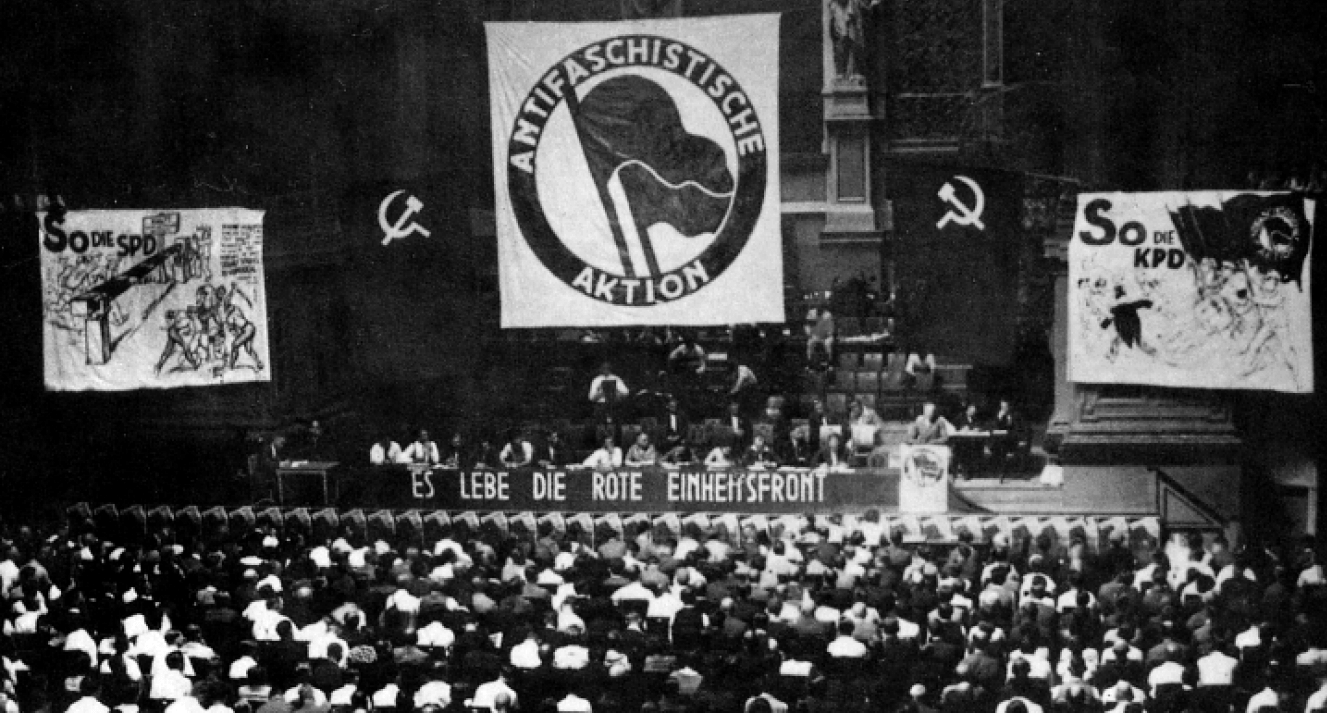
This essay by Haim Kantorovitch, intellectual leader of the Militant trend in the Socialist Party, gives his assessment for Europe’s largest, best organized workers’ movement and its parties failing to prevent the catastrophe of Hitler’s takeover in 1933.
‘The German Tragedy: A Warning to International Socialism’ by Haim Kantorovitch from Towards Socialist Reorientation. American Socialist Quarterly, New York. 1935.
I. Communism and Fascism
THE collapse of the proletarian movement in Germany is complete. The “Daily Worker” may believe that lying, fabricated reports of the “wonderful struggle of the German communists against Fascism” may hide the real facts from its readers. To a certain extent it actually does. A “Daily Worker” reader is really a special psychological type, who cannot be judged by the ordinary standards of human psychology. Experience has taught us that a “Daily Worker” reader may believe things to be true that he knows personally to be false. The thinking communist (a rare exception), who looks for facts instead of interpretations has long ceased to believe his communist press. The unthinking communist does not matter.
The truth is that the collapse of Communism in Germany was much more complete than the collapse of the Social Democratic Party. Its defeat is much more ignoble, and the chances for its recovery are much less than of any other party. Social Democracy went down without any resistance. The communist press may now be proud of its power of prophecy. It may now raise its usual “I told you so” cry. Social Democracy went down without any resistance, the communists may say, because it was not revolutionary enough. It had not prepared the workers for revolutionary mass action. It had not imbued the workers with the revolutionary proletarian spirit, on which the communists have declared a monopoly. But, what has happened to the revolutionary communists?
What resistance did they offer to the Hitler hordes? What became of the famous “Red Front” whose future glories were proclaimed so diligently in the communist press, and whose future heroic deeds were celebrated in advance in communist novels, plays, and poems? Where were these heroes when the Hitler hordes took possession of their houses and their property? Where were they when the decisive moment for which they said they were waiting, arrived? What sacrifices did they make to save their movement? The communist movement went down in defeat without struggle, without resistance, practically without protest. German Communism has only one line of defense, a line of defense which communists are loathe to take openly, but which they are really taking in their usual indirect way. Their defense can only be that to them there is no difference between Fascism and Democracy: that they have, themselves, contributed no small part to the victory of Hitler. It was the communists, more than the fascists, who did all they could to discredit, not only the German Republic, but the idea of democracy as well; it was the communists more than the fascists who did not stop at anything, no matter how low and disgraceful, to discredit the Social Democratic movement. It was the communists, more than the fascists, who continually taught the desperate German masses, that the source of all their troubles lies in the democratic system, that if they could only establish a dictatorship and rid themselves of such “bourgeois prejudices” as freedom justice, democracy, all their problems would be solved. “As regards ‘the class content’ there are no distinctions between democracy and fascism,” declared the communists as late as January 1932, and another communist periodical, at the same time jeers at Trotsky because it seems that he also believes in the “lesser evil” according to which “Bruening is not as bad as Hitler, according to which it is not so unpleasant to starve under Bruening as under Hitler, and infinitely preferable to be shot down by Greener than by Frick.”1
This was the famous struggle against fascism which the German communists carried on. It consisted in teaching the workers that there really was no difference to workers whether they had democracy or fascism. The facts are clear and no amount of communist falsifications can hide the truth: Communist propaganda created the psychologic conditions for the triumph of Hitlerism, and the communist movement is paying dearly for it now.
To console their comrades outside of Germany, the Communist International is not content with fabricating “news from” Germany, it even tries to “explain” to its adherents that what is happening in Germany is really in the best interest of the proletarian revolution. What the victory of fascism seems to have accomplished, according to the latest declaration of the Communist International is simply what the communists wanted to do and could not. The resolution of the Presidium of the E.C.C.I. adopted April 1, 1933, plainly states that it is quite satisfied with the achievements of Hitler. Here is what the Communist International has to say on the German situation:
But the fascist dictatorship, basing itself on armed gangs of national socialists and “Steel Helmets” and commencing civil war against the working class, abolishing all the rights of the proletariat, is at the same time smashing the social democratic theory that it is possible to win a parliamentary majority by means of elections and to develop peacefully towards socialism without revolution. It is destroying the social democratic theory of class collaboration with the bourgeoisie and the policy of the “lesser evil” and is destroying all the democratic illusions among the broad masses of workers.
The working class is actually becoming convinced that the communists were right when for a number of years they fought against democratic illusions, the social democratic policy of the “lesser evil” and collaboration with the bourgeoisie.2
How truly communist this is! Even now, when it has suffered its greatest and most ignoble defeat, it finds cause to rejoice. Hitler is at last convincing the German workers that Communism is right! How sweet this consolation must sound to a German communist, if any are still left!
II. The Disunity of the Proletariat
There can, of course, be no doubt that Hitler would not have had so easy a victory, if he could have had a victory at all, had he had to face a united working class. The disunity of the working class, the bitter and unsavory fight between the communist and socialist forces, and between the innumerable communist factions among themselves, was the strongest asset of Hitlerism. It drained the strength of the workers; it sapped their energy, and what is more, it made the entire proletarian movement seem ridiculous in the eyes of the masses. More energy was wasted in fighting each other than in fighting the common enemy. The communist movement devoted practically all of its time and energy to fighting social democracy. The theory of “social fascism” served as a convenient rationalization for it. According to this theory, social democracy is, to use Stalin’s words, only the moderate wing of fascism, which is even more dangerous than fascism itself. No more condemnatory evidence of this is needed than T. Gusev’s speech before the twelfth plenum of the E.C.C.I. hailed by all good communists as the real, the only line, of guidance for all communist parties. The speech was delivered at a time when fascism was rapidly striding to its final victory, when every ounce of proletarian energy was needed to resist the forward march of Hitlerism. Gusev, in the name of the Communist International, instructs communists how to act at this decisive moment. And this is what he says:
“Therefore, to beat the enemy, the bourgeoisie, we must direct the main blow against its chief social bulwark, against the chief enemy of communism in the working class, against Social Democracy, against social fascism. “It may seem that in Germany at the present time, for example, the chief social bulwark of the bourgeoisie is fascism, and that therefore we should deal the chief blows against fascism.
“This is not correct. It is not correct first, because fascism is not the chief enemy in the workers’ movement, but social fascism is our chief enemy there.”
and he sums up with the following words:
“From all this, it is clear, that in the period of preparation for the revolution, we direct our chief weapon at this period against our chief enemy in the working class, i.e., against social fascism.”3
There is nothing new in Gusev’s advice to his comrades. This has been the communist policy for years. What is interesting is that this advice was given when the victory of Hitlerism was so near that even the blind could see it, and that it was given at the very time when the communists raised their false cry for a united front louder than ever.
Who is responsible for the split in the proletarian movement? To one who is acquainted even superficially with the history of post-war Socialism there can be no doubt about the answer. Have not the communists time and again prided themselves on this achievement? But so strong is the power of lies constantly repeated, that the communists have already convinced themselves as well as many “impartial” radicals (i.e., people, who are communists and dare not join the communist party) that it was the socialists who split the movement.
The Communist International was organized in March 1919. What was its purpose? It was not the unification of the socialist movement, but its splitting up. The Communist International could have united within its ranks the entire socialist movement of the world. The Second International was practically non-existent at the time. Only the extreme right wing supported it and the more the proletarian masses became disillusioned with the war for democracy, the more revolutionary they became. The Independent Social Democratic Party of Germany, the French Socialist Party, the American Socialist Party, and many other parties, were ready and willing to join the newly organized international. They were not admitted. Why? Because the Communist International could not admit them as they were. They had to split first. The demand of the Communist International was: You must get rid, first of all, of your reformist element, expel them if you are in the majority; leave the party if you are in the minority. In either case of course, it meant a split. The Communist International did not want to organize all socialists, or even all communists under its banner. Its ideal was the organization only of “the best”,4 the “most reliable” in short, instead of a mass movement, it wanted an organization of communist saints only. Having organized the saints, it set out to destroy the sinners still left in the proletarian movement. Following this tactical line they remained true to their theory that the proletarian revolution will be made by a “strong, determined revolutionary minority”. Where are these revolutionary saints now? The present leaders of the Communist International were still unknown at that time, and those who could not admit the “reformists” into the Communist International because “they are unreliable and are capable of betraying the revolution”, have all become sinners themselves: Trotsky, Zinoviev, Kamenev, not to speak of dozens of lesser lights. The real saints who initiated the fight to exterminate the unreliable socialist sinners, have all been expelled from the communist community of saints. Their policy, however, is continued even today.
But what about the United Front? Are not the communists constantly clamoring for a united front? We shall not dwell upon the entire question of a united front here. The reader will find a discussion of it in a pamphlet by August Tyler, “The United Front”. What interests us is whether the German communists did really want a united front. When the fascist waves began to rise so rapidly that Hitler’s victory seemed imminent, a group of the German Democratic Party had an interview with the leader of the German Communist Party, Thaelmann. They wanted to learn what chances there were for a united front against fascism. What did Thaelmann tell them? He repeated some of the usual slanderous statements against the Social Democratic Party, and added that “an alliance between the Social Democratic Party of Germany and the Communist Party of Germany was impossible on the basis of these facts and also for reasons of principle.” For “reason of principle”, therefore the communists cannot enter into an alliance with the Social Democratic Party. What are these reasons of principle? Naturally, the theory of social fascism. As long as Communists hold this theory, no one can seriously believe in their cry for a united front. Thaelmann, as well as the communists, in general, everywhere, do not realize how ridiculous they appear by talking about a united front from below. “We communists, who reject any accord with the Social Democratic leaders…repeatedly declare,” says Thaelmann, “that we are at all times ready for the anti-fascist struggle with the militant Social Democratic and Reichsbanner comrades, and with the lower militant organizations.” In other words, the communists will allow militant members of the Social Democratic Party and the Reichsbanner to join them in their fight against fascism, and as the “real enemy” is not fascism but social fascism, these militant members of the Social Democratic Party will be allowed to fight their own party under the banner of the Communist Party.
This is the United Front that the German Communist Party wanted.
III. Social Democracy
Just as the German Social Democratic Party bad a policy of toleration towards bourgeois parties, so the international socialist movement bad a policy of toleration towards the German Social Democratic Party. The number of socialists who, with grave misgivings, watched the growing opportunism of the German Social Democrats was constantly growing, but open criticism was restrained because “it might harm our German comrades.” There were, of course, socialists who were ready to applaud anything that the German comrades did, and to raise to the dignity of socialist principles every compromise which the German socialists were compelled to make. These were the socialists who were so scared by Bolshevism that they were ready to accept anything if only it led away from revolution. Their number was small. But whereas those who were critical of the German Social Democrats kept silent, this small group was very articulate. They were so loud in their praises of everything that the Social Democrats of Germany did, that many assumed that their praises were the official attitude of international socialism towards the German Social Democratic Party.
The German Social Democratic Party had tried a new experiment. It was an experiment of gross-opportunism. In this gross-opportunistic experiment, it departed from most of the fundamental principles of Marxian Socialism. Since 1914, it has practically given up the Marxian concept of class struggle and of social revolution. The civil peace proclaimed by the German Social Democratic Party at the outbreak of the war, was continued through the period from the German revolution to the victory of the counter-revolution. Through all these years, when the German Social Democratic Party was either at the helm of the German Republic, or the most powerful opposition party, it followed the principle of civil peace instead of the class struggle. This experiment in opportunism was watched anxiously by every socialist throughout the world. The watch is now at an end. The results are known to all. The experiment was a miserable failure.
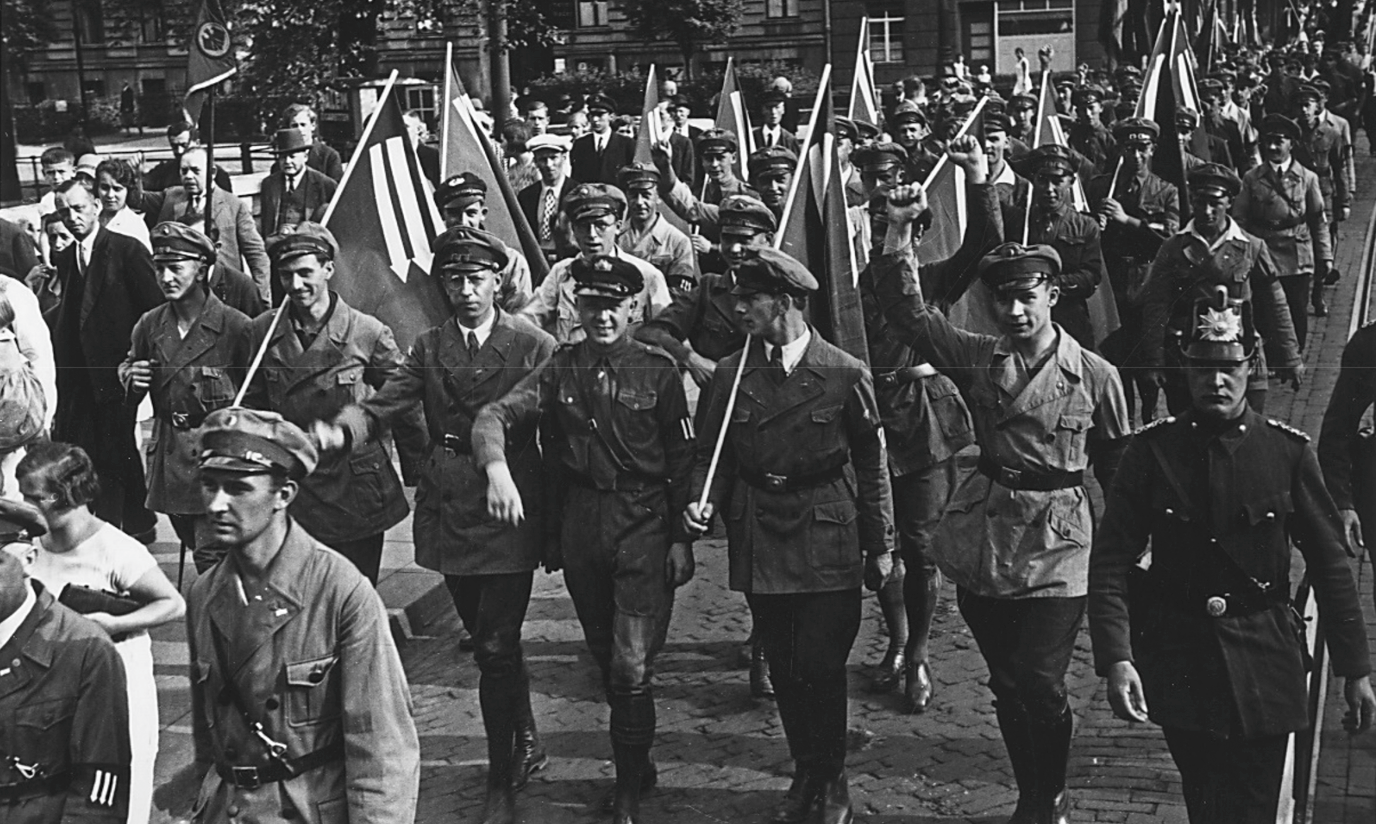
The underlying principle of the tactics of the German Social Democratic Party was that Socialism is a purely political matter. The term political was again narrowed down to pure parliamentarism. Socialism will be voted in. There is nothing more that one can do to attain Socialism than to vote for socialist candidates. There is nothing for a socialist party to do but to conduct election campaigns successfully. The German Social Democratic Party had educated its members according to this principle. So well were they educated that nothing could induce them to betray Socialism at the ballot box. Even after Hitler came to power, under conditions of fascist terror, the Social Democratic Party retained its voting strength. It lost very few of its votes in the last election. But its well organized army was well organized and well trained for the ballot box only. When new conditions arose, when other means of struggle were forced upon it, when it became necessary to fight instead of to vote, it was unprepared. The ease with which Hitler wiped out the strong and well organized Social Democratic Party of Germany has definitely demonstrated that an army trained for peace only, will never be able to fight. The ease with which the German trade unions, the powerful German trade unions which always were under the influence of the Social Democratic Party, submitted to Fascism, the fact that they submitted without the least resistance, is due to the same mistaken conception of the purely political socialists. The German trade unions were socialist trade unions. What exactly was meant by socialist trade unions? Nothing but that the German trade unions were ready to support the socialist political campaigns and vote for socialist candidates. A socialist union once meant, as it should mean, a proletarian organization ready to throw its economic power into the fight for Socialism. But the German socialist trade union was only ready to vote for socialist candidates and forget about it until the next election. That is why some trade union leaders in Germany were so ready to make peace with the Hitler regime, and continue peacefully as pure and simple trade unions under fascist regime. That this shameful peace was not made was simply due to the fact that the Nazi rulers refused it.
Adopting the purely political-parliamentary view of Socialism, the Social Democratic Party, as a consequence, was bound to place all its hope on political democracy. That democracy is a powerful weapon in the class struggle there can be no doubt; that socialists should defend and fight for democracy goes without saying. But the German Social Democratic Party did not content itself with using democracy for Socialism. Instead, it sacrificed Socialism for democracy. Democracy became, for it, not a means to an end, but an end in itself. All distinctions between socialist and capitalist democracy were abolished. Even the self evident truth that capitalist democracy is in itself a constant clash of forces was obliterated. The conviction was fastened upon the masses that wherever there is political democracy, all other means of social struggle but voting cease. The self evident truth that it may be necessary to defend democracy itself by undemocratic means never entered their beads. Comrade Raphael Abramovitch, writing on the German tragedy, expressed him self to the effect that the weakness of the German Social Democratic Party lay in the fact that the ruling classes had ceased to fear it. The ruling classes, as well as the German masses, gradually realized that the Social Democrats “will never fight.”
The extent to which this opportunism demoralized the German Social Democrats is shown by the fact that a large part of the party even tried to interpret the victory of fascism, democratically. Hitler, they said, won a majority at the polls. We will have to adapt ourselves to the new conditions and patiently wait until the next election. If the German Social Democratic Party is not now a legal and respectable opposition of his majesty, Adolph Hitler, it is because Hitler did not want it. And yet, there was a time when the German Social Democrats could have prevented the growth of Fascism. They could have crushed Fascism when it was young, just as they crushed Bolshevism. “The republican leaders,” and among them socialists, “were not unaware that the forces of reaction were growing,” testify historians of the German revolution,5 “but they seemed to have tried to deceive themselves with the thought that the swing to the right meant only the formation of a constitutional opposition.” If “constitutional” it was all right. Democratic principles demanded that the reactionary movement be given a chance to grow. As early as 1919, after the Spartacist revolt was crushed, Philip Scheidemann raised the cry that “the enemy is at the right”, but his cry was not heeded.
Of course, there was a left wing in the German Social Democratic Party. Of course, there were many among the German socialists who fought against these opportunistic tendencies in the Party. But the Party was “well organized and well disciplined”, in other words the party leadership had a strong enough grip on the party not to allow these left tendencies to grow and become influential. It is not the only example where old leaders become a hindrance to their own party when their own senility becomes the guide for party action. The role of leaders is often too much under-estimated. Leaders may not be able to create movements, but they are able to maim them. There is no question but that under a younger, more virile, more militant leadership, the German Social Democratic Party would have taken a different course.
IV. What Now?
For all practical purposes there is neither a communist nor a socialist party in Germany. At present the Hitler government is firmly intrenched. For how long? No one knows. It may be for a very short period, it may last quite a long time. One thing is certain. The Hitler government cannot solve the contradictions of German capitalism which brought it into power. It cannot save the German middle class from which it has drawn its main strength. It cannot abolish, nor even lessen, the misery of the German working class, as it has promised to do. Already there are signs of a growing conflict within the ranks of the National Socialists. There are already visible signs of a growing dissatisfaction among those who took the socialist phrases of Hitler seriously. It will not take long before new opportunities for socialist propaganda and organization will again arise in Germany. German Socialism is not dead; it is only stunned. But when it comes back to life, it will not and cannot be the Socialism of the pre-Hitler era. German Socialism will have to come back as the regeneration of Revolutionary Proletarian Socialism, that will be ready to fight for Socialism.
The German tragedy must serve as an object lesson for socialists in all other countries. The rise and decline of the German Social Democratic Party must be carefully studied and analyzed. It is, after all, by our mistakes that we learn.
Notes
1. Quoted in “What Next” by Leon Trotsky.
2. Inprecor, Vol 13, No. 17.
3. Reprinted ln the “Communist”, January. 1933.
4. The reader may find more on that aspect in my “Rise and Decline of NeoCommunism”, Modern Quarterly, Reprint No. 2.
5. Republican Germany by Quigley and Clark, p. 81.
Socialist Review began as American Socialist Quarterly in 1934. The name changed to Socialist Review in September 1937. The journal reflected Norman Thomas’ supporters “Militant” tendency of the ‘center’ leadership. Beginning in 1936, there were also Fourth Internationalists lead by James P. Cannon as well as the right-wing tendency around the New Leader magazine also contributing. The articles reflect these ideological divisions, and for a time, the journal hosted important debates. The magazine continued as the SP official organ through the 1940s.
For a PDF of the full issue: https://stars.library.ucf.edu/cgi/viewcontent.cgi?article=1140&context=prism

