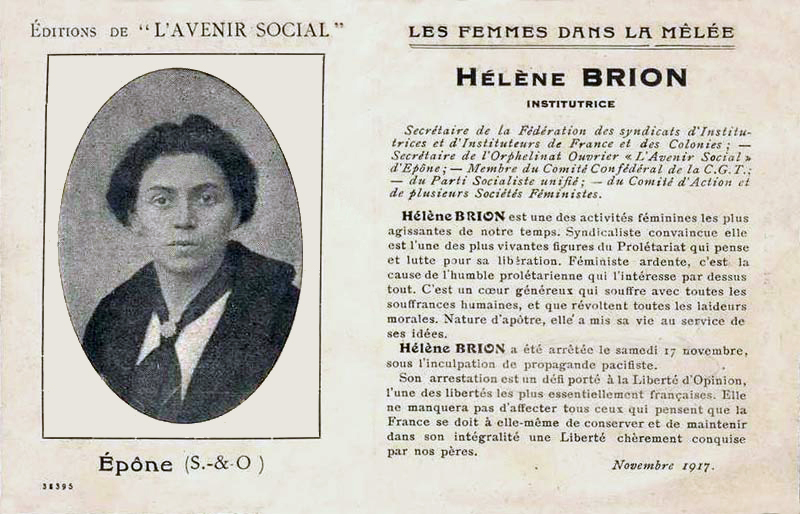
A trenchant plea from Hélène Brion, revolutionary feminist, union leader, and early French Communist. Just returned from Soviet Russia, Brion decries that near total lack of interest in women’s issues by the old Socialist Party and asks that Russian comrades demand of the new French Communist Party that it not repeat its masculinist traditions. By the mid-1920s Brion withdrew from Party politics, finding those traditions unchanged.
‘One of the Aims of French Communism’ by Hélène Brion from Communist International. Vol. 1 No. 16-17. May-September, 1921.
The excellent articles, ‘Novelty in the Russian Revolution’ in the Revue de la Presse Russe among other; things says: “Our revolution, finishing with the prehistoric epoch of the development of mankind and opening the first page of its real history, is especially interesting and instructive owing to the new experiments which it is carrying out on a gigantic scale.”
For us, women, and especially French women, the Russian revolution is doubly interesting because it is practically realising the principles of emancipation in both respects: as workers and as women.
Meanwhile the principle of emancipation of the women is not only unrealised in practice but is even not recognised in theory in the country which, up to now, has been considered as the most revolutionary in the world. In this country more than anywhere else in Europe we have frequently to remember Ibsen’s words, so full of a deep meaning: “The human race does not embrace all mankind—it is only the men.”
Most regrettable was the attitude taken towards this question by the advanced (?) representatives of socialism and syndicalism (Renaudel, Jouhaux and Co.) and the great majority of their followers, members of various organisations. With their usual thoughtlessness and undisguised egoism, which they always demonstrate so brilliantly, these gentlemen constantly opposed all propaganda of the idea of emancipation. As regards the sphere of legislation, there exists but a very insignificant number of laws which are bringing a slight alleviation into the conditions of life of the French women, namely: the right of research of paternity by means of the law (recherche doila paternite), the permission for married women toy dispose of their earnings, the demand for the right of suffrage for women, etc. These laws are in no wise the result of parliamentary activity of the socialists. Certainly, the socialists did not, at any rate, vote against them, but to their shame be it said they were not their initiators.
In political life the socialist party always occupied an ambiguous and indefinite position on this question. Under the strong pressure of the feminist movement it found itself compelled, beginning from 1908, to put forward the candidatures of women both in the municipal, and in the legislative institutions. However the party always took care that such candidatures should not be numerous and should be put forward only in completely “virgin” districts which had never yet voted for a socialist candidate—that is to say, in such places where failure could be foreseen in advance, where it was possible to obtain a ludicrously small number of votes and where the task was a specially thankless one. If the Party had really taken the women’s question to heart, it could have advanced the question of the women’s candidature on a large scale in a Socialist district where the election of the Party’s candidates would have been ensured beforehand. May be, this bold innovation might have entailed the proclaiming of the elections to have been non-valid—the Party would have risked the loss of one seat, but how great would have been the agitational significance of this fact for the women, what a splendid effect it would have made! But, this did not even occur to the minds of our pseudo “great men.”
In the trade unions the position of the women was no better. A vast majority of the unions which constituted the Amsterdam International were most unwilling to receive women. For these gentlemen it is yet a question—whether a woman has a right to work. At any rate they repudiate her right to receive a good pay for her work, her right to enjoy a fundamental technical education and they suffer her only in such enterprises which demand no qualified workers and where the work is badly renumerated. But since the world war the limits of women’s labour are becoming ever more enlarged. The women have begun to demand the same pay as the men get for equal work, but this is totally inadmissible from the point of view of the majority of the members of the trade unions as was declared openly in Paris in May 1920 by three, not very eminent, officials of the trade unions. “That they have worked as much as we did, may be quite possible,” one of them said, “but they ought not to receive the same pay as the men, they are still only women.” The second official added (and the third agreed with him): “What would be the good of being a man otherwise.”
Such speeches are a terrible symptom. It is the psychology of slaves who wish to have slaves also at whatever cost; it is greatly to be regretted and proves an extreme moral degeneracy. Naturally, under such conditions, women and especially women feminists always keep away from Socialism, syndicalism, and all that was reputed to be “the liberative movement.”
They will cease to take this negative attitude towards Communism as soon as they will become acquainted with it and learn what it wishes to attain for them. It is however necessary for the Communists to meet them halfway, as they are doing for the seamen, soldiers, peasants, that is to say, the Communists must begin a special propaganda in conformity with the special conditions of women’s enslavement. This however the French comrades do not understand. You, Russian Communists, men and women, must explain this to your French comrades. You have deemed this necessary and Moscow became the centre for the special work among the women. If this is necessary in Russia, then it is easy to understand how much more necessary it is in our country, where during 130 years, the masculine and bourgeois democracy has been the supporter of the hideous conditions of social reality. Be assured that such special agitational work among the women will not remain fruitless. You know better than others, what an important role women’s enthusiasm and women’s revolutionary will can play during the revolutionary period. You have seen the Russian women in their revolutionary work. If you have not seen this yet in the French women, it is only because up to now no one has ever thought of carrying on a propaganda among them, of enlightening them, winning them over to the cause of universal liberation. Standing apart from all movements—they are waiting. Go to them, you, who dare all and can accomplish all. They will immediately answer your call and they will struggle together with you, with all the militant ardour of which they are capable. Only then will the victory of the proletariat over its enemies be ensured in France—the victory of labour, which as the above mentioned article says “opens the first page of the real history of mankind.”
The ECCI published the magazine ‘Communist International’ edited by Zinoviev and Karl Radek from 1919 until 1926 irregularly in German, French, Russian, and English. Restarting in 1927 until 1934. Unlike, Inprecorr, CI contained long-form articles by the leading figures of the International as well as proceedings, statements, and notices of the Comintern. No complete run of Communist International is available in English. Both were largely published outside of Soviet territory, with Communist International printed in London, to facilitate distribution and both were major contributors to the Communist press in the U.S. Communist International and Inprecorr are an invaluable English-language source on the history of the Communist International and its sections.
PDF pf full issue: https://www.marxists.org/history/international/comintern/ci/old_series/v01-n16-n17-apr-may%201921-grn-goog-r3.pdf

