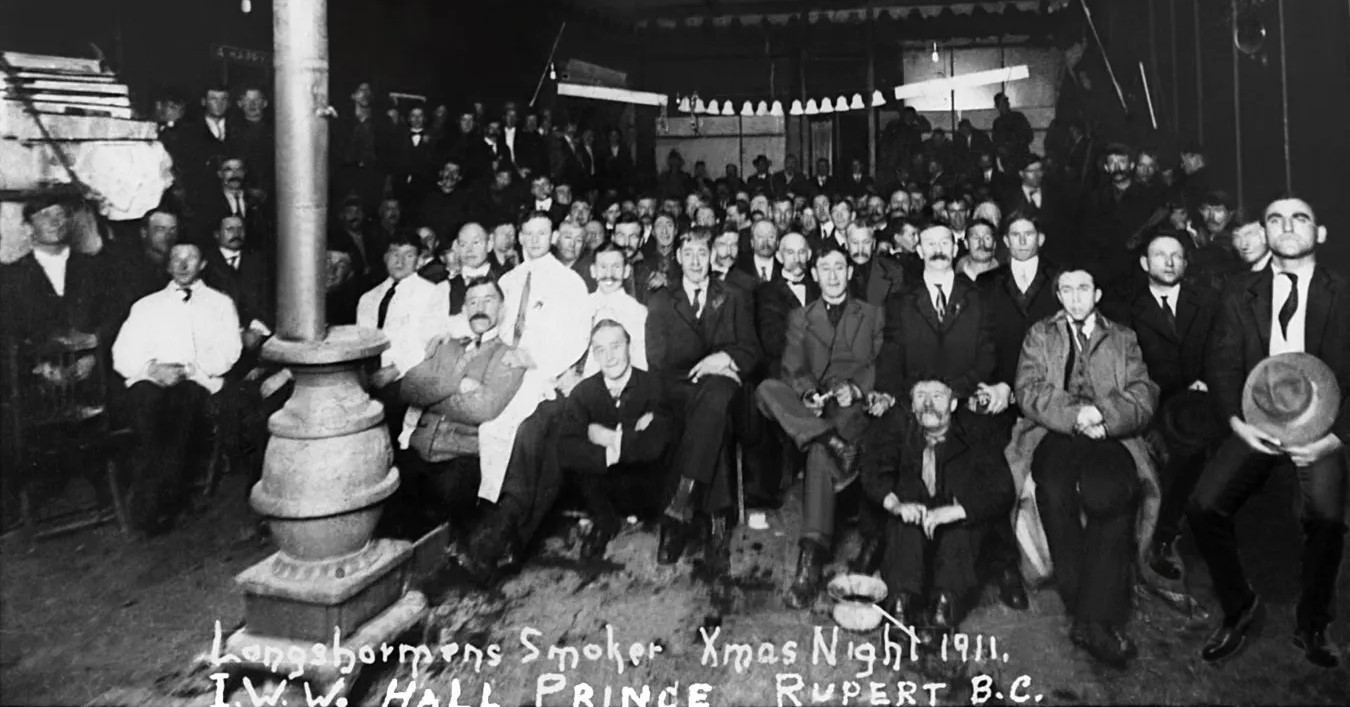
Program and report of a holiday party in the northern Minnesota town of Bemidji hosted by the I.W.W. on a stormy Christmas night, 1916.
‘Smoker in Bemidji’ by George Ginton from Solidarity. Vol. 8 No. 365. January 6, 1917.
A smoker was held in Bemidji, Minn., on Christmas night under the direction and supervision of Branch Secretary Nels Madison with the object of bringing the Workers together, both organized and unorganized, for educational purposes.
The Program was as follows: Meeting opened at 8:30 P.M. with introduction by chairman.
Song sung by body: “Workers of the World Awaken.”
First speaker introduced: Fellow Worker R.E. Carter. Subject, “8- Hour Day,” on which he spoke with brilliancy, pointing out how the Brotherhood officials sold out the rank and file of said Brotherhood of which he is also a member.
Song by Fellow Workers Rossall and Noel, entitled “Rebel Girl,” which met with great approval and applause from the audience.
Strong duet by Fellow Workers Quirk and Gunnes. Speech by Comrade Weber–subject, “Economics,” in which he pointed out the power of the workers and the necessity of organizing under the banner of Industrial Unionism.
He also explained the capitalistic control of courts, churches and other institutions,
Song by audience “Solidarity Forever.”
Recitation by Fellow Worker R.E. Carter entitled “American Circus.” Speaker, Chairman Branch Secy. Nels Madison. Subject, “Difference between Craft Unionism and Industrial unionism,” which he explained very clearly, defining the way in which craft unions sabotage on their own class. He closed his address with a talk on Everett Free Speech Fight, which he explained in every detail. After which a collection was taken in behalf of the Fellow Workers in Seattle jail due to their activity in Everett.
Song by audience “Should I Ever Be a Soldier,” which met with applause.
Speaker, Comrade Hannah, subject “Necessity of Organization,” which he explained how the master class was oppressing the workers and that Industrial Unionism was the only road to freedom. The smoker was a great success with an attendance of 150 despite the fact that it was a stormy evening.
Lunch was served consisting of Sandwiches and coffee, then cigars were passed freely among the workers. We had a dutch raffle which was a great success. The auctioneer Fellow Worker C.E. Tonning, who filled the place much to the amusement of the audience. The meeting was then thrown open to the audience for questions. All present seemed to take great interest as many questions were asked by farmers and others, which Branch Secy. Nels Madison answered very successfully and attempts to corner him were in vain, to the satisfaction of all present. The smoker proved to be a success and we believe that by these means, we can educate the workers and swell our membership and otherwise further our aims for the emancipation of the wage slaves. The smoker was closed by the chairman at 1:00 A.M., after which the fellow workers present left for the different camps to fight the battle of emancipation. I would add that others take example from Bemidji and do something along these lines to bring the workers together.
No. 400
GEORGE GINTON Bemidji Branch
The most widely read of I.W.W. newspapers, Solidarity was published by the Industrial Workers of the World from 1909 until 1917. First produced in New Castle, Pennsylvania, and born during the McKees Rocks strike, Solidarity later moved to Cleveland, Ohio until 1917 then spent its last months in Chicago. With a circulation of around 12,000 and a readership many times that, Solidarity was instrumental in defining the Wobbly world-view at the height of their influence in the working class. It was edited over its life by A.M. Stirton, H.A. Goff, Ben H. Williams, Ralph Chaplin who also provided much of the paper’s color, and others. Like nearly all the left press it fell victim to federal repression in 1917.
PDF of full issue: https://www.marxists.org/history/usa/pubs/solidarity-iww/1917/v8-w365-jan-06-1917-solidarity.pdf

