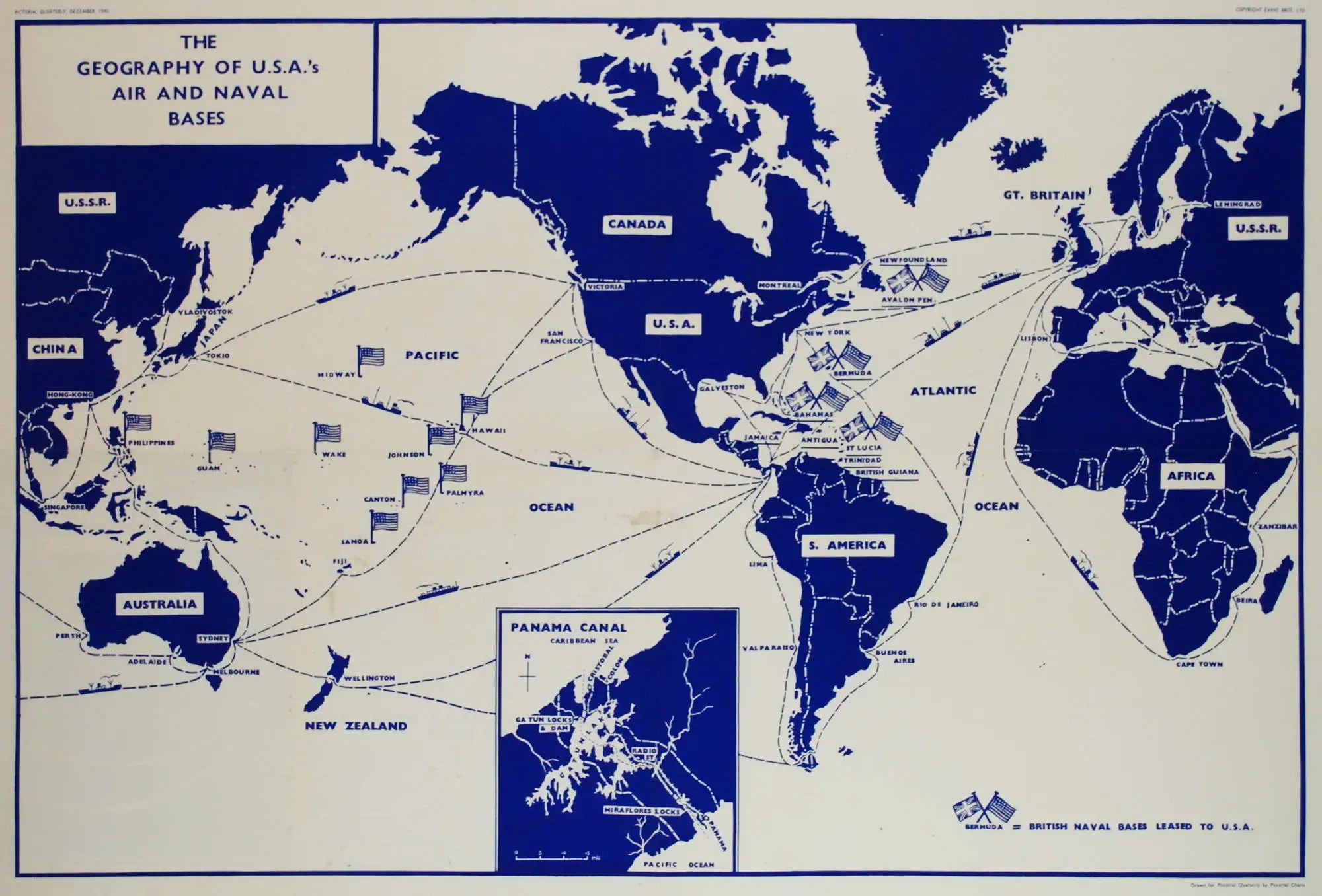
An interesting read from a time of another transition. When these fifty-nine theses were written, U.S. imperialism was already the most powerful force on the planet, the rest of the imperialists just had not received the message. It would take World War Two, and fifty million dead, for them to accept the fact. The document below, drafted for the Communist League’s Third National Convention, analyzes the U.S.’s rise, its relations with other powers, its specific colonial policies, the effect of the Great Depression, and its impact on U.S. workers.
‘Position and Perspectives of American Imperialism’ from The Militant. Vol. 4 No. 12. June 15, 1931.
DRAFT THESIS OF THE N.C. OF THE COMMUNIST LEAGUE FOR THE THIRD NATIONAL CONVENTION
1. American capitalism holds the unique distinction of being the strongest link in the imperialist chain today and of facing tomorrow the most convulsive interplay of contradictions growing out of its world position. Since the “war to end all wars” the world economic center has shifted to the United States. It is the main creditor nation. The expansion of its productive forces and its accumulation of capital, concentrated in the hands of gigantic corporations, has exceeded all previous capitalist development. Economically the United States, extending its tentacles over the entire globe, is the dominant imperialist power.
2. The economic superiority of the United States has grown potentially due to the disintegration of Europe. But the old forms in which this superiority manifested itself–industrial technique, trade balance, stable dollar and European indebtedness–have lost their actuality. The advanced technique finds factories standing idle, the trade balance is unfavorable, the dollar is in decline, the debts are not paid. The superiority of the United States must find its expression in new forms, the way to which can be opened only by war. American capitalism is up against the same problems which pushed Germany on the path of war in 1914. The world is divided amongst the great powers. It must be re-divided. For Germany it was a question of “organizing Europe”. The United States must “organize the world”.
3. But the World War, which brought hegemony to American imperialism, also ushered in the stage of capitalist decay and the period of the proletarian revolution. In this situation the attempts to extend the American hegemony further–stimulated all the more by the crisis–will involve the most serious conflicts, wars and revolutions. History thus brings humanity face to face with the volcanic eruptions of American imperialism.
4. The enormous contradiction between the productive forces of powerful America and decaying capitalism as a whole confronts the financial oligarchs and their government for a solution which cannot be found on the plane of the capitalist mode of production. This contradiction and the gigantic national and social problems flowing from it can be resolved only in the proletarian revolution.
5. In the past, the uneven development of capitalism acted as a lever favoring the advance of capitalist United States. Its enormous resources enabled it to experience the most rapid expansion within the system of growing capitalism. Today the dialectic of world relations is turning this lever into its opposite in the sense that it is creating new and greater difficulties for American imperialism which is now faced with the expansion of its productive forces within a declining capitalist world system. In attempting to establish a more complete domination; in attempting to extend the foundation of its structure, it enters into direct conflict with the rival powers which are no less vitally concerned in the re-division of the world. Simultaneously, however, it must assume the leading role in the task of defending the decaying system as a whole against the extension of the October revolution. In this sense, American imperialism is today the basic world counter-revolutionary force.
6. Through the uneven development of capitalism the United States arrived at its stage of combined development. It is expressed in the existence side by side of a high degree of concentration of industry and finance, an antiquated banking structure, strong remnants of individual competitive capitalism and split-up tenant holdings in the southern states. More decisively, however, is this expressed in the opposite extremes of a most advanced industrial development together with the most backward political ideology and organization of the masses. But this most advanced industrial development increased its basic contradictions. In the United States there are more than anywhere else, an accelerated accumulation of capital; an enormous expansion of the power and scope of the credit and financial system; a much more rapid growth of constant capital (means of production and raw materials) than variable capital (labor power) and a steadily increasing relative overpopulation (workers divorced from the means of production).
7. The present great mobilization of capitalist resources for the further reorganization of industry and finance, as an effort to get out of the crisis, will result in a higher organic composition of capital. Henceforth we will have a yet more complex machinery of production; a greater industrial concentration and a greater centralization of capital. And, on the other hand, an increased intensity of exploitation and more violent depression of the wage level. But while American capitalism seeks a solution in this direction and while it marshals its resources to get out of this crisis, it remains bound up with the decay of capitalism as a system. By its present measures it prepares the ground for much greater contradictions in the next historical stage.
8. The aggression of American capitalism in both fields at home and abroad, against the American workers and against the European powers–operate to turn the very strength of this dominant imperialist sector into basic factors of weakness. This is the great contradiction which it cannot escape. The course which it pursues leads in an immediate sense, to more intense class struggles and to new imperialist wars. On a historical plane, it signifies cataclysmic developments towards revolution.
9. This perspective we face with a politically backward American working class. But in this respect also the dialectic of the class relations is at work today transforming this special phenomenon into its opposite. The economic basis for the ideological regrouping of class forces is already established. American politics will follow suit and become Europeanized. The tradition of two capitalist parties holding exclusive sway will soon belong to the past. It will give way to the emergence of the working class as a political factor. It can be affirmed with certainty that the motion of these economic forces at work will speed the working class rapidly in this direction. But it remains yet to be decided whether the political emergence of the working class will flow at first primarily in revolutionary or reformist channels. That decision by and large rests with the Communist vanguard.
Problems of American National Economy
10. The contradiction between socialized production and capitalist appropriation has reached a most acute stage in the United States. The development of this contradiction has propelled American capitalism through unheard of heights of bourgeois prosperity to the greatest crisis it has yet experienced. In its further course still more severe crises will be encountered in the general downward curve of world capitalism toward the proletarian revolution.
11. The accumulation of capital, the economic law of motion of capitalist society, has so far carried through the transformation of competitive capitalism into monopoly capitalism, into imperialism the rapid tempo of accumulation, aided by an exceptionally great concentration of natural wealth has been unprecedented. American capitalism, in its early period, when it was centered within the industrial northeastern states, found, by pushing westward, a mighty field of expansion for export of capital and export of means of production. It found immense natural resources and a market within the borders of the nation. Within the limits of its own borders the prerequisites were at hand for monopoly development and domination by finance capital. It became not only the largest producer of raw materials but also the largest manufacturing nation. New markets were sought beyond the borders of the forty-eight states. But the powerfully developed national economy, due to vastly expanded productive forces and surplus of capital available, produced also its opposite of growing interdependence upon world economy. American capitalism extended its structure throughout the planet and acquired a world basis. Within this international field American imperialism forged its way ahead, reducing the share of the rival powers in world economy. In this sense the law of uneven development of capitalism became a lever favoring the United States.
12. The law of uneven development of capitalism presents itself as a historical reality. Its most elementary expression is the distinction between advanced countries and backward countries. In their development, they have passed through different stages, through different forms and at an uneven tempo. The uneven character as far as America is concerned was first shown in its late emergence as an imperialist power. The great possibilities of capitalist expansion within the borders of the forty-eight states, which it enjoyed for a long time, and the ability to maintain a relatively high wage level, accounts for the retarded consciousness of the workers. Class relations remained in flux and prevented the crystalization of a stable proletariat. At the same time the exploitation of the working class was more intense than in any other capitalist country.
13. Within this uneven development of capitalism emerges also the stages of combined development. Backward countries supplement their backwardness with the latest advances. America added to its still remaining backward features of land-holding, virtual peonage with its Jim-Crowism obtaining in the southern states, the most highly developed material culture. Alongside of carry-overs of past decentralization and older industries retaining the backward features of smaller competitive concerns, exists today a high degree of industrial concentration. In the very decisive field of banking, where reorganization now proceeds apace, the antiquated structure still comprises thousands of small country and city neighborhood banks, existing side by side with powerful metropolitan institutions, the resources of which mount into billions. Together with these mighty advances, however, has remained the political backwardness and low level of class consciousness of the masses as evidenced by the small proportion of workers organized in trade unions and the absence of a mass political party whether reformist or revolutionary.
14. Industrial concentration which increased immensely during and after the world war has now reached a system of full grown corporate control. There was a fusion of banking and of industrial capital, a vast expansion of the credit system together with a heavy export of finance capital. The financial capitalists assumed control over monopolist combinations, control of investment resources and control of credits. The interlocking banking corporations now direct governmental domestic policy at home and imperialist policy abroad. Many bourgeois economists and parlor pinks hail this as “organized capitalism” But the general results of concentration and centralization of capital already give adequate proof of the Marxian axiom that under monopoly capitalism competition does not disappear but becomes transformed, assuming higher and more aggravated forms.
15. In this process of production and distribution account is taken, not of the needs of society, but of the utilization of capital. It is production for capital and production carried on for an unknown market. Thus arises the enormous contradiction between the development of the productive forces and the available markets, the antagonism between socialized organization of production within the factories and anarchy of production in society as a whole.
16. On the one hand this is illustrated most clearly in the index figures of American industry showing a vast productive capacity lying idle today, and on the other hand in the unheard-of size of the unemployed army. Moreover, the machinery of production has reached such proportions that operation even at partial capacity is capable of glutting the market. The relative decrease of labor power is transformed into an absolute decrease of necessary labor power for the productive process. Alongside of it exists the entirely unparalleled overproduction of capital, that is, of means of production to the extent that they serve as capital, serve for the exploitation of labor. This is the essence of the present crisis.
17. The distinguishing feature of this crisis is not that it is bottomless or the final crisis of capitalism, which is mistakenly asserted even among Communists. The distinguishing feature lies in its occurring within the general crisis of decaying capitalism. The business cycles have been in operation throughout the general historical period of birth, growth and decay of capitalism. But they have become altered and intensified according to the epoch in which they occurred. During the stage of the “normal” growth of capitalism the business cycles operated within the bounds of the system as a whole, as a mechanism of a general, upward curve. The crises became periods of readjustment for further expansion. Now the course is reversed and the cycles have become the mechanism of the downward curve, unstable, and limited, but a mechanism nevertheless, expressing the ebbs and flows of the decay stage. The industrial stage of American capitalism witnessed dynamic upward conjunctures and difficult but relatively short depressions. The present financial stage, however, is becoming characterized by cumbersome, contradictory upturns, tending to be of short duration and heralding deeper plunges into prolonged and turbulent crises.
18. That is the general perspective, but it is of importance also to attempt to arrive at a precise estimate, or the most likely variant, for the immediate future. The estimate of the bottomless or final crisis must be dismissed out of hand as having no foundation in fact. A possibility of arriving at new heights of prosperity is hardly likely within a general process of decay. There remains the variant which derives most directly from the position held by the United States in world economy. The United States, which still forms the strongest link in the imperialist chain, is preparing to issue out of the crisis in the one direction at the cost of reducing the rations of world economy for the rival powers, and in the other direction at the cost of the American working class. The first direction implies a solution by military means; the second, a permanent army of unemployed and a further reduced standard of living as the heavy price which the workers will have to pay.
19. Capitalism, however, is essentially a social relation. The excess of means of production as against the excess of workers without employment and without means of existence in itself constitute an enormous sharpening of social antagonisms, needs of the unemployed are growing daily, economic pressure of the low standard of living upon the employed workers is increasing. There is already an immense sharpening of the class struggle. The gigantic disproportions within the industrially highly developed United States can mean only the vast enlargement of the scope of these struggles.
Capitalist Readjustment
20. Due to the high development of American national economy, the contradictions involved in the accumulation of capital and the falling rate of profit have reached very great proportions. With the accelerated process of the former grew the overwhelming tendency of the latter because of the much more rapid growth of constant capital (means of production and raw materials) as compared to variable capital (labor power). To the owners of the means of production this presents the problem of increasing the mass of capital in order to neutralize the tendency of the falling rate of profit. Concretely, this is expressed today in certain decisive features of the capitalist way of crisis readjustment. These features are: the effort to raise the intensity of exploitation of labor, to further depress the wage level, to expand credits and increase stock capital, to cheapen the elements of constant capital, and to increase the share in the world market. By this process, the organic composition of capital becomes higher, laying the basis for an enlargement of the contradictions. The development of the national economy to a higher plane subordinates it yet more to the destructive influences of the decaying world system of which the United States is a part.
21. There can be no solution to these problems on a capitalist basis. But in the absence of the proletarian revolution, a breathing space for American capitalism is possible. It still has very powerful resources at its disposal. It is now attempting to consolidate its position by a process of sweeping reorganization.
22. This reorganization finds its popular expression in the NRA section of the New Deal program, which is presented as a vehicle of recovery. On the one hand it aims ostensibly at the restoration and stabilization of the purchasing power of the broad masses, though distinctly on the lowest possible level, together with an upturn in commodity prices to reestablish the profit inducement for capital investments. On the other hand–and this is far more fundamental–it aims at greater concentration of industry and centralization of capital, the strengthening of monopoly capital under governmental regulation and support, to prepare the basis for new imperialist expansions. This will facilitate the quick transformation of industry to a war footing when deemed necessary. In a word, the reorganization of American economy aims at the restoration of capitalist profits and has nothing in common with planned economy.
23. Flowing from the fundamental aim of strengthening of monopoly capitalism the NRA is designed as a means of regulating social relations, that is, class relations. Its whole pattern is interwoven with attempts to elevate the system of class collaboration to the status of a permanent institution.
24. The general NRA scheme is being extended in various directions, some of them of a purely temporary character, others of a more permanent nature. One of these directions is embodied in the momentary policies pursued by the Roosevelt administration. As a first step came the inflation of credits and the devaluation of the dollar. After that will follow the inflation of currencies, in order to raise the internal commodity price level and facilitate competition on the world market. Another direction was constituted by the Public Works Program and the Civil Works schemes. The former represents an expenditure of funds for projects over a longer period of time, intended to start the wheels of industry in motion, the latter was evolved for mainly temporary relief purposes. In a third direction, the extensions embrace agriculture, as exemplified by the Agricultural Adjustment Act. By and large this is an effort to regulate agricultural production by the method of curtailment and even ploughing under of planted wheat and cotton fields and the slaughter of livestock, all in order to increase prices of agricultural products. The curtailments are to be reimbursed out of a processing tax. Additional extensions can be expected, all as a part of the general scheme of the reorganization of American national economy.
The Function of N.R.A.
25. The essential function and purpose of the NRA centers around the problem of strengthening the domestic market in order to issue out of the crisis by so-called normal means. But that too is intended in the main as a preparation for world conquests. The NRA sets out ostensibly to stabilize the purchasing power of the masses by means of minimum wage regulations and to spread employment through the limitation of working hours. The minimum wage level of the industrial codes of between eleven and fifteen dollars weekly represent distinctly the crisis wage level. Moreover, the combination of increasing prices and devaluation of the dollar have already at the end of the first year of the New Deal policies, imposed unbearable conditions upon those workers fortunate enough to have jobs. For the working class as a whole, and that includes the millions who are unemployed, the total income remains vastly reduced. In comparison with the code regulations of working hours, it should be noted that during the first five months of 1933, prior to the inauguration of the codes, the average weekly working hours in manufacturing industries for all workers, full-time and part-time, were 34.7. It is now generally conceded that the operation of the codes have not appreciably increased employment. With the Civil Works scheme at an end, the unemployed army, according to all reliable estimates, will remain about as large as before.
26. Still the problem of reorganizing labor power in accordance with the productive forces remains on the agenda for American capitalism. The present productive forces even if working only at partial capacity, will pile up new over-production in a short time. The relative decrease in the number of workers employed has become transformed into an absolute decrease in the number of workers necessary to the process of production. On its reverse side, this is expressed in the huge army of unemployed. Additional measures to create employment and to further reduce working hours can therefore be expected to be initiated by the capitalist government. A large unemployed army will, of course, remain in any case; but the aim of the exploiters is to neutralize this army by partial employment in a system of rotating work and relief.
27. It is clear that in essence the “recovery” features of the NRA policies do not at all aim to improve the conditions of the workers, regardless of what temporary advantages they may offer. On the contrary. The restoration of capitalist profits and salvaging of the badly dislocated capitalist system of production is the aim. When we add to the matter of restoring profits, the payment of interest on the mountainous, internal, private and governmental debts, vastly increased by the “recovery” expenditures–all to be extracted out of surplus values produced by the workers–it is easy to foresee that exploitation will henceforth reach a degree of intensity hitherto unheard of.
28. After the early flush of revival artificially stimulated by the various NRA measures, business has again declined. There are not yet any signs of a serious strengthening of the domestic market. Those which are reported, are largely confined to industries turning out consumable goods, while the more vital sections of capital goods still lag. Nor have the gains in export trade amounted to much more than the monetary increase due to the dollar devaluation, and in the main, the gains recorded are due to the increased business growing out of the imperialist race for armaments.
29. During the crisis the reduction of the cost of production made rapid strides. Mass unemployment and the lowering of commodity prices enabled the capitalists to reduce wages and lower the whole standard of living. Thus the Europeanization of the American workers proceeded in more ways than one. The intensification of the speed-up system followed alongside of mass unemployment. The cheapening of commodities and raw materials reduced the costs of the elements of constant capital.
30. From this point the economic reorganization proceeded apace and took on concrete shape, first and foremost in the banking section of national economy. The crisis shook the financial structure to its roots, resulting in the elimination of its weakest parts. Naturally this process favored the chain bank system through which the largest central banks tightened their grip on the whole financial structure. The steps which are being taken now are not final by any means. They can be considered only as the first of a new stage. In turn, they will enable the masters of finance to proceed at a faster pace, not only with the further strengthening of their domestic control, but also, and primarily, with the consolidation of their position against other imperialist powers.
31. Following closely upon the heels of the reorganization of finance came the further concentration and centralization of industry. New mergers and the elimination of weaker competitive concerns were on the order of the day and were greatly facilitated by the wiping out of many small independent banks. Rationalization and standardization of the machinery of production to make out of it a more uniform whole, took on rapid shape. Now monopoly formations and governmental subsidies to industry and to the banks are worked out in constantly new forms, the most notable being the subsidies through the Reconstruction Finance Corporation. In general, the organic composition of American capital is reaching a higher level.
32. The insoluble agrarian crisis in this stage of development of American economy is the outcome of the attempts of capitalism to reorganize agriculture, to industrialize it and subordinate it to industry under the control of finance capital. The birth of capitalism disrupted the old relationship by which industry was subordinated to agriculture. Now capitalism attempts to restore the pre-capitalist equilibrium between industry and agriculture in reversed relationship and on a higher plane. It has already accomplished this in its rudimentary forms; but this process cannot be completed under capitalism. The completion of this cycle and the new equilibrium can only be established on the basis of the socialist mode of production. The contradictions of the capitalist mode of production shatter every attempt at stabilization of agriculture on this basis and choke off its further developments. For every measure taken, new and greater problems arise, leaving the agrarian section of economy in a state of chronic instability and in a permanent crisis.
33. Agriculture is becoming increasingly subordinated to industry under the control of finance capital. It was characterized first by a stationary and then declining farm population and acreage, and by the inability to meet the competition of younger agrarian countries (Canada, Australia, Argentine) on the world market. During this period the farmers’ income has dropped more than $6,000,000,000 annually, resulting in a general impoverishment of the farmers and an increase of farm tenantry. Agriculture is saddled with an annual rent burden of $700,000,000 and mortgaged to the tune of $8,500,000,000. The condition of agriculture imposes a terrific strain upon the rest of the national economy. Taxes on the farmers have not decreased, but show signs of increasing. Bankruptcies and foreclosures on a wholesale scale have been held in abeyance only because they would now hit the bankers harder than the farmers. The economics of the New Deal together with the devaluation of the dollar, tend to increase the prices of industrial products needed by the farmer more rapidly than the prices of agricultural products. For the future there is indicated a renewed influx of farm population to the cities, further complicating the unemployment problem. The advance of American capitalism on the world market will add new and greater problems in the sphere of the chronic crisis of American agriculture.
34. It is not to be expected that there will be a return of American national economy to the conditions prevailing before the NRA. That is no longer possible. On the contrary, further extensions of the NRA system, and especially of its most fundamental features, can be counted upon. Above all, there is sure to be a further strengthening of government supervision and control of industry and finance, in one form or another. The main features of the NRA system are of a permanent character, and will count in the shaping of future economic developments.
35. At the beginning of these general reorganization efforts of American national economy, only very little opposition was encountered from the working class. But rapid changes in its attitude have been prepared by the objective conditions and are already manifested on a national scale. In the present stage the working class is entering into great struggles. Its dynamic qualities, which have lain dormant, are coming to the fore. There will be rich opportunities for the new revolutionary party.
International Problems
36. The specific estimates so far set forth have dealt only with the internal structure of American imperialism. Equally, if not more important are its international problems. However, on the politico-economic plane the problems at home and abroad integrate. To secure a respite to overcome the dislocation within its structure American capitalism must obtain success in both fields, at least as far as the determining factors are concerned. Its ability to accomplish its aims will be tested in the crucible of future events. But the general outline of the course pursued is already clear.
37. The opening up of new markets for commodities, means of production and capital, is a life and death matter for the capitalist system. The American imperialists strive to achieve this task by “peaceful” methods wherever possible, by forceful methods when necessary. Short and long term credits are advanced, together with direct capital investments; certain debts are revised in order to obtain trade concessions; moratoriums are declared; commercial invasions ordered. Revolutions are engineered, as in South America, and economic pressure is openly applied–in short, all forms of pressure are exerted to further imperialist expansion. For them it is not merely a problem of sending surplus capital abroad to be employed at a higher rate of profit. To that is added the life and death necessity of finding fields in which to unload the super-abundance of capital, to put it to work to keep the system afloat.
38. The dependence of the imperialist nations on world economy has long ago driven the U.S. deeply into every sphere of the international field. In content the American policy of “lofty” isolation pursued in the past is already transformed into aggressive participation in world affairs to increase its Shylock-share. Whether the form of the new policy is formally official or unofficial, does not in the least alter its content. And therefore, as a result of the crisis and the aims which flow from it, the tempo and the scope of the aggressive advance is due to become sharply intensified and enlarged. For American imperialism this is already established as an irrevocable condition. There is no other way for it to obtain a respite except at the expense of its own exploited working class and of the other imperialist powers which appear as contenders in the world market.
39. The War Debts problem, the political developments in Europe, the invasion of China by Japan and the relations, open and concealed, with and against the U.S.S.R., are, therefore, first rate problems needing immediate and constant attention. Of great importance, too, is the struggle to maintain the American dollar in its present position. And there are vital problems involved in the question of armament relationships among the powers.
40. Today creditor and debtor nations, by and large, have similar economic structures and compete in exports of manufactured goods. The American advance thus meets rising tariff barriers. The rivalries of the other powers sharpen as they fight more stubbornly for their diminishing “rations” and further shake the world equilibrium. The greatest rivalry obtains now and the most intense conflicts will occur between the U.S. on the one side and the contesting world powers on the other, chiefly England. The rivalry and the contests are spread all over the globe. They may be expressed in revolutions engineered in South America in the contest of investments and for markets. They may be expressed in the contest for control of oil wells in Persia; or of interests in China; around the diplomatic conference tables in Europe; in the question of war debts; or the Pound vs. the Dollar. In their general-aspect these questions are all summed up in the struggle of American imperialism for further and more complete world hegemony, the way to which can be opened up only by war.
41. In Europe the proletariat has suffered defeats of serious historical consequences. The Internationals have collapsed. Fascism, victorious in Germany, is advancing over capitalist Europe. This inaugurated a new reactionary period. But it also signalized the new, American, imperialist offensive to redivide the world market. Simultaneously with the proletarian defeats and the fascist advance followed the breakdown of the League of Nations. And in place of the disarmament conferences, the race for armaments, led by the United States, is now openly pursued. To retain its supremacy also in war it relies upon its vastly superior economic resources.
42. Long ago America put its stamp on the forehead of Europe through the Dawes Plan, the Young Plan the Hoover Moratorium, etc. It proceeded to Americanize Europe and simultaneously to save the decaying capitalist system. In order to prevent the development of a proletarian revolution in Germany, the United States intervened and became by its measures the supporter of Fascism. But with the victory of Fascism, and the consolidation of its power, this relationship changed. The United States will now oppose the struggle of German imperialism for a place in the sun.
43. The American colonial policy is not so well defined as is that of the older powers, but its policy is just as ruthless. In Mexico the American imperialists have gained the upper hand, overcoming German and English influence and subjecting the Mexican state power to Wall Street. The weight of Mexico on the side of American imperialism for the present is vital for the further penetration of Central and South America and the ousting of Great Britain. How seriously this penetration is being pursued was revealed at the last Pan-American conference.
44. With the bayonet and the dollar America has made steady gains, but stability is far from being obtained; on the contrary, greater convulsions in Latin America, growing out of resistance to the Iron Heel of the north can be looked for. Witness Cuba! Its revolution was essentially a stage in the struggle of the masses against American imperialist domination, which extends to every phase of Cuban life. The issue in Cuba is far from settled, even though Wall Street has now succeeded in tightening again its grip on the island’s wealth. But the workers’ seizure of plantations and mills, during the revolution, and the emergence of embryo soviets on the doorstep of American imperialism foreshadow events to come.
45. While insisting on the Monroe Doctrine for Latin America, the United States demands the “open door” in China. But this slogan proved powerless before a few Japanese divisions. The latter’s subjection of Manchuria secured for it the advantage at present. However, the United States is preparing to again strengthen its position in the Orient. The passage of the Philippine “Independence Bill” will serve its imperialist needs in the Islands, at the same time that it attempts to eliminate competition with American agriculture. But this whole question reflects also a much greater objective. In reality the American imperialists are making ready to establish a territorial base in China. Simultaneously they are flirting with the Indian national bourgeoisie, revealing their intention of raising the question of India at the next stage.
Soviet Union & U.S. Imperialism
46. In pursuing this course the American imperialists are seeking to counteract Japanese aggression also from another direction. That is essentially the significance of the recognition of the U.S.S.R. at this time. By recognition they hope not only to obtain a good slice of the Soviet market but also to penetrate farther into the Far East. Whether or not this will hasten the actual war preparations of the Japanese imperialists, it will certainly increase the general war tension in that part of the globe. The main conflict there is between the United States and Japan for possession of China.
47. It would be entirely false to assume that the granting of recognition to the U.S.S.R. means a fundamental change of attitude toward it. Of course there is a change of form and appearance of relationship, but that is made possible by the concessions given to capitalism by the Stalinist regime. The greatest concession is the practically completed liquidation of the Comintern. It goes without saying that the Soviet Union has much to gain from American recognition. But it is essential to remember that in spite of it the world dominant power of Wall Street remains the main antagonist of the proletarian dictatorship and the main enemy of the October Revolution.
48. There is now serious danger that the Stalinist regime will grant much greater concessions which will further weaken the revolutionary heritage, weaken the proletarian dictatorship and strengthen the enemy. The two systems, the proletarian dictatorship and capitalist imperialism, cannot live peacefully alongside one another. The downfall of the Soviet Union through capitalist intervention would be the greatest catastrophe in history. On the other hand the “embrace” of American recognition with further concessions exacted before a final conflict of the two systems and with the Soviet Union left without direct assistance of the world proletariat, will inevitably mean a further narrowing of the bureaucratic Soviet regime and increase the danger of the victory of counter-revolution. The defense of the Soviet Union against the dangers from both directions, therefore, remains an ever more pressing proletarian duty. But the actual problems of defense of the Soviet Union, the same as the problems of the world revolution, are bound up directly with the creation of the Fourth International.
Capitalist System in Decay
49. Today the capitalist world is filled with the most acute and rapidly growing contradictions. These, however, will not tend to strengthen the other rival powers against the domination and economic weight of the United States. On the contrary, as in the period of growing capitalism other nations were in a large measure dependent upon England, more so in the period of capitalist decay will the other powers be dependent upon America. While the capitalist world, through the stages of uneven development, has become more uniform in the present imperialist epoch, nevertheless, there is unevenness also in the decay stage. The position which America holds within it shows the one side of this uneven process of decay. On the other side is shown the rapid disintegration of the highly developed and, politically, more matured nations of Europe. But the picture of disintegration in Europe today will pale into insignificance when compared to the violent convulsions of the United States tomorrow.
50. From the uneven process of capitalist decay flow certain definite strategical problems which are posed before the revolutionary party. On the one hand is posed the possibility of the proletariat seizing the power in the countries which represent the weak links in the imperialist chain. On the other hand, is emphasized the impossibility of building socialism in one single country. It is necessary to remember, in this connection, only the fact that the Soviet Union is subject to the conditions of the very unstable equilibrium of the world market and of world political relations, both of which are dominated by decay capitalism, whereas a socialist system demands a much higher economic level and an extension of the October revolution on an international scale. These two problems of strategy can therefore not be separated but must go hand in hand so that a policy of socialist construction first of all presupposes a policy of preparing the revolutionary parties of preparing the proletariat for the extension of the proletarian revolution to the weakest links in the imperialist chain. In direct relation to these problems must be considered also the world dominant position of the United States.
51. The present structure of American imperialism is an outgrowth of the preceding industrial stage.
But, by way of comparison, it is a far different structure, resting upon finance capital, which means that it rests upon a much more expanded base. That base was extended long ago far beyond the boundaries of the forty-eight states. Thus, while the productive forces within the country remain its basic pillars, outside lie its fields of markets, of investments, of influence and of control, all of which constitute the world foundation of the structure of American imperialism. It has, in this sense, a world basis. It can neither be drawn back within the national boundaries, nor can it become a nationally self-sufficient unit. Its productive forces contradict the very thought of such a procedure. On the contrary–further expansion is demanded. From the contradiction of the internal basis of American imperialism and its world aim arise its multiple problems. Only a few examples need be mentioned to make this clear:
52. Firstly, the efforts of the United States to broaden its markets abroad with the sharp competition prevailing there, produces the opposite condition of a narrow market at home, due to the compelling necessity of cheapening the cost of production and the consequent reduction of the purchasing power and the pauperization of the masses of the American workers and farmers.
53. Secondly, the paths to the world market are, to a certain extent, blocked by the heavy weight of reparations and war debts. While the United States is the main creditor nation its further advance nevertheless demands the downward vision, if not the ultimate cancelation, of intergovernmental debts. American imperialism, to serve its international needs, is willing to come to an understanding on the war debts in exchange for markets, concessions and satisfactory regroupings. But its internal problems will thereby become more acute. An unbalanced government budget cannot be balanced by shifting a large share of the war debts to the American taxpayers. To make up the deficit, the imperialists will intensify the drive on the lesser exploiters and the working class.
54. Thirdly, the very aim of world supremacy is bound up with the struggle for supremacy of the American dollar, to have it finally and completely supplant the British pound. The creditor advantage is reflected in the gold dollar, but the war debt problem is made more difficult by it. The American capitalists’ fight for “recovery” presupposes a higher commodity price level, while retaining the cheapened level of production cost. This could be facilitated by, and, as a matter of fact, demands, a certain degree of inflation–“controlled inflation”. But inflation conflicts with the world creditor position and weakens the supremacy of the dollar. The question of remaining on or going off the gold standard becomes a question of tactic in the present stage of the struggle between the United States, England, and France. In the struggle of the Pound, the Franc and the Dollar, America has scored several important victories and is attempting to clothe the international exchange in the national uniform of the dollar. In reality American imperialism needs the devaluated dollar to raise its internal price level, to liquidate its heavy internal debts and to compete effectively in the world market. Devaluation is under way but it has also impaired the very advantage of the creditor position.
55. Fourthly, above all, however, looms the fundamental contradiction of American imperialism. On the one hand, its productive forces must find expansion within a declining world system. It can accomplish this only through struggle to replace the rival powers. But on the other hand it is compelled to assume the main responsibility for the salvation of this system from the further extension of the proletarian revolution Thus is created an additional and most serious contradiction, never experienced by the giants of the former industrial stage. Without a question of doubt this brings American national economy much closer to the elements of decay which are at work in the capitalist system as a whole. Its world wide structure will in the struggle for complete hegemony, be subjected to convulsive shocks and tremors on a scale hitherto unknown. And out of that will develop, with more rapid strides, the objective conditions for the proletarian revolution in the United States.
The Insoluble Contradiction
56.The uneven development of the capitalist system during the stage of its general growth on a world scale, became a lever favoring America. Attaining to the dominating position within the system as a whole it could expand at the expense of the others. This gave it great advantages. Now, the lever formerly favoring American imperialism is becoming transformed into its opposite. The gigantic productive forces of American capitalism are counterposed to the diminishing world markets. America is an exporter of all forms of commodities from raw material to machinery, while being at the same time a dominating financial capitalist nation. The ebbs and flows which characterize the general upward curve of the capitalist mode of production now describe a downward curve.
57. The position of American imperialism drives it, in the further struggle for redivision of the earth, in the direction of complete world hegemony. But the very contradictions of the system as a whole, which become intensified at every step in this direction, will not allow it to reach this goal. On the one hand it meets the resistance of the rival powers, and the conflicts among the rival powers, struggling to maintain their rations in world economy. On the other hand it meets the growing decay of the system which it is attempting to absorb, to rehabilitate and to remold. And while, endeavoring to save itself from this decay, American imperialism must first of all strike to save every rival power and the system as a whole, from the further advance of the proletarian revolution. Enormous new contradictions arise, intensified conflicts, wars, and revolutions.
58. By the dialectics of the further process of capitalist imperialist development, the dominating position of American imperialism within the world system as a whole is becoming transformed into a basic factor of weakness. The process of its decay will therefore be much more rapid than that formerly experienced by other powers. This leads to the conclusion that the objective political conditions will mature for the proletarian revolution within the United States with greater speed.
59. Thus a fundamental examination of the position of American national economy and of its role as a world dominant imperialist power reveals a clear perspective of greatly intensified class struggles in the immediate future. The proletarian revolution in the United States begins to pose its problems in all their magnitude. They will press for solution. For that the proletarian vanguard must prepare.
The Militant was a weekly newspaper begun by supporters of the International Left Opposition recently expelled from the Communist Party in 1928 and published in New York City. Led by James P Cannon, Max Schacthman, Martin Abern, and others, the new organization called itself the Communist League of America (Opposition) and saw itself as an outside faction of both the Communist Party and the Comintern. After 1933, the group dropped ‘Opposition’ and advocated a new party and International. When the CLA fused with AJ Muste’s American Workers Party in late 1934, the paper became the New Militant as the organ of the newly formed Workers Party of the United States.
PDF of full issue: https://www.marxists.org/history/etol/newspape/themilitant/1931/v4n12-jun-15-1931.pdf

