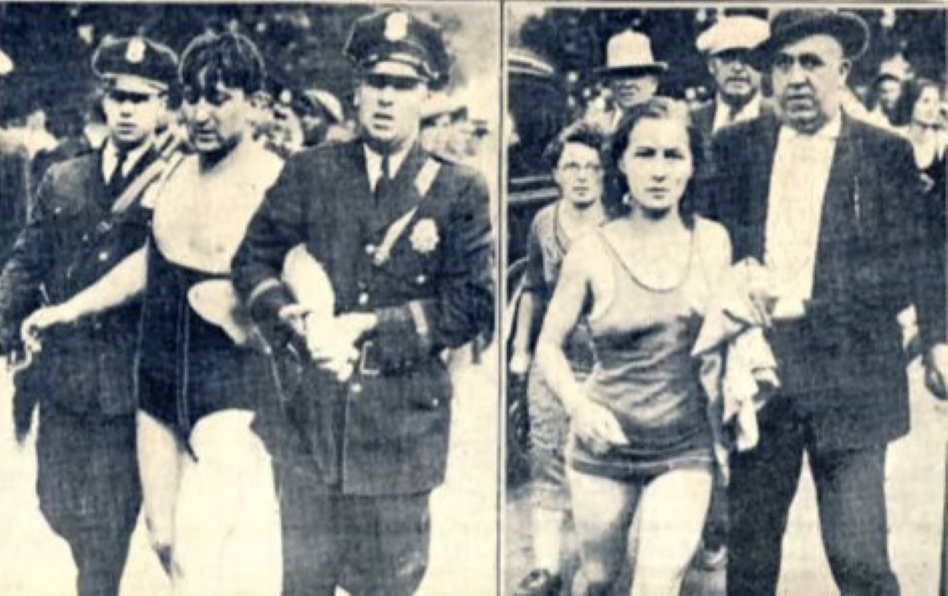
A mass violation of Jim-Crow laws a generation before the Civil Rights Movement as the Communist Party and Young Workers League lead hundreds of Black and white youth in a running battle with the police as they attempt to go for a swim at Denver’s segregated Washington Park beach in the summer of 1932.
‘The Battle of Denver’ by Elizabeth Lawson from The Daily Worker. Vol. 9 No. 208. August 31, 1932.
White and Negro Workers Battle Hooligans and Cops for Right to Beach
Determination was written on every face as the workers left communist headquarters in Denver. Tomorrow, Negro and white together, they would make a united attack on the new Jim-Crow edict of the police department. The speakers at the meeting had outlined the plans fog this struggle for the Negroes’ rights.
The city of Denver was sweltering under a hot summer sun. The white workers—those who did not live too far away or who had carfare—sought relief at the bathing beaches. But the Negroes—packed into crowded tenements—they could not go to the Denver bathing beaches. Their skins were black.
“Tomorrow,” said the speakers at the Communist mass meeting, “tomorrow we will go to the park, Negroes and whites together. We will have trucks on hand to carry the Negroes who want to go swimming. We intend to assert the rights of the Negroes to bathe in the public park. We Communists offer the Negroes leadership, protection and assistance in the struggle.”
Three o’clock, next afternoon. Three truckloads of Negro bathers arrived at the park. White workers, men and women, were there to receive and welcome them.
The city officials were also waiting for them, but there was no welcome in their voices. Carl S. Milliken, manager of Safety, and Walter B. Lowry, Manager of Parks, sent police to ask Negroes to assemble on the east side of the lake. Lowry began to speak:
“You are here,” he said, “at the instigation of the Communists and no good can come of this. You never before tried to use this beach. A year ago I offered to build you a beach, but you refused. (“A Jim-Crow beach!” cried voices in the crowd.) You know the white people are not going to stand for this. You have been ill-advised by Communist leaders. If you go into the water you are asking for trouble and I fear you will get it.”
The Negroes booed.
Said Milliken: “Do not do this thing. You are permitting Communist leaders to turn your head. Nothing but trouble can result.”
Shouts from the crowd. “It is true,”
Milliken went on, “that there is no law to keep you citizens from using this beach, but you have never attempted it before, and you know you are not doing this for any reason in the world except to bring about trouble. I warn you I will not stand for rioting, and I also give you fair warning that if you do go into the lake, you will be acting at your own peril.”
“We’re citizens—why don’t you have your cops protect us?” jeered the Negroes.
A few minutes more of speechmaking; then a stir in the crowd, and a sudden movement, and the Negroes swept past Milliken and Lowry, and Chief of Police Clark. With a shout they entered the water.
Suddenly two hundred whites—hooligans, police agents, and workers who had been misled by bosses’ propaganda, advanced upon the Negroes. They were armed with sticks and rocks, and they were cursing.
THEY were met by an opposing crowd. But not of Negroes only. In the forefront of this crowd were white workers, Communists, Communist sympathizers, and militant workers. Negro and white stood shoulder to shoulder, resisting police and hoodlums.
The Negroes and the whites who were protecting them gained the shelter of the three trucks. Jay Anyon, 22-year-old white Communist, called for a determined stand against the police attack.
Fists began to fly. Patrolman Harry T. McKinney picked out a Negro worker and felled him with a blow. The next instant rocks and stones flew in all directions. Clubs got into action.
Screams arose: “Kill the n***s! Kill the Communists!”
Four policemen pounced on Anyon. Swinging blackjacks battered him down. One officer struck him several blows with a revolver.
Battles raged in every corner of the park. Always two opposing groups—on the one side Negroes and Communist-led white workers—on the other the police and the hooligans. Whites threw themselves forward to protect the Negroes, who were, as always, singled activities out for special attack.
Seventeen persons, among them Communist leaders, were jailed. In court, they opened an attack on the Jim-Crow laws and ordinances, and the whole system of segregation. They put forward their Communist program of full equality—economic. political and social.
Milliken, Manager of Safety, issued a statement:
“The Negroes of Denver, who have always been quiet, peace-loving and peace-abiding citizens, have been the victims of a vicious Communist propaganda. This was caused entirely by Communists. We feel confident that the Negroes will realise this and will not lend themselves to further disturbances. We will show no quarter to the Communist agitators.”
OR IN other words: “The Negroes of Denver, who, single-handed and alone, were unable to put up any effective struggle for their rights, have now found allies, white and Negro Communists. The fight for their rights was made at the instigation of Communists. Smash the Communists, and we smash the leadership in this struggle.”
But at this very moment, the fight for the rights of Negroes in Denver is going forward. New sections of workers are coming forward to defend the jailed Negroes and whites. New plans are being laid. More white workers are shedding their prejudices and their boss-inspired hatreds. More Negroes are coming to realize that the leadership of the Communist Party is the only effective leadership in the battle against Jim-Crowism and segregation.
The Daily Worker began in 1924 and was published in New York City by the Communist Party US and its predecessor organizations. Among the most long-lasting and important left publications in US history, it had a circulation of 35,000 at its peak. The Daily Worker came from The Ohio Socialist, published by the Left Wing-dominated Socialist Party of Ohio in Cleveland from 1917 to November 1919, when it became became The Toiler, paper of the Communist Labor Party. In December 1921 the above-ground Workers Party of America merged the Toiler with the paper Workers Council to found The Worker, which became The Daily Worker beginning January 13, 1924.
PDF of full issue: https://www.marxists.org/history/usa/pubs/dailyworker/1932/v09-n208-NY-aug-31-1932-DW-LOC.pdf

