
In October, 1929, the month of the Stock Market Crash 429,000 workers were counted as unemployed. Three months later that number was 4,065,000. Five of the New Masses’ young, proletarian writers provide short prose pictures from around the country of the shocked unemployed, none knowing it was just the beginning and would get much, much worse. They are Harvey O’Connor (New York City), Ralph Cheyney (Chicago), Robert L. Cruden (Detroit), Joseph Kalar (Little Falls, Minnesota), and Norman MacLeod (Arizona and New Mexico).
‘No Help Wanted’ from New Masses. Vol. 5 No. 10. March, 1930.
NO HELP WANTED! A NATIONWIDE SYMPOSIUM ON UNEMPLOYMENT
The richest country in the world is starving. Men, women and children, always living on the ragged edge of life, are now learning the full depth of misery. While the internal revenue bureau reports unheard-of profits and the creation of 206 new millionaires in America, seven million workers are out of a job. All the assurances of the president, the press and the pulpit have failed to bring relief. Unemployed workers are storming city councils in New York, Chicago, Detroit, Cleveland and other cities. These are no abject slaves. They demand “Work or Wages.” The police reply with increasing brutality. The workers answer with united nationwide unemployed demonstrations for March 6. To reach the heart of the situation the New Masses has appealed to its group of young writers in all sections of the country. We present their story. No dry statistics here. It is a gaunt recital of worker-writers. All are in their twenties. All are at the work bench or have but recently left it. We believe this is an authentic pulsebeat of what is happening today in America.—The Editors
“Work of Wages”: New York by Harvey O’Connor.
Nobody knows how many jobless men and women there are in the nation’s metropolis. Learned and not so learned secretaries of labor dispute the point heatedly. State Labor Sec. Frances Perkins says unemployment is the worst since 1921; Federal Labor Sec. James J. Davis says tush-tush, things are already getting better; Federal Commerce Sec. Lamont sees good old normalcy right around the corner.
Such ignorance and confusion may seem peculiar in government officials. Davis can tell you to the last man how many radical foreign-born workers were shipped out of the country in 1929 because their ideas didn’t have his approval. Sec. Lamont knows how many pigs were stuck in the Chicago hog market, and how much their carcasses fetched for the meat barons. Sec. Perkins knows how many slaves Buffalo employers asked for from the state job bureau. But not one of them knows how many miserable workers walk the winter streets, slush creeping up their sox through leaky shoes.
Nor does anybody care much. Why should they, so long as the workless tramp meekly from factory gate to factory gate, their hands outstretched humbly for wage slavery? Only when surly men and bitter women become desperate, invading mayors’ magnificent suites, pushing cops to one side, thundering their demand for Work or Wages, does the bourgeois world become excited. The answer usually is More Cops. Sometimes stampeded city councils toss out a few thousands, to be expended stingily by calculating welfare agents.
Nobody on the Bowery, along Sixth Ave., or at the various haunts of Manhattan’s unemployed can tell you about the number of unemployed. All they know is that their bellies are empty, that February winds are raw, that spring is a long way ahead, that life is hell.
Next to having a job, the worst fate for a worker is to have none. Eight hours on the hunt for a job is worse than eight hours on the job.
Once Manhattan’s workless looked gratefully to a sullen sky. It meant snow! Snow meant clogged streets! Clogged streets meant work! Work, cursed by those who have it, desired by those who can’t get it! They get up early in the morning, 5 or 5:30, gulp three swallows of coffee and walk briskly to the nearest snow removal hiring station. At 6 a minion of the Department of Street Cleaning approaches, glares upon the suppliants, unlocks the door to the shack, barn or deserted building which houses the bureau. Soon thereafter comes another minion. He mounts a soapbox and picks ’em out. “Alright you, there, and you, and you. Shake a leg. The muck’s waitin’.” In a few minutes it’s all over and half the jobless are still waiting. “Say, why don’t you ever see me,” demands one. “You? What’s your name?” The jobless one answers. “Don’t remember your name. Where were you election day?
Even so. Working all day bending over a huge snow shovel, tossing the sodden heavy stuff high over head into waiting trucks is a political job. You’ve got to vote the ticket to get a chance at a swell job like that, paying $4 a day.
“City Haul”: Chicago by Ralph Cheyney.
I am going to be laid off in ten days. We have enough money in the bank to carry us two weeks longer if we quit all amusements, walk instead of ride and eat no meat. What then I don’t know. My wife has been staying home looking after the three babies—the twins are now bawling celebration of their first birthday. She will go to work IF she can get a job—but jobs for women as for men are damn few and far between here with a mob after them. Things like this turn a pink or red still redder.
A big Chicago department store, Leiter, advertised for some saleswomen. At least 2,500 rushed for the jobs and the jam was so great that ten were hurt in the crush.
Large corporations are firing workers by the thousand. The Western Electric has laid off 1,400 workers within the last two or three weeks. Undoubtedly in celebration of Hoover’s new era of unprecedented prosperity. While rugged individualism is glorified by the way in which workers elbow their way in the long lines in front of the few places where jobs are being filled. “No Help Wanted” shouts at you from factory walls everywhere.
I heard today that the Zinser Personnel Service usually considers two hundred applications for positions a fair day’s share but that on a single day last week this white collar employment agency received two thousand applications for jobs. And this is only one of approximately three hundred job exchanges in Chicago!
The employees of the South Park Board have taken a 15% wage cut rather than lose their jobs. Other workers are going ahead on a part time schedule. Others in small plants force their bosses to keep the strongest and most skilled on a full-time basis but drop the others. American workers en masse have yet to learn the lesson of Solidarity.
The Chicago situation is further complicated by the fact that the City Hall Treasury has been so gutted by grafters that city employees must live on air until the city can scrape together the back pay it owes them. If you can’t be a racketeer in Chicago, better not be in Chicago. Take your choice between a job and no pay or no job and no pay!
The total number of jobless workers in Chicago today has been estimated at about 350,000—an army equal to the combined populations of three of the largest neighboring cities: Rockford, Peoria and East St. Louis.
When you walk the streets in search of a job, it gives you a “grand and glorious feeling” to see two signs side by side, “No Help Wanted” and “NOTHING CAN STOP U.S.” When you turn to the very short “Help Wanted” columns of the newspapers, it’s “inspiring” to find no job you can fill, no bread to fill your belly and your family’s, but instead editorials and featured interviews telling you all about the prosperity you are enjoying.
There is a certain Christian Socialist in Chicago who on Sundays is an Episcopal divine and on weekdays a city editor of a large newspaper. The statement is credited to him, “We are on the verge of a panic—and the newspapers don’t dare tell the facts about how many people are out of jobs.”
To sum it up: the capitalists want large numbers of unemployed (raw material they can turn into scabs and soldiers for the war they are now brewing)—and what the capitalists want they get! Today. Maybe tomorrow. But for how long?
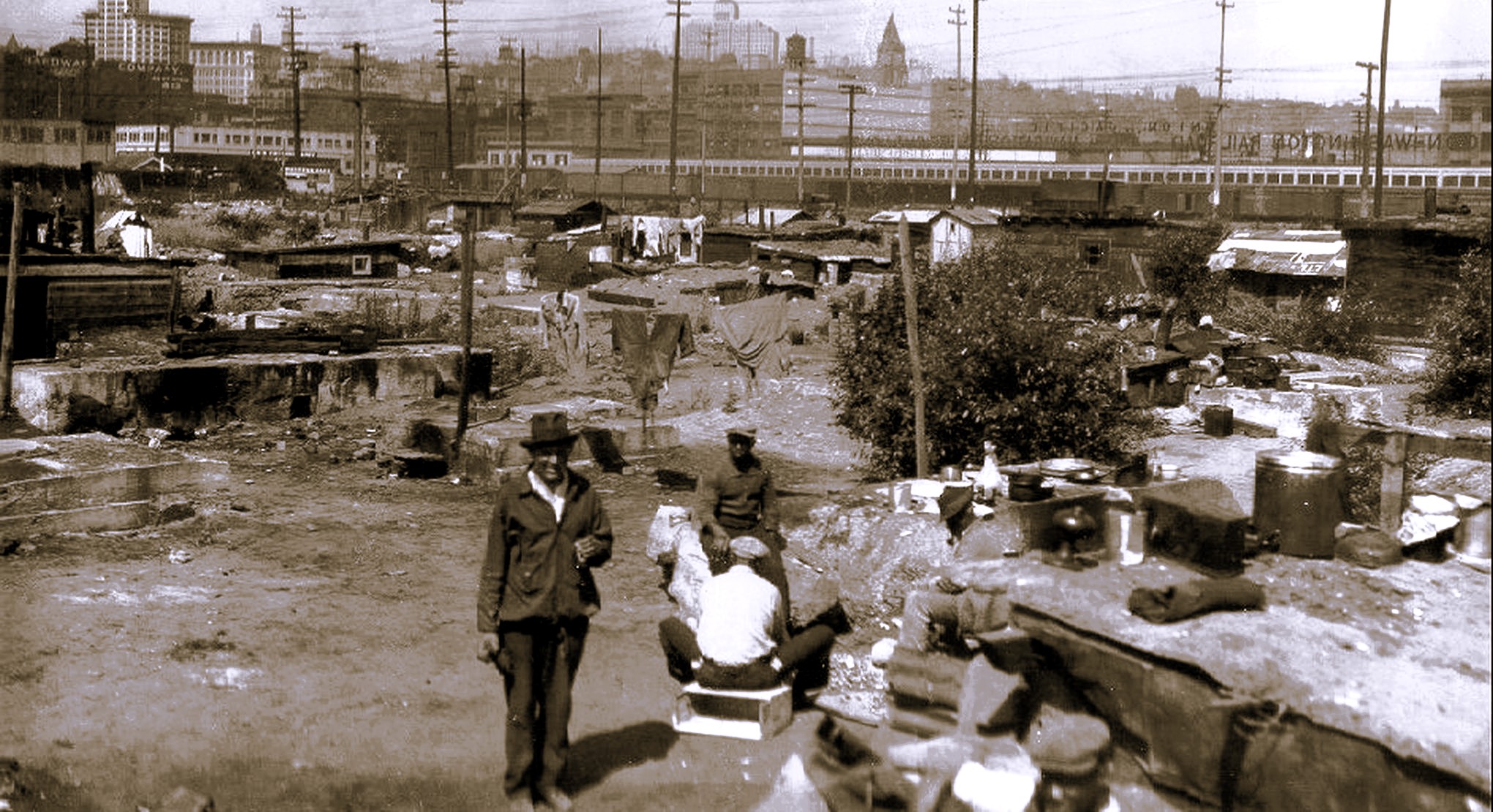
“1930 Model”: Detroit by Robert L. Cruden.
Lean men haunt the streets, their faces gaunt with want, their shabby coats hanging heavily on sagging shoulders. The winds whistle fiercely through the now smokeless factory districts and the men stalk in anguish. They go like hungry wolves after prey. Rows of workers’ homes, shabby, ill-painted boxes, stretch as far as the eye can see, but only here and there does a faint wisp of smoke mark a fire…Now and again the lined faces of ill-fed women stare hopelessly throu.gh dirty windows. At intervals a half-clad child scurries down the street, chilled and bitten by the cold.
Last winter it was the same. Summer came—but while the lean men tramped the scorching pavements the number of jobs diminished. Winter has come again and now jobs are not even to be bought. Unemployment has stretched forth its palsied fingers—
Like dark clouds piling up before a storm the number of unemployed has steadily increased since that remarkable trek to Detroit when Ford announced his “hiring” of 30,000 men. But few were chosen and ranks of that workless army have since been added to by the thousand lured here by false advertising of bus companies and trade schools. The major plants of the city—Chrysler, Fisher, Hudson—stand deserted, like relics of a grim past. Their workers are stalking the snow-filled streets for bread. Ford laid off 30,000 at one fell blow last Fall. Since then many thousands have joined their hungry comrades as the company has let out contracts for parts to sweat-shop firms in other parts of the country.
Terrified by their own figures the Employers’ Association has stopped issuing its weekly employment data. State labor officials keep tight mouths on unemployment and seek to divert us by an “attack” on private employment agencies. Local papers headline an “increase of 3.3% in the auto employment” and editorially comment on “the big auto year, 1930.” Little is said concerning the Chicago Auto Show with its “sharp decline in sales” nor is there much space given to the new European cartel which will quite materially injure that “foundation of American prosperity”—the auto industry. Not a ray of hope!
The bosses have not been lacking in efforts to placate the unemployed. The mayor appointed a committee of business men to solve the local problem, but like Longfellow’s Arabs they “folded their tents and silently stole away” with a note that nothing could be done but to trust in God and the bosses! Amidst the plaudits of the press a $7,500,000 public works program was launched but it has foundered in the stormy waters of civic finances. The Welfare Department, with at least 14,000 families directly dependent on it for subsistence, has received an additional $450,000 to carry on its work and expects a deficit of $2,000,000 by June—“as the result of industrial conditions.”
Although the city could afford no money for public works it has found enough for a $2,000,000 increase in the police dept. A special machine gun squad is being trained. Hundreds of policemen are to be added to the force. For unemployment brings retribution, crime. In the last three months of 1929, when jobs were vanishing, there were 376 robbery crimes as compared to 274 of the same period in the previous year. Judge Frank Murphy lays ’the increase to “straightened economic conditions.”
But even more alarming than the increase in the crime rate is the growth of workers’ unity. Unemployed meetings of the Trade Union Unity League have filled to overflowing. Negro, Russian, Southerner, Polack, side by side, shoulder to shoulder, under the banner of revolutionary action, are demanding, “Work or Wages,” hundreds of workers are joining the Communist Party. An ominous portent—and one to be beaten down, crushed, at all costs. Radio agents of the masters plead with the unemployed not to be “misled” by the “wild” Communists. But if pleading fails police clubs and machine guns are waiting…
The dark clouds are piling up, drawing nearer as the days pass. Starvation has done its work.
“Prosperity Blues”: Little Falls, Minnesota by Joseph Kalar.
It was good to watch the fatboys toedance like chorusgirls, warbling arias to prosperity, chanting “We are the greatest nation that ever was,” while the belly of capitalism swelled like a balloon until it touched the table—
Sleep crept stealthily up our thighs flooding our brains with bromides and we forgot—
now the planingmill limps through the days, no orders no orders chant the timeclocks no orders come back tomorrow or the day after or next year, maybe—
yesterday or the day before or last year it was fun, maybe, to get a vacation, to go home and sit before the fire reading the newspapers telling how prosperous we were—
one day isn’t so bad, but another and another: well there’s the kids at home, there’s the house, there’s the rent—
it’s goodbye now to the secondhand ford; its howdoyoudo to the bill collector; its goodbye now to the radio, to the new furniture; its goodbye now to the bankbook—
now it isn’t so funny anymore and it’s queer, isn’t it, how hymns to prosperity remind you of bullfrogs sitting on lilypads snapping at flies and croaking at the yellow moon?—
America is a fatman gorged with too much food, dying of indigestion. Too much prosperity, like too much meat, is bad for the stomach, and now America is slowly dying of auto-intoxication—
or the papermill…no orders no orders…down for ten days or twenty days or a month…and papermakers, aristocrats to their fingertips, now remember something as they get a job as sweepers in a sawmill saying goodbye 8 bucks a day, howdoyoudo 3 bucks…—
no orders no orders is a tune to dance to, the New American Jazz; it is a tune that sweeps into the papermill like a great broom sweeping out workers; comes like a cold wind into the planingmill; howls like a gaunt hungry wolf down the canyons of lumber in the yard—
no orders no orders, boys, nothing to do now but go home not smiling anymore—
remembering how sleep crept stealthily up our thighs flooding our minds with bromides and how we forgot!
‘Southwest Anthology”: Arizona by Norman MacLeod.
The smoke from the smelters hangs over the town of Douglas, settling like the blanket of death upon the streets running at cross purposes: Man and present social forces. In the gray of dawn I stand with a long line of Mexicans, Indians and nondescripts waiting for physical examination at the smelters. Time hangs like the smoke from a railroad train heavy upon the ground and whistles blow.
In two hours I am ushered before a signatory of the medical profession who thumps and scrutinizes me and hands me a little card all signed and cross-marked in particular places. Then into the main room of the headquarters building where I sign a paper saying that if I am hurt while working for the company I will ask no financial return or company hospital care. Hundreds of other men do likewise. At two in the afternoon we are told to report back to the yards.
We all return. A red checked corpulent man in overalls lines us into a row and passes us on parade. Somebody else is selected for convertible puncher and the rest of us are dismissed. No work today. Maybe tomorrow. Come back again.
Across the border is the only place to go. Agua Prieta. The bartender at the Dollar Saloon is a southerner. Pull that old line about the home in Alabama. Maybe a drink. You can never tell…
It is the same in Bisbee and Phoenix. Long lines. Little work. Little pay. And newspaper optimisms. The Arizona Packing Company is making money. The lumber camps in the north, McNary and others, nothing doing. McNary is run on a transplanted colony of southern Louisiana Negroes and the pay is low. Wells and backhouses side by side. And above the entrance to the lumbermill: “Enter at your own risk!”
What is there left to say? Tucson? A fat city for the conveniently sick…and rich. Make it high! A bill collector enforces the doctors’ communications.
“Not For a Poor Man” New Mexico by Norman MacLeod.
Albuquerque, a little better; not so powerful; the richer people go down farther south for the climate and more enjoyable sanitariums. But even in Albuquerque there is no place for a poor man. A doctor asked a patient his financial condition. No money. Tennessee is the place for him. The health center of the southwest wants rich convalescents. The best people, the biggest cars and what goes with it.
Mexicans work in the stores ten hours a day for five dollars a week and think they are lucky. And they are. A man stumbled against me last night, footsore and weary. (I know that ache that goes from the feet to the brain, destroying all fibre between!) A dime? No work.
But the cops make a big haul. The court house officials get away with three thousand dollars. A mock of the trial, for politics, Mexicans and Governor Dillon says he will take a hand. The home for female delinquents is just being exhonerated. The several young girls killed by the matron was an inevitable thing. They had to be disciplined.
And the newspapers broadcast the nation’s wealth…
The New Masses was the continuation of Workers Monthly which began publishing in 1924 as a merger of the ‘Liberator’, the Trade Union Educational League magazine ‘Labor Herald’, and Friends of Soviet Russia’s monthly ‘Soviet Russia Pictorial’ as an explicitly Communist Party publication, but drawing in a wide range of contributors and sympathizers. In 1927 Workers Monthly ceased and The New Masses began. A major left cultural magazine of the late 1920s and early 1940s, the early editors of The New Masses included Hugo Gellert, John F. Sloan, Max Eastman, Mike Gold, and Joseph Freeman. Writers included William Carlos Williams, Theodore Dreiser, John Dos Passos, Upton Sinclair, Richard Wright, Ralph Ellison, Dorothy Parker, Dorothy Day, John Breecher, Langston Hughes, Eugene O’Neill, Rex Stout and Ernest Hemingway. Artists included Hugo Gellert, Stuart Davis, Boardman Robinson, Wanda Gag, William Gropper and Otto Soglow. Over time, the New Masses became narrower politically and the articles more commentary than comment. However, particularly in it first years, New Masses was the epitome of the era’s finest revolutionary cultural and artistic traditions.
PDF of full issue: https://www.marxists.org/history/usa/pubs/new-masses/1930/v05n10-mar-1930-New-Masses.pdf

