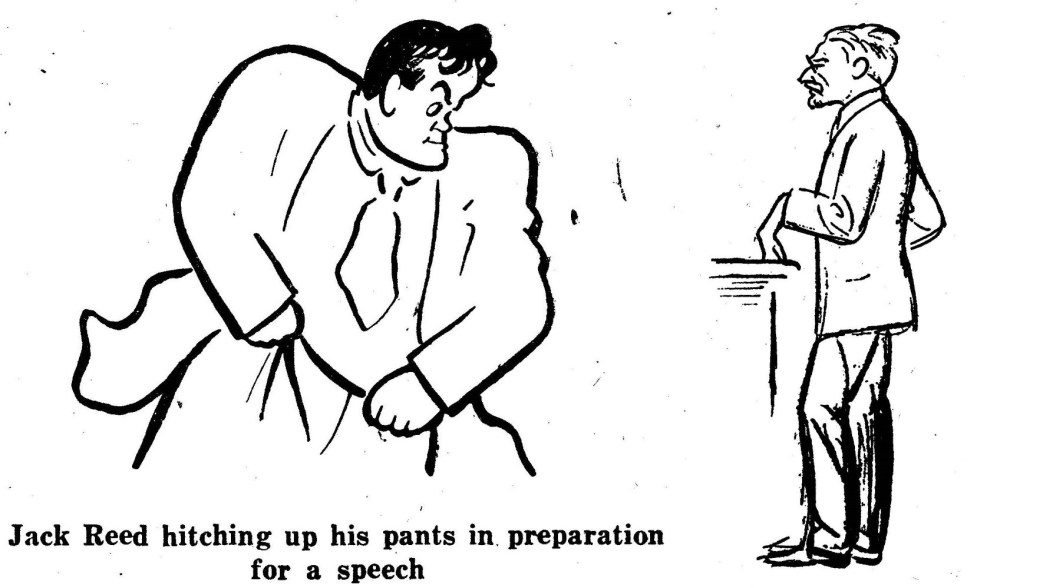
The rich, if exhausting, debate at the Second Comintern Congress on the relationship of the Communist movement to the labor unions in which John Reed, a delegate for the ‘United Communist Party’, and Louis C. Fraina (delegate for the ‘C.P.A.’) clashed on the U.S. situation, bringing in other forces for a wider discussion over tactics. In particular, Fraina bumped heads with Radek and Zinoviev. Fraina’s two interventions, along with a short introduction, below.
‘The International and Unionism’ by Louis C. Fraina from The Communist (old C.P.A.). Vol 3 No. 1. April, 1921.
Perhaps the discussion of Unionism was the most interesting and intense of any discussion at the Second Congress of the Communist International. The small syndicalist group was clearly unable to impress the Congress; but there was another group, of which I was one, who defended a position combining Communism with the peculiar experience of the American and British movement on Unionism. I was appointed by the Executive Committee of the International as co-referee with Karl Radek to open the discussion in the Congress; and I reprint my two addresses in order (1) to inform the Party of my position; (2) to dispose of the slanders of Reed, Flynn & Co. that I represented a conception not in accord with the requirements of the American movement. The minority theses were formulated by myself and J.T. Murphy, of the Shop Stewards of England. Among others, our two chief points were included in the final theses adopted–extra-union organization and our suggestions on the Labor Union International Another point: Reed, Flynn & Co. declared in Moscow (more hysterically than convincingly) that the theses would be “ruinous” for us. This is nonsense: the theses are ample for our purposes.
The First Address.
AFTER discussion in the Trade Union Commission we found ourselves much more in agreement than expected. The differences that still exist are largely differences of emphasis and practice, and not of principle.
The differences were first developed by the declaration convening a conference to organize an International of revolutionary Labor Unions. Some of the fundamental features of this declaration were totally unacceptable; for example, the condemnation of revolutionists leaving the trades unions was put in such a form as to exclude constructing a new labor organization, which would cripple the American movement, since in our country, where 80 per cent of the workers are unorganized and the trades unions dominated by the aristocracy of labor, the construction of a new revolutionary labor organization is an imperative revolutionary task. Then, the admission of separate industrial unions to the conference is made conditional upon the consent of the Central Labor organization of the country. Moreover, no provision is made for a representative each on the organization committee of the
Labor International of the I.W.W. and the Shop Stewards of England–two movements of vital importance in the development of the revolutionary mass struggle.
Our objections to Comrade Radek’s theses (only some of which have been met by his accepting several of our amendments) were, first of all, comprised in the conception of unionism. Radek approached the problem almost exclusively from the standpoint of the masses in the unions to be won for Communism. That, of course, is fundamental. But it is also fundamental to consider the unions as unions in relation to our task–as organs of revolutionary struggle and as factors in the economic reconstruction of society after the conquest of political power. Radek, also, made too narrow and artificial the conditions under which Labor Unions may be organized. And, finally, it appeared in Radek’s theses as if our task is to capture the trades union bureaucracy; there was no understanding of and no provision for extra-union organizations (such as Shop Committees, Shop Stewards, etc.) as means of aggressive struggle against the bureaucracy and mobilizing the masses for action.
In the United States, the approach to revolutionary conceptions has been through revolutionary unionism. These conceptions were: the necessity of extra-parliamentary action to conquer political power, destruction of the bourgeois state machinery, and organizing the proletarian state not on geographical but industrial divisions. These conceptions made it easy for us to understand the fundamental tactics of the Russian Revolution. But at the same time we were compelled to carry on a severe theoretical struggle against the I.W.W. conception that only the industrial unions are necessary to overthrow capitalism, without soviets and proletarian dictatorship. The American Communist movement has done a very important work in merging the old revolutionary conceptions of industrial unionism. in the new conceptions of Communism. in the new conceptions of Communism. And a necessary part of our work is to recognize the revolutionary functions of the labor unions.
The I.W.W. in the United States has been a real revolutionary force not primarily because of its agitation for industrial unionism nor because it tried to boycott and destroy the American Federation of Labor; in neither has it been very successful. The I.W.W. has been a tremendous revolutionary force in the American movement because it expressed the awakening to consciousness and action of the great masses of unorganized unskilled workers excluded from the American Federation of Labor. All movements to break the A.F. of L. by leaving the old unions have been a failure; during the war, when the old unions made a partnership with the government, the I.W.W. members were compelled to join the old unions; and these I.W.W.’s by agitating from within developed very powerful revolutionary movements in the old unions.
The American experience, accordingly, emphasizes the necessity of working within the old unions (in the revolutionary sense); but this experience equally emphasized the necessity of constructing new unions (in accord with objective condition) in order to unite revolutionary work within the old unions with work from without.
There is no controversy on the need of working in the old unions. On that we are agreed. For the American Communist movement to reject working in the old unions and adopt the slogan, “Destroy the American Federation of Labor by leaving it,” would destroy the Communist movement and not the reactionary labor unions.
The controversy centers on the methods. and purposes of working in the old unions. We maintain that the emphasis must not be on capturing the bureaucracy, but on liberating the masses from the domination of this bureaucracy, and mobilizing the masses independent of the bureaucracy.
In the old unions the bureaucracy is practically immovable, imposed upon the masses, and a barrier to action. In the United States the trades union bureaucracy in addition to constitutional provisions, long term offices and parliamentary tricks, uses gunmen to suppress rebel opposition in the unions. I mention this not as an argument against working in the reactionary unions, but as an argument against the idea of capturing the bureaucracy; we must fight this bureaucracy in the unions, but it will be impossible to capture or destroy it until the revolution itself or after.
Really revolutionary work in the trades unions has two important aspects.
1) The organization of Communist groups (necessary in all workers’ organizations).
2) The formation of extra-union organizations (Shop Committees, Shop Stewards, etc.). These are organizations of the workers in the unions expressing the requirements of the immediate economic struggle of the workers, and their struggle against the bureaucracy and the limitations of trades union forms of organizations does not mean that the workers leave the old unions; on the contrary, the workers stay in the unions but definitely organize their opposition. Moreover, these extra-union organizations act within and without the trade unions, and if they cannot get the unions to act in a crisis these extra-union organizations act independently of the unions and of the bureaucracy they are the most adequate means of driving the unions to more revolutionary action and of mobilizing the masses for the aggressive struggle against capitalism. In England and in the United States these extra-union organizations have been produced by life itself, by the experience of the struggle of the workers; it is through the creation of such extra-union. organizations that the Communists can best become the leaders of the immediate economic struggle of the working class. What we insist upon is not leaving the old unions, but organizing an aggressive, decisive struggle in the unions and against the bureaucracy, it is also necessary to carry on this struggle outside of the old unions. This is accomplished by the organization of new, independent unions. It is absolutely necessary that the organization of such unions (and secessions from the old unions) be based upon objective conditions, and express the mass struggle itself. But it is equally necessary not to be afraid of new unions. It is just as harmful to act in general against splits and new unions (where these concern masses) as it is to split in small groups thereby isolating ourselves from the masses. But after all, a split is a decisive, aggressive act, and may accomplish more revolutionary agitation than years of peaceful routine work in the unions. Moreover, by uniting the independent industrial unions with the extra-union organizations in the old unions, we perfect a force that will batter from within and without; and which, inspired and dominated by the Communists, will constitute a powerful factor in mobilizing the masses for action. We are in a revolutionary epoch, and our fundamental task is to liberate the masses for action–we cannot depend upon the peaceful prolonged process of capturing the bureaucracy.
Parallel with this problem of extra-union organizations is the problem of industrial unionism as against the craft form of unionism. This problem has three aspects:
1) Industrial unionism is the organization expression of the unorganized unskilled workers (which in the United States comprise the majority of the industrial proletariat). The construction of new generally implies the adaption of industrial unionism. Industrial unionism is the basis for the development of revolutionary unionism.
2) The agitation for industrial unionism is a necessary part of our work in the old unions. These unions mostly organized on the antiquated bases of crafts, are, under the pressure of concentrated industry, unable to really unite the workers in the unions and carry on an aggressive struggle. The workers in the old unions revolt against the limitations of the forms as well as the purposes of the trade-unions; and we must urge upon them the industrial union form of organization–an indispensable phase of our struggle to transform and revolutionize the old unions.
3) The unions will, after the conquest of political power, become organs of the administration of industry under the proletarian state. Craft unions cannot, because of their form of organization corresponding to integrated industry, function as means of the management of industry. Industrial unions are necessary, as is proven by the Russian experience. The larger the industrial unions and the understanding of industrial unionism, the easier will be the task of economic reconstruction after the revolutionary conquest of power. This is the conception of unionism developed and formulated by the American movement; and we are convinced that it is an indispensable phase of Communist tactics.
The Second Address
I wonder why comrades Radek and Zinoviev are so wrought up. They insist on emphasizing the necessity of working in the unions–but that is an argument only against the representative of the United Communist Party of America, who is opposed to working in the old unions. But the position of the U.C.P. is emphatically not that of the other comrades who are criticizing comrade Radek’s theses. In my opening address I emphasized my acceptance of working in the old unions, acceptance of working in the old unions, not simply because of the arguments made here, but because the whole experience of the American movement imposes that policy upon us. The Shop Stewards–are they against working in the old unions? It would be preposterous to assert that; the Shop Stewards and similar organizations are not a part of the old unions, they are the most adequate expression of the Radek-Zinoviev policy of working in the labor unions. I have said, as concerns the United States, that approximately 80 per cent of the workers are unorganized; but nevertheless it is impossible to abandon the old reactionary unions; and if for no other, because of one particular reason: the majority of the unorganized workers are foreigners, the majority of the organized Americans; we must make our contact with these American workers, since they will necessarily assume the leadership in the Revolution,–not in the theory but in the action of Revolution.
But how are you going to work in the old unions? That is the crucial question–the question of methods and means. When you say, work in the old unions, you say much–and nothing. It is necessary to have Communist groups in the old unions; but what are these to do? Are they simply to preach abstract Communism? Radek answers, no: they must become the leaders of the economic struggle of the workers. Very well; but that requires means; and the means, we insist, do not consist of pacific penetration of the unions, of trying of making a fetish of maintaining the old to elect new officials in place of the old, organizations and forms of unionism; the means consist of aggressive struggle in the unions, of mobilizing the masses liberating against the bureaucracy and of extra-union organizations and industrial them, of the agitation for and construction unions. Comrade Radek recognizes and accepts this, but does not make it a living and pulsing part of his theses; Radek is so absorbed with the problems in Germany, where certain people have issued the slogan “abandon the old unions,” that he over-emphasizes the other policy.
And again because of concentration on Germany, Radek treats very gently the problem of organizing new and secession unions. Under certain conditions a split is necessary; it must not be forced; but equally we must not allow a split to be imposed on us, we must not be like lambs, we must possess a policy on new unions that gives us the initiative in the matter and not our enemies. After all, a split is in a measure a revolutionary act; it may accomplish more in driving the masses onward than months and years of ordinary agitation; sometimes it may be necessary, even, to force a split. It is action that we insist upon. It is on the basis of action, and not theoretical divergences, that splits must come.
Moreover, we insist upon recognition of the new forms that are developing in unionism. Particularly in England and America, this development is of the utmost importance. We must objectively study these developments, learn from them, adapt our theory to the peculiar variations and forms of life itself. That is revolutionary practice; that is what is necessary, particularly on problems of unionism.
We must liberate the masses in the unions for action. Through their economic struggles, through understanding and adapting ourselves to the variations they develop in forms of organization and action, we mobilize them for the Revolution. We must not be abstract, or doctrinaire; we must always realize that it is the action of the masses potentially that develops the means and the forms of the final revolutionary struggle.
Emulating the Bolsheviks who changed the name of their party in 1918 to the Communist Party, there were up to a dozen papers in the US named ‘The Communist’ in the splintered landscape of the US Left as it responded to World War One and the Russian Revolution. This ‘The Communist’ began in September 1919 combining Louis Fraina’s New York-based ‘Revolutionary Age’ with the Detroit-Chicago based ‘The Communist’ edited by future Proletarian Party leader Dennis Batt. The new ‘The Communist’ became the official organ of the first Communist Party of America with Louis Fraina placed as editor. The publication was forced underground in the post-War reaction and its editorial offices moved from Chicago to New York City. In May, 1920 CE Ruthenberg became editor before splitting briefly to edit his own ‘The Communist’. This ‘The Communist’ ended in the spring of 1921 at the time of the formation of a new unified CPA and a new ‘The Communist’, again with Ruthenberg as editor.
PDF of full issue: https://www.marxists.org/history/usa/pubs/thecommunist/thecommunist3/v3n01-apr-1921.pdf

