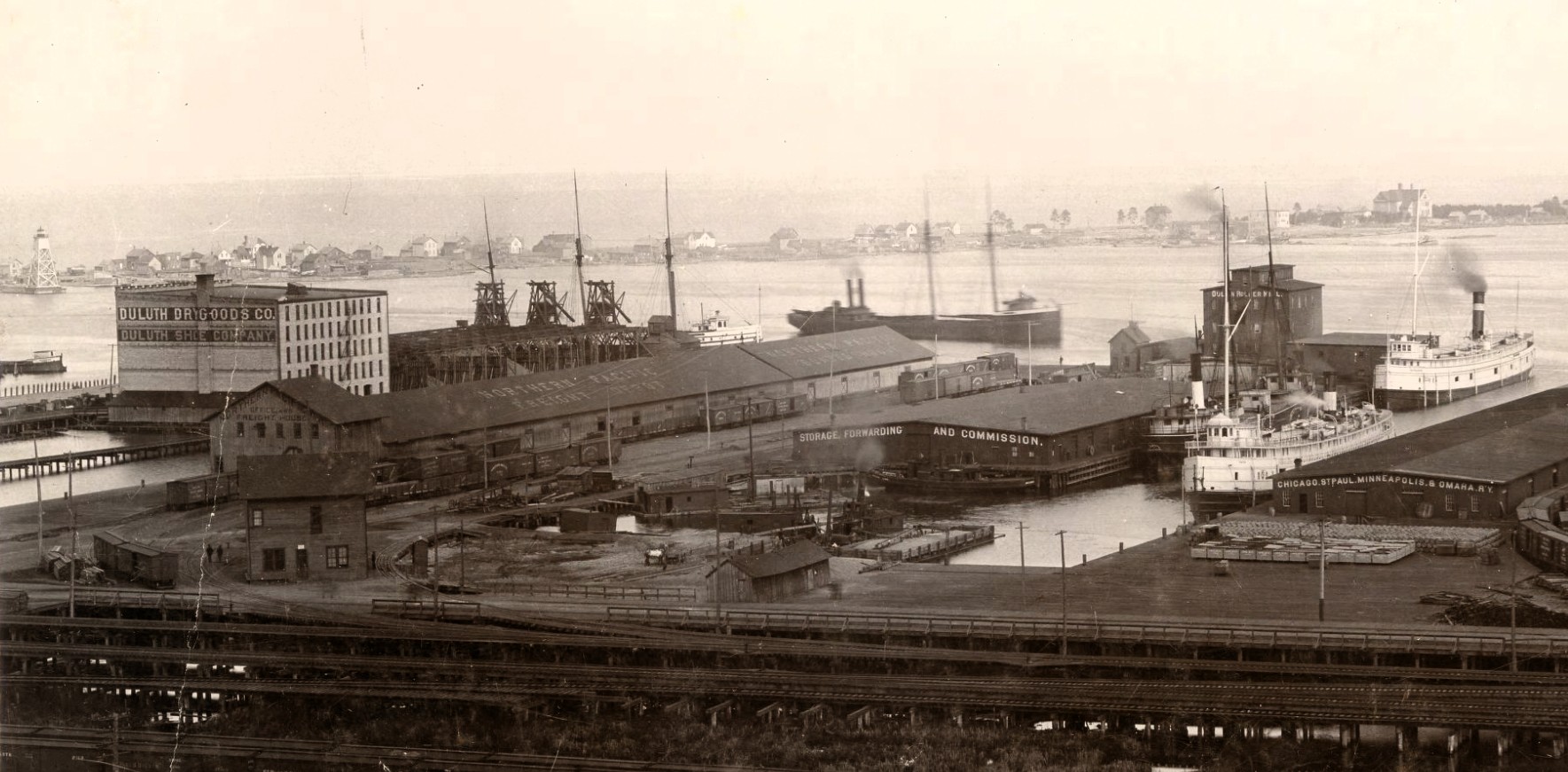
Lakes mariner James Lance yearns for someone to tell the story of labor on the Great Lake, site of a largely unseen class war, and still a central transportation artery for U.S. industry, with 100s of millions of tons being handled by 10s of thousands of workers.
‘The Men of the Lakes’ by James Lance from Industrial Pioneer. Vol. 1 No. 11. March, 1924.
MANY reams of paper have been used in the telling of sea stories; Mother Ocean, from time immemorial, has been the favorite theme of writers of all countries. Much has been written of the lives of deep-sea sailors, of the golden treasure-troves in Davy Jones’ locker, of wild storms, wild lands, wild men and wilder women which have been seen by those who “go down to the sea in ships.” The lamp of romance has shed its most colorful rays over the vasty deep.
Salt water has proven an irresistible lure for the ink-slingers and typewriter-pounders; the fact that there are bodies of fresh water here on the American continent which have as many stories on their broad bosoms as Mother Ocean ever had seems to have escaped their notice. Or perhaps it is because most of these stories would have to be written around the subject of Labor—a subject with which the majority of the pot-boilers are hopelessly out of touch—that the Great Lakes have never had much space allotted to them—fortunately—for much of the sea-stuff would give an honest-to-goodness son of the sea the heeby-jeebies, and no doubt, lake stories turned out by the same imaginative individuals would be as far from a portrayal of actual conditions.
Lakes Full Of Life
Nevertheless, the lakes should be able to break into print once in a while. Enough happens every year between Ogdensburg and Duluth ‘to fill several large sized volumes even after being rigidly censored by an editor with an aversion to windy tales. The lakes are full of life and much can be written around the men who “push the big wagons along with number four shovels,” who stand the long watches at the wheels, who balance themselves precariously on the slippery gratings of the engine-rooms, who scrub and paint, make fast and let go the vast fleets of cargo-carriers which plow the waters of the inland seas every summer.
And these stories need not be fiction either. Facts are fully as entrancing as fiction ever was. Romance is ever present in the lives of the men aboard the boats and it only needs some one with the kindred feeling which makes mankind a great brotherhood, some one who has actually soiled his dungarees and bruised his hands along with them to tell the story of the men of the lakes, and to make everyone realize that, here, right at home, one of the greatest chapters of modern history is being unfolded.
The Romance Of Work
Romance, aye, the romance of the working-class; stories with depths and breadths as great as life itself flicker across the screen, hold the attention for a moment and are forgotten in the intensity of succeeding ones. Stories of strikes and lockouts, ‘stories of hardship and misery, stories of unflinching heroism and stories of senseless sacrifice of precious lives for profit-mad masters, each have to be allotted a brief moment by those who would know the lakes and the men who have made them GREAT.
If you are a sceptic, one who must see to believe, the solution is an easy one. In six or eight weeks every port from Buffalo to Fort William will be awakening from the winter’s sleep, men for the boats will be in demand and the beneficent Lake Carrier’s Association will only be too glad to give you plenty of opportunities to find out for yourself whether there really is anything worth seeing or experiencing—particularly if you tell the shipping master that you are inexperienced.
If, on the other hand, you do not crave actual experience and are willing to take your excitement second-hand, if life in the raw appeals you and you feel safer in a ten-story building securely anchored to the ground, or in a spacious bungalow in the suburbs, and are fortunate enough to be able to finance such a mode of existence, you can find plenty of men who will tell you endless tales of life on the lakes.
Strolling Along The Lake Front
A stroll down lower Main St. in Buffalo, a few hours spent along Harbor Avenue in South Chicago, a pleasant word to some lad sitting on the duck at the foot of Fifth Avenue in Duluth or a day spent along Bridge Street in Ashtabula Harbor or along Reed Street in Milwaukee will convince you that events of great importance have happened and are still happening every day on the lakes.
Perhaps you might be lucky enough to meet “Castalia Dutch” in some of these places; perhaps “Scrap-iron Pete’ might be passing along, perhaps “South Chicago Johnny” or “Socialist Sam” might add to your store of knowledge. And, if none of these better-known characters were to be found you could still meet hosts of others who have tales to tell of hard-boiled mates, rotten chuck, lousy fo’cs’les and hard-steaming ‘‘workhouses.” The tales you would hear would make you stop and wonder—some of them might strain your credulity —but if all of them could be put together they would make a magnificent whole—an epic of life and labor.
The Story of Exploitation
Running through all of them you would find a general pattern with all the threads centering in one design—and when you looked closely enough—this pattern would become clear and plain and you would see that the real story, the story around which all the rest revolve, is the story of the exploitation of Labor and that the one outstanding feature in all the narratives is the never-ending struggle between those who have and those from whom it has been taken away “even that which they hath not.” In the story of the lakes, as in all other stories, the dominant feature is the CLASS STRUGGLE.
And, the saddest part of the story is, that until now, these men who have lived the story of the lakes, who have been part and parcel of its tragedy, did not understand why they were unable to delete the misery and the degradation from the tale and put happiness and joy, equality and freedom in their places. The story of the lakes, so far, has been one of sorrow and defeat for Labor—endless toil and scanty reward.
David and Goliath All Over Again
The story of the lakes has not been molded along such somber lines because the men have not tried; they have, in all sincerity. Many bitter battles have been staged, but the problem has just been too big for them to solve. It has been the story of David and Goliath over again, only this time David was out of luck and the Biblical ending has been supplanted by one nearer what might be expected when an unarmed stripling attacks—or tries to defend himself from—one who has practically unlimited strength.
The Goliath of the lakes is the Steel Trust; its name, of course, has been changed to one more suitable to the element it uses; afloat, the trust has become the Pittsburg Steamship Company—but its tactics are as brutal as those in force in the mills ashore. Against this monster and the weapon it has created—the Lake Carriers’ Association—the men of the lakes have battled in vain. Their struggles have been a succession of tragic failures. Union after union has been utterly smashed, strike after strike has been lost, thousands of the best fighters have been driven from the lakes by the use of the blacklist and today the men of the lakes are drinking the bitter cup of sorrow and defeat—not of their own volition—but because they are the threads in the great pattern and because the weaving of that pattern must include sorrow and travail and be colored by the blood and tears and sweat of Labor.
Breaking the Melancholy
And is the story of the lakes to continue along such melancholy lines? Is there no hope for these men who have been fighting against degradation so long? Is their ‘lifeblood to continue to color the great pattern of the class struggle without ever seeing that pattern finally ended and the story of the lakes started again with a new design—with freedom as the motif? Can the men who have made the lakes GREAT achieve GREATNESS themselves? The entrance of a new factor into the struggle—a union—one entirely different from those found wanting in the past—gives us courage and assurance to answer: YES.
The Marine Transport Workers’ Industrial Union of the IWW has appeared on the scene and the coming chapters bid fair to change the trend of the story. A new dawn is breaking over the inland seas and the morrow holds promise of better things. The men of the lakes, can, if they will, use this new union to end their misery and hardship. The story of the sea has had many happier lines written into it since the advent of this new force for Labor’s aid. Since its inception it has wrought many changes in the lives of the men who are engaged in heart-rending toil aboard ships the world over. Fresh water will not dim its efficiency, the pattern of the story whose mission it is to change is the same everywhere and its entry into the life of the men of the lakes marks the turning-point from which the story of the lakes will become better and brighter as time goes by.
Always fighters, the men of the lakes are now ready to try again, and this time through this union, they have the first real opportunity of accomplishing anything they ever had. This new weapon will be the long-looked-for influence which will brighten and sweeten the story of the lakes even as it is brightening the story of the sea. And when this union has assumed the directing of the story and recast it along happier lines, the story of the lakes will be one which will task the abilities of real writers, not pot-boilers, but writers who have lived the story they are writing. And the heroes will be those men who have suffered and sacrificed, toiled and died, roasted in midsummer on Lake Erie and frozen on Lake Superior when the howling snowstorms sweep out of the north to take their toll of life. Whose bones lie bleaching on the bottom of “sailors’ graveyard”—the men of the Kirby and Merida, the men of the Price and the Cyprus—all those working class heroes who have been sacrificed for the unholy profits of the masters—SONS OF LABOR—who have made the GREAT Lakes truly GREAT.
The Industrial Pioneer was published monthly by Industrial Workers of the World’s General Executive Board in Chicago from 1921 to 1926 taking over from One Big Union Monthly when its editor, John Sandgren, was replaced for his anti-Communism, alienating the non-Communist majority of IWW. The Industrial Pioneer declined after the 1924 split in the IWW, in part over centralization and adherence to the Red International of Labour Unions (RILU) and ceased in 1926.
PDF of full issue: https://www.marxists.org/history/usa/pubs/industrial-pioneer/Industrial%20Pioneer%20(March%201924).pdf
 Revolution's Newsstand