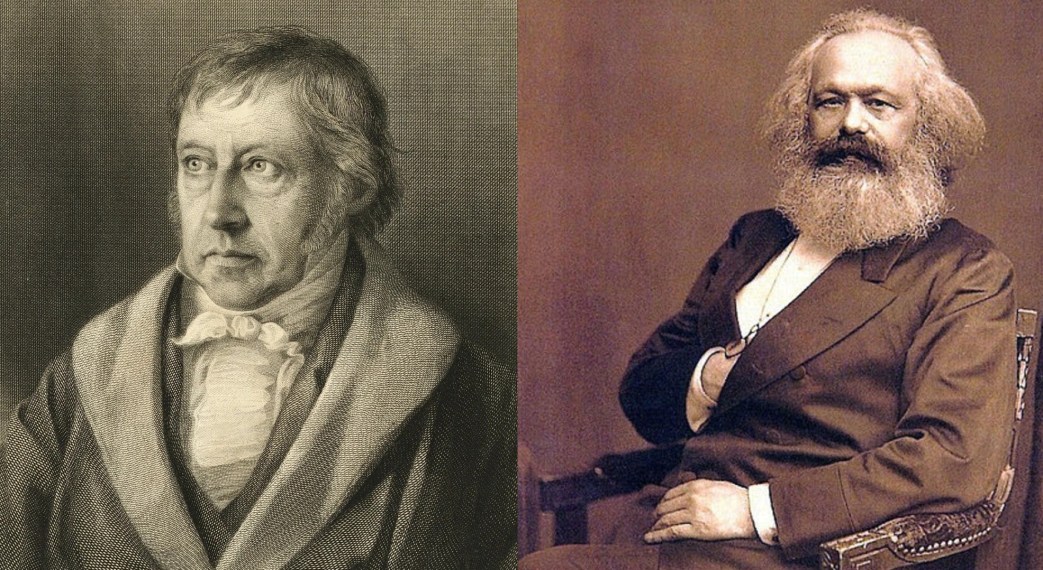
Haim Kantorovitch defends the dialectic in the materialism of Marxism with a look at the changing relationship to Hegel’s thinking by Marx and Engels.
‘The Social Philosophy of Marxism’ by Haim Kantorovitch from American Socialist Quarterly. Vol. 1 No. 2. April, 1932.
I. The Social Roots of Marxism
“Behind every philosophy there lurks a man” said F.C.S. Schiller, but behind Marxism lurk two Socialists. The usual picture of Karl Marx, the cold, impassive scientist, who always weighs and measures, who follows Spinoza’s precept, “not to love, not to hate, but to understand” is all wrong. His latest biographies, based on reliable material lately unearthed, reveal to us a passionate revolutionist, a dreamer and a fighter, a scientist and a man of action. As for Frederick Engels, every one knows him more as a passionate agitator and practical leader, than a philosopher. This does not detract in the least from their reputation as thinkers, and also does not minimize their theoretic achievements. The conception of the impassive, purely objective, impartial and absolutely unbiased scientist is nowadays more and more discarded. The theory of unconscious motivation has killed the myth of the pure scientist, who is after “truth and nothing but the truth”. Science is pragmatic, The exact sciences are limited by experimentation and verification. Nevertheless enough place is left for phantasy. Witness only the numerous conflicting theories that are born every day, based on chemistry, physics, biology. Philosophers generally arrive at their conclusions first, and only later look for rationalizations, very correctly observes the usually wrong F.C.S. Schiller. If this is a sin against science, then there is no scientist without sin, and the greater the scientist, the greater are his sins.
Marx and Engels were both natural pragmatists. Their philosophy could not be anything but pragmatic. In their youth both were Hegelians, idealists. They left the “phantom world” of idealism because it could not serve the purpose of those who refused to be satisfied with “explaining the world” and were out to “change it”.
Dreamers they were, certainly. Who that is alive does not dream? But they knew that the world is neither made nor changed by dreams. They knew life, they knew hardships; they felt the weight of “material forces” on their backs. One must bear in mind the time and conditions under which the thoughts of Marx and Engels grew and matured. Marxism was not born ready made in the heads of Marx and Engels. It was not just “thought out” by them, rather it grew up. Its elements were in the air. Its main tenets were already latent in society. Its main principles, in chaotic form, mixed with utter nonsense, had already been partly proclaimed by others. The labor movement had begun to practice Marxism, even before it was born. Marx and Engels were not out to find a new theory, rather they found a new practice, and wanted to explain it. “We do not proclaim to the world in doctrinaire fashion any principle. This is the truth, bow down before it…We only want to make clear to men for what they really are struggling, and to the consciousness of it they must come whether they will or not.” (From a letter from Marx to Ruge, written in 1843.) In Germany at that time every one was seeking new truths, final truths, absolute truths. Marx and Engels left this search to their academic colleagues. For themselves they chose another task: To find a method by which to explain and interpret what was really taking place before their eyes, a method through which they could uncover the hidden motives and deeper meanings of the fierce class struggle that they were witnessing.
That political, economic, and even the cultural struggles of their times were class struggles was not hard to perceive. This was the time when the bourgeoisie was preparing for its last struggle against whatever was left of feudalism, but it was also the time when the workers of Europe realizing that they had their own way to go, and their own interests to fight for, began to feel themselves a separate class. Class consciousness was born before it was proclaimed. “In 1842 England witnessed the first strike on a large scale… that bore a political revolutionary character; in 1843 the idea of an impending revolution was widely spread in England; in 1844 an insurrection broke out among the Silesian weavers; in 1845 and 1846 Socialism spread rapidly on all sides in Germany…the spectre of communism was abroad in Europe.”1 The working class did not wait for a theory to explain its rise, or to justify its class struggle. The class struggle is a justification in itself. When Proudhon theoretically disapproved of labor coalitions (trade unions) Marx replied not with a theoretical justification, not with arguments that prove that trade unions are good or necessary; he simply took their existence for granted. The question for Marx was not: are they good? are they reasonable? but why are they here? whither are they tending? It is the same with the class struggle theory, this so much abused part of the Marxian theory. Marx and Engels did not ask themselves whether the class struggle is good, or reasonable, or desirable; they applied to the class struggle the same questions, whence and whither? There is a bitter struggle going on between different social classes. Is it only an accident? It is a passing nightmare? Or is it, as the press assured its readers then, just as it is doing now, the result of the subversive propaganda of the damned agitators?
Marx and Engels lived not only in the age of rising capitalism, but also in the age of science and reason. Whatever could not stand the test of reason was to be discarded; whatever could not defend itself before science was of no account. It was the time when “metaphysics”, the erstwhile queen of the sciences, was banished from actual life. Scientific method invaded every nook and corner of human thought. It began to make inroads into the social sciences; even this domain which until lately had been left entirely to metaphysics, was invaded. It was no longer possible for anyone with a scientific frame of mind to ascribe to chance or to agitators, any social phenomenon, and especially such a significant and far reaching phenomenon as the rise of the labor movement, and the beginning of its open struggle for power.
Marx and Engels went through the mills of Hegelianism. From Hegel (and not only from him) they learned to look at things dialectically. Hegel’s mysticism was turned into a beacon light of realism for them. Hegel’s idealistic dialectics, which, according to Marx, was standing on its head, was placed on its feet, and its feet firmly implanted in reality. The dialectic method, shorn of its mystic language and its idealistic content, became the corner stone of the dialectic materialism of Marx and Engels. “Marx and I,” writes Engels, “were almost the only persons who made it their business to save a reasonable dialectic out of the ruins of idealism, Hegelian idealism not excepted, and to transform it into a materialist conception of nature.”
Engels seems to have been very proud of what he and Marx did with the Hegelian dialectic. The critics of Marxism however think that there is nothing to be proud of. Marxism, they believe, would be much better off without it. Edward Bernstein, in 1898 argued that the dialectic “spoiled” Marxism. Max Eastman repeats the same thing in 1927, only with much less knowledge of Hegelianism, and with very little insight into Marxism. From Edward Bernstein to Max Eastman to Norman Thomas critics agree that the dialectic ruined Marxism.
II. Hegelian Elements in Marxism
In his unfinished work “The Philosophical Evolution of Marx” George Plekhanov says, “Some historians of philosophy simply consider Marx as one of the left wing Hegelians. This is not the whole truth.” In his philosophic evolution Marx went through three separate stages in relation to Hegel and Hegelianism. At first he was simply a Hegelian. In his first theoretical work “On the Difference Between the Democritean and the Epicurean Philosophy” he accepts Hegel in his entirety. He is full of admiration for him. He refers to him as the “Giant-thinker” (den riesenhaften Denker). Hegel’s idea of self-consciousness (Selbstbewustsein) is the guiding idea of his work.
Later on, under the influence of life’s experience, cooled off by the later developments of the young Hegelians, and last but not least, under the influence of Feuerbach, Marx abandoned Hegelianism. In his “Holy Family” written in collaboration with Engels, Marx is thoroughly anti-Hegelian. “Marx’s writing for years past against Bruno Bauer, Feuerbach, Stirner, the Young Hegelians, and the true Socialists,” says Ruehle, “had in the last analysis been shafts aimed at the Hegelian principle of the absolute, at the Hegelian priority of the idea, at Hegel’s metaphysical trend…in a word, whatever the ostensible target, Marx’s missiles had really been thrown at Hegel’s head.”
In this second period of his philosophic development, Marx is in full revolt against Hegel; he is in revolt against Hegel the mystic, the idealist, the metaphysician, for whom everything dissolves in a logical category. Marx was more and more drawn into practical politics. As editor of the “Rhenische Zeitung” he demanded from his contributors “…less vague argument, pretentious. phraseology, and self satisfied contemplation of one’s own image in the mirror; and…more definiteness, more concern with concrete actualities, more accurate knowledge of the matters in hand.” When the “Rhenische Zeitung” was closed by the censor, and Marx devoted himself largely to the study of French Socialism, he was still less in a mood to “deal in shadows”. He saw that “Hegel’s interpretation of history presupposes an abstract or absolute spirit, which evolves in such a way that mankind is only a mass which bears it up, unconsciously or consciously…The history of mankind is transformed into history of the abstract spirit of mankind, which, because it is abstract, is something beyond real human beings.” When the “Holy Family” was written, Marxism was as yet in its embryonic stage, but of one thing Marx and Engels were already certain, and that was that, “man, the real living man does all things…history is nothing else than the activity of man pursuing his own aims.”2 Marx and Engels were gradually drifting into materialism. They were not alone in this process. “The practical necessity of the struggle against positive religion, brought many of the most resolute young Hegelians to the English-French materialism,” relates Engels in his “Feuerbach”. But they were not yet ready to part entirely with Hegelianism. They dared not raise the flag of revolt.
Ludwig Feuerbach dared. “Living in rural seclusion, far from the busy world of affairs,” he came out openly against Hegel. In place of Hegel’s idealism he put materialism. His works were greeted with enthusiasm on all sides. Engels calls his influence “liberating”. He really did liberate a whole generation of intellectuals from Hegelianism. “Materialism was raised to the throne”.
The influence of Feuerbach on Marx and Engels was tremendous. In spite of the many changes and amendments to Feuerbach’s philosophy by Marx and Engels, they remained Feuerbachians for the rest of their lives. The essential principles of their materialist philosophy are those of Feuerbach. They developed these principles further; they enriched them not only with a social and historic content, but also, with whatever was best, whatever was really revolutionary in Hegel.
Hegel the idealist, the conservative, was at the same time also Hegel the realist, the revolutionist. In his system, Hegel was idealistic and conservative, even reactionary, but he himself always asserted that what is important is not a system of philosophy, but a method. Philosophy is for Hegel something like an autopsy. “The owl of Minerva takes its flight when the shades of night are gathering”. He even goes so far as to say that philosophy must always come too late. “When reflection awakens it is a sign that an historical form of life has drawn to a close.” Philosophy does not lead; it follows. Hegel viewed philosophy from an evolutionary-dialectical standpoint. The history of philosophy was for him not a history of mistakes or of unsuccessful essays to solve the riddles of the universe. Every system of philosophy was for him an historically determined expression of its time, place and environment. They were all “true”, they were all “reasonable”, because they were all necessary stages in the development of philosophy.
Hegel reached this conclusion because he here applied his dialectic method; Hegel erred in his “system”, because his system was in contradiction to his method. According to his dialectic method “systems of philosophy” are as impossible as unnecessary.
According to Hegel’s dialectic method reality is a constant process, a constant flux, nothing is; everything is becoming, changing, developing inner contradictions, transforming itself into something else. “Dialectics,” says Engels, “comprehends things and their representations, ideas in their essential connection, concatenation, motion, origin and ending.”
“According to Hegel,” says Engels, “the truth to be recognized by philosophy was no longer a collection of ready made dogmatic propositions which once discovered had merely to be learned by heart. Truth lay in the very process of cognition, in the long historical evolution of science, rising from lower to ever higher stages of knowledge, but never reaching (by the discovery of a so-called absolute truth) the point beyond which no advance would be possible.”
This makes an end once for all to the absolute truth. Absolute truths are abstract, metaphysical and eternal. “For the dialectician no such truths exist. Truth for him is something always bound up with time, place and condition. It is always concrete. It always changes together with time and conditions. It passes through different stages. What has been true at one stage, becomes false at another, beauty becomes ugliness, and reason is transformed into absurdity. Everything not only develops, it also carries within itself its own opposite. It is contradictory in itself. Things are not either good or bad, either true or false, either beautiful or ugly, they are good and bad, true and false, beautiful and ugly, at once, though they usually reveal only one side of their contradictory natures. It is in their contradictions that Hegel (and Marx and Engels, after Hegel) see the guarantee of further evolution and of further progress.3 “Every step in the evolution of the universe as well as in human society, is conditioned and necessary, and made unavoidable by the development of inner contradictions within everything that is. These contradictions are the constant driving force behind things and events.” “Every stage is necessary, that is to say, justified for the time and under the conditions out of which it arises, but it becomes invalid and forfeits its justification under new and higher conditions which gradually develop within its own womb. It has to give place to a higher stage, which in its turn will decay and perish.” (Engels)4
Some Marxists, scared by the critics of the dialectic philosophy, try to pacify the critics by reducing dialectics simply to the theory of evolution. The place of Hegel is then taken by Darwin and Spencer.5 Historically it is false. Hegelianism cannot be eradicated from Marxism, and dialectics is not simply evolution. It is much more than evolution. It is, as one Russian publicist once remarked, “the algebra of revolution”. Moreover, by denying the revolutionary character of our dialectic philosophy, we do not gain anything. Our critics will find other grounds on which to criticize our theory. But we lose much; we lose our theory of revolution.
The non-dialectical theory of evolution is too often used as an argument against the theory of revolution. The evolutionary process is, according to the sociological evolutionist, a slow, gradual unbroken process of quantitative accumulations. Things grow bigger or smaller, but essentially they are always the same. This theory of evolution explains quantitative change, but it cannot explain the transformation of quantities into new qualities. Socially, such a theory of gradual, unbroken evolution is reactionary. The evolutionist, says Plekhanov, begins with the assertion, natura non fecit saltum, nature does not leap. It hates to jump. It goes on slowly and continuously. From nature this principle is brought over into sociology and history. Historia non fecit saltum, history does not leap. History is the same slow, gradual, unbroken, even process. Unscientific Socialists may speak of revolutions, but we evolutionists know better. Historia non fecit saltum,—evolution really excludes revolution.
Now Hegel was not a Socialist, and certainly not a revolutionist. He did not think of revolution when he worked out his fertile dialectical theory. He did not even grasp the revolutionary potentialities of his philosophy. But he grasped the fact that the “metaphysical”6 theory of evolution was wrong. Nature as well as history continually makes jumps. Revolutions are constantly taking place, as part of the evolutionary process. At certain points in their evolution the accumulation of quantities goes over into new qualities.7
The metaphysician is especially afraid of contradictions. He is the slave of formal logic. A is always A. A cannot be A and not A at the same time. But dialectic is first of all a revolt against formal logic. It is not true that A must always be A. Things, (for Hegel it is ideas) are not always either this or that, they are this and that. It is not either evolution or revolution. It is evolution and revolution, each determining and calling forth the other, each a result of the other. “It is a common notion,” says Hegel, “that things have their origin through gradual increase or decrease, but, there is also such a thing as sudden transformation from quantity to a new quality.”
Everything eventually negates itself, transforms itself into something else. This transformation is due to the fact that every phenomenon has within itself the forces that will bring about its transformation. The inner contradictions which everything bears within itself are bound, sooner or later, to bring about the revolution that will change the thing into its opposite.
How fruitful this theory became in the hands of Marx and Engels we will see in a later chapter.
NOTE OF EDITORS: This is a chapter from a forthcoming book, “The Social Philosophy of Marxism”. The next chapter is on “’Pre-Marxian Socialism”
NOTES
1. M. Beer, “Life and Teachings of Karl Marx,” p. 39. National Labour Press, Ltd., 1921, England.
2. Quotations from the “Holy Family” are taken from Otto Ruehle’s “Karl Marx, His Life and Works.”
3. “The Fundamental Problems of Marxism”, by George Plekhanov, English translation, and “Feuerbach,” Frederick Engels.
4. The differences between Hegel’s idealistic dialectic and Marx’s materialistic dialectics are treated in a separate chapter.
5. As for instance in Enrico Ferri’s “Socialism and Modern Science”.
6. Metaphysical here simply means non-dialectical. See Engels’ “Socialism, Utopian and Scientific”.
7. George Plekhanov “A Contribution to the History of Materialism”, p. 129, collected works, Vol. 8 (Russian). There is also a German translation.
Socialist Review began as American Socialist Quarterly in 1932. The name changed to Socialist Review in September 1937. The journal reflected Norman Thomas’ supporters “Militant” tendency of the ‘center’ leadership. Beginning in 1936, there were also Fourth Internationalists lead by James P. Cannon as well as the right-wing tendency around the New Leader magazine also contributing. The articles reflect these ideological divisions, and for a time, the journal hosted important debates. The magazine continued as the SP official organ through the 1940s.
For a PDF of the full issue: https://archive.org/download/radical-society_1932-04_1_2/radical-society_1932-04_1_2.pdf

