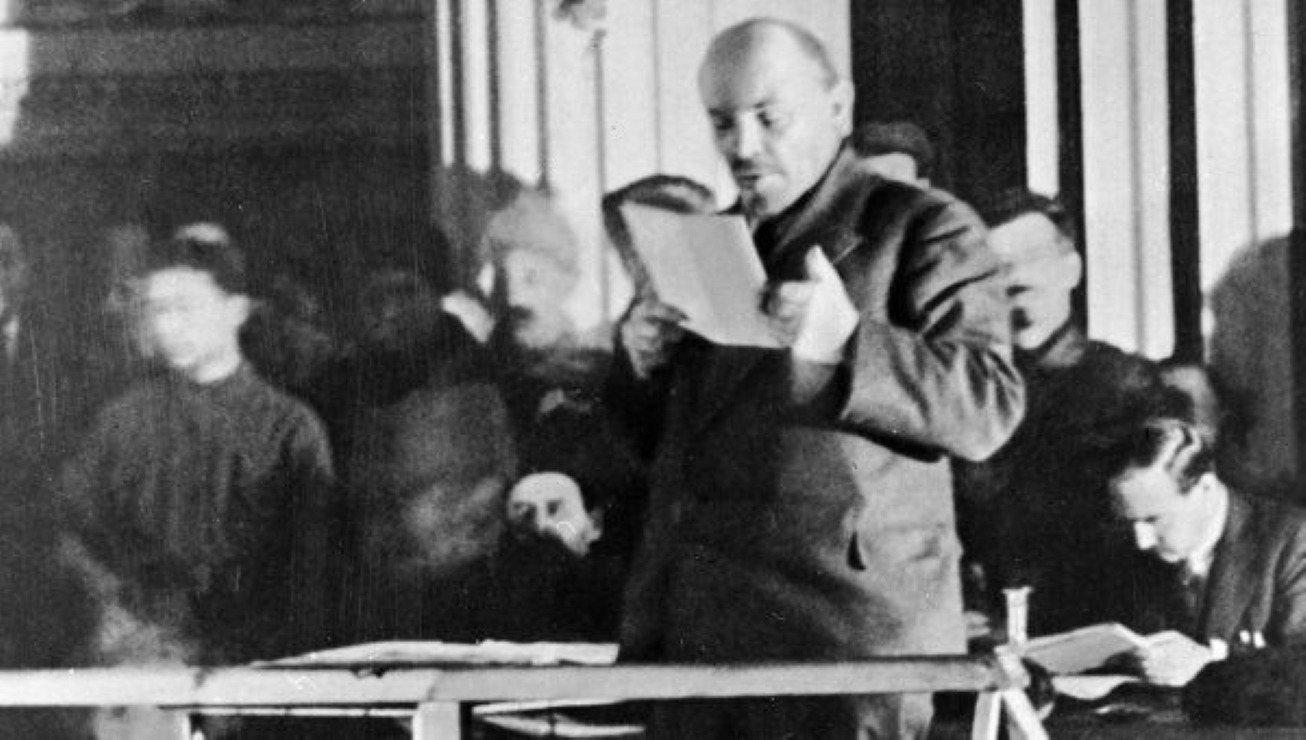
The original, full English translation of among Lenin’s most consequential speeches. Given to the Communist Party’s Tenth Congress in March, 1921 he proposes the key mechanism, the tax in kind, of the New Economic Policy. That Bolshevik gathering marked a turning point in the Revolution, coming near the end of the Civil War, and after the contentious debate on trade unions, it introduced the N.E.P. and placed a virtual ban on factions. As the congress was underway both Germany’s ‘March Action’ and the Kronstadt Rebellion, each referenced by Lenin, broke out. This speech is a good example of why ‘quoting’ Lenin is almost always a disservice to his positions, unless the quote contains the entire speech or article. As with all of Lenin’s most important work, its words are weighed and considered, with nuance and caveat in each sentence; those sentences become paragraphs, each considering contradictory arguments; each paragraph building on the last, ending in a single cohesive thesis.
‘Lenin’s Speech on the Tax in Kind’ from Soviet Russia (New York). Vol. 4 No. 21. May 21, 1921.
COMRADES: The question of substituting a tax in kind for the requisition of grain is above all a political question, because the essence of this question is the relation of the working class to the peasantry. The very fact that this question had to be put proves that we must subject the relations between the workers and peasants on the hostile or peaceful attitude of whom depends the fate of our revolution, to an examination and revision that must be as complete and intelligent as possible. I need not dwell long on the question of the causes that have made such a revision necessary. You all know what are the circumstances that have made the situation of the peasantry a particularly difficult one. First of all there is the great distress that was brought about by war, destruction and failure of crops, which necessarily brought with it a certain alienation of the peasantry from the proletariat to the bourgeoisie.
Let me speak but a few words on the theoretical significance of this question. There is no doubt that the social revolution in a country where the overwhelming majority of the population consists of small farmers and producers may only be achieved by providing for a number of special transition measures that would be entirely unnecessary in countries in which the wage workers constitute the overwhelming majority in industry and agriculture. In countries with a highly developed capitalism a special class of agricultural wage workers has developed in the course of decades. Only such a class may prepare the ground socially, economically, and politically for the immediate transition to Socialism. We have already emphasized in a number of pamphlets and speeches, as well as in our press, that in Russia the state of affairs is not the same, in other words, that in Russia the industrial workers are in the minority and the small farmers overwhelmingly in the majority. The social revolution in such a country may meet with complete success only under two conditions:
1. It must be supported by the social revolution in one or more of the advanced countries. As you know, much has been accomplished in this respect in recent days, as compared with the past, but this condition is still far from fulfillment.
2. There must be an understanding between the proletariat, which is the executor of the dictatorship and holds the state power in its hands, and the majority of the population. This understanding will be wide in its scope, and may include a great number of measures and transitional stages. It must be mentioned here that we must clarify the matter of our propaganda and education. People who think that politics means petty intrigues, who sometimes have even gone so far as to undertake acts of deception, must be most emphatically condemned in our midst. The working classes must not be deceived. In three years we have done very much to elevate the political consciousness of the masses. The masses have learned most in the open struggle. In accordance with our view of life and our ten years of revolutionary experience and the practical lessons of our revolution, we must look at things as they are: the interests of classes are different; the small peasant has aims that are not the same as those of the worker.
We know that only an understanding with the peasantry can save the social revolution until the revolution is ready to break out in other countries. We must speak practically on this matter in all meetings, and in our press. We must not attempt to hide anything; we must say openly that the peasantry are discontented with the form of the relations thus far realised with us, that they do not want this form, and that it has to be changed. This is a fact. The peasants have clearly expressed their will in this matter. But this will is the will of great masses of the working population. We must reckon with this fact and we should be sufficiently objective in our politics to say: “Let us go over this question!”
We must say: if you want to go backward, if you want to restore private property and bring about free trade, this will mean that you are handed over irrecoverably to the power of the landed proprietors and capitalists. A great number of historical examples and lessons in the revolution will prove this. Anyone who has even the most rudimentary acquaintance with the principles of Communism and political economy must be convinced of the inevitability of these facts. Let us go over this question together: is it in the interest of the peasants to remove themselves so far from the proletariat as to hand over the country once more to the power of the capitalists and landed proprietors, or is it not in their interest to do so?
It is my impression that if we properly examine this question, we shall come to the conclusion that in spite of the divergence between the economic interests of the proletariat and the small peasants, the final outcome is in our favor. Difficult as our situation is, the question of contenting the middle and small peasants most be solved. There are now more peasants with medium holdings than before. Oppositions have been adjusted; the soil is more equitably distributed; the estates of the big peasants have for the most part been expropriated. In Russia this has been more fully realized than in Ukraine and in Siberia, but on the whole statistics show that a certain levelling process has begun, in other words, that the sharp contrasts between the big peasants and the landless peasants have been removed. In general we may say that the peasantry now has holdings of so-called medium size.
Alteration of the Economic Basis
Can we make these medium peasants content with their economic position? If anyone among the Communists believed that the entire economic basis could be altered in three years, he was a dreamer. It is not a crime to admit that there are many such dreamers among us. In fact that condition is not even a disadvantage. How could we have undertaken a social revolution in a country like ours if we had not had such dreamers? Practice has also shown, however, that these experiments as such have played also a negative role, since people who were led by the best intentions and desires went into the villages in order to establish agricultural collective economy, without knowing anything about agriculture, or without having any experience in organizing collective farms. You know very well how many cases of that kind there have been. I repeat that this is not surprising, since the transformation of the entire psychology of the petty peasants is a labor that will require generations. This question of stabilizing the ideology of the small peasants can be solved only on a material basis. The application of tractors and machinery in agriculture on a large scale, the electrification of the whole country, would immediately produce a transformation of the thought of the small peasants. And when I speak of generations, remember that generations do not necessarily mean centuries. You know very well that the obtaining of tractors and machinery and the carrying out of the electrification of a gigantic country are a matter of decades. Objectively considered, that is the state of things.
Let us now ask, what is to be done? We must make efforts to satisfy the requirements of our peasants, who are dissatisfied, and rightly so, who cannot be satisfied with the present state of affairs. We must say: this thing cannot go on. How shall we satisfy the peasants, in fact, what do we mean by satisfying the peasants? Whence shall we obtain the answer to this question? The demands themselves will be our answer. We know these desires and demands. We must, however, subject them to a revision and attempt to connect all that we know of the economic demands of the peasants with our knowledge of the economic situation. If we go carefully into this question we must at once come to the conclusion that the small peasants can be satisfied in two ways: in the first place, by a certain freedom of exchange of commodities, a certain freedom for the small peasants, and, in the second place, we must get commodities and products; for what would be the use of a freedom to exchange commodities, if there are no commodities to exchange? And what is the use of a freedom to trade if you have nothing with which to carry on trade? We must well note these two conditions, for otherwise the whole thing will remain on paper, and you know classes cannot be contented with paper decrees, but only with material facts. How we are to get the goods–we shall speak of that later. First, let us speak of what is really meant by freedom to exchange commodities. Freedom to exchange commodities means free trade, free trade means: back to capitalism. Freedom to exchange commodities, free trade, means an act of exchange between the individual small peasants. All of us who know even the a b c’s of Marxism will understand that this exchange of commodities, this freedom to trade, inevitably will result in a division of the producers of commodities into possessors of capital and possessors of labor power, in other words, that we shall have new forms of capitalist wage-slavery, which never descended from on high, but always developed, in all countries, out of the agricultural classes who had p ducts in their hands. We know this very well in theory, and everyone in Russia who has observed the life and economic conditions of the small peasants cannot fail to come to this conclusion.
Communist Party and Free Trade
The question now is: Can the Communist Party recognize free trade and pass over to this state? Are there not irreconcilable incompatibilities in this situation? Our answer must be that the practical settling of these questions is of extreme difficulty. I can foresee, and I have already observed in conversations with many comrades, that replacing the grain requisitions by a tax in kind is going to center most of the discussion on the matter of the right to exchange commodities within the limits of the local economic needs. What does this mean; what limits must here be drawn; how are we to realize this condition? If anyone thinks that an answer to this question may already be given at this Congress he is mistaken. This question will not be answered before it is taken up in our legislation. Our problem in this Congress is to formulate the main lines of the question. Our party is a governing party and the decision that the party congress adopts will be binding for the whole Republic. We must therefore take up this question now as a matter of principle only.
Our decision on the principle involved in this question must be communicated by us to the peasantry, for the spring campaign is at hand. We must call in the assistance of our entire party apparatus, of all our theoretical powers, of all our practical experiences, in order to decide what is best to be done. Theoretically speaking, we may to a certain extent reestablish free trade and hand over to the small peasants the rights and privileges of capitalism, without in that way destroying the root of the political power of the proletariat. Is this possible? If we were in a position to obtain even a small quantity of commodities and the state should take possession of these commodities, the proletariat now holding political power would receive, in addition to that political power, the economic power also. The opening of the commodity exchange will have an invigorating effect on the small peasants whose activity has been almost crippled by the pressure of the destruction brought about by the war and the impossibility of developing their economic life normally. The individual small peasants need a stimulus that will be adapted to their economic situation. We cannot extricate ourselves from this difficulty without resorting to freedom of local exchange of commodities. If this exchange of commodities gives to the state a certain minimum quantity of grain, sufficient to satisfy the needs of the cities, of the factories, and of industry, this exchange of commodities will contribute to solidify and strengthen the political and national power of the proletariat. The peasantry demand that the worker, who holds in his hands all the factories and all industries, shall prove to them in fact that he is ready to enter into exchange relations with them. On the other hand, a great agricultural state with poor communications, in the individual parts of which agriculture does not operate under the same conditions, emphatically requires a certain freedom of commodity exchange in the domain of local agriculture and local industry.
In this field everything has been defective until now. It would be the greatest crime not to admit this fact.
Relations with Cooperatives
But we were under an iron compulsion. For up to the present time we have had such incredibly difficult conditions, produced by the war, that it was impossible for us to take any other than war-like measures, even in the field of agriculture. It is a miracle that our distracted country has been able to bear a war of this kind. But this miracle has not descended from on high; it was born of the economic interests of the working class and the peasantry. Simultaneously–and this must not be overlooked in propaganda and agitation–we went further than was necessary from either a theoretical or a political standpoint. We may admit a free local exchange of commodities in such a way as not to destroy the political power of the proletariat. How this is to be done will be shown by actual practice. It is my duty only to show theoretically that it is possible. The proletariat holding the state power in its hands can, if it has control of certain products, put these products into circulation and thus secure a certain satisfying of the middle and small peasants. This satisfying of their needs must be undertaken on the basis of the local exchange of commodities.
Now let me say a few words on this local exchange. First I must here touch the question of the cooperatives. It is of course a fact that we shall need the cooperatives in a local exchange of commodities. Our program emphasizes that the cooperatives which we took over from capitalism are the best instrument of distribution and that we must preserve this instrument. So far for our program. But have we really utilized the cooperatives as fully as we might have? No! And this is partly due to our own errors, partly forced upon us by the war. The cooperatives embraced elements whose economic situation was relatively secure, and who were therefore, in their political sympathies, Mensheviks and Social-Revolutionists. What can you do about it? It is a law. (Laughter from the audience.) The Mensheviks and Social-Revolutionists are people who consciously or unconsciously cooperate in reconstructing capitalism and give their aid to the Yudeniches. That is also a law. We must fight them, and when you are fighting, you fight to the utmost. We must defend ourselves, and we have done so. But can the present situation continue to be maintained? No, it is impossible. It would doubtless be an error if we should tie our hands, and therefore I propose, in the question of cooperatives, the following resolution, which is very short. I shall read it:
“In view of the fact that the resolution of the Ninth Congress of the Russian Communist Party, as to our relations with the cooperatives, is based entirely on the principle of requisitions of grain, which are now replaced by a tax in kind, the Tenth Congress of the Russian Communist Party resolves to alter the resolution in question. The Congress commissions the Central Committee to formulate the conditions for developing and improving the structure and activity of the cooperatives, in accordance with the program of the Russian Communist Party, and to take as its basis the substitution of a tax in kind for the requisition of grain.”
The resolution of the Ninth Congress ties our hands. It says that the cooperatives are to be placed under the Commissariat of Provisions. The Commissariat of Provisions is an excellent institution. But it would be a great political error if we should forcibly put the cooperatives under the Commissariat for Provisions, and thus tie our hands, in the regulation of our relations with the small peasants. We must give the newly elected Central Committee instructions to elaborate the new measures and undertake alterations. In this matter we stand, theoretically speaking, before a great number of transitional stages and transitional measures. One thing is clear to us: the resolution of the Ninth Congress assumed that our development would follow a straight line. It has turned out, as is always the case in all the history of revolutions, that the course of evolution has followed zigzag lines. Therefore it would be a political error to tie ourselves down to any resolution. If we now alter this resolution, we may say that we are acting in the spirit of our program, as is demanded by the importance of the cooperative organizations.
In altering this resolution, we say that we must accept the substitution of a tax in kind for the grain requisitions as a basis for our measures. When shall we be able to put it through? Not before the harvest, in other words, not for a number of months. Will this measure be the same in all places? By no means. To attempt to proceed with a rubber stamp in Central Russa, Ukraine, and Siberia, as if they were parts of the same region, would be the greatest folly. I propose that we publish this fundamental idea of the freedom of local exchange of commodities as a resolution of the Congress. I imagine that in a few days a letter or appeal from the Central Committee will be published, which will state much better than I am doing here the following: do not hurry, destroy nothing, and act so as to content in the highest possible measure the demands of the middle peasantry, without causing the interests of the proletariat to suffer thereby. Try to do both these things and draw practical conclusions from your experiences, and then inform us what you have achieved, and we shall form a special commission, or even several commissions, which must then devote themselves to the study of these practical experiences. We must subject to a tenfold inspection the measures we have taken, before we may proceed on the basis of our experiences.
How and Where to Get Commodities
We shall now be asked how and where we are going to get commodities. This will be much easier for us now, since our economic situation, as measured by the international yardstick, has much improved. How we shall get the commodities–that is another question. But the possibility of obtaining the commodities is now at hand. The economic relations which we are maintaining with the upper classes of other states will give to us, the proletarian state power, the possibility of granting to the peasantry the alleviation of a free exchange of commodities. I know that this has called forth derision. In Moscow there is a large group of representatives of the bureaucratic intelligentsia who are at great effort to produce a certain “public opinion”. This group began to make fun of us: “See what has become of Communism. It is like a man walking on crutches and with his face made unrecognizable by a great bandage.” Communism in their eyes is now a sort of caricature. I have heard jokes and jibes of this kind frequently. Russia came out of the war in such a condition as really to resemble a man who has been beaten up until he is half dead. For seven years they have been striking us, and we may now be glad that we can move about at all, even if it is with the aid of crutches. Such is our position. And if any one says that we can get out of this situation without the aid of crutches, he will give evidence of a complete misunderstanding of the present situation. So long as the revolution has not yet broken out in other countries, we must not grudge the hundreds of millions and milliards, which our boundless resources and our rich raw materials afford us, as a compensation for the trade that the advanced capitalist countries may give us. We shall later recover all this with advantage to ourselves. If the most advanced countries are still smarting with the wounds inflicted by four years of war, what is to be said of us, who have been waging war for seven years?
In our backward country we have need now of an economic breathing spell, after our seven years of war. We have learned from the reports of Comrade Lezhava that many hundreds of thousands of poods of various foodstuffs have already been purchased in foreign countries and are being forwarded here with the greatest possible speed by way of Lithuania, Finland and Latvia. Today we have received news that a contract covering the delivery of 18,500,000 poods of coal, purchased by us, has been signed in London, in order to furnish the industry of Petrograd with fuel. If this will help us provide commodities for the peasants, it may be irregular or even in violation of our program, but we need a breathing spell.
Exchange of Commodities by Individuals
I must say a few words still on the exchange of commodities by individuals. When we speak of freedom of exchange we mean an exchange of commodities by individuals, in other words, an aid to the big peasants. We must not hide from ourselves the fact that the substitution of a tax in kind for grain requisitions represents a certain strengthening of the wealthy peasantry. But this tendency of the wealthy peasants must not be resisted by means of edicts, by means of prohibitions, but by national measures and national concentration. If the nation can receive machines, it will be strengthened and elevated thereby. And if the machines are available in sufficient quantity, and the electrification has been carried out, this will mean the end of the big peasants. But so long as this is not possible, we must give a certain quantity of goods away. He who has the goods at his disposal, also holds the power. The peasants in Russia, as far as their possessions are concerned, have recently been much equalized, and now consist for the most part of medium peasants; and we need not fear that the exchange of commodities will be completely individualized. Each man will be in a position to give the state some compensation for these goods. One will furnish his excess in grain, another will give garden products, a third will give his labor power. The situation is now this: either we must economically satisfy the medium peasants and consent to a freedom of commodity exchange, or it will be impossible to maintain the power of the proletariat in Russia, in view of the slowing down of the international revolution. We are economically not fitted for this task. We must be clear on this point, and speak of it fearlessly. In the proposed legislation there are a number of other contradictions. Therefore the final words have been made to read thus: “The Congress approves in its general outline the proposal of the Central Committee to replace the grain requisitions by a grain tax, and commissions the Central Committee of the Party to eliminate these contradictions in as short a period as possible.” We have not yet had an opportunity to eliminate these contradictions. We have not had sufficient time for these details. The All-Russian Central Executive Committee and the Council of People’s Commissars will work out in detail a plan for carrying out the tax in kind as well as the necessary edict. If you accept this proposal today, we can immediately refer it to the All-Russian Central Executive Committee, which will then, together with the Council of People’s Commissars and the Supreme Council of National Economy, and that of the National Defence, make this project a law, and what is more important–issue practical instructions.
Why This Change Was Necessary
Why was it necessary for us to substitute a tax in kind for the grain requisitions? The grain requisitions created a peculiar monopoly which demanded all the excess grain and foodstuffs from the peasants. But we could not do otherwise, since we were in a position of extreme distress. The national monopoly is the very best method from the Socialist standpoint. But in a peasant nation, having control of a certain amount of industry and a certain quantity of goods, the system of taxes and of free exchange of commodities is capable of application as a transition measure. This exchange of commodities will be a spur and a stimulus for the peasants. The peasants will and must make efforts, in their own interest, to raise the productivity of their farms, because they will now not be asked to give up all their excess foodstuffs, but only the amount covered by the tax in kind, to be delivered as far as possible in advance. We must build up our national economic life with an eye to the economic position of the middle peasant, whose ideology we have not been able to alter in the course of these three years. The quantity of foodstuffs to be raised by the grain requisitions was increased last year. The amount of foodstuffs to be raised by the tax in kind should be much smaller.
If there is a crop failure, we cannot take any excess foodstuffs, because there will not be any to take, unless we want to deprive the peasant of the last bite he has to eat. Should we have a crop failure, we shall all have to starve a bit, and the state will be saved. Otherwise the state would go to pieces. If we have a good harvest, our excess supply will amount to half a billion poods; this will be sufficient for consumption and will even enable us to create a certain grain reserve. The main point is to stimulate the peasant. Therefore we propose the acceptance of the resolution. It is always difficult to look for transition measures. As we have not succeeded in advancing equally and in a straight line, we must not be petty, but must simply gather our forces. A peasant who has even a modicum of class-consciousness cannot help understanding that we represent as a government the working classes, those working classes with whom the toiling peasant can agree (and the peasants represent nine tenths of our population). A class-conscious peasant understands very well that every turn for the worse means a return to the old Tsarist Government. The Kronstadt events have clearly emphasized this. The Kronstadt people do not want the White Guards and they do not want us, but they cannot have anybody else. The Kronstadt mutineers have put themselves in a position which is the best kind of agitation for us and against any other kind of government.
Acceptable Relations with the Peasants
We are now enabled to come to an arrangement with the peasant, and this arrangement must be brought about with intelligence and adaptability. We understand the whole apparatus of the Commissariat of Provisions and we know that it is a very efficient apparatus and must be preserved. But we must subordinate this apparatus to the demands of policy. The whole magnificent machinery of the Commissariat of Provisions will be of no use to us if we are not able to achieve acceptable relations with the peasants. If the politic al situation requires a decisive change, adaptability, and wise measures of transition, the leaders must accommodate themselves to this condition. A well built apparatus must be able to function under any circumstances. If its structure becomes a mere petrifaction, it will lose its applicability. For this reason precisely we must apply all our forces to achieve a complete subordination of this apparatus to the demands of policy. Policy means: the relation between the various classes, and this relation decides the fate of the republic. We must always keep the great whole before our eyes; this very evening we must be in a position to proclaim to all the world by wireless that the Congress of the governing party has replaced the grain requisitions by a tax in kind and has thus stimulated the small peasants to improve their methods and increase their cultivated area. If the Congress will take this step, it will improve the relation between the proletariat and the peasant and may give expression to its conviction that in this way a permanent relation may be attained between the peasantry and the proletariat. (Stormy applause.)
Soviet Russia began in the summer of 1919, published by the Bureau of Information of Soviet Russia and replaced The Weekly Bulletin of the Bureau of Information of Soviet Russia. In lieu of an Embassy the Russian Soviet Government Bureau was the official voice of the Soviets in the US. Soviet Russia was published as the official organ of the RSGB until February 1922 when Soviet Russia became to the official organ of The Friends of Soviet Russia, becoming Soviet Russia Pictorial in 1923. There is no better US-published source for information on the Soviet state at this time, and includes official statements, articles by prominent Bolsheviks, data on the Soviet economy, weekly reports on the wars for survival the Soviets were engaged in, as well as efforts to in the US to lift the blockade and begin trade with the emerging Soviet Union.
PDF of full issue: https://www.marxists.org/history/usa/pubs/srp/v4-5-soviet-russia%20Jan-Dec%201921.pdf

