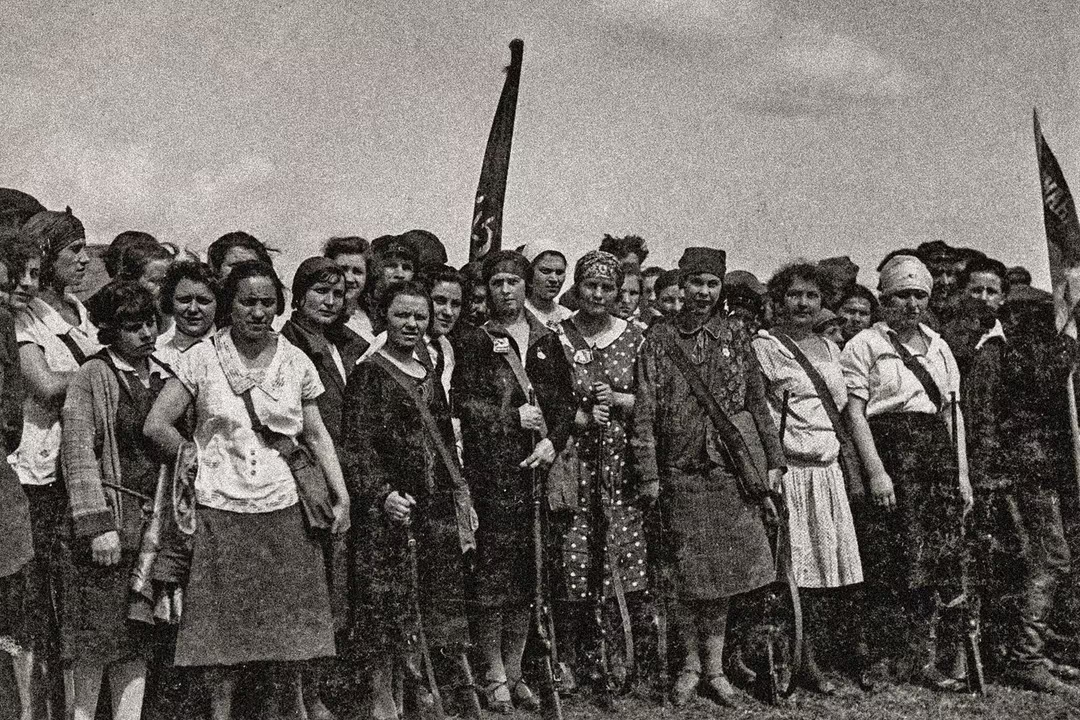
A central figure in the proletarian women’s movement both before and after the creation of the Third International, Hertha Sturm reports on the rising role of women during Germany’s revolutionary crisis of 1923.
‘Working Women as New Active Troops in the Class War’ by Hertha Sturm from International Press Correspondence. Vol. 3 No. 64. October 4, 1923.
The rising revolutionary movement in Germany, visibly expressed in the great strike wave in the first half of August, is showing a characteristic feature which distinguishes it from all former movements: the spontaneous activity of the masses of proletarian women. The character and significance of this phenomenon must be accorded due consideration.
During former revolutionary struggles of the German proletariat in Berlin and Central Germany in the year 1919, during the Munich Soviet republic, the Kapp putsch and the March action, women played an important part. But–and this was the decisive point–in all these cases it was a question of a few individuals or small groups, politically schooled to a certain degree of clarity, and consciously fulfilling a political duty. These were communists and their immediate adherents, following the Party slogans, but not able to carry along with them the broad masses of politically unenlightened women.
In August 1923 the matter was very different! Here mighty masses were engaged in the struggle–in many districts the majority of the women, of the working class, and of the proletarianized middle class. And the extent of the movement was so wide that the women communist disappeared in the great mass, and did not appear to have the leadership any longer. Women comrades hitherto unknown and without name, and even non-partisan women, grasped the initiative, placed themselves at the head of the others, and had not the least trouble in carrying along with them thousands and thousands of fellow-women of their class. And more than this, the masses themselves acted so spontaneously, so energetically, that their leaders and spokesmen were at the same time only the executors of their demands,
This does not signify that the movement has passed out of the hands of the Communist Party. On the contrary: No slogan was issued, no action carried out, which had not been for weeks or even months the subject of daily agitation in the Communist Party, and especially of the national Women’s Secretariat of the CP. of Germany, in the press and at meetings, at home and in the market. But that which had merely seemed lifeless words now sprang suddenly into life, as if the women had all at once grasped the true significance of that which they had heard so often: “We have to do this and that ourselves! We only. Nobody else can help us!”
Since the Ruhr occupation, there have been two questions which have forced themselves into prominence in the daily struggle for bare existence: wages and prices. The masses of working women do not yet understand much about the fundamental laws of capitalist economics, nor much about the real or pretended relations between their position and the Ruhr occupation. It is not from books or newspapers, but from their own personal experience, that they have learnt that the basis of their existence is vanishing from beneath their feet day by day. The rising excitement, hitherto finding its safety valve in the everlasting repetition of the sigh: “It cannot go on like this much longer!”, finally reached boiling point and exploded. The women took action. Their first and immediately intelligible demands culminated as a rule in a cry of: “Prices must be reduced and controlled–wages must be raised, if we want to live!”
It was the women who exercised the most powerful pressure on the men, inducing them to strike. How many workmen knew anything of the daily and hourly rise in prices of all food stuffs, when they placed their apparently high wages in the hands of their wives on payday, or sat down to the meal prepared for them when they returned from work? What idea had they of the hours and days spent by the housewives running from one place to another, or standing and waiting endlessly, for potatoes or margarine? All the care and worry of the household was borne by the women. And thus inner necessity led to the formation of these hitherto unknown processions and demonstrations: hundreds, even thousands, of housewives, in their aprons, their shopping bags and baskets over their arms, women who had gone from one empty shop to another, and tried every market, without being able to buy even the barest necessities. These processions march to the factories and workshops, call out the shop stewards, bring about the immediate convocation of meetings of the workers, and explain the situation to these personally. The housekeeping money is insufficient. Under these conditions we and our children will starve. You must have higher wages! If you cannot get them by any other means strike!
In this manner the strike among the Berlin metal workers was brought about in July of this year, after thousands of women had tramped about unwearyingly for three days, from early morning until the end of the working day, in Oberschöneweide, Niederschöneweide, and Johannisthal, going from one great factory to another, and continually plaguing the men. These processions became typical features of the August movement. In Hanover, the strike began by a procession of women forming before the largest undertaking in the city, the Continental Co. Ltd., and inducing the men to come out. In many quarters of Berlin the women went from one works to another to make sure that all workers were striking, and to fetch out the unenlightened. In Magdeburg the women thus controlling the strike, found men working in the carpenter’s shop of a large factory. They took away the men’s tools and drove them into the street. In Halle, where the tramwaymen did not follow the strike slogan at first, the women stopped the cars, pulled down the drivers, and beat them in their indignation. In numerous places, the factories in which the majority of those employed were women were the first to go wholeheartedly into the strike; this was the case for instance, in the textile factories in Gera, the aniline and celluloid factories in Dessau and Bitterfeld. In various places in the Ruhr area women voluntarily offered to do picket work.
The same masses of women still further seized the initiative: In the cities they went to the mayors and food supply offices, in Berlin even to the minister for food supplies, and demanded concrete measures for the alleviation of the most urgent necessity: confiscation of all food obtainable; food for the strikers, unemployed, and social pensioners out of public funds; feeding of children in schools, postponement of payment for milk for infants, old people and invalids; recognition of the control committees, etc. In many cases not only were promises received, but the women were successful in having a commencement made with the carrying out of their demands. Besides this, women have taken active part in the spontaneous action of existing control committees, and of those rapidly springing into existence, which have fetched out food hoarded in the great storehouses of the wholesale dealers, have confiscated corn, milk, and cattle on large farms, and have sold these at low prices. The interruption of the acute struggle has caused the driving force of the masses of women to disappear from the surface for the time being. But they are latently effective. Women are and remain members of the control committees, and of the commissions negotiating with the mayors; they are preparing for the election and participation in the factory council congresses; they form 40, 50, and more per cent of those attending the public meetings held by the Communist Party. They have lost their fear of the street and of politics, their consciousness of power is increased by their successes, their respect for the God-imposed lawful authorities who have trembled before them is greatly shaken, if not gone forever.
What role will these women play in the coming struggles? No action has ever proved so plainly as the last that the masses, though far from being ready to enter into a struggle for distant political aims, are ready to take up action today for wages and bread. It has never been so evident that the proletarian masses are still well capable of and desirous of fighting. And it has never been so obvious that the working class possesses, in its women, powerful fighting forces which have never yet been mobilized, and which, if systematically employed, would be capable of exercising a decisive influence on the issue of the revolutionary struggle. The fresh and unbroken elementary power of the masses of the women are a factor with which both sides must reckon in the beginning of the civil war. The bourgeoisie and its social democratic flunkeys will exert every endeavor to divert the proletarian women from their class, and to split the united front just forming. Woe to the revolutionary proletariat, woe to the Communist Party, if this danger is not observed or properly estimated. The uprising of the women, primevally forceful and promising great aid to the proletarian cause in its instinctive power, born of misery and despair, can become an instrument of disaster if permitted to act as an uncurbed force without clear political aims, if it is led into false channels, if counter-revolution and reformism gain possession of it. Everything depends upon the energy, the tenacity, and the skill exercised by the communists in sustaining and invigorating the interest once aroused among the women of the proletariat, in clarifying the class instinct as yet so vague, in deepening political knowledge, in securing the sympathies already won, and in leading the fresh and welling up activity of the proletarian women into the path of conscious revolutionary class warfare!
International Press Correspondence, widely known as”Inprecorr” was published by the Executive Committee of the Communist International (ECCI) regularly in German and English, occasionally in many other languages, beginning in 1921 and lasting in English until 1938. Inprecorr’s role was to supply translated articles to the English-speaking press of the International from the Comintern’s different sections, as well as news and statements from the ECCI. Many ‘Daily Worker’ and ‘Communist’ articles originated in Inprecorr, and it also published articles by American comrades for use in other countries. It was published at least weekly, and often thrice weekly. The ECCI also published the magazine ‘Communist International’ edited by Zinoviev and Karl Radek from 1919 until 1926 monthly in German, French, Russian, and English. Unlike, Inprecorr, CI contained long-form articles by the leading figures of the International as well as proceedings, statements, and notices of the Comintern. No complete run of Communist International is available in English. Both were largely published outside of Soviet territory, with Communist International printed in London, to facilitate distribution and both were major contributors to the Communist press in the U.S. Communist International and Inprecorr are an invaluable English-language source on the history of the Communist International and its sections.
PDF of full issue: https://www.marxists.org/history/international/comintern/inprecor/1923/v03n64[41]-oct-04-Inprecor-loc.pdf

