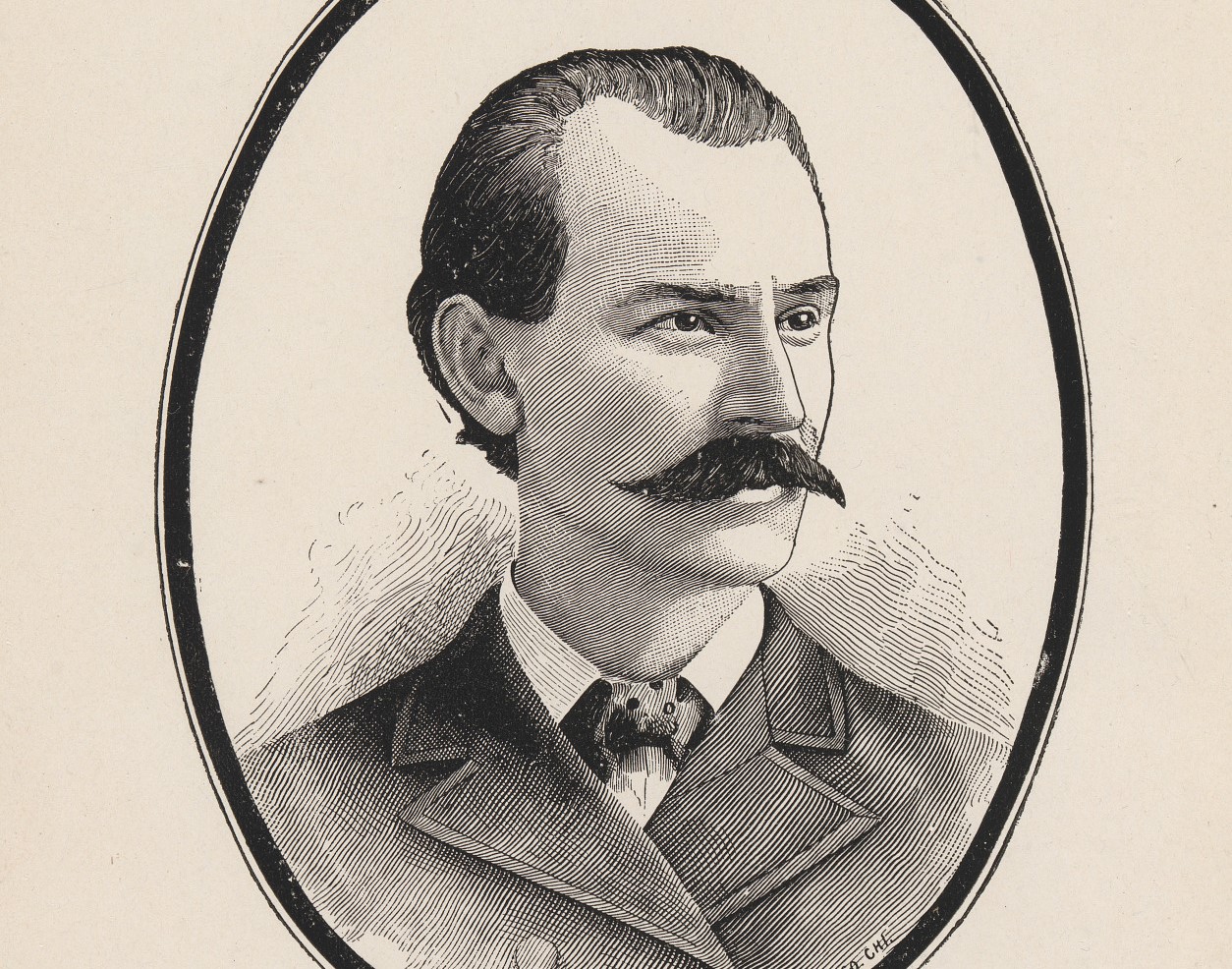
Today, November 11, is the Day of the Martyrs. Parsons’ comrade Dyer Lum, who would take over editing The Alarm, on his last visits with the condemned revolutionary.
‘Albert R. Parsons in Prison’ by Dyer D. Lum from Life of Albert R. Parsons, edited by Lucy Parsons, Chicago. 1889.
TO HAVE known Parsons was to love him. Some reminiscences of his later days may serve to bring out more clearly his sterling integrity and manly character. However much others may doubt the correctness of his views, none who knew him ever doubted his sincere earnestness and truthfulness. Short in stature, of slight physique and nervous temperament, even his friends did not realize the heroism which lay dormant in his breast. But when the occasion came to test his courage, to prove what manner of man he was, he rose to the height of manhood and coolly laughed death in the face rather than submit to a cowardly alternative.
After the verdict of the Supreme Court of Illinois, sustaining the sentence of death, I immediately returned from the East to Chicago. At my first interview with the prisoners Parsons asked me to try and ascertain the exact status of affairs. He said friends were daily bringing in words of hope; that he realized the situation, and, knowing human nature, believed that, under similar circum-stances, he might do the same thing. “But I want the cold facts; can you get them?”
I went to a friend who was in a position to know, and he got a gentleman who had business with Grinnell to incidentally ask what the chances were. Grinnell answered that Fielden and Schwab would probably be saved, if they signed what would be required of them. He further said that he had talked with Judge Gary upon Parsons’ case, but that nothing could be done, as Parsons was regarded as too dangerous a man to leb slip with a chance of final release. In fact, the impression given was that Parsons’ boldness and eloquence had made so deep an impression upon the Court that his death was decided upon. It was an open secret that, in presenting the case to the jury, Grinnell meant to have excepted Parsons1 from the extreme penalty, but forgot it. Parsons’ eight-hour speech of defiance, when called up for sentence, banished the last ray of hope.
We knew that, no matter how many petitions were presented, how many friends might intercede, the decision, as in all such cases, finally depended upon the signatures of the Judge and Prosecuting Attorney.
When I conveyed this information to Parsons his eyes glistened with that strange light so well known to his associates, and he replied:
“Ah! that is their answer. They shall now have mine.”
Two days after appeared his letter to Gov. Oglesby, contemptuously refusing “mercy,” and demanding liberty.
As the day of execution drew near the case of Parsons began to assume a more favorable appearance. His voluntary return, to court trial with his associates, and his fearless bearing, even aroused a feeling of sympathy. The Defence Committee and men of influence beseeched him to sign the paper which some of the others had consented to do. In my last interview with him he told me of the pressure brought to bear upon him to recant. He was a loving husband and a fond father. Probably no married life had ever been less clouded than his, for perfect felicity always reigned.
He told me of promises made, and which seemed to be based upon good reasons. I assured him that I believed that he alone of the five stood a fair chance for commutation. He replied earnestly, with that nervous gesture of the index finger so habitual to him :
“But Fischer and Engel say they will sign if I do ; they leave the decision to me. Will they then die?”
I replied that for Lingg, Fischer, Engel, and Spies there was absolutely no hope ; nothing could save them. He drew up his slight form, and, with a firmness which never after forsook him, replied:
“Then every night in Joliet upon retiring, and every morning in arising, I should be haunted with the thought that I had made cowards of them in vain. No ; I shall die with them.”
Two nights before his murder, when friends had been denied access, and even his beloved wife could not see him, one of the bailiffs came to his cell and said that Melville E. Stone, editor of the Daily News, desired to see him in the library. Mr. Parsons refused, saying that if Mr. Stone wished to see him he must come to his cell. Consequently, the great man of the press was ushered in behind the bars and took a seat before the cell door. Mr. Parsons still refused conversation unless his visitor should come inside and sit with him. Stone complied. Then for three hours Stone, one of the principal members of the Citizens’ Association, plead with Comrade Parsons to sign the retraction of his principles and live. With kindness, with sarcasm, with appeals to love for wife and children—with all the arts he knew so well to employ—he beseeched him to sign, guaranteeing life as reward. But Albert R. Parsons had already made the sign of obliteration over life and refused to sacrifice honor. At last, wearied with Stone’s importunities, he arose, and, pointing his accusing finger at the great editor, said to him: “You, Mr. Stone, are responsible for my fate. No one has done more than you to compass the iniquity under which I stand here awaiting Friday’s deliverance. I courted trial, knowing my innocence; your venomous attacks condemned us in advance. I shall die with less fear and less regret than you will feel in living, for my blood is upon your head. I am through. Go!” And the interview ended.
When Herr Liebknecht and Dr. Aveling were in Chicago they called at the County Jail to offer their distinguished sympathy to the condemned men. When Aveling was introduced to Parsons he said: “Mr. Parsons, I am sorry to see you in there.” Mr. Parsons smiled and said: “That reminds me of a story. William Lloyd Garrison was once arrested in Boston, for, as you know, he was a social heretic in his day. While in jail his friend, Wendell Phillips, called upon him and said, as you did, ‘I am sorry to see you in there.’ Mr. Garrison instantly retorted: ‘Mr. Phillips, I am sorry to see you out there.’ Aveling laughed and answered: “Very good story,” but he moved on to proffer sympathy to another. The anecdote seemed too pointed to permit of discussion, but Parsons’ hearty laugh followed him as he passed on.
And this was the man the infamous conspiracy strangled and cowardly sprang the trap to choke off his dying words. Calm, unmoved, and fearless, the men whom so many had tried to humiliate, to dishonor, to apostatize, rose superior to their accusers and stepped upon the scaffold with a smile of pity for the hirelings who were selected to perform their brutal task. And among all names now so dear to working men, as having been borne by men who died in their cause, none will live and shine with greater lustre than that of Albert K. Parsons.
DYER D. LUM.
Notes
1. The author was told by an attorney on the morning of the rendering of the verdict that Grinnell had just expressed the regret to him that he had forgotten to mention to the jury that, in view of the fact that Parsons had voluntarily surrendered, he ought to be entitled to some consideration. This proves what kind of a “fair” trial it was.
PDF of full book: https://archive.org/download/lifeofalbertrpar00pars/lifeofalbertrpar00pars.pdf

