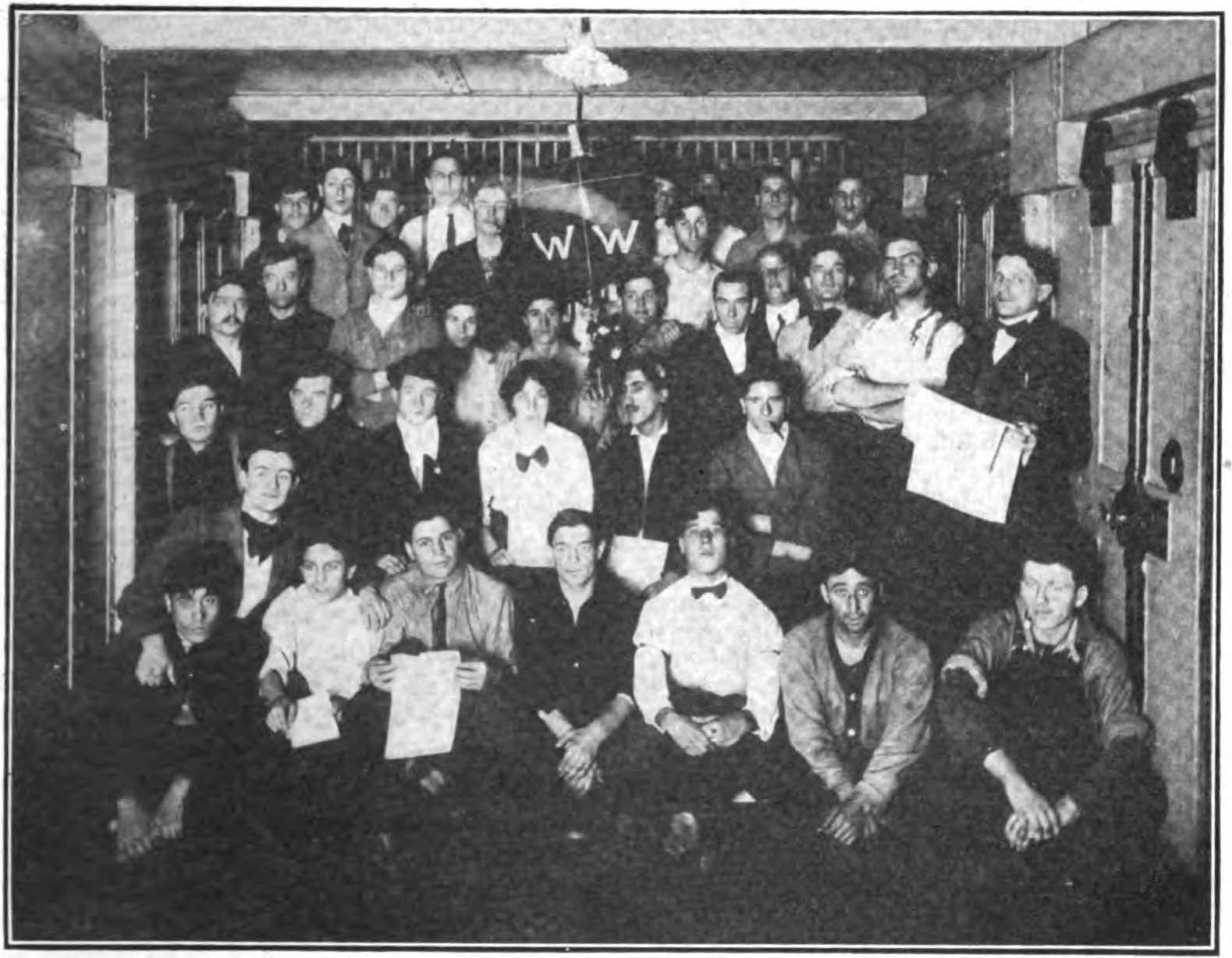
Phillips Russell on the twenty strike supporters, including the Mayor of Schenectady, from five nationalities, men and women, facing charges after a police riot during the 1912-13 winter confrontation with the mill bosses of Little Falls.
‘What is a Riot Anyhow?’ by Phillips Russell from New Review. Vol. 1 No. 5. February 1, 1913.
What is a riot?
According to the interpretation put upon certain sections of the (State Penal Code by the authorities of Herkimer County, N.Y., in which the town of Little Falls is situated, it is the assemblage of “three or more” persons who gather to listen to Socialist agitation, or to discuss ways and means of improving their economic conditions.
That is why in the now celebrated Little Falls strike cases our whole scheme of political and economic propaganda and education is under attack.
That is why the strike of the textile workers in Little Falls assumes an importance all out of proportion to the number of people involved.
That is why every sort of support, moral and financial, must be given by all lovers of liberty to the twenty defendants in these cases, including fourteen now in jail and the six out on bail.
The names of the rioters are: George R. Lunn, the Socialist mayor of Schenectady; Harvey Simmons, a Socialist alderman of the same city; Robert A. Bakeman, a former clergyman, also of Schenectady; Benjamin J. Legere, an organizer of the Industrial Workers of the World;, George Vaughan, Fred Hirsch, Fillipo Bocehini, Orazio Morlando, Antonio Capuana, Rocco Filomena, Carlo Furille, Antonio Preta, Bomenico Bianchi, Pietro Cornacchio, Antonio Schietroma, Rona DeGuerre, Samuel Mayton, John Lefteney, Helen Schloss, Louis Lesnicki, and Zageyka Wladya—two women and eighteen men, members of five different nationalities.
Legere and the nine Italians, and the little Polish woman, Zageyka Wladya—which is as close as the authorities could arrive at the proper spelling of her name—must stand trial also on additional charges of assault in the first degree, the penalty for which is as high as ten years in the penitentiary. They are alleged to be the persons who attacked the two policemen injured in a clash between the guardians of law and order and the strikers.
Mayor Lunn and his comrades arrived in Little Falls on Oct. 17 and began speaking in Clinton Park. This spot has since become so famous that persons unfamiliar with the town probably imagine that there is something peculiarly magnificent and sacred about it to cause the Little Falls authorities to forbid its defilement by Socialist speakers and working people out on strike. As a matter of fact Clinton Park is a commonplace plot of ground, measuring perhaps 200 by 300 feet and sparsely covered by reluctant grass and a few immature trees. The reason that it became tabu during the strike was that it is situated between two of the principal mills affected and actually runs up to the doorway of one of these mills. The company officials were not long in informing the police that this anti-capitalist agitation going on so near their doors was excessively annoying to them, besides having a distracting influence on the employes who remained at work.
The police were not slow to act. In fact, with the words of their chief—”we have kept these people in subjection in the past and mean to continue to do so”—ringing in their ears, they descended on the park with zest and manfully pulled off their boxes speakers who quoted from such anarchistic documents as the Declaration of Independence, the Constitution of the United States and the Bible.
Flushed with success, the police next attacked a parade of peaceful pickets on the morning of October 30. Here, however, their clubs met with resistance and two of them were wounded, one by a knife and one in the leg by a bullet, which, witnesses declare, was fired by an excited special policeman. Following this affair the police indulged in a carnival of arrests until at one time forty-six strike prisoners were in jail.
Now the law, with its usual elasticity and looseness, defines a riot or riotous assemblage, in effect, as any assemblage of three or more persons which disturbs the peace, etc., and such an assemblage immediately becomes unlawful as soon as a public official has read a document pronouncing it so. Consequently any person who addresses such a throng or is unable to get away before a long-legged policeman can catch him is guilty either of inciting to riot or refusing to disperse from an unlawful assemblage. And there you are!
Under such a construction any Socialist or labor meeting may be declared unlawful whenever it annoys an exploiter of labor or a person of conservative mind, and its speakers and participants may be thrown into jail as criminals. The indictment of Mayor Lunn et al. specifically charges them with the commission of “a crime.” The police blotter, by the way, explained that Mayor Lunn was arrested—”For speaking.”
When asked at a preliminary hearing if he had ever read the Constitution of the United States, Chief Long of the Little Falls police answered that he thought he “seen a copy once.”
Evidently it was but a passing glance, and judging by the support; Chief Long received from the business men and respectable citizens of Little Falls they started reading the Constitution backward, but stopped at the first paragraph.
Absolutely all constitutional and human rights were annulled and even made sport of by the authorities during the Little Falls strike. They now seek to fasten a conviction upon at least a few of the most active workers and sympathizers and thus set a precedent that will be most dangerous to the Socialist movement in this state and in other states in the future.
The Socialist movement must now determine, by the support it gives these defendants, whether this precedent shall be set.
The New Review: A Critical Survey of International Socialism was a New York-based, explicitly Marxist, sometimes weekly/sometimes monthly theoretical journal begun in 1913 and was an important vehicle for left discussion in the period before World War One. Bases in New York it declared in its aim the first issue: “The intellectual achievements of Marx and his successors have become the guiding star of the awakened, self-conscious proletariat on the toilsome road that leads to its emancipation. And it will be one of the principal tasks of The NEW REVIEW to make known these achievements,to the Socialists of America, so that we may attain to that fundamental unity of thought without which unity of action is impossible.” In the world of the East Coast Socialist Party, it included Max Eastman, Floyd Dell, Herman Simpson, Louis Boudin, William English Walling, Moses Oppenheimer, Robert Rives La Monte, Walter Lippmann, William Bohn, Frank Bohn, John Spargo, Austin Lewis, WEB DuBois, Arturo Giovannitti, Harry W. Laidler, Austin Lewis, and Isaac Hourwich as editors. Louis Fraina played an increasing role from 1914 and lead the journal in a leftward direction as New Review addressed many of the leading international questions facing Marxists. International writers in New Review included Rosa Luxemburg, James Connolly, Karl Kautsky, Anton Pannekoek, Lajpat Rai, Alexandra Kollontai, Tom Quelch, S.J. Rutgers, Edward Bernstein, and H.M. Hyndman, The journal folded in June, 1916 for financial reasons. Its issues are a formidable and invaluable archive of Marxist and Socialist discussion of the time.
PDF of full issue: https://www.marxists.org/history/usa/pubs/newreview/1913/v1n05-feb-01-1913.pdf

