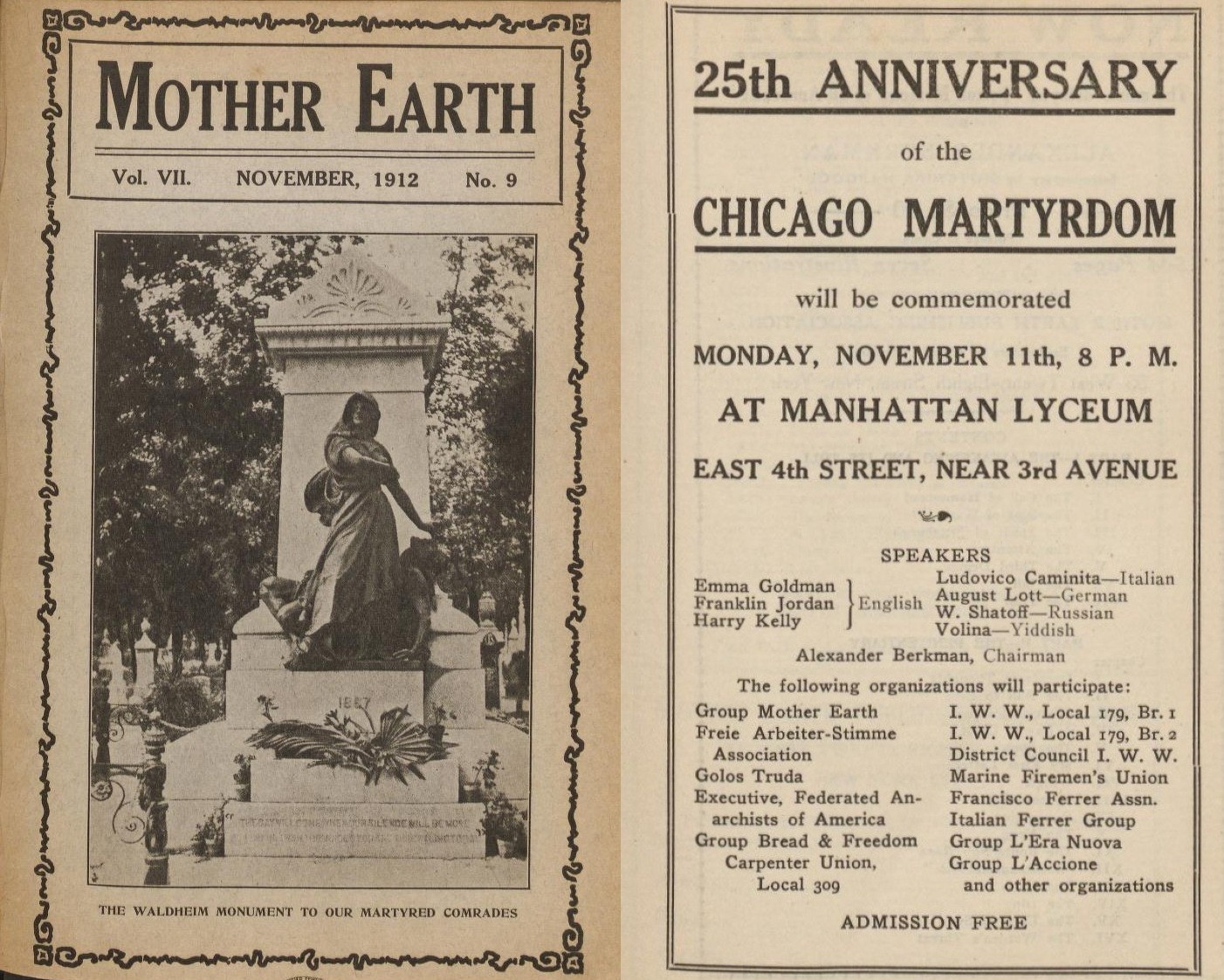
Berkman on Haymarket’s meaning twenty-five years after.
‘The Causes of the Chicago Martyrdom’ by Alexander Berkman from Mother Earth. Vol. 7 No. 11. November, 1912.
A QUARTER of a century has passed since the hanging of our comrades in Chicago, on the 11th of November, 1887. The perspective of time has helped to dissipate the fog of prejudice and passion that at the time beclouded the grave questions at issue; the passage of the years has clarified the situation which resulted in the Haymarket tragedy. An impartial analysis of the events that culminated in the hanging of the Chicago Anarchists compels the unbiased mind to the conclusion that our comrades were the victims of a judicial murder, the direct result of a conspiracy of privilege and authority.
The gallows of 1887 was no accident. Labor events of the preceding decade cast their shadow before. Already in the early seventies—in 1872 and 1873—began the movement for an eight-hour workday. By degrees it assumed such proportion as to force the legislatures of several States to pass laws making eight hours a legal working day for State employees. The agitation kept up, and within a few years the movement became national and powerful shone to induce Congress to pass, in 1878, an eight-hour law for Federal employees.
But the Federal eight-hour law, as well as the similar State statutes, remained a dead letter, in spite of all the resolutions, appeals, and protests of labor. The lords of industry refused to introduce the shorter workday, and their word was the supreme law.
The working masses began to awaken to the realization that parliamentary methods were a farce. The conviction was ripening that no amelioration of labor conditions could be hoped for from political sources. The idea was germinating in the mind of Toil that victory cannot be had for the asking; that it must be fought for—fought in the industrial arena, by the means nearest and most effective in the hands of labor—the method that has since become known as direct action.
It was the dawning of a new consciousness. It found clear expression in the International Congress of Organized Labor, held in Chicago, in 1884, by the Federated Trades Unions of United States and Canada. That congress decided that organized labor must make a determined effort by the direct means of its economic weapons, to win the eight-hour day. The 1st of May, 1886, was chosen as the great Labor Day, on which a united attempt was to be made for the recognition of the demands of the workers.
The more radical labor element of the country—the revolutionary Socialists and Anarchists of the time—had already before realized that the road of labor’s advancement and ultimate emancipation was not to be sought along political lines, but in direct economic and industrial warfare. Already in 1883, at the Pittsburgh Convention, the revolutionists of the International Working People’s Association issued a proclamation, condemning all indirect political activity as ineffectual and misleading, and emphatically advocating revolutionary methods, direct action, and the general strike. The ablest and most energetic spirits of the International Working People’s Association were Parsons, Spies, Fielden, and their comrades. They were indefatigable in the labor movement, and their activity in no small degree helped to revolutionize and enlighten the working masses.
***
The month of May, 1886, was approaching. Capital and labor faced each other in grim determination. Never before had the workers of America given such a demonstration of united, solidaric effort. Capitalism was in a panic.
On the 1st of May a tremendous strike-wave swept the country. In the very forefront of the struggle stood Chicago. Twenty-five thousand workers laid down their tools on the First of May, and within two days the number was doubled. By the 4th of May practically all the workers of the great city were on a general strike.
The enemy resorted to every means to stifle the revolt of labor. The capitalist press advised strychnine and lead for the discontented wage slaves, and the armed fist of the law hastened to the service of Mammon. The paid myrmidons of capital vied with each other in shooting down the workers. Bloody encounters between police and strikers were numerous. The most brutal assault took place at the McCormick Works, where conditions were so unbearable that the men were forced to go on strike already in February. At this place the police and Pinkertons deliberately shot a volley into the assembled strikers, killing four workers and wounding a score of others,
It was to protest against these cold-blooded police murders that the Haymarket meeting was called, on the 4th of May, 1886.
It was a perfectly orderly meeting, such as were daily taking place in Chicago in those days. The Mayor of the city, Carter Harrison, was present; he listened to several speeches and then—according to his own sworn testimony later on in court—he returned to police headquarters to inform the Chief of Police that the meeting was all right. It was growing late—about ten in the evening. Heavy clouds appeared on the sky; it looked like rain, The audience began to disperse, till only about two hundred were left. Then suddenly a hundred police rushed upon the scene. They halted at the speakers’ wagon, from which Fielden was addressing the remnant of the audience. The police captain in charge commanded the meeting to disperse. Fielden replied: “This is a peaceful assembly.” Without further warning the police threw themselves upon the people, mercilessly clubbing men and women. At that moment something whizzed through the air, and seven policemen lay dead on the ground, and about sixty wounded.
***
The beast of Law and Order thirsted for blood. The fury of the masters knew no limits. Rebellious labor was to be crushed with an iron hand; the spirit of discontent was to be stifled, its voice drowned in the blood of the most devoted and able men of the people. Our Chicago Comrades were the chosen victims.
It took six long years till there was found a man in an official position—Governor Altgeld, of the State of Illinois—a man of supreme honesty and sincere-conviction, with moral courage officially to stamp the hanging of our Chicago comrades as a premeditated judicial murder. By incontrovertible facts and evidence he proved that our martyrs were the victims of a police conspiracy to convict, prompted and financed by the plutocracy of Chicago. Governor Altgeld adduced merciless proof upon proof that the conviction of our comrades was based upon willful and conscious perjury; that the jury was packed by the official specially chosen by the court for the purpose; that the ‘ides was bitterly prejudiced and that he openly intimidated jury and witnesses, and that finally the Anarchists were convicted for conspiracy to throw a bomb, the actual thrower of which has remained unknown and therefore in no way shown to have been connected with the accused. They were convicted and hanged, because it was intended they should die. For they were guilty of enlightening and revolutionizing the proletariat—a crime tyranny ever punishes with death.
***
The historic role of government is murder. The law is the statutory reflexion of Mammon. When the interests of capital demand it, when the fabric of oppression and exploitation is threatened, government steps in to strengthen the foundation of Things As They Are, and to crush everything that appears to menace their continued existence. ‘Tis the triumph of Law and Order.
If the Chicago tragedy had accomplished nothing more than to clarify the function of capital and the true role of government, the martyrdom of our comrades has not been in vain.
Mother Earth was an anarchist magazine begin in 1906 and first edited by Emma Goldman in New York City. Alexander Berkman, became editor in 1907 after his release from prison until 1915.The journal has a history in the Free Society publication which had moved from San Francisco to New York City. Goldman was again editor in 1915 as the magazine was opposed to US entry into World War One and was closed down as a violator of the Espionage Act in 1917 with Goldman and Berkman, who had begun editing The Blast, being deported in 1919.
PDF of full issue: https://archive.org/download/mother-earth/Mother%20Earth%20v07n09%20%281912-11%29%20%28c2c%20Harvard%20DSR%29.pdf

