Years after the first Palmer Raids and the repression keeps on. Thirty-eight, largely foreign-born radicals lifted in a swoop by local police in Philadelphia.
‘The Philadelphia Red Raids’ by Erasmo Abate from The Toiler. No. 180. July 16, 1921.
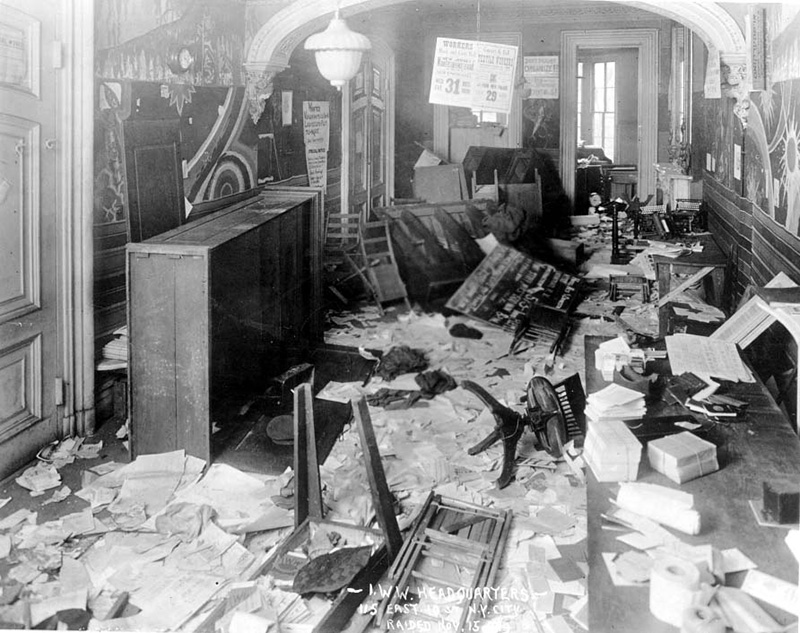
The City of Brotherly Love was the scene of a spectacular Red-raid conducted in the Palmer style the night of April 25 last. The Red hunters’ city police, acting under instructions directly emanating from Mayor Moore’s office, made it their business to arrest during that night all suspected radicals who could be found walking in the streets at a late hour. In one case they rushed into a house without having a search warrant and seized twelve men and a woman upon the seeming presumption that a meeting of the United Communist Party was being conducted there.
The house was afterward ransacked by the law and order gentlemen and valuable articles were stolen including one hundred dollars in cash.
There was some wine in the basement and the “honest” guardians of the law got drunk, came to a fight and shot each other. Of course they say the shooting was accidental and denied stealing. Naturally the crooked drunken officers got whitewashed pretty quickly of their crimes and who do you think the criminals are now claimed to be? The occupants of the raided place.
Thirty-eight workers were arrested throughout the city during the night. While no preliminary hearing was accorded to any of the prisoners, a true bill of indictment was found by the grand jury against all the men under the state Anti-Sedition Act which provides a penalty upon conviction by a jury, raging from one to twenty years imprisonment or ten thousand dollars fine or both.
Through a great effort all the imprisoned comrades have been released on bail of 5,000 dollars each. An additional bail of $1,000 had to be provided for twenty rearrested on deportation warrant by the emigration authorities.
Thus the law is swiftly grinding, steam rolling these thirty-eight victims of the present capitalist system.
Attempted Railroading.
Attorney I. Lasker Greenberg is in charge of the defense. It is due to his heroic efforts if so far the boys have not been railroaded to the penitentiary or summarily deported as such is the desire of Mayor Moore, who is the third glory of the United States after Ole Hansom of Seattle strike fame and Calvin Coolidge of Boston police strike breaking activities. Trials are being called on one day notice despite the fact that an agreement had been entered between the defense counsel and the District Attorney of Philadelphia County, under which all sedition cases were postponed pending action on these cases by the immigration authorities.
Five weeks ago, while attorney Greenberg was absent from Philadelphia, Harry Belavsky was put on trial and convicted by a jury, including one woman, following the address of the district attorney who indulged a considerable time telling the old ridiculous story of free love and nationalization of women in Russia, evidently with the intention to arouse the woman juror’s pride and secure a conviction.
A motion for a new trial was entered at once by Mr. Greenberg giving sixty-one reasons for it and six for arrest of judgement. Then constitutionality of the so called Sedition Act of 1919 was also strongly attacked.
Previous to this W.B. Brukas was tried under the same charge in Wilkes Barre, Pa., Mr. Greenberg acting as defense council. A similar argument as in the Belavsky case was presented to the trial Judge by Mr. Greenberg. A favorable decision on the case was handed down sometime later by Judge H. P. Fuller of Luzerne County.
Indictment is Quashed.
Judge Fuller’s decision reads in part:
“Under this Act criminal intent is entirely eliminated, and a news boy who may innocently sell a newspaper containing any of the proscribed matters is guilty of felony, punishable by fine of ten thousand dollars and imprisonment for twenty years, the Act being apparently one of many hysterical and ill-digested measures growing out of the war.”
And further:
“On May 10th, 1921, the Act was amended solely by striking from the definition aforesaid the words “which tends”, and substituting the words “the intent of which is”.
“It can hardly be denied that the change wrought by the amendment is so radical as to create in effect a different crime.”
“The constitutionality of the Act is strongly assailed on sundry grounds; but in the limited time at our disposal we will not undertake to determine this question which is now pending for decision in Philadelphia. For the reasons above indicated, the motion to quash is allowed.”
Following this sweeping victory, it became evident what would be the ultimate end of the Sedition Act. If the Act could not stand its first test it logically had to fall through in the following one. Though the trial judge refused to set bail pending the decision on the appeal for a new trial and arrest of judgement after the conviction of Belavsky, there was good grounds for hope that his indictment would be quashed. Five weeks he sat in jail and finally the expected decision came. It was Judge Andrew B. Smith of Philadelphia this time to give another mortal blow to the Flynn Act.
Needless to say, the constitutionality of the Act was not decided upon. In his decision judge Smith asks the question, “Is the Act of 1919 unconstitutional?”–but he does not answer his own query. He bases his decision mainly on the one given by Judge Fuller. He says:
“Under the former Act as was said by Fuller, P.J. in quashing an indictment under it (Comth. vs. Brukas, not yet reported in Luzerne County; “Criminal intent is entirely eliminated” for instance as this learned jurist illustrates “a newsboy who may innocently sell a newspaper containing any of the proscribed matters is guilty of a felony”, and in various consequences although entirely innocent of wrong and who could spurn as infamous any suggestions” of wrong doing or intent.”…
“We may conclude that what was, under the Act of 1919, and charged in this indictment a crime but under the Act of 1921, is not….the conviction at bar was without warrant of law and no valid judgment can be pronounced thereon; there must be an arrest of judgment.” “And now June 27th 1921, Rule for arrest of Judgment in this case is made absolute and the defendant Harry Belavsky is discharged under the present indictment.”
District Attorney Peeved.
While these decisions call for the immediate quashing of all indictments pending in similar cases, the District attorney has expressed the intent of appealing Belavsky’s case and furthermore, continue with the prosecution of the others.
It is now evident that a long legal battle will have to be fought in order to hold the gains made and secure a final victory. One of these legal battles that costs much and can possibly be lost, no matter how good the counsel engaged may be, should the necessary financial fund be lacking faces us. The defense treasury is empty and money is needed. Heavy expenses are to be met every day for both state and deportation cases and these must be paid on the spot.
The readers of The Toiler understand that if the defense should be hindered in its work by financial obstacles, it may mean a long sentence in the penitentiary for many comrades and deportation for many others. Some of the prisoners have large families that have to be provided for, others are political exiles from different countries and cannot be deported without risk of life and liberty in their home countries.
Will You Help?
So, what are we all going to do? Leave our comrades defenseless? Let their wives and children starve? It is the duty of all lovers of liberty to attend to this matter in the quickest possible way.
Get busy among your friends and comrades and collect all the money you can for this defense. Organize dances, picnics, mass-meetings in order to help this cause. Do not leave a single stone unturned to bring this case to a successful conclusion. Go to it comrades and show your solidarity for the victims of capitalist reaction.
Send all contributions to Ester Wiseman, Secr.-Treas., Workers Defense and Relief Committee of Pennsylvania–3914 Poplar St., Philadelphia, Pa.
The Toiler was a significant regional, later national, newspaper of the early Communist movement published weekly between 1919 and 1921. It grew out of the Socialist Party’s ‘The Ohio Socialist’, leading paper of the Party’s left wing and northern Ohio’s militant IWW base and became the national voice of the forces that would become The Communist Labor Party. The Toiler was first published in Cleveland, Ohio, its volume number continuing on from The Ohio Socialist, in the fall of 1919 as the paper of the Communist Labor Party of Ohio. The Toiler moved to New York City in early 1920 and with its union focus served as the labor paper of the CLP and the legal Workers Party of America. Editors included Elmer Allison and James P Cannon. The original English language and/or US publication of key texts of the international revolutionary movement are prominent features of the Toiler. In January 1922, The Toiler merged with The Workers Council to form The Worker, becoming the Communist Party’s main paper continuing as The Daily Worker in January, 1924.
PDF of full issue: https://www.marxists.org/history/usa/pubs/thetoiler/n180-jul-16-1921-Toiler-rsz-chronAM.pdf

