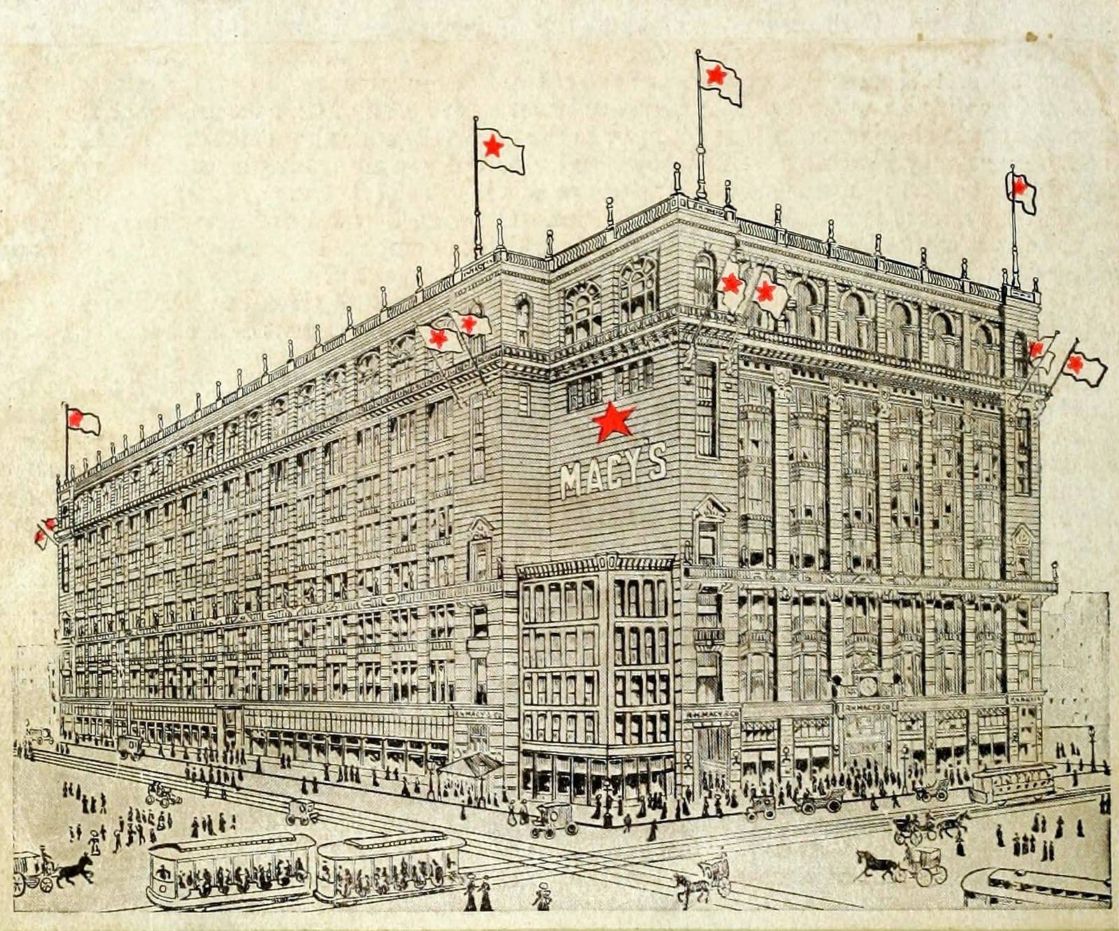
Brutally fast-paced, back-breaking service work for little pay and appearance standards no man would ever be asked to abide. The department store restaurant waitress.
‘Working in Macy’s Model Restaurant’ by Macy Worker from The Militant. Vol. 2 No. 2. January 20, 1934.
In the summer of 1931, R.H. Macy opened their new restaurant on the sixth floor. I was one of the applicants for a position as waitress. We were all given “intelligence tests,” and thorough physical examinations. Macy’s, unlike other organizations of its kind, does give a thorough physical examination. Every girl hired was strong and physically fit. In spite of this, the work proved too hard and grueling for most of us. Approximately 125 waitresses were hired when the restaurant opened. Six months later there were about 25 girls remaining, who were employed at the same time as I.
“Improvements” Under the NRA
But now R.H. Macy is operating under the NRA and conditions are not the same as in 1931–not at all; they are worse. Wages are less, more work is required from each girl, and the list of restrictions grows longer and longer.
Each waitress is hired to work a certain shift at rates which vary with the number of hours of work, that is, a girl working from 11:30 until 2 P. M. five days a week receives a salary of $2.50 for the entire week, and an average commission of $3–a total of $5.50 for an entire week’s work. Girls working from 8:30 to 4:10 get $10–the highest scale. The working hours are short, but they are the busiest hours of the day. As a matter of fact, in those two and a half hours: each waitress works as hard and uses as much energy as some workers do in a whole day.
Under Macy’s system of “no tipping” but of charging a service fee of 10 per cent of the amount of the check, the girls in Macy’s are “tipped” on the average of six cents per customer, whereas the general average in other restaurants of this type is 10 cents per customer.
The stated hours of work may be from 11:30 to 2:00, but if a customer comes in at 1:59 the waitress: must stay until the customer leaves.
All the girls are thus forced to do actual extra waitress duty for about a half hour or more each day.
Discipline and Penalties
The girls are held to the most rigid sort of personal discipline. Every morning they are inspected. They stand at stiff attention in line while several trained disciplinarians look them over. They are required to have well cared for nails, with the proper shade of nail polish, they must wear a certain type of shoe, their hair must be finger-waved, no less, and their uniforms must be immaculate, all at their own cost, of course.
The Macy restaurant clientele being of the “refined” type that does not approve of a great deal of make-up, the restaurant management forbids the use of lipstick. The girls are urged, however, to use rouge to hide an inevitable pallor. The uniforms and the white aprons, collars, and cuffs, which are part of it must be washed, starched and ironed every day. This means an extra hour of work each night, which is somehow overlooked when the pay envelopes are filled.
The tiniest speck on a uniform is sufficient excuse to levy punishment. The terrible offenders may be punished by being sent to work in the kitchen, for which they receive 83 cents for the entire day, or else they may be sent home altogether and lose their salary and commission for the entire day. By a strange coincidence the greatest number of specks appears on the slowest days, and many a girl is “reluctantly” sent home to learn to keep her uniform clean in the future.
II.
The restaurant has a seating capacity of seven hundred. A waitress must make an average of four trips to and from the kitchen for each customer or group of customers, and if there are any special requests, or mistakes, another trip or so. The front tables are about a block from the kitchen. Waitresses “take turns” on the different tables.
On the weeks when a girl has the front tables, her commissions are negligible, because it takes so much longer to wait on each customer at these tables. It is not possible to serve more than a few.
The “Steady Extra” Racket
Recently there has been installed a vicious system which places an added pressure on waitresses. Girls are hired as “steady extras”. They receive no salary, but get the service charge for each customer waited on. They cover no regular tables, but may walt on any customer, and this is where the regular waitress must work fast so that her customers won’t be grabbed by the extras.
These extras are absolutely heartless in taking orders from the waitresses. “Orders from above,” they say. The bitterness existing among the waitresses as a result of this system is not against the organization which imposes it upon them, but against the extras, workers like themselves. Meanwhile, there is a constant rivalry between them to beat each other to the orders which leaves them physically and mentally exhausted at the end of the two-hour rush period.
In the summer months the restaurant is stifling hot, and the kitchen, of course, far worse. I have seen more than one girl waiting in the kitchen for her orders fall over in a lead faint.
No Bus Boys
There are no bus boys.
Waitresses must clear and set their tables. They may not enter the kitchen with an empty or half-filled tray. “If your own tables are cleared, another table that isn’t can always be found,” says Rule II. This rule is more important at Macy’s than the Ten Commandments, and is rigidly enforced. Girls are often forced to walk across the entire restaurant to find enough dirty dishes to allow them to enter the kitchen.
The waitresses are not the only ones who suffer in this restaurant. Part of the tray girl’s job is to bring silver and water pitchers to the tables. These trays weigh from 25 to 40 pounds. The tray girls are supposed to be 17 years old. My guess is that some of these kids are even younger. The average stay at Macy’s of a tray girl is between two and three weeks.
Fainting spells and illness among this group of youngsters are more frequent even than among the waitresses.
This wage scale is subject to no additions such as commissions. This is all they can earn. Carrying water and silver used to be their only job, but now, under the NRA they are forced to show their patriotism by cleaning tables, setting them up, and taking orders, just as any waitress, but without any commissions. (These particular commissions go to the “house”).
None of the girls is allowed meals as part of her salary. But if a girl comes in early enough she is allowed one roll and one cup of coffee. Those who have this munificent breakfast have nothing else until they go off duty. Those who come in a few minutes later, unless they have had breakfast out, also have nothing until they go off duty.
Macy’s “Mutual” Benefit.
All salaries are subject to compulsory deductions. A certain percentage is taken off each month to pay M.M.A. dues (Macy Mutual Aid). This “mutual” benefit works in a mysterious manner. M.M.A. dues are deducted very soon after employment, but in order to receive the benefits you must have been with R.H. Macy & Company for six consecutive months.
Sick employees under the M.M.A. may receive two-thirds of their salary each week during their illness, starting from the fifth day of their illness, or part payment of their hospital and doctor fees. No payments continue longer than six months, no matter how sick the employee is.
Sick Workers Not Rehired.
If an employee is sick for four days or less, she receives nothing from the M.M.A. If and when she recovers from a long illness she cannot be rehired at Macy’s. Nobody is ever rehired after a long illness–just one of the great store’s “unadvertised specials.”
The intense rivalry among employees of the restaurant because of the conditions under which they work makes difficult any expression of solidarity among these workers. They are played off against one another in the selfish interests of their employer. The elaborate spy system, about which another article might be written, is ever present in the entire store. These workers need the message of unionism badly. Outside help and advice are sorely needed.
-MACY WORKER.
The Militant was a weekly newspaper begun by supporters of the International Left Opposition recently expelled from the Communist Party in 1928 and published in New York City. Led by James P Cannon, Max Schacthman, Martin Abern, and others, the new organization called itself the Communist League of America (Opposition) and saw itself as an outside faction of both the Communist Party and the Comintern. After 1933, the group dropped ‘Opposition’ and advocated a new party and International. When the CLA fused with AJ Muste’s American Workers Party in late 1934, the paper became the New Militant as the organ of the newly formed Workers Party of the United States.
PDF of full issue: https://www.marxists.org/history/etol/newspape/themilitant/1934/jan-20-1934.pdf

