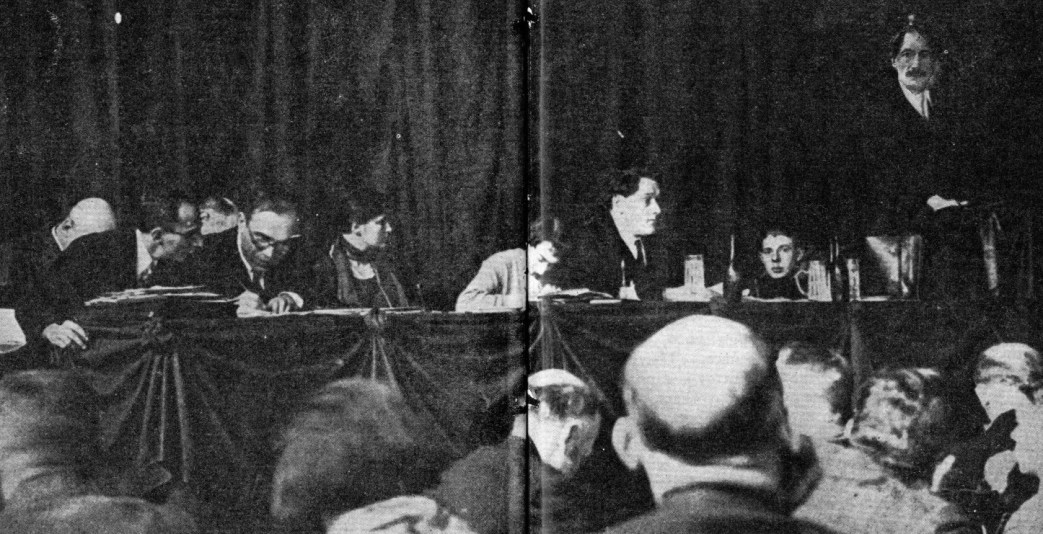
A report of the Communist International-called International Anti-Fascist Congress was held in Berlin during March, 1929.
‘The First International Anti-Fascist Conference’ by A. Markoff from Labor Defender. Vol. 4 No. 6. June, 1929.
THE International Anti-Fascist Congress held in Berlin, March 9th and 10th, was an important political event. For the first time, the opponents of fascism, proletarian and intellectual, came together to work out a common program of action, to find ways and means for a successful struggle against fascism. Two hundred and forty delegates from about forty countries came to the Congress, fully determined not only to demonstrate against fascism, but to establish a permanent International body which will mobilize, coordinate, and consolidate the antifascist forces of the entire world.
The need for such a gathering has been keenly felt in every country and when Henri Barbusse, chairman of the Committee for the organization of the Congress, issued the call, it found immediate response in every country.
Many of the delegates had to overcome great obstacles, and in several instances, actually risked their lives to get to the Congress. Delegates coming from Italy were compelled to travel on foot many miles in order to escape arrest, and several were arrested two or three times before they managed to get out of the country.
The International Anti-fascist Congress was also successful in enlisting the active cooperation of individuals prominent in the struggle against fascism. They served on the presidium and took active part in the formulation of policies and resolutions adopted at the Congress. Among these were the famous French author, Henri Barbusse; the well known German author Alfons Papuet; the chief editor of one of Germany’s largest news-[sic]tic bourgeois “Tempo”, Manfred Georg; the old German revolutionary, Ledebour; a former deputy of the Italian chamber for the Catholic Party, (Popolari), Guido Miglioli; the former Prime Minister of the Hungarian Republic, Count Michael Karolyi; the former Prime Minister of Albania, Archbishop Fan Noli; the workers deputy in the Polish Seym (Parliament), Bittner; the member of the Swiss National Council, Dr. Welti; the well known anti-fascist, Professor Gennari from Italy, and many others.
The coming together of these nationally and internationally known figures with the workers of many countries, forming a united front to fight fascism; is in itself an achievement, but far greater than this is the recognition on the part of practically every one mentioned, that the working class is the only social force capable of eradicating fascism, that the intellectuals must join the workers in this important struggle. For some time, many of these intellectuals labored under the illusion that fascism could be fought with sentimental appeals to liberals, appeals in the name of democracy, etc., but now they definitely indicated in their speeches that only through a proletarian revolution can fascism be destroyed. Henri Barbusse, in his opening speech at the Congress, expressed the sentiment of all the delegates when he said, “The advance guard in the struggle against fascism are the workers, the intellectuals must also join in the struggle, the intellectuals must go to the workers and join them in the common struggle against fascism.” “Fascism could only be countered by an action of the working masses”, said Manfred Georg, chief editor of the largest bourgeois democratic paper in Germany.
Guido Miglioli, speaking on the Fascist terror in Italy, concluded his speech with the following: “The fascism struggle against has not come to a conclusion. It is being conducted in Italy underground by the only social force which is capable of and determined to carry it through to a victorious end, the working class. The fate of the still living victims of fascist terror is in our hands. They are looking to us for assistance and this congress must send them the message they expect from us. My dearest wish is that our next congress may close not with a shout of protest against the barbarities of fascism, but with a shout of triumph at the overthrow of fascism”.
The victims of fascism and capitalism who are confined behind prison bars were honored by the congress when they were elected as honorary members of the presidium: Warren K. Billings and Tom Mooney U.S.A.; Terracini and Gramsci, Italy; Rakoszi, Hu gary; Panov, Kostov, Terpechev, Bulgaria; Keroshevitz and Pivade, Yugoslavia; Stephanov, Buvor and Doerogheanu-Gherea, Roumania; Bachinsky and Taraskievitch, Poland; Andre Marty, and Riccardo Caretti, France; Rudolf Margies, Germany.
THE chief topics discussed at the Congress were:
1. Fascism, imperialism and the danger of war; 2. The fascist terror; 3. The situation of the workers and intellectuals under fascism; 4. Ways and means for conducting the international struggle against fascism.
Fascism, declared Henri Barbusse, was not only the work of a few scoundrelly adventurers as it might seem to some superficial observers–it was the main characteristic of a whole historical period of development, it represented the last means of the reaction to hold up the advance of progress and to crush the rising proletarian and peasant classes.
George Middleton, one of the hunger-marchers to London, stated that in Great Britain, fascism is developing within the trade union movement. The fascistization of the trade unions is being accomplished with the support of the trade union bureaucrats. Count Michael Karolyi dealt with fascism in Hungary. Hungary and Italy, he declared, represent the greatest immediate danger to peace in Europe.
The second point on the agenda of the Congress, the fascist terror, was dealt with by many speakers. Guido Miglioli declared that fascist terror in Italy fell into three periods. The third period was the period of abolition of every vestige of democracy, systemization of the terror, terror used as an exclusive method of the fascist government. The third period was the period of the fascist Special Tribunal which, during the two years of its existence, had imposed sentences totaling over 5,000 years of hard labor, it was the period of mass deportation without trial, it was the period when the open terror was supplemented by a widespread system of espionage upon all fields of public, private and even family life. The fascist so-called trade unions represented one great espionage organization, every official of these unions was in effect an employee of the State and a fascist spy.
Henrich Bittner, a member of the Polish Seym, told of the oppression of national minorities in Poland. Not less than 40% of the population of the Polish Republic were non-Polish peoples. In its struggles to crush the National-Revolutionary movement of the national minorities, Polish fascism was using two methods against the workers and poor peasants, open and unlimited terror, but against the possessing classes amongst the national minorities, the method of corruption. Normal democratic rights like the right of a more or less free press, the right to meet and hold demonstrations, etc., were non-existent for the workers and the national minorities in Poland. George Ledebour, the old grey-haired veteran of the German working class movement, praised the Red Front Fighters in Germany.
Had such an organization existed in Italy in 1922, there would have been no successful march on Rome by the fascists. In any case, the struggle against fascism was the same as the class struggle against capitalism, and victory over fascism could only be obtained by the overthrow of capitalism and the setting up of a socialist order of society. That was what the Russian workers had done and now they have no trouble with fascism. Archbishop Fan Noli described the fascist terror in Albania and other Balkan countries. He declared that Achmed Zogu, the present ruler of Albania, is a puppet in the hands of Mussolini.
Dr. Petrescanu who spoke in name of the Rumanian delegation, declared that the workers must not be deceived by the change of government. The Maniu government was just as fascist as the former Bratianu government and the terror is still carried on against the workers and peasants and national minorities, especially in Bessarabia. Prof. Gennari of Italy spoke at length on the third point of the agenda, namely, the situation of the workers and intellectuals under fascism. “The fascist terror was no fortuitous occurrence, but a measure in full accordance with the present economic development of capitalism. Wages in Italy had fallen to the level of twenty years ago. The situation of the Italian workers was similar to that of the Chinese coolies and for that reason it is forbidden to collect any statistics concerning the living conditions of the workers. This situation had only been made possible by the destruction of the workers’ trade union organizations. The officials of the fascist labor unions were appointed from above by the State and were actually employees of the State.”
Non-fascist workers can only obtain work after the claims of fascists are settled. This means that unemployment is widespread among anti-or non-fascist workers, and this became a further weapon of fascist oppression. The struggle for free trade unions in Italy is a struggle against the fascist system in general. The workers all over the world should support the Italian workers in their struggle and the day would surely come when Italy would cease to be a paradise for capitalists and a hell for the workers.
THE delegates from the United States discussed the role of the U.S. government in relation to fascism. They declared that while the government of the United States is supporting the fascist regimes in Italy, Poland, etc., with financial loans, there are thousands of workers in the U.S. ready to fight fascism. They also brought to the attention of the Congress the fascist development in the U.S. The existence of the Ku Klux Klan, the American Legion, the tendency to convert the existing trade unions into company unions are signs of fascism. The U.S. government will not hesitate to use direct fascist methods at the time when the existence of capitalism is threatened by the working class. This growing menace must not be permitted.
A huge mass meeting against fascism was held in Circus Bush, Berlin, where many of the delegates addressed the crowd. The circus was filled to its capacity, hundreds were turned away. The audience cheered the speakers, and pledged their solidarity with the congress.
The Chief of Police in Berlin, Zoergiebel, a member of the Social Democratic Party, prohibited a demonstration against fascism, and declared that if a demonstration did take place, the police would be ordered to break it up if need be by force of arms. The “Vorwaerts,” the official organ of the Social Democratic Party, opened an attack on the International Anti-Fascist Congress branding it a “manouvre from Moscow,” and stating that only social Democrats have the “moral right” to fight fascism. After the mass meeting, forty-two workers were arrested, several beaten up by the police. These socialists who talk of fighting fascism approved the action of Zoergiebel in prohibiting a demonstration as they approved of the recent murder of many workers for parading on May Day.
As a result of the International Anti-fascist Congress, an International Anti-fascist Bureau was established, for the purpose of coordinating the anti-fascist activities of various countries. A set of resolutions was adopted which will serve as a basis for the work.
The International Labor Defense, Workers International Relief, Italian Anti-Fascist Alliance, Lithuanian Anti-fascist Alliance, Anti-Horthy League, the Trade Union Educational League, Civil Liberties Union, Anti-Imperialist League, and other organizations through their representatives organized the Anti-fascist Federation, whose function is to coordinate the anti-fascist forces, to combat not only fascism in Europe, but to fight fascism in the United States as well.
Labor Defender was published monthly from 1926 until 1937 by the International Labor Defense (ILD), a Workers Party of America, and later Communist Party-led, non-partisan defense organization founded by James Cannon and William Haywood while in Moscow, 1925 to support prisoners of the class war, victims of racism and imperialism, and the struggle against fascism. It included, poetry, letters from prisoners, and was heavily illustrated with photos, images, and cartoons. Labor Defender was the central organ of the Scottsboro and Sacco and Vanzetti defense campaigns. Not only were these among the most successful campaigns by Communists, they were among the most important of the period and the urgency and activity is duly reflected in its pages. Editors included T. J. O’ Flaherty, Max Shactman, Karl Reeve, J. Louis Engdahl, William L. Patterson, Sasha Small, and Sender Garlin.
PDF of full issue: https://www.marxists.org/history/usa/pubs/labordefender/1929/v04n06-jun-1929-LD.pdf
 Revolution's Newsstand